What Happened to Total Attorneys Leads? The Evolution of Legal Case Acquisition
Discover what happened to Total Attorneys leads and how elite firms now use AI-driven intake systems to secure high-intent MVA cases efficiently.
The era of the volume-first legal lead model is officially over, replaced by a landscape that demands technical precision over raw quantity. Many firm partners still find themselves asking what happened to total attorneys leads after the platform was absorbed into the Internet Brands ecosystem years ago. You’ve likely felt the frustration of watching ROI decline on shared platforms where the same claimant is sold to multiple competitors simultaneously. It's exhausting to chase unresponsive leads that never materialize into signed retainers, especially when market consolidation makes it nearly impossible to tell who actually owns the data you're buying.
You deserve a growth infrastructure that functions as a foundational layer for your firm rather than a source of constant friction. This article explores the market shifts that transformed legacy lead generation and explains how elite firms now use AI-driven infrastructure to secure high-intent MVA cases. We'll examine the move toward automated verification and reverse append technology that delivers litigation-ready inquiries. By the end, you'll understand how to implement a scalable system that eliminates intake bottlenecks and restores clinical precision to your case acquisition strategy.
Key Takeaways
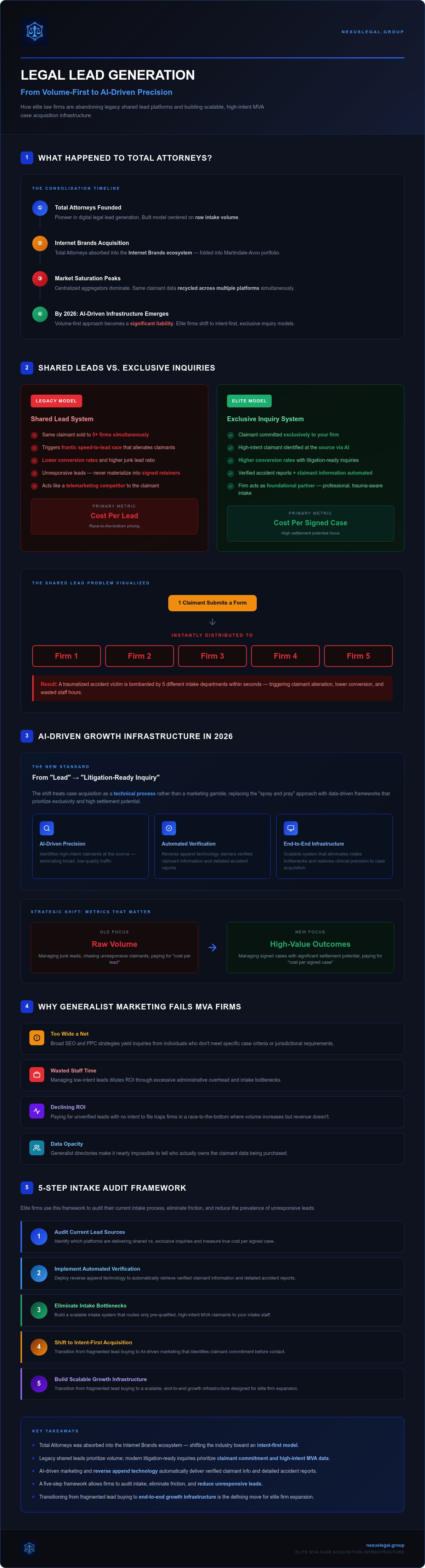
- Understand exactly what happened to total attorneys leads and how market consolidation into the Internet Brands ecosystem shifted the industry toward an intent-first model.
- Distinguish between legacy shared leads and modern, litigation-ready inquiries that prioritize claimant commitment and high-intent MVA data.
- Discover how AI-driven marketing and reverse append technology allow firms to secure detailed accident reports and verified claimant information automatically.
- Learn a five-step framework for auditing your current intake process to eliminate friction and reduce the prevalence of unresponsive leads.
- Identify the strategic benefits of transitioning from fragmented lead buying to a scalable, end-to-end growth infrastructure designed for elite firm expansion.
The Evolution of Legal Lead Generation: What Happened to Total Attorneys?
You likely remember Total Attorneys as a pioneer in the digital lead generation space. They built a model centered on raw intake volume, but as the digital marketplace matured, you probably noticed your conversion rates began to decline. When you ask what happened to total attorneys leads, it's helpful to understand that the platform didn't simply disappear; it was systematically integrated into the massive aggregator networks that now dictate the terms of legal advertising.
This structural shift moved you away from independent, boutique providers and toward a centralized ecosystem. While this centralization provides scale, it also introduces systemic friction that can stall your growth. You've likely found yourself competing in a crowded field where the same claimant data is recycled across multiple platforms, leading you to wonder what happened to total attorneys leads in the modern marketplace. By 2026, this volume-first approach has become a significant liability if your firm values operational efficiency and high settlement potential.
The Consolidation Era and Market Saturation
You can trace the timeline of this shift to when Internet Brands acquired Total Attorneys, eventually folding it into a broad portfolio including Martindale-Avvo. This consolidation created a market where aggregator dominance often leads to extreme saturation for your firm. When you're forced to fight four other firms for the same claimant, the value of that inquiry evaporates instantly. You shouldn't rely on generalist directories that struggle to maintain MVA quality because their systems aren't built for the specific verification your practice needs.
The Shift in Lead Quality Metrics
You should move your firm away from legacy metrics like "cost per lead" and adopt more rigorous standards like "cost per signed case." The old model trapped you in a race-to-the-bottom where you paid for "junk" leads; people who were unreachable or had no intent to file. You don't have to accept this administrative overhead as a cost of doing business. Elite firms are abandoning volume-based platforms for exclusive inquiry models that function as a foundational layer for expansion, ensuring every case you take on has high settlement potential.
Shared Leads and the Friction of Competition
The shared lead model creates an unsustainable operational burden for modern intake departments. When a lead is distributed to five or more firms simultaneously, it triggers a frantic speed-to-lead race that often alienates the claimant. From a psychological perspective, a person who has just experienced a traumatic accident is in a vulnerable state. They don't want to be bombarded by five different intake departments within seconds of submitting a form. This friction inevitably leads to lower conversion rates and a higher junk lead ratio. Transitioning to an exclusive inquiry model allows your firm to act as a foundational partner rather than a telemarketing competitor, providing a much higher level of professional care.
The Limitations of Generalist Legal Marketing
Broad SEO and PPC strategies often cast too wide a net, yielding inquiries from individuals who don't meet your specific case criteria or jurisdictional requirements. Managing these low-intent leads wastes valuable staff time and dilutes your ROI through excessive administrative overhead. Elite firms are moving toward a specialized growth infrastructure that uses AI-driven marketing precision to identify high-intent claimants at the source. This shifts the internal focus from managing raw volume to managing high-value outcomes, ensuring that every inquiry entering your system has a high probability of becoming a signed case with significant settlement potential.
The Rise of AI-Driven Growth Infrastructure in 2026
In the current legal environment, the concept of a "lead" has been superseded by the "litigation-ready inquiry." This shift represents the rise of growth infrastructure, a foundational layer for firms that treats case acquisition as a technical process rather than a marketing gamble. When partners ask what happened to total attorneys leads, they're witnessing the natural obsolescence of a system that couldn't keep pace with AI-driven marketing precision. The old "spray and pray" approach, characterized by buying broad traffic and hoping for a conversion, has been replaced by data-driven frameworks that prioritize exclusivity and intent.
Exclusivity is the cornerstone of the 2026 marketplace. In a system where speed-to-lead is no longer enough, firms must rely on systems that eliminate the friction of shared competition. By utilizing a sophisticated technological stack, elite firms now identify high-intent claimants before they enter the general directory ecosystem. This proactive stance ensures that your intake team isn't fighting for attention but is instead acting as the first point of contact in a structured, professional journey.
Moving Beyond Basic Contact Information
AI now allows firms to look far beyond simple name and phone number fields. By analyzing behavioral data and digital signals, modern systems can predict case viability with clinical accuracy. This AI-driven legal case acquisition model identifies specific indicators, such as the severity of the accident and the immediate actions taken by the claimant, to flag inquiries as "litigation-ready" before the first phone call occurs. This technical mastery reduces the operational burden on your intake staff, allowing them to focus only on cases with high settlement potential.
High-Intent MVA Case Acquisition Mechanics
The most significant advancement in 2026 is the integration of real-world data points into the digital acquisition flow. By leveraging police report generated MVA leads and emergency services data, firms gain a strategic advantage. You don't have to wait for the claimant to recall specific details under stress. Instead, reverse append technology allows you to verify accident reports and details of those involved automatically. This level of systemic integrity ensures your firm enters every conversation with a complete understanding of the incident, setting a new standard for case acquisition efficiency.
Evaluating Your Firm’s Intake and Verification Systems
High-intent inquiries are only as valuable as the system designed to receive them. Many firms that once relied on legacy models still find themselves questioning what happened to total attorneys leads, failing to realize that the bottleneck often exists within their own intake protocols. Even the most qualified litigation-ready inquiry will fail to convert if your internal verification process is manual, slow, or riddled with friction. In 2026, a firm's growth infrastructure must function as a sophisticated filter that protects your staff’s time from low-value administrative tasks.
To identify where your current system is failing, implement this 5-step audit framework to evaluate your case acquisition pipeline:
- Intent Analysis: Determine if your inquiry sources are capturing claimants at the peak of their legal search.
- Data Verification: Cross-reference claimant statements with objective third-party data in real-time.
- Friction Audit: Identify and remove redundant intake questions that lead to claimant drop-off during the initial contact.
- Automation Assessment: Pinpoint stages where manual labor can be replaced by AI-driven vetting to reduce response latency.
- Conversion Velocity: Measure the exact duration from the moment of inquiry to the delivery of a signed retainer.
Automated Intake and Verification Protocols
The implementation of AI-driven verification eliminates unqualified inquiries instantly, ensuring that your intake team only engages with viable cases. Automated vetting protocols significantly reduce firm overhead by filtering out "junk" leads that lack insurance coverage or jurisdictional relevance. This clinical approach to intake management is explored further in our automated intake for plaintiff firms guide, which details how to engineer high-intent growth through technical precision. By automating the initial vetting stage, you allow your team to focus on building the attorney-client relationship rather than performing basic data entry.
Reverse Append Technology and Accident Reports
Technical mastery in case acquisition requires more than just a claimant's self-reported data. Reverse append technology is the process of using limited data to pull comprehensive accident records. By integrating this technology directly into your intake phase, you can verify participant details, vehicle damage, and insurance coverage before your staff even picks up the phone. This proactive verification ensures that every conversation is informed by factual accident reports, allowing your firm to prioritize cases based on settlement potential and liability clarity. It transforms the intake call from a fact-finding mission into a strategic consultation.
Implementing a Scalable Case Acquisition Framework
Implementing a scalable case acquisition framework is the final stage in modernizing your firm’s growth strategy. Transitioning from legacy lead buying to an integrated growth system requires moving away from the transactional mindset of the past decade. While many partners still investigate what happened to total attorneys leads, the most successful firms have already moved toward technical infrastructure that controls the entire claimant journey. This shift ensures that your firm isn't just a recipient of data but an architect of its own case pipeline.
Partnering with a legal technology specialist provides a level of clinical precision that generalist agencies cannot replicate. This collaboration focuses on building a foundational layer of ethical and compliant case generation, ensuring long-term stability and shielding your firm from the volatility of aggregator networks. By positioning your firm as the logical, authoritative choice for high-intent claimants, you eliminate the friction inherent in shared lead models. The disappearance of legacy volume models often leaves partners wondering what happened to total attorneys leads, yet the answer is found in the transition to integrated growth systems that prioritize claimant intent.
Engineering Litigation-Ready Inquiries
The fundamental distinction between a signed case and a qualified inquiry lies in the depth of verification. Elite firms require inquiries that have already been vetted for liability, damages, and insurance coverage. Ensuring every case meets this "litigation-ready" standard allows your attorneys to spend their time on high-value legal work rather than administrative screening. This methodology is particularly effective when applied to a mass tort case acquisition strategy, where volume must be balanced with strict eligibility criteria to maintain ROI.
The Future of Elite Plaintiff Practice Scaling
In 2026, infrastructure is the primary differentiator for scaling a plaintiff practice. Marketing can bring people to the door, but only a robust growth system can process them with the efficiency required for high-volume success. Leveraging Nexus Legal Group for end-to-end growth allows you to outsource the technical complexity of acquisition while maintaining total control over your firm’s expansion. This approach replaces the "race-to-the-bottom" dynamic with a high-performance engine that drives consistent, predictable results across your entire MVA and mass tort portfolio.
Transitioning to a Data-Driven Acquisition Standard
The legal marketplace in 2026 no longer rewards firms that rely on the fragmented, high-friction models of the past. Understanding what happened to total attorneys leads reveals a clear trajectory toward technical consolidation and the absolute necessity of a foundational growth layer. By replacing manual intake with AI-driven marketing precision and reverse append technology, elite firms have successfully eliminated the administrative burden of unverified inquiries. This shift marks the end of the volume-first era and the beginning of clinical case acquisition.
You can now leverage an AI-driven verification engine to secure exclusive, litigation-ready MVA inquiries that meet the highest ethical standards. This infrastructure provides national reach with localized data precision, ensuring every case in your pipeline is vetted for liability and intent before it reaches your intake team. It's time to move beyond legacy lead buying and implement a scalable, automated framework that drives consistent, high-value results. Your firm deserves a system that functions with the same professional excellence you provide to your clients.
Building a predictable pipeline starts with the right technical partner. We're excited to help you achieve your firm's next stage of operational growth through a system built for precision and scale.
Frequently Asked Questions
What happened to the original Total Attorneys lead platform?
The original platform was absorbed into the Internet Brands ecosystem after a series of acquisitions that included Martindale-Avvo and Nolo. This consolidation shifted the industry focus from independent lead generation to massive aggregator networks. Many firms asking what happened to total attorneys leads discovered that the high-volume, shared-lead model they once relied on was replaced by centralized directories that prioritize traffic volume over specific case intent.
How do high-intent MVA leads differ from traditional legal leads?
High-intent MVA leads prioritize litigation readiness over raw contact volume. Traditional leads often consist of basic directory inquiries that lack verification or liability details. In contrast, high-intent inquiries are generated through AI-driven systems that analyze behavioral signals and accident data. This ensures that the claimant is not just browsing but actively seeking legal representation for a specific, viable motor vehicle accident claim.
Is automated intake verification ethical according to ABA standards?
Automated intake verification is ethical when implemented with rigorous data security and compliance standards. These systems act as a foundational layer for firms, ensuring that inquiries meet specific jurisdictional and case-type requirements before human interaction occurs. By using AI to filter for compliance and ethical standards, firms maintain a higher level of professional integrity while reducing the risk of pursuing non-viable or fraudulent claims.
What is reverse append technology in the context of legal marketing?
Reverse append technology is a data-matching process that uses limited claimant information, such as a phone number or name, to pull comprehensive accident records. This allows firms to obtain detailed police reports and verify insurance coverage automatically. It eliminates the friction of manual data collection during the intake phase, providing your team with objective evidence regarding the accident and the parties involved before the first call.
Why are shared leads becoming less effective for personal injury firms?
Shared leads create a race-to-the-bottom dynamic where firms must compete with multiple rivals for the same claimant. This high-friction environment often alienates individuals who are already in a vulnerable state following an accident. By 2026, the inefficiency of calling unresponsive or overwhelmed leads has made the shared model unsustainable. Exclusive inquiries allow firms to build a professional relationship without the distraction of immediate, multi-firm competition.
How does AI-driven marketing improve the quality of mass tort leads?
AI-driven marketing identifies litigation-ready signals by analyzing complex behavioral data and digital patterns. In mass tort litigation, this precision is critical for identifying claimants who meet specific eligibility criteria, such as product use or injury severity. This technical mastery ensures that the inquiries entering your growth infrastructure are highly qualified, reducing the time your staff spends on non-compliant or low-value inquiries.
Can a law firm scale case volume without increasing intake staff?
Firms can scale significantly without expanding their payroll by implementing automated intake and verification protocols. These systems handle the initial vetting and data collection phases, allowing your existing staff to focus exclusively on signing the most viable cases. By replacing manual administrative tasks with a sophisticated technological engine, you eliminate intake bottlenecks and increase the overall conversion velocity of your acquisition pipeline.
What should I look for in a modern case acquisition partner in 2026?
A modern partner should provide end-to-end growth infrastructure rather than just raw leads. Look for a specialist that offers AI-driven verification, reverse append technology, and exclusive inquiries. Your partner should act as a technical foundational layer that integrates police reports and emergency services data directly into your workflow. This ensures that your firm receives litigation-ready cases that are both ethical and compliant.