Questions to Ask a Legal Lead Generation Company Before You Hire
Discover key questions to ask a legal lead generation company before hiring. Learn how to verify sourcing, compliance, and intake fit to win better cases.
What if the lead that arrives fastest is still the wrong one for your firm? The right questions to ask a legal lead generation company go beyond volume and price. They clarify what “qualified” means, how an inquiry is sourced and checked, whether it is shared, and whether delivery fits your intake capacity.
A provider should be able to explain how its inquiries are generated and what happens before they reach your team. Broad assurances alone won’t show whether the process supports your case-acquisition goals. Ask for specific answers you can compare across providers and assess against your intake workflow.
This article offers a repeatable framework for those conversations. You’ll learn how to examine sourcing, verification, consent and compliance practices, delivery, and operational fit. You’ll also see how to distinguish delivered inquiries from later outcomes, such as qualified matters and signed cases. The goal is to evaluate the process behind the lead, not just a promise of volume.
Key Takeaways
- Ask for operational definitions so you know whether a provider delivers inquiries, signed cases, or both.
- Trace each lead from its source through verification and qualification, and ask what evidence supports each step.
- Compare providers using consistent criteria, including reporting definitions, delivery processes, and fit with your intake workflow.
- Ask a legal lead generation company what it can document about compliance, rather than relying on broad assurances.
- Define your case criteria, intake ownership, and capacity before choosing a partner.
Questions to Ask a Legal Lead Generation Company About Its Model
Provider terms can sound interchangeable while describing different deliverables. One company may call a contact a “lead”; another may reserve “qualified inquiry” for someone who has passed additional checks. Start by asking for operational definitions instead of relying on labels. A neutral overview of the lead generation process offers a useful baseline, but your firm still needs to understand exactly what each provider’s model includes.
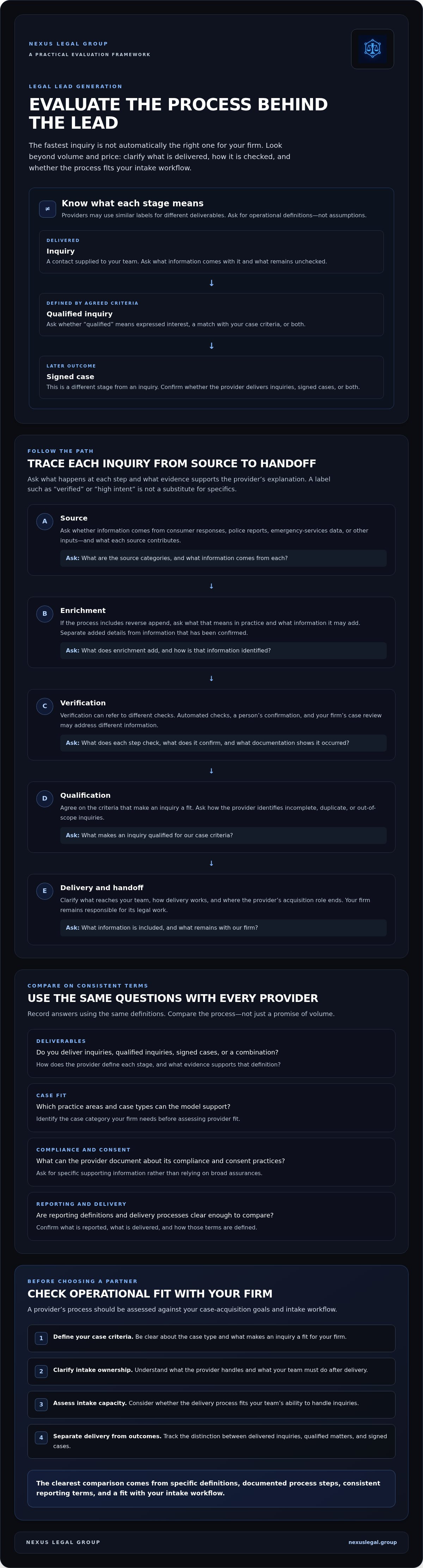
Clarify whether the company supplies inquiries, signed cases, or both. These are different stages in case acquisition, and the distinction affects what your intake team must do after delivery. Ask for definitions you can use to assess the service and compare it with other providers.
What exactly does the provider deliver?
Ask the provider to define an inquiry, a qualified inquiry, and a signed case. Then confirm what information accompanies each delivery, how it was collected or checked, and what remains unverified. For example, does “qualified” mean that someone has expressed interest, that the inquiry matches your case criteria, or both? Request a clear answer rather than assuming every vendor uses the term the same way.
Ask which case categories the provider supports. A company’s ability to generate inquiries for one type of matter does not automatically mean it can meet every practice-area or matter-specific need.
How does the provider’s model fit a plaintiff firm?
Identify the case type you need before assessing fit. Are you seeking motor vehicle accident inquiries, mass tort cases, or another defined category? Ask how the provider’s role relates to your firm’s legal services and where its responsibility for acquisition ends. A case-acquisition provider supplies opportunities or cases; your firm remains responsible for its legal work.
For broader context on technology’s role in acquisition, see Nexus’s AI-driven legal case acquisition guide.
- What do you deliver: inquiries, qualified inquiries, signed cases, or a combination?
- How do you define each delivery stage, and what evidence supports that definition?
- What information is included, and which details have not been checked?
- Which practice areas and case types can your model support?
- What does your process handle, and what remains with our firm?
Record answers using the same terms for each provider. This gives your team a baseline for evaluating sourcing and verification, the next parts of the process to examine.
Questions About Lead Sources, Verification, and Qualification
Lead volume alone does not show whether an inquiry fits your firm’s criteria. Trace the process in order: where the information originates, what gets added or checked, and how the provider decides whether an inquiry meets the agreed qualification criteria. Look for specific steps and evidence, not labels such as “verified” or “high intent” on their own.
How are inquiries sourced and enriched?
Start with the source. Ask whether the provider uses consumer responses, police reports, emergency-services data, or other inputs, and what information each source contributes. If the process includes reverse append, ask what that means in practice and which details it may add. For motor vehicle accident matters, review Nexus’s overview of police-report-generated MVA leads as an example of source-specific acquisition.
What does verification confirm?
Verification means checking specified information associated with an inquiry, but the term has no single universal meaning. Ask which steps the provider performs and what each one confirms. Automated checks may address different information than a person’s confirmation or your firm’s case review. Don’t treat the word “verified” as proof that an inquiry meets your acceptance criteria.
Use these questions to follow the process from sourcing to qualification:
- What are the source categories? Ask what records or responses feed the process and what information comes from each.
- What does enrichment add? Clarify whether reverse append is used to obtain accident reports or details of people involved, and how added information is distinguished from information that has been confirmed.
- What does each verification step check? Request a step-by-step explanation and ask what documentation can show that each check occurred.
- How are incomplete, duplicate, or out-of-scope inquiries identified and handled? Ask the provider to define these categories and explain what happens when an inquiry does not meet the agreed criteria.
- Who sets the qualification criteria? Separate the requirements your firm provides, such as case type or target geography, from the checks the provider performs before delivery.
These questions help distinguish data enrichment from actual qualification. Additional details may give your team useful context, but they do not automatically confirm that a prospective matter fits your criteria. Ask how sourcing and consent records can be documented for review, and consider the ethical issues discussed in the ABA Formal Opinion on Lead Generation. Your firm should assess its own obligations with appropriate counsel.
Use the answers to create a consistent vendor-evaluation record. To see how Nexus describes its case-acquisition approach, visit Nexus Legal Group’s legal case acquisition services.
How to Compare Legal Lead Generation Companies Beyond Volume
A provider’s volume claim is useful only when you know what was counted and how. Compare providers across sourcing transparency, qualification, delivery, reporting, and operational integration. Ask each company to explain its process using the same definitions, then record its answers and supporting evidence. This makes it easier to distinguish a documented operating process from a headline figure.
What evidence supports the provider’s claims?
Ask for process documentation or representative reporting the provider is authorized to share. The goal is to understand what each metric means, not to obtain another firm’s confidential information. Clarify how the provider defines a duplicate, an invalid inquiry, and an accepted case. If those categories are vague, it will be difficult to compare reported results or understand how disputed inquiries are handled.
Testimonials and volume totals can offer context, but they do not explain how leads are sourced, screened, or counted. Treat them as supplementary information, not a substitute for evidence about the process.
How are delivery and accountability defined?
Ask how inquiries are routed to your firm, how delivery is recorded, and what information appears in reports. Clarify how your team can provide feedback and how the provider handles inquiries your firm considers unsuitable. For related qualification context, see Nexus’s guide to verified MVA leads.
Reporting should distinguish provider activity from your firm’s intake outcomes. An inquiry count describes deliveries. Contact attempts, completed intake conversations, qualified matters, and signed cases are later stages. Ask which measures the provider reports, which depend on information your firm returns, and how each is defined. This prevents a rise in delivered inquiries from being mistaken for a rise in signed cases.
Use a comparison worksheet to capture the same fields for every provider:
- Sourcing: What process or source information can the provider document?
- Qualification: How are duplicates, invalid inquiries, and accepted cases defined?
- Delivery: How are inquiries routed and logged for review?
- Reporting: What does each metric count, and who reports it?
- Integration: What steps must your intake team complete, and how is feedback shared?
Add columns for the provider’s answer, evidence supplied, and unresolved questions. Then compare the records side by side. The Nexus Legal Group blog offers additional context on legal case acquisition, while your worksheet keeps the evaluation tied to your firm’s workflow and outcome measures.
Questions About Compliance, Intake Handoffs, and Measurement
Compliance belongs in your due diligence, not in a conclusion drawn from a provider’s marketing language. Ask what the company can document, how it describes each party’s responsibilities, and whether its process fits your firm’s review standards. The answers can inform your assessment, but they do not replace your firm’s own legal or ethical analysis.
What documentation and review can the provider support?
Ask what records are retained about sourcing, inquiry capture, verification, and any consent or communication steps relevant to the provider’s process. Clarify what documentation can be shared for your review, what it demonstrates, and what it does not establish. Request a written explanation of the provider’s role and your firm’s role instead of relying on a broad statement that the process is “compliant.”
Requirements and interpretations can depend on the circumstances. If an answer raises a legal or professional responsibility question, have your firm’s qualified counsel review it. This keeps vendor due diligence separate from legal conclusions.
Can the firm operationally manage the inquiries?
A workable handoff involves more than delivery. Map where an inquiry arrives, who monitors it, how the intake team records its status, and how relevant outcomes are returned to the provider. Ask whether delivery can connect with your CRM or existing intake workflow, and what information or steps are needed to make the handoff practical.
For example, decide internally who owns the initial review, who updates the case status, and how the team flags an inquiry that is incomplete or outside your criteria. Nexus’s automated intake workflow guidance can provide related context, but assess any process against your own systems and staffing.
Before committing, document the operational details that affect accountability:
- Records: What sourcing, capture, verification, consent, or communication records can be provided for review?
- Ownership: Which tasks belong to the provider, and which remain with your firm?
- Handoff: How are inquiries delivered, monitored, and logged in your workflow?
- Feedback: How can your team return disposition information or raise questions about an inquiry?
- Measurement: Which stages can your firm track, from delivery through intake review and signed-case outcomes?
Confirm that your team has the capacity and clear ownership to manage the expected delivery flow. Then decide which outcomes it can consistently record and share. This gives you a practical basis for assessing fit without treating provider-reported activity as a substitute for your own intake and case results.
Choosing a Legal Lead Gen Partner and Getting Started
A sound selection process turns vendor conversations into a decision your firm can explain and review. Define the cases you want to acquire, examine the evidence behind each provider’s claims, assess the handoff against your intake capacity, and document unresolved questions. The questions to ask a legal lead generation company are most useful when your team applies the same criteria to every provider.
What should a firm prepare before vendor discussions?
Set your internal criteria first. Identify target case categories, the qualification factors your firm will use, and the team member responsible for intake. Note workflow constraints, such as how inquiries are received and where outcomes are recorded. Then prepare a consistent question set so you assess each provider against the same requirements, rather than judging them by different sales presentations.
Watch for gaps that make evaluation difficult, such as undefined qualification terms, unclear sourcing explanations, or outcome promises unsupported by evidence. These are not automatic conclusions about a provider’s performance, but they are reasons to ask for clarification and document what remains unverified. If an answer depends on legal or ethical interpretation, refer it to your firm’s qualified counsel.
How can a firm make the next step measurable?
Before moving forward, agree internally on how your team will review delivered inquiries and track later stages, including intake disposition and signed-case outcomes. Confirm who owns each step, what information is returned to the provider, and which reporting definitions will be used. This gives your firm a consistent way to evaluate the process without confusing delivery activity with case results.
Close vendor discussions with a written record of the decision: case criteria, evidence reviewed, workflow fit, agreed responsibilities, reporting terms, and open diligence questions. If key details remain unclear, resolve them before treating the provider as an operational fit. A defined review process supports a more controlled start and helps your team identify where follow-up or adjustment may be needed.
For firms assessing MVA case acquisition or mass tort case generation, Nexus Legal Group describes its legal case-acquisition approach and related offerings on its website.
Make Your Vendor Decision Evidence-Based
Choosing a legal lead provider is an operational decision, not a volume contest. Define the case types your firm wants, ask for clear explanations of sourcing and qualification, and assess whether delivery, reporting, and intake responsibilities fit your workflow. The questions to ask a legal lead generation company should help your team compare evidence consistently and identify unresolved issues before committing.
Nexus Legal Group focuses on legal technology and case acquisition for plaintiff firms. Its MVA case-acquisition approach uses police reports, emergency-services data, reverse append technology, and automated verification. Reviewing the process can help your firm assess how those acquisition steps fit its own criteria.
With clear criteria, defined ownership, and a practical measurement plan, your firm can make a deliberate partner decision and plan its next steps.
Frequently Asked Questions
What questions should I ask a legal lead generation company?
Ask each provider the same sequence of questions: What are the source categories and data inputs? How are inquiries verified and qualified? What does delivery include, and how is it recorded? Which metrics appear in reports, and how are they defined? Finally, does the handoff fit your firm’s intake ownership, systems, and capacity? The questions to ask a legal lead generation company should produce operational answers, not broad assurances.
How can a law firm tell whether legal leads are qualified?
Compare the provider’s documented criteria with your firm’s case requirements. Ask what the provider means by “qualified,” which verification steps it performs, and what information each step confirms. Then define firm-specific factors, such as case category or target geography, and clarify which ones are checked before delivery. A provider’s label alone does not establish that an inquiry meets your acceptance criteria.
Should a law firm ask whether legal leads are exclusive?
Yes. Ask the provider to define “exclusive” precisely and put any exclusivity terms in writing. Clarify what the term covers, such as the specific inquiry, delivery arrangement, or stated period, and ask whether conditions or exceptions apply. Do not assume a provider’s policy or infer exclusivity from words like “dedicated.” Compare the written definition with your firm’s expectations before deciding whether the arrangement fits.
What should a legal lead generation company disclose about its lead sources?
Ask the company to identify its source categories and explain what data each contributes. For motor vehicle accident inquiries, ask whether the process uses consumer responses, police reports, emergency-services data, or other inputs. Clarify whether enrichment, such as reverse append, adds details and how those additions are distinguished from verified information. Also ask what sourcing records or process documentation the provider can make available for your firm’s review.
How do you compare legal lead generation companies?
Compare providers using consistent criteria: sourcing transparency, qualification definitions, verification steps, delivery procedures, reporting, and fit with your intake workflow. Request representative documentation or reporting the provider is authorized to share, and identify which metrics are provider-reported. Assess evidence about the process instead of relying on volume claims or testimonials alone. A comparison table recording each answer, supporting evidence, and unresolved questions makes differences easier to evaluate.
What compliance questions should a law firm ask a lead generation provider?
Ask what records the provider can document about sourcing, inquiry capture, verification, and relevant communications. Clarify which responsibilities belong to the provider and which remain with your firm. Ask what available documentation does and does not demonstrate. Do not treat general assurances as a legal conclusion. If the process raises ethical or legal questions, have your firm’s qualified counsel review the details and assess them in context.
How should a law firm measure legal lead generation performance?
Define metrics by stage so inquiry delivery is not confused with case outcomes. Track provider-reported inquiry counts separately from intake progression, such as contact attempts, completed reviews, and matters that meet firm-defined criteria. Then measure signed-case outcomes using consistent definitions. Clarify which figures come from the provider, which rely on your firm’s feedback, and how reporting periods and duplicate inquiries are handled before comparing vendors.