In-House vs. Outsourced Case Acquisition: A Decision Framework for Law Firms
Explore in-house vs outsourced case acquisition for your law firm. Use our clear decision framework to scale capacity, protect quality, and sign better cases.
The strongest case acquisition model may not be the one that offers the most control or the fastest capacity. In-house vs outsourced case acquisition is best assessed by identifying what your team needs to own, what it can scale, and how each inquiry will be measured against firm-specific criteria.
If no one clearly owns marketing, verification, and intake handoffs, adding inquiry volume can increase operational strain without improving case fit. Outsourcing can add acquisition capacity, but it doesn’t replace the firm’s standards for qualification, intake review, or legal judgment. Those concerns matter because a provider’s definition of a qualified inquiry may differ from yours.
This guide offers a practical framework for choosing an in-house, outsourced, or hybrid model. Compare control, capacity, inquiry quality, and internal workload, then assign accountability from inquiry source through intake review. For motor vehicle accident (MVA) matters, acquisition may use police reports, emergency services data, and automated verification. Fit still depends on criteria your firm defines. The goal is to scale acquisition without mistaking more inquiries for better-fit cases.
Key Takeaways
- Map the inquiry lifecycle and assign clear ownership for sourcing, verification, routing, intake, and disposition.
- Compare in-house vs outsourced case acquisition by control, capacity, inquiry criteria, and the workload your team can support.
- Keep firm-defined case standards and final matter decisions clear, even when an external provider supports acquisition.
- Choose an in-house, outsourced, or hybrid approach based on inquiry flow, staffing capacity, intake coverage, and process consistency.
- Before engaging a provider, define your criteria and confirm sourcing methods, verification steps, scope, handoffs, and reporting.
In-House vs. Outsourced Case Acquisition: What Changes for a Plaintiff Firm?
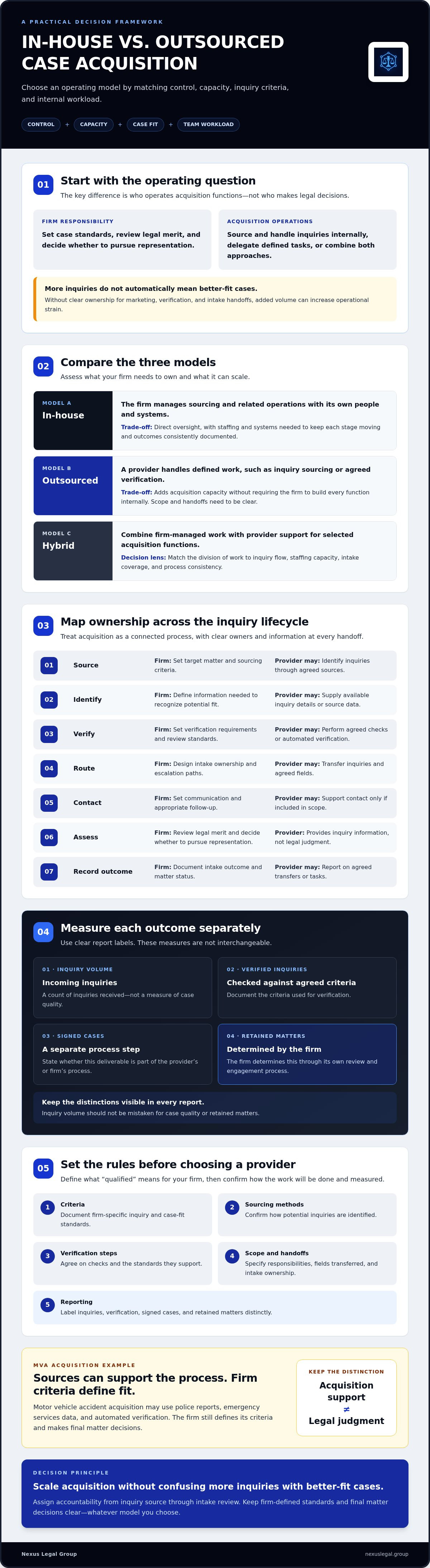
The central difference in in-house vs outsourced case acquisition is who operates acquisition functions, not who makes legal decisions. With in-house acquisition, the firm manages sourcing and related operations using its own people and systems. With outsourcing, the firm delegates defined work, such as inquiry sourcing or verification, to a provider under an agreed scope. Neither model changes the firm’s responsibility for deciding whether to review, accept, or represent a matter.
Keep the outcomes distinct when comparing models. Inquiry volume counts incoming inquiries. Verified inquiries have been checked against agreed criteria, which should be documented. A signed case reflects a separate step in the provider’s or firm’s stated process; it is not interchangeable with an inquiry. A retained matter is determined by the firm through its own review and engagement process. Make sure reports label each measure clearly so inquiry volume is not mistaken for case quality.
What does in-house case acquisition include?
A firm-managed model can bring sourcing, marketing coordination, inquiry handling, and intake into the firm’s operating structure. Internal teams can apply firm-specific criteria, route inquiries, communicate with prospective clients, and record outcomes for review. This gives the firm direct oversight, but requires suitable staffing and systems. Assess whether your team can keep each stage moving and document outcomes consistently, rather than assuming that adding acquisition tasks to existing roles will work.
What does outsourced case acquisition include?
Outsourcing can cover a defined part of acquisition, such as sourcing inquiries or performing automated verification. The provider’s scope may vary: some arrangements focus on qualified inquiries, while others may include signed cases. Specify and measure those deliverables separately. For example, MVA acquisition may draw on police reports or emergency services data, with verification intended to support criteria the firm has defined. The Legal Process Outsourcing (LPO) overview provides broader context for delegated legal-sector functions, though case acquisition should be evaluated on its own terms.
Delegation doesn’t transfer legal representation or final case decisions to an acquisition provider. The firm should retain legal review, matter-acceptance decisions, and the standards used to assess fit. The operational trade-off is that in-house teams own sourcing and handling directly, while an external provider can add acquisition capabilities without requiring the firm to build every function internally. In either model, assign responsibility at each handoff and define “qualified” before reviewing results.
How In-House and Outsourced Acquisition Work Across the Inquiry Lifecycle
Acquisition works best as a connected process, not a series of untracked handoffs. When considering in-house vs outsourced case acquisition, map who owns each stage and what information must pass to the next person or team. The table shows a common division of responsibilities; the provider’s actual scope can vary.
| Stage | Firm-owned responsibility | Potential provider support |
|---|---|---|
| Source | Set target matter and sourcing criteria. | Identify potential inquiries through agreed sources. |
| Identify | Define the information needed to recognize a potential fit. | Supply available inquiry details or source data. |
| Verify | Set verification requirements and review standards. | Perform agreed checks or automated verification. |
| Route | Design intake ownership and escalation paths. | Transfer inquiries and agreed fields to the designated team. |
| Contact | Set the firm’s communication process and handle appropriate follow-up. | Support contact only if the defined service scope includes it. |
| Assess | Review legal merit and decide whether to pursue representation. | Provide inquiry information, not legal judgment. |
| Record disposition | Document intake outcome and matter status. | Provide agreed reporting on transferred inquiries or completed tasks. |
Where does an external provider fit in the acquisition workflow?
Provider support may begin with sourcing and initial verification, then end with a clearly defined handoff to the firm’s intake team. For MVA inquiries, police reports, emergency services data, and reverse append technology may support sourcing or provide additional accident details. Confirm availability and permitted scope with the provider. Don’t assume a particular source or data point is available for every inquiry.
Before launch, agree on required inquiry fields, verification criteria, routing destination, and what happens when information is incomplete. These details connect sourcing to intake and make later review more useful. Firms assessing external MVA sourcing can compare Nexus Legal Group’s MVA case acquisition capabilities with those requirements.
Which decisions should remain with the law firm?
The firm sets target criteria and determines how its team reviews each inquiry. Legal merit assessment, representation decisions, and attorney-client communication should remain within firm-defined processes. Verification can indicate whether specified information has been checked; it doesn’t establish legal eligibility, case value, or whether the firm should accept a matter.
For more detail on structuring the firm’s intake workflow, see automated intake for plaintiff firms. Confirm that a provider’s data availability, verification scope, and handoff procedures match your requirements before relying on them.
Does Outsourcing Reduce Control? Compare Quality, Compliance, and Accountability
Outsourcing can add acquisition capacity without requiring a firm to surrender its case standards. Control depends on how responsibilities are defined: a provider may support sourcing or verification, while the firm sets its criteria, directs intake review, and decides whether to accept a matter. For in-house vs outsourced case acquisition, ask whether your team can see how each inquiry moves through the process and who owns each decision.
Document operating boundaries before engagement. Specify who sets sourcing and verification rules, who routes inquiries, whether the provider has a role in communications, and who makes final matter-acceptance decisions. Set escalation paths, data access, review responsibilities, and reporting expectations. Ask how inquiries are verified, how routing works, and whether inquiries are exclusive or shared. Confirm the exact terms rather than relying on broad labels.
How should a firm define and measure inquiry quality?
Write criteria that distinguish a relevant inquiry from a complete and verified one, then define what firm-specific fit means for intake review. Track disposition and reasons for rejection alongside volume and later conversion stages. This helps locate a gap in sourcing, missing information, verification, or the firm’s own review process. For more on verification standards, see verified MVA leads for law firms.
How can firms oversee external acquisition responsibly?
Set expectations for documented sourcing practices, review procedures, and provider reporting before work begins. Agree on what information accompanies each handoff, how exceptions are flagged, and how the firm can review inquiry-level outcomes. This supports operational oversight without confusing a verification result with legal merit or a promise of representation.
Compliance questions require particular care. Ask how the provider approaches relevant sourcing and communications, but don’t treat a general assurance as a substitute for firm review. Requirements can depend on jurisdiction and the specific activity, so direct legal questions to qualified counsel. The overview of compliant legal lead generation can help frame issues to discuss with counsel and a prospective provider.
Accountability is strongest when the firm can trace an inquiry from source through verification, routing, contact, and disposition, with an owner at every handoff. Firms evaluating external MVA acquisition can compare Nexus Legal Group’s acquisition capabilities with their documented criteria, verification needs, and oversight process.
When Should a Firm Build In-House, Outsource, or Use a Hybrid Model?
Choose a model by identifying where the acquisition process has a real capacity or capability gap. Review inquiry flow, case criteria, staffing capacity, intake coverage, and process consistency. Then map which stages your team can reliably own and where additional support would address a defined need. The right in-house vs outsourced case acquisition decision depends on operational readiness, not firm size alone.
Use these signals to guide your assessment:
- Build in-house when direct workflow ownership is a priority and the firm can consistently manage sourcing, verification, intake, and reporting with its existing people and systems.
- Outsource defined functions when the firm needs additional acquisition capacity or sourcing capabilities it does not currently operate internally. Set clear boundaries around the provider’s scope and the firm’s responsibilities.
- Use a hybrid model when external support can strengthen sourcing or verification while the firm retains inquiry review, prospective-client communication, and matter decisions.
What signals support keeping acquisition in-house?
Look for documented ownership at each stage, enough capacity to handle current inquiry flow, and consistent intake and reporting practices. Ask whether the team can maintain its sourcing and verification processes without creating handoff delays or gaps in review. Assess performance using process evidence, such as complete records and clear dispositions, rather than assuming a larger firm is more operationally ready.
What signals support outsourcing or a hybrid approach?
External support may fit when the firm has a defined gap in sourcing capacity, access to relevant data, or verification workflow. Identify the stage to delegate, the information the provider must deliver, and the decisions that stay internal. For additional context on evaluating MVA inquiry quality, review high-conversion MVA lead analysis.
Before selecting a model, walk through a typical inquiry: who sources it, what gets checked, where it is routed, who contacts the prospective client, and how the outcome is recorded? If your firm can own each stage consistently, an in-house structure may fit. If a specific capability is missing, outsourcing that function or adopting a hybrid arrangement can add capacity while preserving firm-owned review and communication. Reassess the model when inquiry flow, criteria, or staffing capacity changes.
How to Evaluate an Outsourced Case Acquisition Partner
A structured evaluation helps a firm compare providers with the operational requirements identified in its in-house vs outsourced case acquisition assessment. Define inquiry criteria first, then check provider capabilities, document the scope, test the handoff, and review results against agreed measures. This keeps the decision focused on fit and accountability, not just projected inquiry volume.
What questions should firms ask prospective providers?
Ask how inquiries are sourced and what information supports the provider’s stated verification process. Clarify whether the engagement delivers qualified inquiries, signed cases, or another defined output, and how each is reported. Confirm routing procedures, escalation points, exclusivity terms, and how the provider flags or corrects an inquiry that doesn’t meet agreed criteria. Put the answers in writing before launch.
Document the working arrangements so both teams know what to do:
- Sourcing and verification: Which sources and verification steps are included, and what evidence or status accompanies an inquiry?
- Scope and delivery: What exactly will the provider supply, which fields will be transferred, and how will inquiries reach the firm’s intake team?
- Access and oversight: What inquiry-level information can the firm review, what data-handling practices apply, and who can access the records?
- Exceptions and reporting: Who handles incomplete or unsuitable inquiries, how are concerns escalated, and which outcomes will reports distinguish?
How does Nexus Legal Group fit the comparison?
For firms evaluating MVA acquisition, Nexus Legal Group’s capabilities include sourcing based on police reports and emergency services data, reverse append, and automated verification. The company also describes its acquisition service as using AI-driven marketing precision and providing exclusive, litigation-ready inquiries. These capabilities may fit a firm’s defined inquiry criteria, but they don’t replace its intake review or matter decisions. Confirm current service scope, verification steps, data handling, and handoff arrangements directly before determining fit.
Apply the same evaluation sequence to any provider: match stated capabilities to a documented need, confirm deliverables and operating boundaries, then assess whether the handoff supports the firm’s review process. This provides a more useful basis for comparison than broad labels such as “qualified” or “verified.”
Build an Acquisition Model Around Your Firm’s Criteria
The right in-house vs outsourced case acquisition model depends on which responsibilities your firm can manage consistently and where external capacity would address a defined gap. Keep firm-specific criteria, intake review, and matter decisions clear, whether acquisition is managed internally or shared with a provider.
Measure more than inquiry volume. Track verification status, intake disposition, and progression toward signed or retained matters as distinct outcomes. Clear ownership from sourcing through review helps your team assess whether the model is producing inquiries that fit its requirements and identify where the process needs adjustment.
For firms considering MVA acquisition, Nexus Legal Group offers police-report and emergency-services-data sourcing, automated verification, and qualified inquiries or signed cases. Confirm the scope, handoffs, and fit with your firm’s criteria before making a decision.
With defined standards and accountability in place, your firm can scale acquisition with greater clarity.
Frequently Asked Questions
Is in-house or outsourced case acquisition better for a plaintiff law firm?
Neither model is universally better. The right choice depends on your firm’s criteria, operating capacity, and need for direct control. In-house acquisition may suit a team that can consistently manage sourcing, verification, intake, and reporting. Outsourcing may add defined capabilities where internal capacity or sourcing methods are limited. Compare the models by inquiry fit and process accountability, not inquiry volume alone. A hybrid approach can combine external sourcing with firm-owned review.
What does outsourced case acquisition include for a law firm?
Outsourced acquisition can include specific functions such as sourcing inquiries or automated verification, depending on the provider’s agreed scope. For MVA matters, sourcing may use police reports, emergency services data, or reverse append technology. Clarify exactly what information and deliverables the provider supplies and how inquiries are routed to your team. Outsourcing acquisition doesn’t mean the provider represents clients or makes the firm’s legal decisions.
Can a law firm outsource lead generation and keep control of intake?
Yes. A firm can delegate defined sourcing or verification functions while retaining intake review and communication with prospective clients. Establish a clear handoff by specifying required inquiry fields, routing destination, escalation criteria, and who records the outcome. The firm should also retain control over legal review and whether it accepts a matter. Written responsibilities help prevent gaps between provider-supported acquisition and the firm’s intake process.
How should firms measure the quality of acquired legal inquiries?
Measure inquiry quality against written criteria, not volume alone. Define relevance, completeness, verification status, and firm-specific fit, then track how each inquiry moves through intake. Record dispositions and rejection reasons alongside later stages, such as signed cases or retained matters, keeping each measure distinct. An inquiry that meets sourcing criteria may still lack information needed for the firm’s review. These records help identify where the process needs adjustment.
What should a law firm ask a case acquisition provider before engaging?
Ask how inquiries are sourced, what verification steps are included, and what information supports the stated verification status. Confirm whether the deliverable is a qualified inquiry, a signed case, or another defined output. Clarify routing, reporting, exclusivity terms, data access, escalation procedures, and how unsuitable or incomplete inquiries are handled. Put the provider’s scope and responsibilities in writing, and direct jurisdiction-specific compliance questions to qualified counsel.
Does outsourced case acquisition include signed cases or qualified inquiries?
It can include either, but the deliverable depends on the provider and agreed scope. Qualified inquiries and signed cases are different outcomes, so confirm which is supplied and how it is defined and reported. Nexus Legal Group states that it provides qualified inquiries and signed cases for MVA and mass tort matters. Confirm the applicable scope and handoff details directly rather than assuming every acquisition arrangement includes both.
How can a law firm combine internal intake with outsourced acquisition?
Use a hybrid model by assigning external support to defined acquisition functions while keeping firm-specific review and client communication within the firm’s process. For example, a provider may support MVA sourcing and automated verification, then route agreed inquiry details to the firm’s intake team. Define criteria, handoff fields, escalation paths, and disposition reporting in advance. This structure can extend acquisition capacity while preserving firm control over intake and matter decisions.