Mass Tort Claimant Targeting: A Criteria-Led Framework for Law Firms
Improve mass tort claimant targeting with our criteria-led framework. Learn how to align case criteria with intake to acquire qualified, high-intent cases.
More reach can produce less useful intake. Mass tort claimant targeting works best when campaign audiences, messages, and channels align with a firm’s case criteria, rather than being optimized for inquiry volume alone. A high response count can still hide mismatches, especially when potential claimants have limited understanding of the litigation or the information the firm needs to assess their circumstances.
That gap makes campaign performance difficult to judge. Marketing activity may look strong while intake teams spend time clarifying basic details or identifying inquiries that don’t fit. A criteria-led process connects campaign design to intake verification, with clear measures for evaluating relevance and intent at each stage.
This article explains how plaintiff firms can define targeting around campaign and intake requirements, coordinate audience, message, and channel decisions, and assess outcomes beyond reach. It also covers how ethical, compliant case acquisition can support a clear path from inquiry to verification. Nexus Legal Group provides mass tort inquiries and signed cases for plaintiff firms, focusing on qualified acquisition rather than volume for its own sake.
Key Takeaways
- Separate campaign reach, expressed interest, qualified inquiries, and signed cases to evaluate each stage accurately.
- Structure mass tort claimant targeting around the litigation’s stated criteria, audience relevance, and a clear campaign message.
- Compare broad-reach, issue-specific, and consent-led approaches by relevance, message clarity, feedback quality, and intake demands.
- Connect campaign planning to intake evaluation by tracking whether inquiries provide the information needed to assess fit.
- Use ethical, compliant case acquisition to support plaintiff firms with qualified mass tort inquiries and signed cases.
What mass tort claimant targeting means for plaintiff law firms
Mass tort claimant targeting is the process of aligning a campaign’s audience and message with the criteria of a specific litigation opportunity. It gives campaign planning a practical reference point: the product, exposure, or alleged harm at issue, along with the information a firm needs to assess an inquiry. Since mass tort litigation differs from class actions, this overview of mass torts can help frame a campaign’s scope.
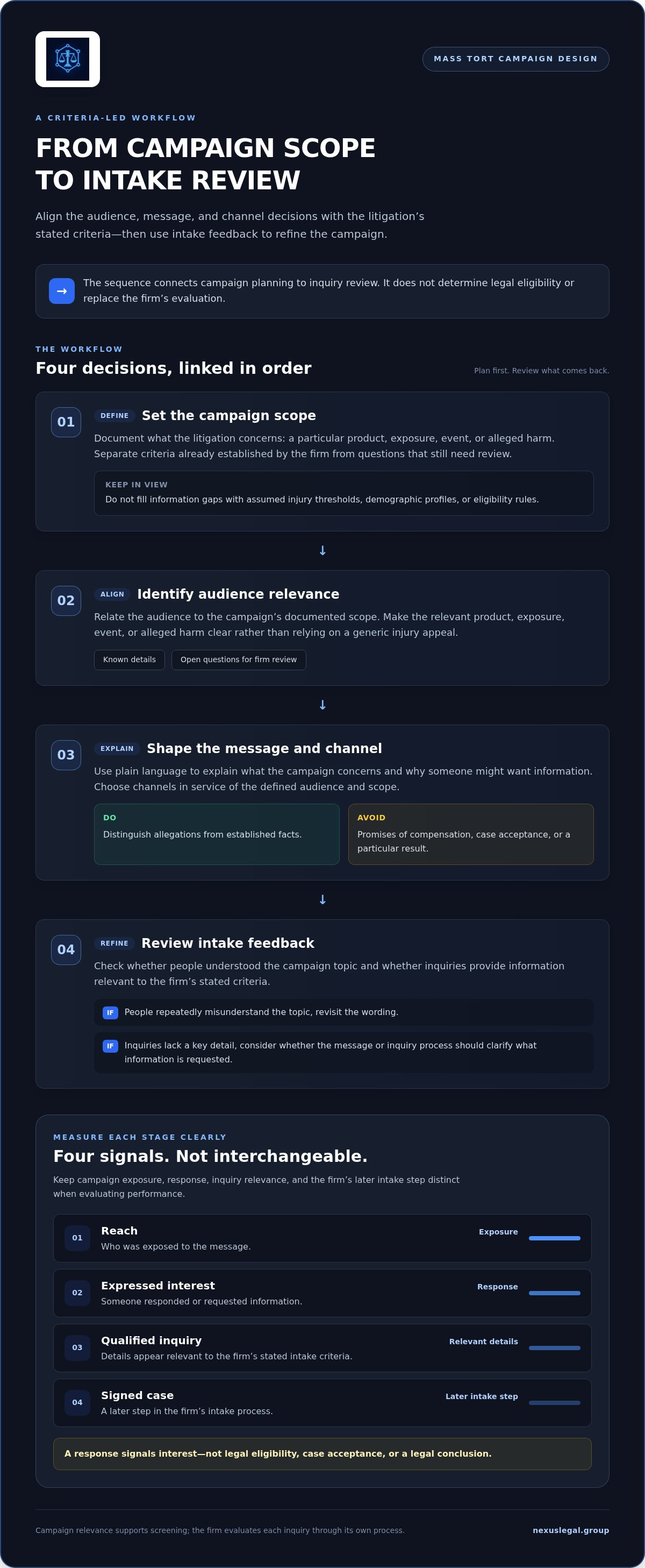
Keep four campaign outcomes distinct. Reach measures who was exposed to a message. Expressed interest means someone responded or requested information. A qualified inquiry contains details that appear relevant to the firm’s stated intake criteria. A signed case reflects a later step in the firm’s intake process. These stages are different signals, not interchangeable measures of campaign success.
Targeting informs case acquisition by shaping who a campaign seeks to reach and how it explains the opportunity. It doesn’t determine legal eligibility or replace the firm’s evaluation of a person’s circumstances. Keeping those roles separate helps firms assess campaign quality without treating an advertising response as a legal conclusion.
How targeting differs from general legal marketing
A mass tort campaign focuses on a defined litigation opportunity, such as a particular product, exposure, or alleged harm. Its audience and message should reflect that context. Broad personal injury messaging may address a wider range of incidents and legal needs without focusing on one litigation. Specificity helps people understand what a campaign concerns, but relevance alone doesn’t establish whether someone meets a firm’s legal criteria.
Why targeting quality matters beyond inquiry volume
If a campaign attracts people whose circumstances don’t align with its focus, intake teams may spend time clarifying basic details or determining that an inquiry doesn’t fit. A high response count may not show whether the audience understood the message or provided information useful to the firm’s review.
Clear, accurate messaging helps people understand the topic without implying that every respondent qualifies or will obtain a particular outcome. Firms can use intake feedback to identify where the audience or message needs refinement, then assess whether later inquiries better match their stated criteria. For broader operational context, connect targeting decisions to an integrated mass tort case acquisition strategy, rather than evaluating media activity in isolation.
Build mass tort targeting around campaign fit, audience, and message
A reliable campaign starts with the litigation opportunity, not a channel or a broad audience assumption. For mass tort claimant targeting, follow a defined sequence: establish the campaign scope, identify audience relevance, shape the message, and review intake feedback. This connects campaign decisions to the firm’s stated criteria while leaving legal assessment to the firm.
Start by documenting what the campaign concerns, such as a particular product, exposure, event, or alleged harm. A legal advertising approach should also account for broader ethical and compliance considerations, as discussed in compliant legal lead generation guidance. Separate criteria already established by the firm from questions that require further review. Don’t fill gaps with assumed injury thresholds, demographic profiles, or eligibility rules.
Set audience and campaign criteria before selecting channels
Define audience relevance in relation to the campaign’s documented scope. If the litigation concerns a specific product, for example, make the product’s role clear rather than relying on a generic injury appeal. Record which details are known and which remain open questions for the firm’s review. This gives channel decisions a grounded purpose without implying that exposure or interest alone establishes eligibility.
Make claimant-facing messages clear and appropriately scoped
Use plain language to explain what the campaign concerns and why someone might want to learn more. Distinguish allegations from established facts, and avoid language that promises compensation, case acceptance, or a particular result. A response signals interest; it is not a legal conclusion.
Use intake feedback to assess whether the audience understood the message and whether inquiries provide information relevant to the firm’s criteria. If people repeatedly misunderstand the campaign topic, revise the wording. If inquiries lack a key detail, consider whether the message or inquiry process should clarify what information is requested. Keep changes tied to the campaign scope, not assumptions about who is legally eligible.
Campaign relevance is a screening input, not a legal conclusion. That distinction helps set accurate expectations while allowing the firm to evaluate each inquiry through its own process. Firms building a structured acquisition program can use Nexus Legal Group’s mass tort case acquisition for ethical, compliant qualified inquiries and signed cases.
Compare mass tort targeting approaches by relevance, not reach alone
Compare campaign approaches by the signals they produce, not simply by how many people see an advertisement. Broad-reach campaigns, issue-specific messaging, and consent-led inquiry capture serve different functions. The right mix depends on the litigation’s scope, the audience’s likely familiarity with the issue, and the firm’s intake process. Assess each approach against consistent criteria so a large response count doesn’t overshadow whether inquiries provide useful context for review.
Use these measures to structure the comparison:
| Approach | Audience relevance | Message clarity | Feedback quality | Intake demands |
|---|---|---|---|---|
| Broad-reach campaigns | Can create visibility across a wide audience, with fit varying by who responds. | Must make the campaign topic clear despite a broad audience. | Response volume shows interest, not whether inquiries match campaign criteria. | May require more screening to understand each person’s circumstances. |
| Issue-specific messaging | Connects the message to a defined product, exposure, or alleged harm. | Can explain relevance directly, but requires precise, careful wording. | Responses may give clearer context about what prompted interest. | Intake still needs to assess details against firm criteria. |
| Consent-led inquiry capture | Centers on people who take an action to request information. | Can set expectations at the point of response. | Captures an engagement signal, not proof of eligibility. | Requires a process to review the inquiry and its fit. |
Broad reach versus issue-specific targeting
Broad reach can support awareness, but visibility alone may tell the firm little about audience fit. Issue-specific messaging narrows the subject and gives potential claimants more context before they respond. For example, a campaign about a defined product can name it instead of relying on a general injury appeal. Precision matters: wording should identify the issue without overstating allegations or suggesting that interest establishes a valid claim.
Evaluate channels as part of an integrated campaign
Digital advertising, search engine optimization, public relations, social media, and television are examples of channels discussed in CAMG’s overview. Treat them as possible components, not endorsements or performance benchmarks. Assess whether each channel can communicate the campaign context clearly, reach an audience relevant to its scope, and produce inquiries the firm can evaluate through intake. Consider each channel alongside the message and the information the inquiry process captures.
Compare responses against campaign criteria, not just by volume. Ask whether inquiries show that people understood the topic, whether the information captured helps intake assess fit, and where ambiguity appears. A related analysis of MVA acquisition signals illustrates how teams can examine engagement information, but MVA findings aren’t evidence of mass tort performance. Use campaign-specific intake observations to guide message or channel adjustments. This keeps mass tort claimant targeting grounded in inquiries a firm can evaluate, rather than assumptions about which medium will perform best.
Turn claimant targeting into a measurable campaign-to-intake workflow
A measurable workflow connects campaign decisions to what intake teams learn from inquiries. For mass tort claimant targeting, define measures and handoff points before launch so campaign and intake stakeholders assess the same process, not separate snapshots. Keep a record of campaign assumptions, the information collected, and the reason for each later adjustment.
- Document the campaign brief. Record the litigation topic and the firm’s stated intake criteria. Separate established criteria from questions that require the firm’s own assessment.
- Define the audience. Describe who may have relevant context based on the campaign scope, without treating an audience description as an eligibility rule.
- Review the message. Check that the campaign clearly identifies its subject and does not overstate allegations or imply a particular result.
- Capture and route inquiries. Identify what information intake needs to review an inquiry against the firm’s criteria, then ensure the handoff preserves that context.
- Evaluate and document. Review campaign indicators alongside intake feedback. Record the pattern that informed any change to the audience, message, or process.
Define useful measures without substituting volume for quality
Set definitions in advance for response volume, contactability, criteria alignment, and signed-case counts. Response volume indicates how many people engaged. Contactability reflects whether follow-up could occur using the information provided. Criteria alignment describes whether inquiry details correspond to the firm’s stated intake criteria. Signed-case counts capture a later stage in the process. These measures answer different questions, so don’t collapse them into one headline number or treat any single measure as proof of legal merit or case value.
Use consistent labels and review periods across campaign and intake reporting. For example, when an inquiry lacks a detail needed for intake review, record that separately from an inquiry containing information inconsistent with a stated criterion. This distinction helps teams determine whether a pattern points to message clarity, information capture, or audience assumptions.
Close the feedback loop between targeting and intake
Schedule reviews between the people responsible for campaign decisions and those handling intake. Look for recurring patterns, such as repeated confusion about the campaign topic or a missing piece of information. Treat an isolated response as a signal to examine, not automatic grounds for changing the audience. If a revision is warranted, document the observed pattern, the proposed adjustment, and the next measure that will show whether the change addressed it.
Intake workflow design can help firms make handoffs and reviews more consistent. This overview of automated intake for plaintiff firms offers related context for connecting inquiry handling with campaign evaluation.
Campaign performance indicators describe marketing and intake activity; they do not determine legal case outcomes. Use them to assess whether the process is producing inquiries that can be reviewed against the firm’s criteria, then leave legal evaluation to the firm.
How Nexus supports ethical mass tort claimant acquisition
Once a firm has defined campaign fit, audience, messaging, and intake measures, the next step is to align acquisition with those decisions. Nexus Legal Group provides mass tort case generation for plaintiff firms, including ethical and compliant qualified inquiries and signed cases. Its case-acquisition infrastructure connects campaign focus with firm objectives while leaving the firm responsible for evaluating legal matters.
That distinction matters operationally. An inquiry gives the firm an opportunity to assess information against its criteria; a signed case is a separate outcome in the acquisition process. Treating these stages transparently helps firms set expectations, review campaign activity, and understand what they are evaluating.
What a criteria-led acquisition relationship should support
A useful acquisition approach starts with shared clarity about the campaign’s focus and the firm’s objectives. Align on the litigation topic, the intended relevance of inquiries, and the distinction between qualified inquiries and signed cases. This gives both sides a clear basis for discussing whether the acquisition approach reflects the firm’s priorities, without assuming every inquiry will lead to a signed case or legal outcome.
Move from targeting framework to a growth conversation
Bring the campaign framework into the discussion. Start with the litigation opportunity and the firm’s stated criteria, then clarify what the campaign message should communicate and how the firm will assess intake feedback. That preparation keeps the conversation grounded in operational fit rather than reach alone. It also gives the firm a practical basis for considering how acquisition can support its growth objectives.
Before discussing an acquisition approach, organize the key decisions:
- Define campaign fit. Summarize the litigation focus and the firm’s relevant intake criteria.
- Align the message. Identify how the campaign should describe its subject clearly and accurately.
- Set evaluation expectations. Decide how the firm will review inquiry information and distinguish it from signed-case outcomes.
This structure makes it easier to discuss scope, expectations, and the connection between targeting and intake. Nexus’s focus on high-intent case acquisition supports this criteria-led approach: campaign relevance informs acquisition, while the firm evaluates inquiries through its own process. The objective is a disciplined, ethical framework for generating qualified inquiries and signed cases, not a promise of a particular result.
Effective mass tort claimant targeting depends on alignment across campaign focus, audience expectations, and intake review. A measured acquisition approach supports that alignment while keeping inquiry generation distinct from legal evaluation and case outcomes.
Put your next campaign framework into action
Your next campaign is an opportunity to make mass tort claimant targeting a repeatable decision process. Before launch, identify the assumptions the team needs to test, the intake signals that matter, and how those findings will inform the next campaign decision. This creates a practical basis for learning without confusing marketing activity with legal evaluation.
Start with one clearly scoped litigation opportunity and agree on what useful inquiry information looks like. As the campaign develops, review the evidence with campaign and intake stakeholders, then document what to maintain or adjust. This gives growth planning a disciplined foundation and keeps the process responsive to what the firm learns.
Build your next campaign around clear objectives and an evidence-led feedback loop. Discuss mass tort case acquisition with Nexus Legal Group to explore a criteria-led approach to qualified inquiries and signed cases.
Frequently Asked Questions
Can mass tort claimant targeting guarantee signed cases?
No. No targeting approach can guarantee signed cases. Mass tort claimant targeting can align a campaign with a relevant audience, and inquiry intent can inform acquisition, but each response still needs appropriate intake and firm review. Someone may respond to a campaign while leaving key details unclear, for example. Track responses and completed intake steps separately from legal outcomes. Neither Nexus nor a marketing system controls whether a person signs or a matter proceeds.
How often should a law firm review its mass tort targeting criteria?
Review criteria at defined campaign checkpoints and when documented intake feedback shows a meaningful mismatch. A recurring pattern, such as inquiries consistently misunderstanding the campaign topic, may warrant examining audience assumptions or message wording. A short-term fluctuation alone may not justify a change. Base revisions on current campaign requirements and intake evidence, rather than following a universal review schedule or treating a marketing partner as the source of legal eligibility criteria.
Is a high response rate enough to judge a mass tort campaign?
No. Response volume shows that people engaged, but it doesn’t establish whether their circumstances align with campaign criteria or whether an inquiry will become a signed case. Before launch, agree on how the team will define responses, contactability, and intake alignment. Then consider those measures together. A campaign with fewer responses may still provide intake with clearer information to review. Use reliable, campaign-specific data rather than generic benchmarks to interpret results.
What should a firm do when an inquiry does not match its campaign criteria?
Record the mismatch accurately and follow the firm’s established intake process. A useful record distinguishes an inquiry that lacks relevant details from one that appears inconsistent with a stated campaign criterion. If similar issues recur, review the documented pattern with the campaign team to determine whether audience assumptions or wording need refinement. Don’t make a legal eligibility determination from marketing data alone, or contact people outside the firm’s appropriate procedures.
Can one mass tort message work across every marketing channel?
Not necessarily. Keep the core campaign facts consistent, but adapt their presentation to each channel’s format and audience context. A short social post and a longer information page may need different levels of explanation, for instance. Both should use plain, accurate language that preserves the campaign’s meaning and avoids unsupported claims. Have the firm review channel-specific versions appropriately before use, especially where format changes could affect how readers understand the message.
Who determines whether a mass tort claimant has a viable legal claim?
The law firm evaluates whether a person may have a viable claim through its own legal and intake processes. Marketing targeting can identify inquiries that appear relevant to a campaign, but it doesn’t determine legal viability. A response, verification detail, or expressed interest is not a legal conclusion and shouldn’t be presented as one. Matching a campaign’s product or exposure topic may give the firm a reason to review someone’s circumstances, but it doesn’t promise representation.
How much should a firm invest in mass tort claimant targeting?
There’s no single budget figure that fits every firm or campaign. Investment depends on the firm’s objectives, operating capacity, audience strategy, and plan for evaluating inquiries. Before committing resources, define the campaign’s intended scope and the measures the team will use to assess activity and intake fit. Then review results against those objectives using campaign-specific evidence. A generic budget range can’t show whether an approach suits the firm’s priorities or capacity.