Trucking Accident Law Firm Marketing for High-Value Leads

See how trucking accident law firm marketing uses SEO, Google Ads, clear messaging, and case tracking to attract qualified leads and measure signed cases.
Truck accident firms don’t build meaningful visibility by treating every injury inquiry the same. Effective trucking accident law firm marketing connects search visibility, paid campaigns, and case-specific messaging so prospective clients can understand a firm’s focus and take the next step.
It makes sense to expect marketing to do more than generate calls. The strategy also needs to distinguish truck crash inquiries from broader personal injury demand and show whether campaigns are producing signed cases, not just activity. This article explains what a personal injury marketing agency does and how its work can support truck accident firms through SEO and AI search visibility, Google Ads structure, clear client messaging, and performance measurement. You’ll see how these elements fit together to create a more accountable acquisition system.
Key Takeaways
- Build search content around truck-specific legal issues and explain relevant federal driving rules accurately, including the 11-hour daily driving limit for property-carrying drivers set by the Federal Motor Carrier Safety Administration.
- Separate truck accident paid-search campaigns from general auto campaigns, and send each ad to a landing page tailored to the search intent.
- Communicate the firm’s relevant experience clearly, using precise, supportable claims that help prospective clients understand its focus.
- Assess campaign performance by tracing calls to their source and reviewing signed cases and case value, rather than relying on lead volume alone.
- When accident-report details and lead verification are central to acquisition, consider how reverse append and other MVA lead services can support the process.
SEO and AI search visibility for truck accident attorneys
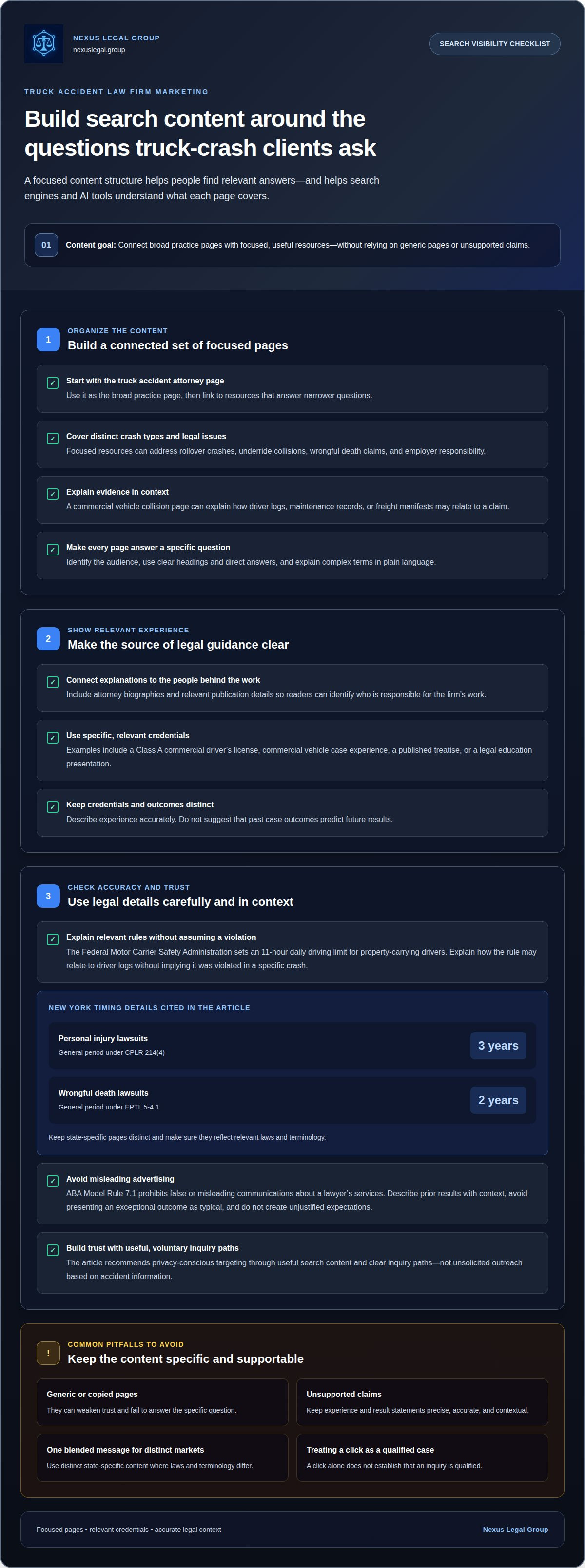
Truck accident search visibility depends on matching specific questions with useful, well-supported answers. A focused trucking accident law firm marketing strategy can organize pages around crash types, liable parties, evidence, and the legal process. For example, a commercial vehicle collision page can explain how driver logs, maintenance records, or freight manifests may relate to a claim. Clear headings and direct answers also help search engines and AI tools interpret the content.
Build a content structure that connects broad practice pages with focused resources. A truck accident attorney page can link to explanations of rollover crashes, underride collisions, wrongful death claims, and employer responsibility. Each page should identify its audience, answer a specific question, and explain complex terms in plain language. Add attorney biographies and relevant publication details so readers can connect legal explanations with the people responsible for the firm’s work.
Attorney experience should be specific and relevant. A lawyer with a Class A commercial driver’s license can explain how operating a truck differs from ordinary driving. A published treatise, legal education presentation, or experience handling commercial vehicle cases can add useful context. Describe credentials accurately, distinguish experience from case results, and avoid suggesting that past outcomes predict future ones.
Search content must also handle attorney advertising responsibly. ABA Model Rule 7.1 prohibits false or misleading communications about a lawyer’s services. Describe prior results with context, avoid presenting an exceptional outcome as typical, and don’t create unjustified expectations. A page about a settlement, for example, should explain the result accurately without implying that another injury claim will produce the same result.
For practical accuracy, the Federal Motor Carrier Safety Administration sets the daily driving limit for property-carrying drivers at 11 hrs. Explain how that rule may relate to driver logs, without implying that a violation occurred in a particular crash. In New York, the New York State Legislature sets a general three-year period for personal injury lawsuits under CPLR 214(4), while wrongful death lawsuits generally have a two-year period under EPTL 5-4.1.
Privacy-conscious targeting relies on useful search content and clear, voluntary inquiry paths, not unsolicited outreach based on accident information. Common mistakes include generic pages, unsupported claims, copied content, and treating a click as proof of a qualified case. Each can weaken trust or obscure performance. For firms serving distinct markets, create state-specific content that reflects relevant laws and terminology, and keep separate market pages distinct rather than blending them into one national message.
Truck accident Google Ads and campaign structure
For commercial vehicle campaigns, structure matters. Separate truck accident searches from general auto advertising and match each ad to a relevant page. Google Ads, SEO, television, and referrals serve different roles, so compare them by signed cases and case value over time, not clicks alone.
PPC and Landing-Page Optimization
Build distinct PPC groups for searches about truck crashes, commercial vehicles, and specific collision types. Keep truck accident keywords separate from general personal injury and auto campaigns, where car-related searches can absorb budget intended for truck cases. Use searches such as “truck accident lawyer near” a relevant location as a starting point, then align the ad language with the user’s intent.
Send each ad to a truck-specific landing page rather than a general injury page. Someone seeking help after a tractor-trailer collision should find relevant information, a clear explanation of the firm’s focus, and an obvious way to make an inquiry. Review the mobile layout, contact form, call option, and consistency of the message. If the ad promises information about a commercial vehicle accident case, the landing page should address that subject directly.
Keep campaigns segmented by case type and, where the firm serves distinct local markets, geography. This makes it easier to identify which searches attract qualified inquiries and which bring unrelated traffic. Adjust targeting and page content based on those patterns instead of broadening keywords simply to increase impressions.
Campaign Analytics and ROI
Measure the path from search to signed case. Track calls and forms to the originating keyword or page, then record whether each inquiry becomes a signed case. A high click-through rate can indicate relevant ad copy, but it does not establish acquisition value if inquiries do not progress. Compare campaign performance over time using signed cases and case value, not lead counts in isolation.
Connect advertising data with intake outcomes. For example, compare a truck-focused landing page with a general auto page by reviewing inquiry source, qualification, and signed-case outcomes. This shows whether the campaign attracts the intended audience, including people seeking a lawyer after a truck accident, rather than simply generating traffic. Use the findings to refine keywords, ad groups, and page content together.
For firms connecting paid acquisition with MVA inquiries, MVA case acquisition support can be part of the broader lead strategy. Keep its role distinct from Google Ads management, and assess each source through the same outcome-focused measurement process.
Truck accident law firm positioning and client messaging
A clear position tells prospective clients which truck accident cases the firm handles and how its work differs from general injury representation. A firm might focus on collisions involving tractor-trailers, delivery vehicles, or complex questions about a driver and trucking company. Specificity helps people recognize relevance before contacting an accident lawyer. It also gives the firm a consistent framework for its website, advertisements, and intake conversations.
Make experience concrete and relevant to the work. An attorney biography can describe commercial vehicle experience, a truck-crash litigation focus, or relevant legal publications. Explain what that experience means in practice, such as evaluating driver logs, maintenance records, or responsibility across multiple parties. Avoid broad labels like “top lawyer” when readers need to understand the firm’s actual experience with accident cases.
Client messaging should answer practical questions in plain language. Explain what an intake team may ask about, such as the collision location, vehicle type, injuries, and other parties involved. Someone describing a delivery-truck crash may not know whether the driver, employer, or another company matters. A clear explanation shows why those details can help assess the accident case without implying a particular legal outcome.
Discuss settlements with context, not as promises. A past result can illustrate the work involved in a particular case, but it should not suggest that every client will receive the same settlement. Explain the circumstances that shaped the result and distinguish that example from the reader’s situation. This gives prospective clients useful information while keeping advertising precise and measured.
Keep the message consistent across every point of contact. If an advertisement emphasizes commercial vehicle collisions, the landing page and first intake conversation should address that focus directly. Train intake staff to use clear language, listen for key facts, and explain the next step without pressuring the caller. A driver’s account of a highway collision, for example, may raise different questions than a passenger’s account of a local delivery-vehicle crash.
Invest in messaging that reflects the firm’s actual capabilities and audience. Review sample calls, inquiry patterns, and prospective clients’ questions. Then refine phrases that create confusion or attract inquiries outside the firm’s focus. A well-positioned accident lawyer does not need dramatic claims. A precise description of relevant experience, case focus, and communication process gives people a practical basis for deciding whether to reach out.
Marketing performance results
Measure personal injury marketing by inquiry quality and progression, not visibility alone. A Google impression shows that an ad or result appeared; it does not establish whether a truck accident attorney reached a suitable prospective client. Track each inquiry from its originating page or campaign through intake and case decisions. This helps distinguish traffic from business outcomes.
Use consistent stages for each commercial vehicle campaign. Record the source, inquiry type, initial qualification, follow-up status, and whether the firm signed the case. For example, do not group a call about a delivery-truck collision with an unrelated car accident inquiry. Clear categories reveal which messages produce relevant conversations and where prospective clients stop engaging.
Then evaluate results over an appropriate period. Many personal injury firms see early movement in rankings and Google Business Profile visibility within three to six months, with stronger lead growth over six to twelve months. Short-term snapshots may therefore give an incomplete picture. Review campaign performance quarterly, comparing similar periods and noting changes in demand, competition, and intake handling.
- Connect calls and forms to the keyword or page that generated them.
- Record whether each inquiry became a signed case.
- Compare case value and case type alongside lead volume.
Case value adds context, especially when liability questions involve several parties or federal trucking rules. A campaign attracting fewer inquiries could still support the firm’s objectives if those inquiries concern the commercial vehicle cases it handles. Conversely, high call volume can hide poor alignment if callers seek services outside the firm’s focus. Review case categories with the intake team before reallocating resources.
Interpret search metrics alongside operational factors. If Google visibility rises but signed cases do not, review landing-page relevance, inquiry handling, and source attribution before changing the campaign. If calls increase but qualified truck accident cases remain flat, examine search terms and intake classifications. This diagnostic sequence helps identify the stage that needs attention instead of treating every performance issue as an advertising problem.
Use the quarterly review to document what changed, what the data shows, and what action follows. For example, compare inquiries from a truck-focused page with its signed cases, then assess whether the page attracts the intended audience. This creates a practical record of performance and supports decisions based on client acquisition rather than clicks alone.
What marketing strategies work best for trucking accident law firms?
Strong strategies connect audience targeting with credible information and dependable inquiry handling. A firm can pair truck-focused educational content with local visibility, professional referrals, and clear intake processes. For example, an 18-wheeler collision page can explain common evidence and identify the information the firm needs to understand an inquiry. Each channel should support the same practice focus.
Educational content builds relevance before a prospective client calls. Create resources that explain truck collision scenarios, potentially responsible parties, and how evidence such as driver logs or maintenance records may matter. A short article about a rollover crash can answer a specific question, while a related practice page explains the firm’s approach. Use clear language, avoid promising outcomes, and update material when the firm’s services or market focus changes.
Professional referrals can complement digital outreach. Build relationships with people and organizations that may encounter commercial vehicle crash inquiries, while keeping communication informative and appropriate. A useful referral resource might summarize the firm’s truck accident focus and offer a direct way to reach its intake team. Track referrals separately from search and advertising to understand which channels produce relevant conversations.
Response handling is part of the strategy, not an administrative afterthought. Truck accident inquiries may arrive outside standard office hours, so firms pursuing these cases should plan how calls and messages will be handled, including through an answering service. An intake process should capture the collision location, vehicle type, injury details, and any known parties. Clear routing helps inquiries reach the right team without unnecessary repetition.
Local market activity also shapes channel choices. A firm serving several communities can tailor educational pages to local concerns and make its geographic focus clear. For instance, a page for a regional freight corridor can address commercial vehicle crashes there without implying representation beyond the firm’s actual service area. Consistent business information and useful local resources help prospective clients recognize the firm’s relevance.
Coordinate content, referrals, and intake through a shared measurement process. Review which sources generated inquiries, which conversations matched the firm’s case focus, and where people disengaged. If a referral resource produces relevant calls but intake notes lack key details, improve the resource and intake prompts together. This operational review turns separate tactics into a connected acquisition strategy.
Nexus Legal Group: Reverse Append MVA Leads To Obtain Accident Reports and Details of those involved
Nexus Legal Group provides motor vehicle accident leads connected to accident reports and the people involved. Its Reverse Append MVA Leads To Obtain Accident Reports and Details of those involved offering supports lead acquisition when those details can inform intake and follow-up. It can suit firms seeking a structured source of MVA inquiries alongside existing marketing channels.
Reverse append lead work connects accident-related information with details about people involved, supporting a more informed intake process. For a firm handling truck accident cases, these details can help staff identify whether an inquiry relates to a commercial vehicle collision and route it appropriately. This is lead acquisition, not legal representation or case handling. Firms remain responsible for their own legal assessment and communications with prospective clients.
Nexus Legal Group also offers Police Report Generated MVA Leads and Emergency Services Generated MVA Leads. These options serve firms seeking inquiries associated with police reports or emergency services information. High-Intent MVA Case Acquisition supports firms focused on acquiring inquiries aligned with motor vehicle accident case needs, while Automated Verification is another part of the lead-related offering. Together, these options can support an acquisition process built around relevant MVA inquiries and the firm’s intake criteria.
Consider this approach when refining how your firm sources accident-related inquiries or when intake needs a clearer connection between lead details and case review. Define the case types and geographic markets relevant to your practice, then consider how report-related details and lead verification fit your workflow. Evaluate whether the source aligns with the cases your firm handles and how your team records inquiry outcomes.
For example, a firm may use report-related MVA leads to identify an inquiry for internal review, then apply its established intake process to determine whether the matter fits its practice. The lead source does not replace attorney judgment, client communication, or the firm’s own evaluation. It provides a defined acquisition input that can be assessed alongside other channels and measured against the firm’s case criteria.
To discuss how reverse append MVA leads and related acquisition options can fit your firm’s process, contact Nexus Legal Group.
Set a Clear Direction for Your Next Growth Phase
A disciplined approach to trucking accident law firm marketing starts with a defined acquisition objective. Decide which inquiries fit your practice, how your intake team will assess them, and which outcomes will guide future decisions. That alignment gives each channel a clear role and makes performance reviews more useful.
Nexus Legal Group supports firms evaluating MVA case acquisition and lead verification. Consider how these capabilities fit your existing intake process, case criteria, and measurement approach. Contact the team to discuss whether the available options align with your firm’s priorities.
Growth becomes more manageable when acquisition strategy and intake operations use the same criteria. Choose a direction that supports your practice, then refine it through consistent review.
Start your next improvement with a clear objective and a practical conversation.
Frequently Asked Questions
How much does trucking accident law firm marketing cost?
There is no standard cost. Scope, channel mix, target markets, competition, and intake capacity all affect the budget. Separate media spend from strategy, content, and campaign management so each expense has a clear purpose. For lead acquisition services, pricing depends on the specific case and is provided after a quote request. Compare proposed work by deliverables and measurement approach, not by an isolated total.
What is the average cost per lead for truck accident attorney ads?
A reliable average is not available, and a single benchmark can conceal differences in market, keyword intent, and lead qualification. Evaluate cost per lead alongside the share of inquiries that fit the firm’s case criteria, become signed cases, and progress through intake. For example, a lower-cost source may produce more unrelated contacts, while a higher cost per inquiry may correspond with stronger case alignment.
How do trucking accident law firms use SEO and local SEO to attract clients?
Firms use SEO to make useful, relevant pages discoverable for truck crash questions, practice areas, and attorney experience. Local SEO also helps communicate where a firm practices and which communities it serves. Keep location pages distinct when service areas differ, and make each page genuinely useful rather than changing only a place name. Review search queries and page engagement to identify topics that need clearer coverage.
What rules govern advertising by personal injury and trucking accident lawyers in the United States?
ABA Model Rule 7.1 prohibits false or misleading communications about a lawyer’s services. Advertising that describes case results should avoid implying that past outcomes predict future results. State requirements can also affect lawyer advertising and lead-generation practices, so firms should apply the rules governing their own jurisdictions. The Telephone Consumer Protection Act is relevant to documenting consent for legal lead generation, making clear consent records an important operational consideration.
What should a trucking accident law firm website include to convert visitors into consultations?
Give visitors a direct way to understand the firm and make an inquiry. Include practice pages for relevant truck crash matters, attorney biographies, clear contact options, and a mobile-friendly form with understandable field labels. Explain what information the form requests and how visitors can reach the firm. Separate prompts for collision type and location, for example, can help route a commercial vehicle inquiry without asking visitors for unnecessary details.
How can law firms measure trucking accident marketing ROI and lead quality?
Connect marketing costs to outcomes by tracking each inquiry’s source, qualification status, and signed-case result. Compare campaigns over the same evaluation period, distinguishing duplicate or out-of-scope inquiries from qualified prospects. ROI analysis should account for the time between first contact and case progression, rather than treating every inquiry as an immediate result. Reviewing these records with intake staff can show whether a channel produces leads that match the firm’s criteria.