Precision Legal Case Targeting: Engineering High-Intent Growth for Elite Firms
Stop buying raw inquiries. Learn precision legal case targeting to acquire verified, litigation-ready MVA & mass tort cases for your elite law firm.
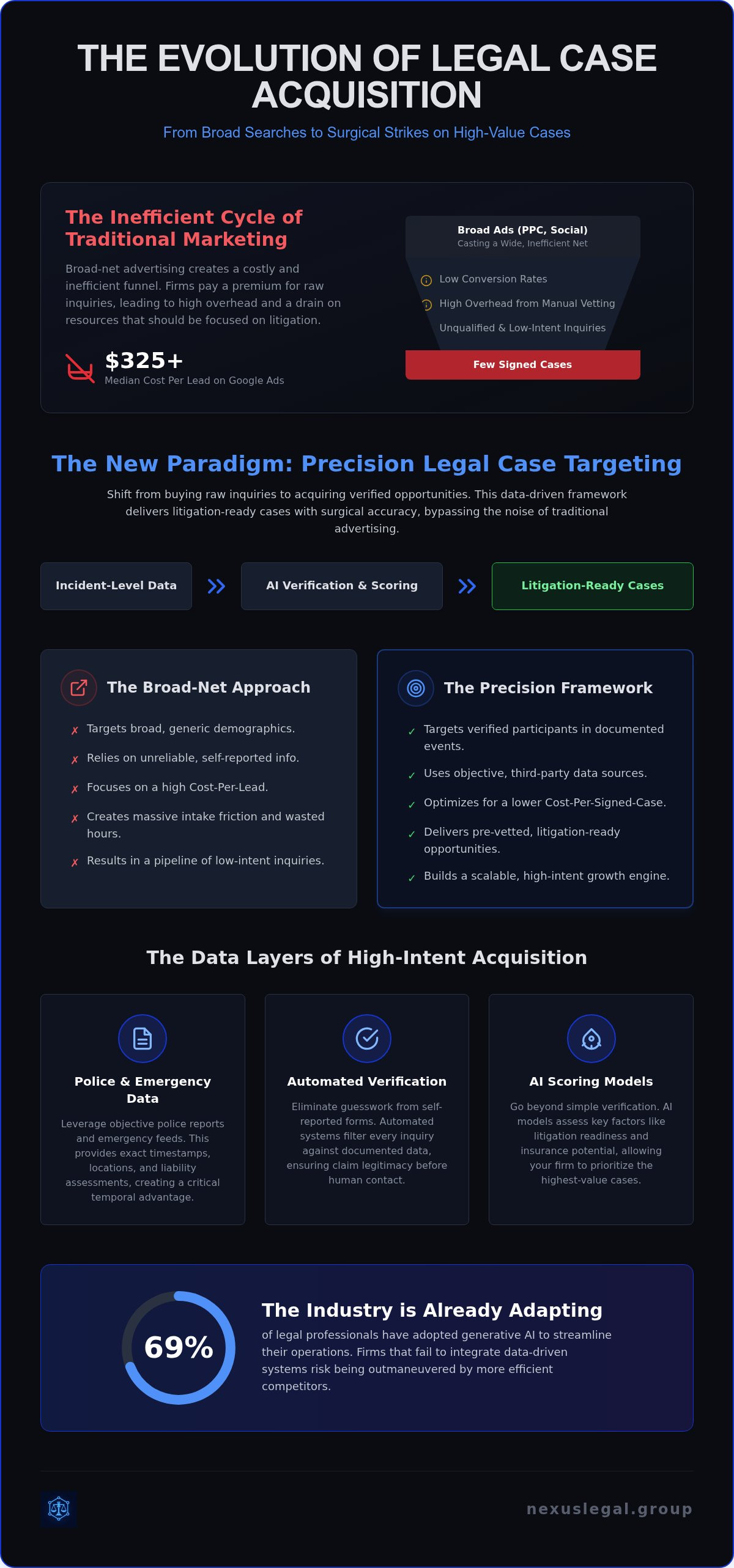
With the median cost per lead for personal injury lawyers on Google Ads climbing to $325 in 2026, elite firms are increasingly paying a premium for the privilege of manual vetting. It's an inefficient cycle where high overhead and low conversion rates from generic digital marketing drain resources that should be focused on litigation. You likely recognize that the traditional broad-net approach is failing to keep pace with a market where 69% of legal professionals have already adopted generative AI to streamline their operations.
You're ready to stop buying raw inquiries and start acquiring verified opportunities. This guide shows you how to transition to a data-driven acquisition framework built on precision legal case targeting. You'll learn how to engineer a system that delivers litigation-ready MVA and mass tort cases with surgical accuracy. We will break down the mechanics of automated verification and incident-level data enrichment, showing you exactly how to lower your cost-per-signed-case while eliminating the friction in your intake workflow. By the end of this article, you'll understand how to position your firm on a foundational layer of high-intent growth.
Key Takeaways
- Shift from broad-market digital campaigns to a system of precision legal case targeting that identifies high-value claimants using specific incident-level data.
- Understand the mechanics of using police reports and emergency services data to establish a temporal advantage and verify high-intent MVA inquiries.
- Learn how automated verification and AI scoring models eliminate friction by filtering for litigation readiness and insurance coverage potential.
- Implement a more efficient growth infrastructure by auditing acquisition costs and integrating data-driven pipelines directly into your firm’s CRM.
- Discover how to build a scalable, compliant acquisition engine that prioritizes exclusive inquiries over shared, low-intent leads.
Defining Precision Legal Case Targeting in 2026
The legal market has moved beyond the era of simple visibility. In 2026, the distinction between a growing firm and a stagnant one lies in the transition from broad-market visibility to precision legal case targeting. Traditional digital marketing models often rely on "spray and pray" tactics, casting a wide net across search engines and social platforms in the hope of catching a viable claimant. This approach is increasingly unsustainable as the cost per lead for personal injury attorneys continues to rise, often reaching several hundred dollars for a single inquiry that may never result in a signed case.
Precision targeting represents a fundamental shift in how firms approach market share. Instead of waiting for a potential client to enter a search query, elite firms use data-driven frameworks to identify individuals based on specific, verifiable incident data. This methodology leverages the principles of targeted advertising but applies them with the clinical accuracy required for high-stakes litigation. Through precision legal case targeting, firms can reduce the administrative friction caused by unqualified leads and focus their resources on cases with high settlement potential.
The Shift from Broad Marketing to Surgical Acquisition
Generic PPC and social media leads are yielding diminishing returns because they lack the necessary context of intent. A user clicking a generic ad might be researching a minor incident with no injuries or even looking for employment. Surgical acquisition moves away from these ambiguous signals by targeting verified participants in documented events. Precision targeting is a data-first approach to case flow that prioritizes the verification of a legal claim before the first intake call is even placed.
Why Elite Firms Prioritize Intent Over Volume
High-volume lead generation often creates an inefficient funnel where staff spend hours filtering out noise. Elite firms recognize that filtering is a cost center, while acquiring high-intent cases is a growth engine. When a case is sourced with pre-verified incident data, the path to litigation and settlement is significantly accelerated. This focus on intent ensures that the firm's operational capacity is reserved for high-value work.
Implementing a robust law firm growth infrastructure allows practices to bypass the chaos of generic lead lists. This structural shift ensures that every dollar spent is an investment in a litigation-ready asset rather than a gamble on a broad demographic. By treating case acquisition as a foundational layer of the organization, firms can achieve a level of systemic integrity that traditional marketing agencies simply cannot match.
The Data Layers of High-Intent MVA Acquisition
High-intent acquisition is not a product of marketing volume. It is a result of the verifiable data layers that confirm an incident occurred before a firm ever engages with a potential claimant. While most agencies treat leads as a commodity, precision legal case targeting utilizes objective, external data sources to validate the legitimacy of a claim. This foundational layer of information eliminates the guesswork inherent in self-reported lead forms, ensuring that every inquiry entering your intake funnel has a documented basis in reality.
Operating within a rigorous technological and legal framework is essential for maintaining firm reputation and compliance. By layering incident-level data with sophisticated enrichment tools, firms can build a comprehensive view of a case's potential value early in the lifecycle. This methodology allows for a more focused allocation of resources, prioritizing cases where liability and injury are clearly documented by third-party responders.
Leveraging Police Reports and Emergency Services Data
Police reports represent the gold standard for MVA case verification. Unlike digital inquiries where a user might misremember details or exaggerate circumstances, police report generated MVA leads provide an objective record of the event, including the parties involved and initial liability assessments. When this data is integrated with real-time emergency services feeds, firms gain a critical temporal advantage. Reaching a claimant shortly after a verified incident ensures that the firm is the first point of contact during the most critical decision-making window.
- Accuracy: Incident-level data provides exact timestamps, locations, and vehicle descriptions.
- Verification: Objective reports confirm the presence of injuries and the extent of property damage.
- Speed: Real-time data feeds bypass the delays associated with traditional SEO or social media search cycles.
The Role of Reverse Append Technology in Case Enrichment
A primary challenge in data-driven acquisition is the presence of incomplete records. Reverse append technology solves this by matching partial data points, such as a location or vehicle identifier, against comprehensive contact databases to build a complete claimant profile. This process secures missing accident details and participant identities that are often omitted in initial reports.
This technical advantage is most visible during the intake phase. When your staff calls a potential client, they aren't asking basic questions to determine if an accident happened; they're confirming the details they already have in front of them. This creates a sense of professional competence and authority that generic lead generation cannot replicate. If you want to see how this data enrichment can transform your firm's efficiency, you should evaluate your current case acquisition infrastructure to identify gaps in your data layers.
Engineering Efficiency with Automated Intake and Verification
Efficiency in case acquisition is often misunderstood as simply answering the phone faster. True operational excellence requires the systemic removal of friction through precision legal case targeting. While some traditional agencies argue that manual intake is the only way to ensure quality, this human-centric approach is frequently the primary bottleneck for elite firms. Manual vetting is prone to fatigue, subjective bias, and high overhead costs that eat into settlement margins. By contrast, an engineered intake framework uses automated verification to act as a primary filter, ensuring that only litigation-ready inquiries reach your legal team.
Modern AI models now score inquiries based on liability and insurance coverage potential with a level of accuracy that exceeds manual review. These systems analyze incident data in real time, cross-referencing accident details against policy limits and liability standards. This technical layer ensures that your firm’s resources are allocated to cases with the highest probability of a successful resolution. Implementing automated intake for plaintiff firms allows you to scale your case volume without a linear increase in staff headcount, creating a more sustainable growth trajectory.
Eliminating Friction in the Vetting Process
The transition from manual call centers to automated verification systems marks a significant evolution in firm operations. Manual processes often allow "ghost" claimants or low-intent inquiries to clog the pipeline. Automated systems utilize instant data cross-referencing to validate the identity and involvement of a claimant before the intake call even begins. This clinical precision in vetting reduces the time spent on unqualified leads, allowing your intake specialists to focus on closing high-value cases rather than basic data entry.
AI-Driven Precision in Mass Tort Acquisition
Qualifying mass tort claimants at scale presents unique challenges that manual systems struggle to manage. AI models are specifically designed to identify complex criteria, such as specific product usage or medical diagnoses, by scanning documentation with speed and accuracy. This automation is particularly critical for maintaining compliant legal lead generation standards. It ensures that every signed case meets the rigorous evidentiary requirements of mass tort litigation. By automating the qualification phase, firms can participate in large-scale litigations with the confidence that their inventory consists of verified, high-intent claimants.
Strategic Implementation of Case Growth Infrastructure
Building a sustainable growth engine requires moving beyond the mindset of simply hiring an agency. You must view acquisition as a core internal infrastructure. Most firms fail to audit their acquisition costs correctly; they often focus on the price of a lead while ignoring the significant cost of the labor required to vet it. A truly efficient system uses precision legal case targeting to ensure that the data entering your pipeline is already validated. This structural shift allows you to monitor performance through granular metrics, such as the cost per signed case and time to settlement, rather than the vanity metric of total lead volume. Identifying "leaky" funnels where high-value cases disappear due to slow intake is the first step in engineering a high-performance practice.
Integrating Data-Driven Pipelines into Firm Workflows
The goal is to connect incident data streams directly to your CRM or Case Management Software (CMS). This process eliminates the delay and human error associated with manual data entry. When a high priority MVA case is identified via real-time emergency data, your team should receive an instant notification. This seamless transfer prevents lead decay, which is the primary cause of lost opportunities in competitive markets. You can follow these steps to integrate a data-driven pipeline:
- Map Data Fields: Ensure your CMS is configured to accept specific incident data points like vehicle type and injury severity.
- Automate Notifications: Set up triggers that alert your senior intake specialists the moment a litigation-ready inquiry is verified.
- Secure Data Transfer: Use encrypted APIs to maintain compliance and protect claimant privacy during the transfer.
Transitioning from Lead Generation to Litigation-Ready Inquiries
Modern firms must adopt a "litigation-ready" standard. This means an inquiry isn't just a name and a phone number; it's a verified event with a documented injury and insurance profile. Shifting to data driven case acquisition fundamentally changes the intake dialogue. Your team stops being salespeople trying to convince someone to sign and starts being case managers confirming facts. This cultural shift increases confidence and improves the conversion rate from inquiry to signed retainer. Precision legal case targeting provides the evidence your intake team needs to handle calls with authority and clinical precision.
By treating acquisition as a foundational layer of your organization, you create a system that values logic and automation over frantic manual outreach. This approach doesn't just lower your overhead; it instills a sense of security through technical mastery of your case flow.
Nexus Legal Group: The Infrastructure for Precise Case Growth
Nexus Legal Group acts as the strategic architect of your firm’s growth infrastructure. We don't just provide leads; we engineer a foundational layer that identifies and secures high-intent inquiries through precision legal case targeting. Unlike traditional providers that sell shared leads to multiple firms, our commitment is to exclusivity. This ensures that when you receive a litigation-ready inquiry, your team is the only one engaging with that claimant. Our technical mastery allows us to operate behind the scenes as a high-performance engine, driving your firm’s expansion with clinical accuracy. We assume a high level of professional literacy in our partners, providing a sophisticated technological solution that removes the guesswork from business development.
Our End-to-End Growth Architecture
The Nexus approach is built on a methodical progression: sophisticated data sourcing, AI-driven verification, and automated intake. This end-to-end architecture is designed to deliver the no-nonsense results that elite plaintiff firms expect. We move quickly through complex data sets to group related incident factors together, creating a well-oiled machine that eliminates the friction in your workflow. By integrating reverse append technology and real-time emergency feeds, we provide a level of connectivity that traditional marketing cannot match. If you want to see the technical integration in action, we invite you to view Nexus Legal Group videos for a complete system walkthrough.
Ethical Standards and Compliance in Precision Targeting
Maintaining a high ethical register is not a secondary goal; it's a requirement for sustainable growth. Our systems are built to ensure that all precision legal case targeting efforts remain fully compliant with industry standards. We protect your firm’s reputation by utilizing ethical sourcing and automated verification that filters out non-compliant inquiries before they ever reach your CRM. This focus on systemic integrity instills a sense of security, allowing you to focus on litigation while we handle the mechanics of case acquisition. We're committed to operational excellence and technical mastery, ensuring every case is ready for the courtroom. It's time to move beyond generic lead generation and build a scalable, data-driven practice.
Engineering Your Firm's Future with Data-Driven Acquisition
Transitioning from a volume-based marketing model to a results-oriented growth infrastructure is the defining challenge for elite firms in 2026. You now understand how the integration of incident-level data and AI-driven automated verification creates a systemic layer that eliminates administrative friction while securing high-intent, litigation-ready inquiries. By shifting your focus toward precision legal case targeting, you ensure that every acquisition dollar is spent on an exclusive case asset rather than a gamble on generic lead volume. This framework provides the technical mastery required to scale your practice with absolute confidence, maintaining the highest ethical and compliant case sourcing standards. You don't need more leads; you need a more efficient engine for case flow.
It's time to stop managing lead noise and start managing case growth. You have the blueprint to move beyond traditional lead generation and establish a foundational layer of systemic integrity. We're ready to help you build the infrastructure that will define your firm's success for years to come.
Frequently Asked Questions
What is precision legal case targeting?
Precision legal case targeting is a data-driven strategy that identifies claimants based on specific, verifiable incident data rather than broad demographic marketing. It focuses on high-intent individuals who were documented participants in a specific accident or injury event. This approach ensures that firms only engage with potential clients who meet pre-defined litigation criteria, significantly increasing conversion rates and reducing time spent on unqualified leads.
How do police reports improve MVA case acquisition?
Police reports provide an objective, third-party verification of an accident that self-reported digital forms cannot match. By utilizing police report generated MVA leads, firms gain access to verified details like liability assessments, vehicle damage, and injury status. This incident-level data allows intake teams to bypass basic discovery and move directly to signing cases with high settlement potential.
Is automated legal intake ethical and compliant?
Yes, automated intake is ethical and compliant when it adheres to ABA Model Rules and state-specific advertising regulations. Our systems are designed to provide truthful, non-misleading communications while filtering inquiries based on objective criteria. This automation reduces human error in the vetting process, ensuring that every signed case meets the rigorous evidentiary and ethical standards required for modern litigation.
What is reverse append technology in a legal context?
Reverse append technology is the process of matching partial incident data, such as a location or vehicle identifier, to complete contact records. In a legal context, this allows firms to enrich accident reports with missing participant identities and contact details. It provides a technical advantage by creating a comprehensive claimant profile before the first intake call is even placed.
How does AI-driven verification reduce firm overhead?
AI-driven verification reduces overhead by acting as an automated filter that removes low-intent or unqualified inquiries before they reach your staff. Instead of paying intake teams to manually vet raw leads, the system uses AI models to score inquiries based on liability and insurance potential. This allows your firm to scale case volume without a linear increase in personnel costs or administrative burden.
What makes an inquiry "litigation-ready"?
An inquiry is considered litigation-ready when it includes verified incident data, documented injuries, and confirmed insurance coverage or liability. Precision legal case targeting ensures that these inquiries aren't just leads, but actionable opportunities with a high probability of a successful settlement. This standard eliminates the friction of discovery, allowing attorneys to focus immediately on the legal merits of the case.
How does Nexus Legal Group ensure lead exclusivity?
Nexus Legal Group ensures exclusivity by delivering inquiries directly to a single firm's CRM in real time. We don't sell shared leads or participate in bidding wars that force firms to compete for the same claimant. This exclusive delivery model protects your marketing investment and ensures that your firm is the first and only point of professional contact for the verified incident.
Can this infrastructure scale for mass tort litigation?
Yes, the growth infrastructure is specifically engineered to handle the complexities of mass tort acquisition at scale. AI models can automatically identify specific criteria like product usage or medical diagnoses within large data sets. This systemic integrity allows firms to build a high-quality inventory of verified claimants for mass tort cases while maintaining strict adherence to ethical and compliant sourcing standards.