How to Get More High-Value MVA Cases: A Data-Driven Guide for Elite Firms
Stop wasting resources on bad leads. Learn how to get more high value MVA cases with a data-driven system that finds litigation-ready files for your firm.
What if the primary constraint on your firm's expansion isn't the size of your marketing budget, but a fundamental reliance on legacy lead generation models that favor raw volume over mechanical precision? You've likely felt the friction of an intake team overwhelmed by low-quality inquiries and minor accidents that never materialize into significant litigation. It's frustrating to watch your cost-per-acquisition climb while your case quality remains stagnant. You need a predictable system that filters out the noise before it ever reaches your desk.
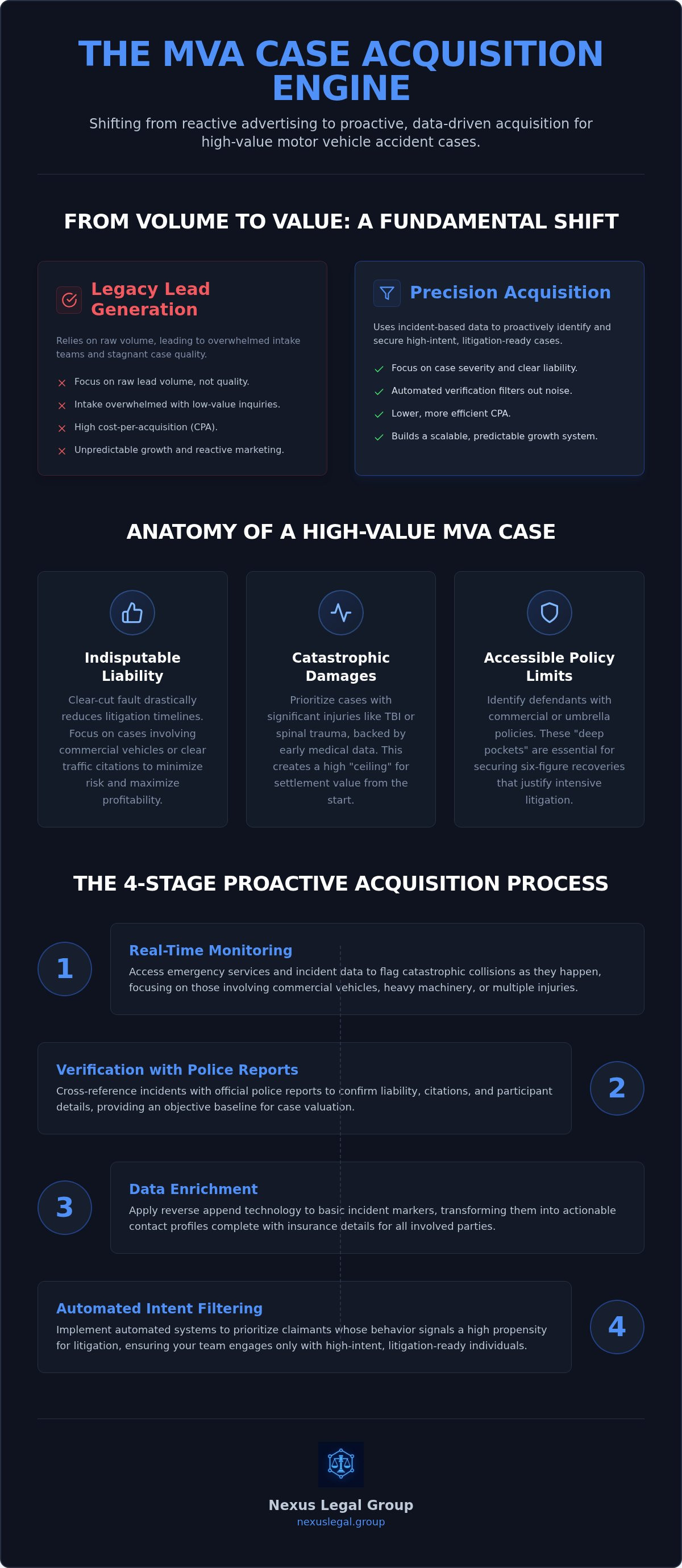
This guide provides a clinical look at how to get more high value MVA cases by shifting from reactive advertising to proactive, data-driven acquisition. We'll show you how elite firms leverage incident-based data, such as police reports and emergency services records, to identify high-intent cases before the competition even knows they exist. By implementing automated verification and reverse-append technology, you can eliminate manual bottlenecks and secure a consistent stream of litigation-ready files. We'll break down the architectural shift required to turn your firm into a high-performance engine for MVA growth.
Key Takeaways
- Define high-value cases through the lens of clear liability and significant damages to refine your firm's targeting parameters.
- Discover how to get more high value MVA cases by integrating real-time incident data and police reports into your sourcing workflow.
- Deploy reverse append technology to enrich basic inquiries with the deep accident details required for immediate litigation readiness.
- Implement automated verification to bypass manual intake friction and focus your resources on high-intent inquiries.
- Construct a scalable growth infrastructure that moves beyond traditional lead buying into a systematic case acquisition engine.
Identifying the Anatomy of a High-Value MVA Case
Elite firms recognize that "high-value" isn't a subjective label; it's a cold calculation of risk and recovery potential. In the 2026 legal market, a high-value motor vehicle accident case is defined by three non-negotiable variables: indisputable liability, catastrophic damages, and accessible policy limits. While standard lead providers flood intake desks with "fender benders" and soft-tissue claims, these inquiries often fail to meet the rigorous criteria of a scaling practice. If you want to know how to get more high value MVA cases, you must first engineer a filter that prioritizes severity over raw volume. This architectural shift ensures that your attorneys spend their time on six-figure settlements rather than chasing minimum-limit policies that barely cover administrative costs.
Every Traffic collision presents a different risk-to-reward ratio for a law firm. Standard leads often lack the data depth to distinguish between a minor rear-end incident and a multi-vehicle crash involving a commercial carrier. Elite firms focus on cases where the "ceiling" is high enough to justify the overhead of intensive litigation. This means identifying incidents with long-term care requirements, permanent disability, or significant loss of income from the very first touchpoint.
The Intersection of Liability and Policy Limits
Clear-cut liability is the most efficient driver of firm profitability because it drastically reduces litigation timelines and defense leverage. When liability is contested, your firm's capital is tied up in discovery and depositions for months or years. High-value cases often involve commercial defendants or high-limit umbrella policies that provide the "deep pockets" necessary for significant recoveries. Identifying a commercial tractor-trailer or a corporate fleet vehicle immediately elevates a case from a standard personal injury claim to a high-priority asset. Multi-party accidents also increase total settlement potential by opening multiple avenues for recovery, provided you have the data to identify every involved entity's insurance coverage early in the process.
Medical Documentation as a Value Driver
Litigation-ready cases require immediate and comprehensive medical documentation to establish a baseline for damages. There's a massive valuation gap between soft tissue claims and catastrophic injury cases involving spinal cord trauma, traumatic brain injuries (TBI), or complex fractures. To determine how to get more high value MVA cases, firms must use early data enrichment to forecast case value before the ink is dry on the retainer. By analyzing emergency services data and initial medical reports, you can predict the "litigation-readiness" of a file before your intake team spends hours on a manual interview. This precision allows your firm to allocate resources toward files with the highest projected ROI while maintaining a lean operational footprint.
Leveraging Incident Data and Police Reports for Precision Sourcing
Reactive marketing models rely on the hope that a high-value claimant will search for a lawyer before an insurance adjuster settles the claim for pennies. This reliance on luck is the primary obstacle for firms asking how to get more high value MVA cases. To scale effectively, you must invert the model. Precision sourcing begins with incident data, allowing your firm to identify a catastrophic collision as it happens rather than waiting for a lead to trickle through a generic funnel. It's about moving from broad audience targeting to specific incident targeting.
The transition to a proactive acquisition engine follows a rigorous four-stage mechanical process:
- Stage 1: Real-Time Monitoring. Accessing emergency services data to flag incidents involving heavy machinery, commercial vehicles, or multiple injuries.
- Stage 2: Verification. Cross-referencing incidents with police report data to confirm liability, citations, and participant details.
- Stage 3: Data Enrichment. Applying reverse append technology to turn basic incident markers into actionable contact and insurance profiles.
- Stage 4: Intent Filtering. Prioritizing claimants whose immediate post-accident behavior signals a high propensity for litigation.
The Power of Police Report Generated MVA Leads
Using police report generated MVA leads provides an objective baseline for case valuation that marketing algorithms simply cannot match. Unlike a search query, a police report contains verified facts regarding point of impact, citations issued, and weather conditions. This data creates an immediate competitive advantage; your firm enters the conversation with a comprehensive understanding of the liability landscape. It allows for a more authoritative outreach that respects the claimant's situation while offering clear legal guidance based on factual evidence rather than generic marketing promises.
Integrating Emergency Services Data
Computer-Aided Dispatch (CAD) data serves as the early warning system for elite firms. By flagging high-severity accidents in real-time, you ensure your infrastructure is ready to process a high-intent inquiry the moment it arises. This level of responsiveness is critical for securing high-value motor vehicle accident cases involving significant trauma. If your goal is to understand how to get more high value MVA cases, the answer lies in the speed and accuracy of your data ingestion. Ethical and compliant data usage is the bedrock of this strategy. You aren't just buying data; you are building a high-intent growth infrastructure that respects regulatory boundaries while maximizing operational efficiency. This systematic approach eliminates the waste of traditional PPC campaigns.
Utilizing AI and Reverse Append Tech to Qualify Inquiries
Qualification is the critical filter that separates high-growth firms from those drowning in administrative overhead. If you're analyzing how to get more high value MVA cases, you must move beyond the limitations of the basic intake form. Reverse append technology allows you to take a single data point, such as a name from an incident report or a partial vehicle identifier, and programmatically construct a comprehensive case profile. This system enriches the inquiry with insurance carrier details, vehicle registration history, and asset markers before your team ever initiates contact. It's a mechanical approach to verification that ensures every inquiry meets your firm's specific litigation criteria.
Modern AI models now predict case outcomes by comparing incoming incident data against thousands of historical data patterns. This isn't speculative; it's a statistical analysis of "litigation-readiness." By understanding the behavioral cues and incident markers that consistently lead to high-settlement outcomes, firms can secure high conversion MVA leads that are already vetted for quality. This level of enrichment transforms a raw inquiry into a verified legal asset, allowing for a more focused and effective acquisition strategy.
Data Enrichment for Trial Lawyers
Standard leads often result in "ghosting" because the initial data is too thin to establish a meaningful connection. Enrichment changes this dynamic by verifying claimant details through multiple third-party databases. This process ensures the validity of the contact information while identifying high-value defendants programmatically. If the data enrichment process reveals that the adverse party is a corporate entity or a driver with a high-limit umbrella policy, the case priority shifts instantly. This allows trial lawyers to enter every conversation with a strategic advantage, knowing exactly which defendants have the "deep pockets" required for a significant recovery.
AI-Driven Intent Scoring
Not all inquiries are created equal, and distinguishing between "browsers" and "litigants" is essential for maintaining a lean operation. AI-driven legal case acquisition works by filtering for high-intent behavior. By analyzing signals such as the speed of response to an incident or specific engagement patterns with digital assets, the system assigns an objective intent score. This ensures your high-cost resources are focused exclusively on inquiries with the highest statistical probability of conversion. It's about eliminating the friction of unqualified inquiries and prioritizing the cases that will drive the most significant growth for your practice.
Implementing Automated Intake to Eliminate Low-Value Friction
Manual intake teams represent a significant legacy bottleneck for firms aiming to scale. The hidden costs of maintaining a large, human-centric intake department include heavy salaries, benefits, and the inevitable errors that come with manual data entry. Perhaps more critically, human teams create a latency gap. High-value claimants expect immediate engagement; if your team is off-clock or busy, that claimant is already calling your competitor. Understanding how to get more high value MVA cases requires a shift toward automated intake for plaintiff firms to ensure 24/7 responsiveness and clinical precision in lead handling.
The logic of automated verification is simple: it qualifies cases before they ever reach a human desk. By creating a frictionless entry point through digital interfaces, you increase signing rates by meeting the claimant where they are. This system doesn't just collect information; it applies a series of mechanical filters to ensure the inquiry meets your firm's rigorous standards for liability and damages. It's a sophisticated gatekeeper that protects your attorneys' time while maximizing capture rates.
Engineering the Intake Workflow
Effective intake relies on conditional logic to disqualify non-viable MVA claims instantly. If an inquiry lacks clear liability or sufficient insurance coverage, the system can route it accordingly without wasting your team's resources. This ensures that your high-level staff only interacts with verified MVA leads for law firms, which significantly improves operational efficiency and staff morale. Integrating these systems directly into your CRM creates a seamless management environment where data moves from the incident report to the case file without manual intervention.
Reducing Overhead with Automated Verification
The impact of instant verification on your Cost-Per-Signed-Case is transformative. By eliminating manual data entry and using API-driven enrichment, you remove the risk of human error that often derails high-value files. This infrastructure allows you to scale intake capacity exponentially without increasing headcount. You're no longer limited by the number of people on your phones; you're only limited by the amount of high-intent data you can ingest. This is the mechanical foundation of a scaling practice that values logic and systemic integrity above all else.
Scaling Your Firm with a High-Intent Growth Infrastructure
Elite firms distinguish themselves by treating case acquisition not as a recurring marketing expense, but as permanent law firm growth infrastructure. This shift in perspective is the catalyst for sustainable expansion. While average practices remain trapped in the cycle of "buying leads" from generic aggregators, elite organizations focus on building a proprietary case acquisition engine. When you solve the problem of how to get more high value MVA cases through a data-engineering lens, you create a barrier to entry that competitors can't easily breach. This infrastructure relies on exclusive, high-intent data streams that provide a continuous feed of verified inquiries directly into your litigation pipeline.
Building a Predictable Case Pipeline
Moving away from the "feast or famine" cycle requires a methodical approach to data ingestion. Traditional marketing often produces inconsistent results, leading to underutilized staff or overwhelmed intake teams. In contrast, modern lead generation for trial lawyers supports multi-year growth plans by providing a steady, predictable volume of high-quality files. This stability allows your firm to make strategic decisions about infrastructure and headcount with confidence. A robust MVA engine also provides the financial foundation to diversify into high-value mass tort cases, creating a balanced and resilient practice model that isn't dependent on a single lead source.
The Nexus Advantage: Litigation-Ready Precision
Nexus Legal Group functions as the strategic architect of your firm's growth. We don't just provide leads; we deliver a comprehensive system that combines AI-driven qualification, real-time incident data, and automated intake verification. This end-to-end solution ensures that every inquiry your firm receives is litigation-ready and verified for high-intent behavior. By providing exclusive access to incident-based data before it hits the open market, we give our partners a definitive edge in the most competitive jurisdictions. If your firm is ready to implement a professional, mechanical approach to how to get more high value MVA cases, it's time to upgrade your acquisition engine.
Engineering the Future of Your Practice
High-growth firms succeed because they treat case acquisition as a technical engineering problem rather than a creative marketing exercise. By prioritizing clear liability and significant medical severity, you ensure your resources are allocated to files with the highest recovery potential. Moving toward incident-based sourcing through police reports and emergency services data allows you to bypass the noise of traditional lead generation and secure a definitive competitive advantage.
Implementing automated intake verification is the final step in mastering how to get more high value MVA cases. By utilizing exclusive incident-based data sourcing and AI-driven marketing precision, you remove the manual friction that stalls firm growth. You aren't just looking for leads; you're building a scalable engine that identifies litigation-ready inquiries with surgical accuracy.
It's time to transition from fragmented marketing tactics to a foundational growth layer that drives predictable results. Your firm is ready to lead the market through data-driven mastery.
Frequently Asked Questions
What defines a 'high-value' MVA case in 2026?
A high-value MVA case is characterized by the presence of indisputable liability, catastrophic medical damages, and accessible high-limit insurance policies. In the current legal landscape, elite firms look for incidents involving commercial carriers or corporate fleets where policy ceilings are significantly higher than standard personal limits. Cases involving permanent disability, traumatic brain injuries, or long-term care requirements offer the highest recovery potential, making them the primary target for practices focused on significant settlements.
How does police report data improve MVA lead quality?
Police report data provides an objective, factual baseline that filters out subjective claimant narratives. By analyzing citations, weather conditions, and point-of-impact data, firms can verify liability before initiating contact. This data-driven approach ensures that your team only pursues cases with a high statistical probability of success. It eliminates the guesswork associated with generic digital leads, allowing you to focus on inquiries that are already verified by law enforcement documentation and official accident records.
What is reverse append technology in legal marketing?
Reverse append technology is a data-enrichment process that takes a single identifier, such as a name or partial vehicle record, and cross-references it with third-party databases. This allows firms to programmatically reconstruct full case profiles, including insurance carrier information and verified contact details. It's a critical tool for identifying how to get more high value MVA cases because it transforms thin incident markers into actionable, litigation-ready inquiries without the need for extensive manual research or discovery.
Can automated intake really replace a manual intake team?
Automated intake doesn't just replace manual tasks; it optimizes the entire qualification funnel through 24/7 responsiveness and conditional logic. By applying mechanical filters to every inquiry, these systems can disqualify non-viable claims instantly, ensuring your staff only handles high-intent files. This reduces overhead costs while increasing signing rates, as claimants receive immediate engagement. It allows firms to scale their acquisition capacity exponentially without the financial burden of increasing their human headcount or administrative staff.
How do I ensure my lead generation is compliant and ethical?
Ethical lead generation relies on transparent data sourcing and strict adherence to national compliance standards. Firms should prioritize incident-based data that is gathered through public records, such as police reports and emergency services logs. By focusing on high-intent inquiries where the claimant is actively seeking legal guidance, you avoid the risks associated with aggressive outbound solicitation. This systematic approach ensures that every signed case is both legally sound and ethically sourced, protecting your firm's professional reputation.
Why is incident-based sourcing better than generic SEO for MVA cases?
Incident-based sourcing is proactive, allowing you to identify catastrophic collisions as they occur rather than waiting for a claimant to perform a search. Generic SEO is reactive and highly competitive, often resulting in high costs for low-quality inquiries that don't meet your firm's criteria. By using real-time data from emergency services, your firm can engage with high-value cases before they are diluted by the open market. This provides a more predictable and efficient case acquisition engine for growth.
What is the typical conversion rate for high-intent MVA inquiries?
While conversion rates vary based on firm infrastructure, high-intent inquiries enriched with incident data typically convert at a significantly higher rate than generic digital leads. This is because the inquiries are already vetted for liability and insurance limits before they reach your intake team. By focusing on how to get more high value MVA cases through automated verification, firms can achieve a more efficient cost-per-signed-case. This mechanical precision eliminates the waste inherent in traditional marketing funnels.
How does AI help in identifying litigation-ready motor vehicle accident cases?
AI models analyze historical data patterns to assign a litigation-readiness score to new incidents. By comparing current accident markers, such as vehicle type, impact severity, and location, against thousands of past outcomes, the system can predict which cases are most likely to result in significant settlements. This allows firms to prioritize their resources on inquiries with the highest statistical ROI. It turns raw data into a strategic asset, ensuring that your firm is always focused on the most valuable opportunities.