Acquire High-Value Commercial Vehicle Accident Leads

Explore commercial vehicle accident leads, assess case-value factors, compare raw, shared, and exclusive models, and make more informed intake decisions.
A lead can describe a serious crash and still reveal little about its potential value. Commercial vehicle accident leads connect law firms with people seeking help after crashes involving trucks, delivery vans, buses, rideshare vehicles, or fleet cars. But the source and detail behind each inquiry can vary.
Look beyond the accident type when assessing a lead. The available information, circumstances of the crash, and whether the inquiry is shared with other firms all affect how it fits your intake process and case-acquisition goals.
This guide explains motor vehicle accident (MVA) and truck accident leads, factors that may contribute to a commercial vehicle claim’s value, and the differences between raw, shared, and exclusive leads. It also covers how lead information and verification shape the path from an initial inquiry to an informed intake decision, helping you evaluate lead models clearly.
Key Takeaways
- Understand how motor vehicle accident inquiries are sourced and how truck-related prospects fit within broader acquisition programs.
- Recognize the case characteristics that can help identify potentially valuable commercial vehicle claims.
- Distinguish raw, shared, and exclusive lead models to assess how each may fit your firm’s intake process.
- Learn what to consider when evaluating lead providers that focus on commercial truck accident cases.
- See how accident-report details and automated verification can support a more informed case-acquisition workflow.
What are Motor Vehicle Accident (MVA) leads?
An MVA lead is an inquiry from someone involved in a motor vehicle crash who may be seeking legal help. In the United States, attorneys must account for applicable advertising and professional-conduct rules: according to the American Bar Association, Model Rule 7.2 allows communications about legal services but limits payments for recommendations, while Model Rule 5.4 restricts fee-sharing with nonlawyers.
Truck Leads in General Accident Programs
Some lead programs combine truck inquiries with other personal injury accident leads rather than running truck-only campaigns. That can widen the inquiry pool, but the label “MVA” alone doesn’t identify whether a client was in a commercial truck, delivery van, or private car. Review how each lead describes the vehicle and crash so your intake team can route it appropriately.
Real-Time and Aged Lead Options
A real-time lead is delivered soon after someone submits an inquiry, allowing the firm to respond while the request is current. An aged lead was collected earlier and may have been contacted or distributed before reaching a new firm. Compare the timestamp, contact history, and distribution to see how the lead fits your response workflow.
Types of MVA Leads
Lead types reflect both how an inquiry was generated and the information it includes. A Facebook or Instagram form may capture the person’s stated need, while a police-report-generated lead may connect an inquiry with accident information. Emergency-services-generated leads come through another source. Review the source, consent details, vehicle category, and delivery timing before assigning an inquiry to intake.
Social advertising can reach people interested in personal injury assistance after a crash, with campaign forms collecting contact details and requests for follow-up. The form should explain who may contact the person and what happens after submission. This supports a transparent handoff from advertising to intake. The lead source alone, however, cannot determine a potential settlement.
California’s SB 37 took effect on January 1, 2026, expanding attorney advertising to digital communications used to attract legal business; it does not prohibit attorney advertising. Across lead models, keep the distinction clear between paying for advertising or lead generation and paying someone to recommend a lawyer. This helps firms assess both the inquiry’s operational fit and the rules relevant to its acquisition.
Characteristics of potentially valuable commercial vehicle claims
For personal injury law advertising, claim potential depends on more than vehicle size. Attorneys can target inquiries that identify a commercial vehicle, describe the collision, and express an intention to seek legal help.
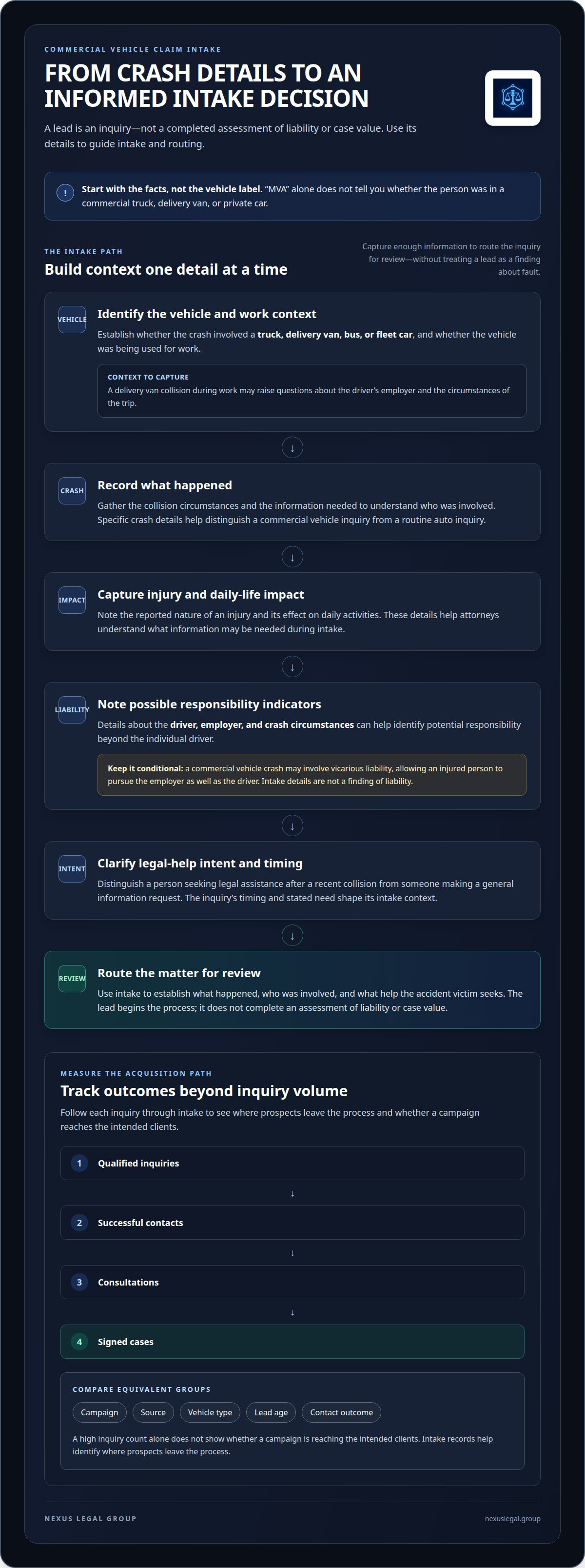
Evaluate lead quality and conversion by tracking each inquiry through intake. Compare qualified inquiries, successful contacts, consultations, and signed cases by campaign and source, then identify where prospects leave the process.
Specific claim details help distinguish a commercial crash from a routine auto inquiry. For example, a collision involving a delivery van during work may raise questions about the driver’s employer and the circumstances of the trip. A commercial vehicle accident may involve vicarious liability, allowing an injured person to pursue the employer as well as the driver.
- Vehicle and work context: Identify whether the vehicle was a truck, delivery van, bus, or fleet car, and whether it was being used for work.
- Injury and impact: The reported nature of an injury and its effect on daily activities can shape the information attorneys need during intake.
- Liability indicators: Details about the driver, employer, and crash circumstances can help identify potential responsibility beyond the individual driver.
- Intent and timing: A person asking for legal assistance after a recent collision presents a different intake opportunity from someone submitting a general information request.
Advertising can use these distinctions to make campaign messaging more relevant. A general personal injury ad may attract broad crash inquiries, while messaging about truck or fleet collisions can set clearer expectations about the cases sought. The form should capture enough detail to route an inquiry accurately, without presenting an ad as a finding about fault or claim value.
Conversion data is most useful when firms compare equivalent groups. Separate results by campaign, vehicle type, lead age, and contact outcome. Then measure how many inquiries become qualified conversations and signed cases. A high inquiry count alone doesn’t show whether a campaign reaches the intended clients. Intake records provide evidence for refining the audience, message, and follow-up.
To connect claim characteristics with acquisition strategy, explore commercial vehicle case acquisition as part of a focused personal injury campaign.
Commercial vehicle accident leads
Commercial vehicle accident leads are inquiries from people involved in crashes with vehicles used for business, such as trucks, delivery vans, buses, or fleet cars. For a law firm, each inquiry starts an intake process, not a completed assessment of liability or case value. Staff can establish what happened, who was involved, and what help the accident victim seeks before routing the matter for review.
Yes. Firms can organize lead targeting around a state or broader geographic service area. Location helps intake teams route inquiries according to the firm’s practice coverage and where its attorneys handle accident cases.
A recent auto accident inquiry benefits from a consistent intake sequence. First, record the person’s contact details and the collision location. Next, identify the vehicle type and reported injuries. Then clarify whether the vehicle was being used for work and whether the person knows the driver’s employer. These details help staff distinguish a commercial collision from a private-car accident and route the inquiry appropriately.
- Confirm the event: Record the reported crash date, location, and vehicles involved.
- Clarify the commercial connection: Note whether a truck, delivery van, bus, or fleet vehicle was involved and its apparent work use.
- Understand the request: Capture whether the accident victim wants legal assistance and how they prefer to be contacted.
- Route the inquiry: Assign it to the intake team responsible for the relevant geography and case type.
For example, an inquiry about a delivery van collision should retain the vehicle context and crash location in the intake record. If either detail is missing, staff can follow up before routing the matter. A consistent record lets the firm distinguish inquiries by geographic fit, vehicle category, and outcome, rather than treating every auto accident lead alike.
Campaign performance should connect acquisition data to intake results. Track whether each inquiry was reached, qualified for further review, scheduled for consultation, or advanced to a signed case. Reviewing these stages by location and vehicle type can show where the process loses potential clients. It also helps the law firm refine geographic targeting and direct intake attention according to practice priorities.
Definition of truck accident leads
A truck accident lead is an inquiry or record connected to someone involved in a truck collision, offered for possible review by an injury lawyer. It may include contact information, crash details, or a request for legal assistance. A lead is not a signed case: the person’s circumstances and the lawyer’s review determine whether representation follows.
For injury law intake, a lead starts a process rather than completing one. Staff can identify the reported injury, collision location, vehicles involved, and whether the person wants to speak with a lawyer. For example, an inquiry about a delivery truck crash may need different follow-up from a private-car accident case.
Truck accident leads can come from advertising inquiries or accident-related information sources. The amount of detail varies. A form response might record the person’s description of the collision, while a report-related lead may include information associated with an accident report. In either case, the intake team must distinguish reported facts from conclusions about fault or case value.
A practical review can follow these steps:
- Classify the incident: Record whether the reported vehicle was a tractor-trailer, delivery truck, or another commercial vehicle.
- Capture the injury inquiry: Note the person’s stated injuries and request for legal help without treating either as an established finding.
- Clarify the work connection: Record any available information about the driver’s employer or the vehicle’s business use.
- Document the outcome: Track whether the inquiry was reached, assessed further, declined, or became a signed case.
A lead and a signed case represent different stages. A lead signals a potential client or relevant accident information; a signed case follows the person’s decision to retain a lawyer and the firm’s acceptance of the matter. Assess campaigns through intake outcomes, not inquiry volume alone.
For example, if someone reports an injury after a truck collision but provides no details about the vehicle or employer, intake can clarify those points before routing the inquiry. If the person seeks help and the information fits the firm’s practice, the lawyer can assess next steps. This structured path connects advertising, accident information, injury law intake, and case review without promising a particular legal result.
Which lead providers specialize in commercial truck accident cases?
Providers focused on truck accident cases generally use truck-specific advertising, broader personal injury campaigns with truck filters, or accident-record-based sourcing. Each approach can produce different information. An advertising inquiry may capture a person’s stated need, while record-based sourcing may connect a lead with crash details. To assess specialization, see how the provider distinguishes truck cases from general auto accident inquiries and what information each lead includes.
Specialization also depends on how inquiries are categorized and routed. A provider serving firms that handle tractor-trailer collisions should distinguish those incidents from delivery van or private-car crashes. Firms can assess whether intake data captures vehicle type, collision circumstances, reported injuries, and the person’s request for legal assistance. These details help determine whether an inquiry fits the firm’s case criteria and the appropriate intake workflow.
Source and delivery model matter, too. A truck-focused advertising campaign, a shared inquiry, and a record-generated lead are not interchangeable. Compare what each lead contains, when the information was collected, and whether other firms receive the same inquiry. For example, a record identifying a truck and describing the collision gives intake staff a different starting point from a general request mentioning only an auto accident.
- Truck-focused advertisers: Generate inquiries through messaging aimed at people seeking help after truck collisions.
- Broad personal injury marketers: Run wider accident campaigns and classify truck inquiries within a larger lead pool.
- Record-based sources: Use accident-related records to develop leads with associated crash information.
Evaluate lead sources through intake outcomes. Group results by source, vehicle category, and geographic fit, then track each inquiry through contact, qualification, consultation, and signed-case stages. This shows whether a source produces relevant conversations, rather than simply a high volume of names. Firms can compare how well inquiries fit their service footprint and case criteria, then refine their acquisition approach.
Before adopting a lead source, define what makes an inquiry usable for your workflow. Specify the vehicle details, contact information, source context, and delivery format your intake process needs. Then compare those criteria with sample lead records and subsequent outcomes. Clear standards distinguish specialized truck accident inquiries from general accident cases and support consistent follow-up across the firm.
Nexus Legal Group: Reverse Append MVA Leads To Obtain Accident Reports and Details of those involved
Nexus Legal Group supports law firms seeking structured motor vehicle accident case acquisition, including inquiries connected to commercial crashes. Its services include reverse append MVA leads to obtain accident reports and details of those involved. This approach can give firms accident-related information for intake and help them assess whether an inquiry fits their practice.
Reverse append MVA leads connect accident information with details about people involved, creating a more useful starting point for case review. Police Report Generated MVA Leads provide another acquisition path centered on police reports. These offerings suit firms seeking accident-related context alongside prospective client inquiries, rather than relying on a general description alone.
For firms focused on high-intent inquiries, High-Intent MVA Case Acquisition supports the goal of reaching people seeking assistance after a motor vehicle accident. Automated Verification adds a verification step to the process. Together, these services address distinct parts of the acquisition workflow, from accident information and lead development to verification.
- Accident information: Reverse append MVA leads are designed to obtain accident reports and details of those involved.
- Police report sourcing: Police report generated MVA leads center on accident information associated with police reports.
- Case acquisition: High-Intent MVA Case Acquisition focuses on MVA inquiries aligned with legal case acquisition.
- Verification: Automated Verification supports a more structured lead review process.
These offerings can help firms create a more organized path from accident information to intake review. For example, a firm evaluating a reported truck collision can use relevant accident details to guide its initial intake assessment. The lead itself does not establish liability or determine whether a case should be accepted; it provides information for the firm’s own evaluation.
Choose an acquisition approach by starting with your firm’s workflow. Consider whether the priority is obtaining accident reports, developing details about involved parties, identifying high-intent MVA inquiries, or adding automated verification. Matching that need to the appropriate service connects acquisition activity with intake and case-review priorities.
Contact Nexus Legal Group to discuss MVA case acquisition for your firm.
Build a More Deliberate Acquisition Strategy
Align your acquisition process with the cases your firm is equipped to evaluate. Define what makes an inquiry relevant, decide how intake will assess it, and track outcomes consistently to guide future campaign decisions. This structure helps your team assess commercial vehicle accident leads against actual practice priorities, rather than relying on volume alone.
Nexus Legal Group’s High-Intent MVA Case Acquisition, Police Report Generated MVA Leads, and Automated Verification support different parts of this process. The right combination depends on the information your intake workflow needs and how your firm reviews incoming matters. A focused discussion of those priorities can help clarify the next decision.
With a defined process and aligned acquisition strategy, your team can move forward with greater clarity.
Frequently Asked Questions
How Much do Auto Accident Leads Cost?
Pricing depends on the case and is provided after a quote request. Cost factors include lead source, accident information provided, whether the inquiry is exclusive or shared, and the verification involved. For planning, compare acquisition expense with intake workload and outcomes such as qualified conversations and signed cases. A lead’s price alone doesn’t show how well it fits your firm’s workflow or case criteria.
How do attorneys get MVA leads?
Attorneys get MVA leads through advertising campaigns and accident-related information programs. A firm may run a campaign for people seeking help after a collision or use police report and emergency services data in lead generation. The source affects what information accompanies an inquiry. Tracking each source through intake helps firms assess which channels produce inquiries aligned with their case criteria and practice priorities.
Is buying MVA leads worth it?
Buying MVA leads may be worthwhile when the inquiries align with a firm’s practice and acquisition goals. Assess the full process, including lead expense, intake time, qualification outcomes, and signed cases. For example, a source may generate frequent inquiries that fall outside the firm’s focus. Comparing outcomes by source helps firms decide whether to continue, adjust, or change an acquisition approach.
What are commercial vehicle accident leads?
For intake teams, the practical value of a commercial crash inquiry often depends on how clearly it can be matched to the firm’s review process. Record the source, the person’s preferred contact method, and any follow-up already completed. For example, if a prospective client calls after submitting a form, staff can connect both interactions in one record instead of treating them as separate opportunities.
How much do leads for commercial vehicle crashes cost?
Pricing depends on the case and is provided after a quote request. Factors include lead source, accident details supplied, delivery model, and verification. Firms can also account for the internal resources needed to process and qualify an inquiry. Comparing these factors with intake outcomes offers a more useful planning basis than treating every lead as equivalent.
Where can businesses buy leads for commercial vehicle crashes?
Law firms can obtain these leads from providers focused on motor vehicle accident case acquisition. Nexus Legal Group offers High-Intent MVA Case Acquisition, Police Report Generated MVA Leads, and Emergency Services Generated MVA Leads. Its services also include reverse append MVA leads to obtain accident reports and details of those involved. Firms can align their acquisition approach with the information their intake process uses.
How are commercial vehicle accident leads generated and verified?
Commercial vehicle accident leads may come from advertising inquiries or accident-related sources, including police reports and emergency services data. Reverse append technology can help obtain accident reports and details about people involved. Nexus Legal Group also offers Automated Verification. These methods support lead review, while the firm’s intake process assesses whether an inquiry fits its practice and merits further evaluation.
What is the difference between exclusive and shared accident leads?
An exclusive accident lead is provided to one law firm, while a shared lead is distributed to multiple firms. This difference affects how many firms may pursue the same inquiry and how intake teams manage follow-up. For example, staff handling a shared inquiry may need to establish whether the person has already spoken with another firm. Compare distribution terms alongside the source and case fit.