Martindale-Nolo Alternatives: Moving from Directory Listings to High-Intent Case Acquisition
Tired of junk leads from directories? Explore Martindale-Nolo alternatives that use data-driven methods to deliver exclusive, litigation-ready cases to your ...
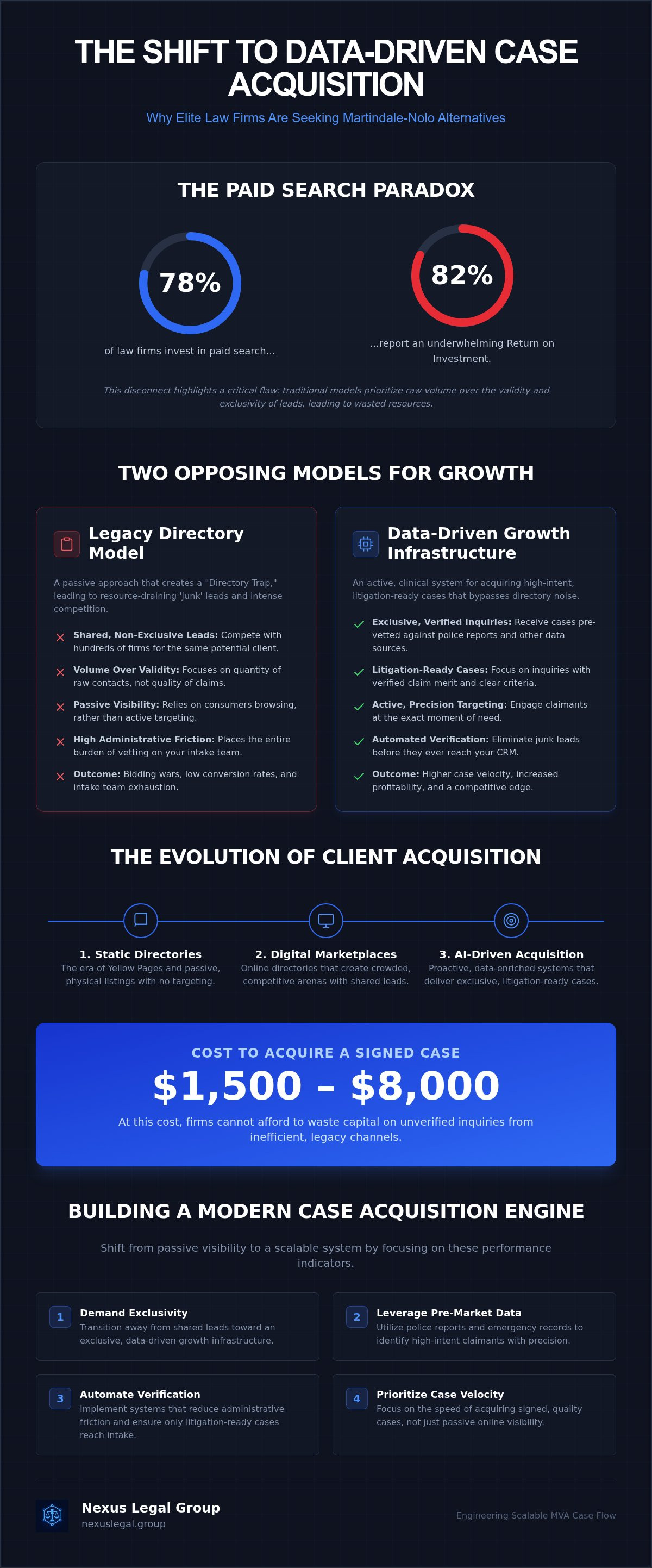
While 78% of law firms invest in paid search, a staggering 82% report that their return on investment is underwhelming. This disconnect often stems from a reliance on legacy directory models that prioritize volume over validity. If you're currently vetting Martindale-Nolo alternatives, you've likely realized that paying for shared, non-exclusive leads is a race to the bottom that exhausts your intake team. You're looking for more than just a name on a list. You need a system that delivers litigation-ready inquiries without the administrative friction of junk leads.
We understand the frustration of trying to scale a firm when your primary lead source lacks exclusivity and precision. This guide explains why elite plaintiff firms are abandoning the directory model in favor of data-driven growth infrastructure. You'll discover how to secure high-intent MVA and mass tort cases through automated verification and police-report-driven data. We will examine the shift from passive visibility to active, clinical case acquisition that ensures your firm remains competitive in a 2026 legal market.
Key Takeaways
- Understand why legacy directory models often lead to resource-draining 'junk' leads and how to transition toward exclusive, data-driven growth infrastructure.
- Learn how to leverage police report data and emergency services records to identify high-intent MVA claimants with clinical precision before they enter the broader market.
- Discover the role of automated verification systems in reducing administrative friction and ensuring only litigation-ready cases reach your intake department.
- Identify the critical performance indicators you should prioritize when evaluating Martindale-Nolo alternatives to focus on case velocity rather than simple visibility.
- Explore the strategic shift from passive directory presence to a scalable, end-to-end acquisition engine that prioritizes the delivery of ethical and compliant signed cases.
Beyond the Directory: Why Elite Firms Seek Martindale-Nolo Alternatives
Elite plaintiff firms are realizing that broad visibility within a crowded marketplace is no longer a viable growth strategy. The legacy directory model creates a "Directory Trap," where your firm is merely one profile among hundreds, competing for the same diluted attention. This structure forces a passive reliance on consumer browsing habits rather than active, precision-based targeting. As organizations seek Martindale-Nolo alternatives, they're moving toward growth infrastructure that prioritizes high-intent case acquisition over simple directory presence.
There's a critical distinction between a standard "legal lead" and a "litigation-ready inquiry." A directory lead is often a raw contact with no verification of the underlying claim's merit. In contrast, a litigation-ready inquiry is enriched with data, such as police report information or emergency services records, ensuring the claim meets specific criteria before it reaches your desk. Modern legal technology has rendered the broad-spectrum approach of directories inefficient for firms that value operational velocity and clinical precision in their intake process.
For decades, Martindale-Hubbell has functioned as a cornerstone for peer-rated credentials and professional visibility. While these directories serve a purpose for B2B referrals and establishing authority, they lack the technical infrastructure to drive high-volume, exclusive MVA or mass tort case flow. Sophisticated firms are now building internal systems or partnering with providers that offer end-to-end acquisition engines, bypassing the noise of legacy platforms to secure claimants who are ready to sign.
The Evolution of Legal Lead Generation in 2026
The legal marketing landscape has transitioned from the static Yellow Pages to digital directories, and now to AI-driven acquisition engines. In 2026, consumer behavior favors direct, high-intent engagement over the friction of directory browsing. Firms that continue to rely on manual intake to vet low-quality leads from broad marketplaces are facing an unsustainable increase in administrative overhead. The goal is no longer just to be seen; it's to be connected to a claimant at the exact moment of need with all relevant data already attached.
Identifying the Limitations of Legacy Marketplaces
Legacy marketplaces frequently distribute shared leads, which inevitably leads to bidding wars and consumer frustration. When multiple firms contact the same individual, the signal-to-noise ratio collapses, and conversion rates plummet. These platforms also suffer from a lack of data enrichment. Receiving a name and phone number without accident details or verified injury status places the entire burden of vetting on your firm. This administrative friction is the primary reason elite firms are pivoting toward exclusive, data-verified acquisition models that eliminate the "junk" before it hits the CRM.
Mechanical Precision: The Architecture of High-Intent Case Acquisition
Elite law firms don't wait for claimants to discover them in a sea of generic profiles. They utilize AI-driven marketing to identify high-intent individuals before they ever touch a digital directory. This proactive approach is a hallmark of sophisticated Martindale-Nolo alternatives. By the time a user begins browsing a list, they've often already been engaged by firms using a predictable client acquisition framework that prioritizes speed and data accuracy. When the cost to acquire a signed case through traditional digital channels ranges between $1,500 and $8,000, firms cannot afford to waste resources on unverified inquiries. These systems don't just generate traffic; they engineer outcomes by applying clinical precision to the intake funnel.
Data enrichment is the catalyst that transforms a raw contact into a qualified inquiry. It replaces the ambiguity of self-reported information with verified, institutional data. This architecture ensures that every case is vetted for ethical compliance and litigation readiness before it reaches your intake team. By removing the guesswork inherent in legacy models, firms can focus their energy on high-value litigation rather than administrative sorting. This shift toward systemic integrity is what separates market leaders from those trapped in the directory cycle.
Data Enrichment via Police and Emergency Services Reports
Real-time incident data provides a strategic advantage that static directory listings cannot match. By tapping into emergency services records, firms can identify motor vehicle accidents as they occur. Reverse append technology is a method to match fragmented data with official records. This process enriches a simple contact name with critical accident details, allowing for a more informed initial consultation and a higher probability of a signed retainer. Leveraging this data ensures your firm is pursuing cases with documented impact and clear liability.
The Role of Automated Legal Intake Verification
Automated intake verification is the foundational layer of a modern growth infrastructure. AI filters inquiries against pre-defined litigation parameters, such as the statute of limitations or specific injury thresholds, in seconds. Transitioning to Martindale-Nolo alternatives that offer automated verification allows firms to scale without a corresponding increase in headcount. This rigorous vetting process ensures that your team only spends time on ethical and compliant signed cases. Integrating this verified data directly into your firm's existing workflow creates a seamless transition from inquiry to adjudication, maximizing the efficiency of every administrative resource.
Directories vs. Growth Infrastructure: A Strategic Comparison
Choosing between traditional legal directories and modern acquisition systems requires a fundamental shift in how you view firm expansion. While legacy platforms focus on passive visibility, Martindale-Nolo alternatives are increasingly defined as growth infrastructure. This distinction is critical; a directory is a destination where you wait for a claimant to find you, whereas infrastructure is an active mechanism designed to capture and verify intent. The hidden costs of "cheap" directory leads often manifest in the hundreds of hours your intake team spends chasing unverified, shared contacts who have already been called by three other firms.
Scalability in a directory model is inherently limited by the platform's fixed traffic and the number of competitors sharing that space. In contrast, a data-driven infrastructure model compounds in value. By refining your acquisition parameters and leveraging proprietary data channels, your firm creates a predictable flow of cases that doesn't plateau. This systematic approach prioritizes velocity, reducing the time between the initial inquiry and the signed retainer by providing all necessary case data upfront.
Exclusivity as a Growth Multiplier
Exclusivity is the primary foundation of high-intent acquisition. When a claimant is shared among multiple firms, the resulting bidding war creates a poor consumer experience and dilutes your firm's brand authority. By securing exclusive inquiries, you gain a psychological advantage, positioned as the singular solution to the claimant's problem. This direct connection is a core component of a sophisticated Law Firm Growth Infrastructure, ensuring that your marketing spend isn't subsidizing a competitor's intake efforts. Exclusive inquiries consistently yield higher conversion rates because they eliminate the friction of multi-firm competition.
Litigation-Ready Inquiries vs. Raw Contact Data
The depth of data provided in an inquiry determines the efficiency of your entire intake department. A standard directory lead often provides nothing more than a name and a phone number, leaving your team to perform the heavy lifting of verification. Litigation-ready inquiries, however, arrive with enriched data points such as verified accident dates, injury severity, and police report confirmation. This "conversion-readiness" means your intake specialists spend less time qualifying and more time signing. When evaluating Martindale-Nolo alternatives, the metric of success should not be the volume of contacts, but the percentage of inquiries that arrive ready for immediate adjudication.
Strategic Evaluation: How to Vet a High-Performance Lead Provider
Vetting Martindale-Nolo alternatives requires a departure from vanity metrics like cost-per-click or simple profile views. You're auditing a technical system, not just buying a listing. A high-performance provider must demonstrate how their data is sourced, verified, and delivered without manual intervention from your team. If a provider cannot explain the mechanics of their data enrichment process, they likely aren't offering the clinical precision required by elite plaintiff firms. You need to look under the hood of their acquisition engine to ensure it aligns with your firm's operational standards.
Integration capabilities are equally vital for maintaining a well-oiled growth machine. Your acquisition engine shouldn't exist in a silo; it must integrate seamlessly with your CRM or case management system. This connectivity ensures that verified data flows directly into your litigation workflow, reducing friction and accelerating the time-to-sign. Systems that require manual data entry or provide fragmented information are simply legacy tools rebranded for a modern market. True growth infrastructure eliminates these bottlenecks by automating the path from inquiry to adjudication.
Key Metrics for Elite Plaintiff Firms
Cost-per-signed-case is the only metric that truly reflects the health of your acquisition engine. While Google Ads benchmarks for signed cases in 2026 range from $1,500 to $8,000, your actual ROI depends on your internal intake efficiency. You should measure how many hours your staff spends per qualified inquiry. If your team is stuck in a cycle of vetting unverified contacts from Martindale-Nolo alternatives, the administrative overhead is quietly eroding your margins. High-intent inquiries should result in higher retention rates, as claimants are already verified and ready to proceed with litigation.
Assessing Ethical and Regulatory Compliance
Compliance isn't optional; it's a foundational requirement for any sophisticated practice. With the implementation of California Senate Bill 37 in 2026, attorney advertising regulations have become significantly more stringent, carrying penalties up to $100,000 per unique advertisement for misleading claims. You must verify that your provider's methods align with these updated standards and specific state bar rules. Ask specific questions about their consent mechanisms and data sourcing to ensure every signed case is ethically obtained. For a deeper look at these requirements, review our guide on Compliant Legal Lead Generation.
Nexus Legal Group: Engineering Scalable MVA Case Flow
Nexus Legal Group provides the foundational growth layer for sophisticated law firms that have outgrown the limitations of legacy directories. While you're evaluating Martindale-Nolo alternatives, it's clear that your firm requires more than just a higher volume of traffic; you need a system that engineers predictable outcomes. We've replaced the passive, shared-lead model with a high-performance engine that identifies and verifies high-intent claimants before they ever reach a public marketplace. This approach moves your firm from a position of visibility to one of systemic dominance, ensuring your intake team focuses exclusively on litigation-ready cases.
Our infrastructure is designed to eliminate the friction that typically plagues the path from inquiry to signed retainer. By positioning our technology as an integrated part of your business expansion strategy, we provide a clinical level of precision that general marketing agencies cannot match. We don't just generate interest; we deliver ethical and compliant signed cases through a process rooted in technical mastery and operational excellence. It's about building a sustainable case flow that compounds in value as your firm scales.
The Nexus Infrastructure Model
We combine AI precision with clinical intake verification to ensure every case meets your firm's specific litigation criteria. This end-to-end approach utilizes police report generated MVA leads and emergency services data to identify incidents with documented liability in real time. Our reverse append technology enriches these leads by obtaining accident reports and the specific details of those involved automatically. This ensures that the inquiries you receive aren't just names on a list, but high-intent opportunities backed by institutional data. Elite firms choose this model because it prioritizes exclusivity and data integrity over the noisy, unverified environment of traditional directories.
Next Steps for Firm Partners
Transitioning from a directory-dependent model to a scalable infrastructure begins with an audit of your current conversion gaps. If your intake specialists are spending the majority of their day vetting unverified contacts, your current system is inefficient. You should evaluate your current cost-per-signed-case against the operational velocity offered by a data-driven acquisition engine. Moving toward Martindale-Nolo alternatives that offer automated verification allows your firm to scale without increasing administrative overhead. It's time to replace legacy tools with a powerful engine that drives growth from behind the scenes.
Transitioning to High-Performance Acquisition Infrastructure
Moving your firm beyond the limitations of legacy directories requires a commitment to technical precision and operational efficiency. You've seen how the shift toward data-driven growth infrastructure allows elite practices to bypass the "Directory Trap" and secure exclusive cases with documented liability. By integrating real-time incident data from police reports and emergency services, you ensure your intake team handles only litigation-ready inquiries. This eliminates the noise of unverified leads and focuses your resources on high-value adjudication.
This systemic approach to high-intent case acquisition is the hallmark of the most effective Martindale-Nolo alternatives. It replaces the administrative burden of vetting unverified leads with a streamlined, automated path to signed cases. Adopting this model isn't just about increasing call volume; it's about engineering a predictable flow of MVA and mass tort opportunities that scale alongside your firm's long-term ambitions. By prioritizing AI-driven marketing precision and verified data, you position your firm as a leader in the competitive 2026 legal market.
Your firm's expansion is a matter of mechanical precision, and the right infrastructure is the engine that will drive your next stage of growth. We look forward to helping you build a more efficient and scalable practice.
Frequently Asked Questions
What are the best alternatives to Martindale-Nolo for personal injury firms?
The most effective Martindale-Nolo alternatives are those that replace passive directory listings with active acquisition engines. These systems utilize AI-driven precision and data enrichment to connect firms with claimants at the moment of incident. Unlike legacy marketplaces, high-performance alternatives focus on delivering exclusive, litigation-ready inquiries that integrate directly into your firm's growth infrastructure. This shift ensures that your marketing budget is spent on high-intent cases rather than diluted visibility among hundreds of competitors.
How do high-intent MVA leads differ from standard directory leads?
High-intent MVA inquiries are captured through behavioral triggers and real-time incident data rather than passive browsing. Standard directory leads often originate from users researching general legal topics, which creates a lower signal-to-noise ratio. High-intent inquiries arrive with verified accident details and documented liability, ensuring the claimant is ready to sign. This mechanical precision reduces the time your intake team spends qualifying raw contacts who may not have a viable case.
Is it better to buy shared leads or exclusive inquiries for a plaintiff firm?
Exclusive inquiries are the superior choice because they eliminate the bidding wars and consumer fatigue associated with shared leads. When multiple firms contact the same individual, conversion rates plummet and brand authority is diluted. Exclusivity ensures that your firm is the singular point of contact, protecting your intake resources and improving the claimant's experience. This model is a foundational requirement for any firm looking to scale their case flow with clinical efficiency.
What is automated intake verification and why does it matter for case acquisition?
Automated intake verification is a technological filter that vets inquiries against specific litigation parameters, such as injury severity or statute of limitations, before they reach your staff. This matters because it eliminates the administrative friction of manually sorting through junk leads. By automating the qualification process, your team only engages with inquiries that meet your firm's exact criteria. This system ensures that your operational overhead remains low while your case velocity increases.
Are Martindale-Nolo alternatives compliant with state bar ethics rules?
Compliance is a primary requirement for any sophisticated acquisition system. Reputable Martindale-Nolo alternatives build their engines around state bar ethics rules and federal regulations like the TCPA. It's critical to ensure your provider adheres to the latest standards, such as California’s SB 37, which requires clear office location disclosures. Ethical providers use transparent consent mechanisms to ensure every inquiry is obtained through compliant and professional advertising practices that protect your firm's reputation.
How does police report data improve the quality of motor vehicle accident leads?
Police report data provides institutional verification of an incident's severity and liability, replacing the ambiguity of a claimant's self-reported narrative. Firms receive enriched data points confirmed by official emergency services records, allowing for immediate case valuation. This accuracy ensures that your firm is pursuing cases with documented impact and clear liability. Leveraging this data allows for a more strategic initial consultation and a significantly higher probability of a signed retainer.
What should I look for in a legal growth infrastructure provider?
You should prioritize providers that offer proprietary data sourcing, automated verification, and end-to-end CRM integration. A high-performance partner must demonstrate how they identify intent and filter inquiries with clinical precision. Look for a system that focuses on cost-per-signed-case rather than simple lead volume. The provider should function as a foundational growth layer for your firm, offering a predictable and scalable flow of exclusive, litigation-ready inquiries without increasing your administrative burden.
Can I integrate high-intent case acquisition systems with my existing legal CRM?
Yes, modern acquisition systems are designed for seamless integration with standard legal CRMs through secure API connectivity. This ensures that verified inquiries flow directly into your intake pipeline without the need for manual data entry. Automation at this stage is essential for maintaining case velocity and reducing operational bottlenecks. By connecting your acquisition engine to your existing workflow, you create a well-oiled machine that moves claimants from the initial inquiry to a signed case efficiently.