Guide to Effective Nonprofit Wellbeing Outreach

Learn how nonprofit wellbeing outreach connects communities to therapy, crisis care, and case management through partnerships, referrals, and communication.
What happens after someone asks for help at a community event? Effective nonprofit wellbeing outreach turns that first connection into a clear path to support, linking people with local organizations that can coordinate therapy, crisis intervention, and case management. A single organization rarely meets every need, so the strength of outreach depends on how well partners connect their services.
It makes sense to focus on awareness, but a flyer or event is only one part of the process. People also need to understand what support is available and how to take the next step. This guide explains how local wellness partnerships can make those connections more practical and accessible.
Learn how to identify complementary partners, coordinate referrals, and shape outreach around community needs. The guide also covers ways to make events and communications useful beyond the moment, helping people move from finding information to connecting with relevant support.
Key Takeaways
- Coordinate families, schools, and health organizations so community outreach can connect people with relevant support.
- Use shared events and clear communications to build mental health awareness and reduce stigma.
- Make pathways to therapy, crisis intervention, and case management easier to understand and access.
- Understand how mental health needs affect individuals and communities, and why accessible support matters.
- For plaintiff law firms seeking motor vehicle accident inquiries, explore how case acquisition and automated verification can support intake workflows.
Partnerships among Local Wellness Organizations
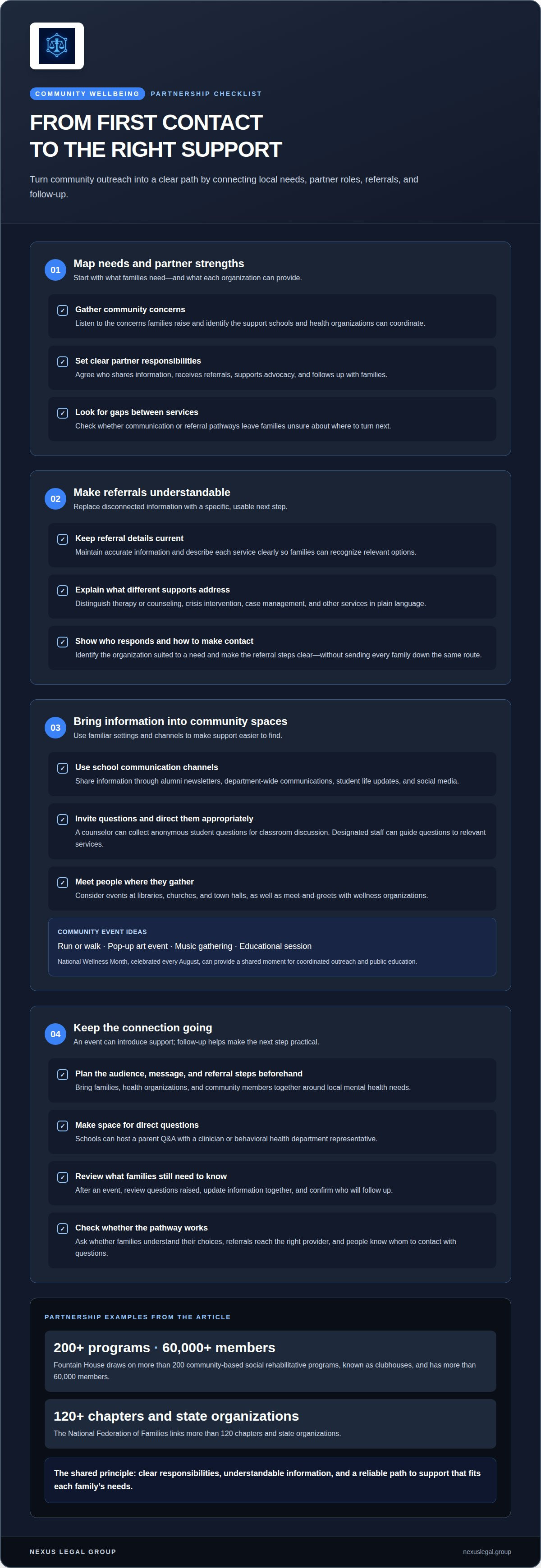
Wellness partnerships turn community needs into practical routes to support. A nonprofit wellbeing outreach plan can start by mapping the concerns families raise, the services schools can provide, and the care health organizations coordinate. Partners then define who shares information, receives referrals, and supports advocacy. For example, a school can host a mental health information session while a community organization explains available services and helps families identify a relevant next step.
Fountain House demonstrates how a network can extend community-based support. It draws on more than 200 community-based social rehabilitative programs, known as clubhouses, and has more than 60,000 members. Local organizations can apply the same partnership principle without copying one model: connect community groups, schools, families, and health organizations around clear responsibilities. Shared planning can help members find activities and support that suit their needs, while partners can identify gaps in communication or referral pathways.
Family-focused organizations can also connect people with appropriate providers. The National Federation of Families links more than 120 chapters and state organizations. Local partners can make those connections useful by maintaining current referral information, describing each service clearly, and assigning follow-up responsibilities. Families facing uncertainty can then move from a general conversation toward a specific support pathway, rather than receiving disconnected names or information.
Schools offer a practical setting for awareness and stigma reduction. A counselor can collect anonymous student questions and address them in classroom discussions. Schools can also share mental health information through alumni newsletters, department-wide communications, student life updates, and social media. These channels give students and families several ways to find useful information. Designated staff can direct questions to relevant support and clarify which services address educational, counseling, or other needs.
Joint events can extend partnerships beyond school settings. Community organizations can host meet-and-greets with mental health and wellness organizations or hold educational events at libraries, churches, and town halls. Partners can organize a run, walk, pop-up art event, or music gathering to build awareness and invite participation. National Wellness Month, celebrated every August, gives partners a shared calendar moment to coordinate outreach and public education.
To make nonprofit wellbeing outreach useful beyond an event, partners can agree on the audience, message, and referral steps beforehand. They can invite families, health organizations, and community members to advocacy activities focused on local mental health needs. Schools can host a parent question-and-answer chat with a clinician or behavioral health department representative. Afterward, partners can review questions raised and update information, strengthening access to care, recovery support, and future collaboration.
Community outreach initiatives serve as an occasion for partners to make their roles visible and help families understand how to seek support. Open Arms Initiative works with other nonprofits and community organizations to connect families with appropriate providers. Partners can put this approach into practice by explaining referral steps clearly, identifying which organization can respond to a particular need, and showing families how to make contact. When partners share this information consistently, someone who first encounters support at a school, community event, or nonprofit can be guided toward an appropriate provider instead of having to work out the next step alone. The aim is not to send every family through the same route, but to make relevant options easier to recognize and access. Partners can also agree on how to keep these connections useful over time. They can review whether families understand their choices, whether referrals reach the right provider, and whether people know whom to contact with questions. If information is unclear, organizations can revise their explanations together and identify who will follow up. Schools and community groups can share general guidance while respecting families’ circumstances and directing individual questions to appropriate providers. An event can introduce services, but a clear way to continue the conversation helps turn awareness into a practical connection. Coordinated communication and follow-up can reduce conflicting directions and prevent families from having to repeat their concerns to multiple partners. Strong partnerships rely on these everyday practices: clear responsibilities, understandable information, and a reliable path from an initial conversation to support that fits each family’s needs.
Mental Health
The Centers for Disease Control and Prevention estimates that 1 in 5 adults in the United States will experience mental illness annually. That scale makes mental health an ongoing community concern, not a specialized issue affecting only a small group. Nonprofit planning can respond by making information understandable and routes to care easier to identify.
The World Health Organization estimates that anxiety and depression cost the global economy $1 trillion annually in lost productivity. For local organizations, this underscores why mental health support intersects with daily life, employment, education, and family responsibilities. Outreach can address these connections without reducing a person’s experience to a workplace or economic outcome.
Access involves more than knowing that care exists. High deductibles, limited insurance coverage, and long waitlists can make mental health care difficult to reach. Useful outreach identifies these practical barriers and explains available pathways in clear language. For example, a community nonprofit can distinguish counseling, crisis intervention, and case management so people understand the different forms of support.
Referral design matters. Organizations can maintain a current directory of services, describe each service’s role, and designate a staff member to guide referrals. A warm handoff, such as helping someone connect with an intake team, makes the next step more concrete than sharing a phone number alone. Explain what information a person may need to provide.
Recovery support should reflect different needs and preferences. Some people seek individual therapy, while others benefit from peer connection or help coordinating housing, work, and care. Nonprofits can explain these options without suggesting one route suits everyone. Clear descriptions help people choose a next step that matches their immediate concern and longer-term goals.
For crisis intervention, outreach materials should make the intended route unmistakable. Separate urgent crisis guidance from general appointment information, and use plain language to explain where each path leads. Staff and community partners can rehearse referral procedures so they know who receives a concern and what follow-up involves. This helps prevent confusion during stressful conversations.
Finally, use feedback to improve access. After an information session or referral, organizations can ask whether the instructions were clear and whether the person reached the next service. Review recurring obstacles with families, schools, and health organizations. This practical feedback helps nonprofits refine communication, strengthen advocacy, and make mental health support easier to navigate.
Feedback can be made useful by asking whether a person could identify the next step, what made it difficult to take, and what kind of follow-up would feel appropriate. Responses should be reviewed for recurring obstacles, while protecting privacy and avoiding pressure to disclose personal details. One-in-five Americans experienced a mental health episode in 2020. In the United States, 4.9 million people who sought mental health help were unable to access services. These figures reinforce the value of pairing clear information with practical navigation: a referral should include a manageable action, an explanation of what to expect, and a way to ask for help if the route fails. Outreach should also make room for trusted community settings and family support, rather than assuming that everyone will begin with a formal provider.
The Confess Project of America has trained 1,900 barbers to provide mental health advocacy. The Alcott Center for Mental Health Services has provided community mental health services since 1979. The Youth Mental Health Project educates, empowers, and supports families and communities in understanding and caring for youth mental health. Since its start in 2006, To Write Love on Her Arms has donated more than $3 million directly to mental health treatment and recovery. These examples point to several ways nonprofit work can meet people where they are: through trusted relationships, community services, family education, and support connected to treatment and recovery. Organizations can consider which local partners already have relationships with people who may hesitate to approach a clinic, then agree on simple referral steps and boundaries. They can also check that outreach materials are welcoming, accessible, and specific about what happens after someone asks for help. Ongoing review can distinguish a resource that is merely listed from a pathway people can actually use, and guide adjustments when participants say the instructions or handoff were not clear.
Nexus Legal Group
Nexus Legal Group serves plaintiff law firms seeking motor vehicle accident (MVA) case inquiries, not organizations coordinating mental health care. Nonprofit wellbeing outreach connects people with therapy, crisis intervention, and case management; MVA case acquisition addresses a separate legal intake need. Keeping these pathways distinct helps direct people toward support suited to their situation.
For firms focused on MVA matters, High-Intent MVA Case Acquisition supports case acquisition through relevant inquiries. Police Report Generated MVA Leads connect lead generation with police reports, while Emergency Services Generated MVA Leads provide another MVA-focused source. These offerings suit firms looking to find and assess potential accident cases, rather than build community wellness partnerships.
Automated Verification supports intake by verifying inquiries. In a firm’s workflow, it can provide a structured point to assess lead information before the next intake step. Its value depends on the firm’s case criteria and how it handles incoming inquiries. This is distinct from mental health screening or clinical assessment.
Start with the need at hand. For local mental health education, stigma reduction, or connecting families with care, community organizations and health providers are the relevant partners. For a plaintiff law firm seeking MVA case acquisition, Nexus Legal Group’s offerings address that separate objective. This distinction prevents lead generation from being mistaken for treatment, crisis response, or nonprofit outreach infrastructure.
For firms considering an MVA intake workflow, identify the role each offering should support. Police report generated leads and emergency services generated leads are distinct sources; Automated Verification serves a verification function; High-Intent MVA Case Acquisition describes the broader acquisition focus. Clarifying the business need helps determine whether these offerings align with the firm’s intake priorities, without conflating legal inquiries with wellness referrals.
Nexus Legal Group focuses on MVA case acquisition and related lead offerings for plaintiff law firms. It is not a substitute for mental health care or the community partnerships described in this guide. That boundary matters: effective referrals direct each person or organization to the type of support it needs.
To discuss your firm’s MVA case acquisition needs, contact Nexus Legal Group.