Finding Commercial Vehicle Accident Cases: A Law Firm Workflow
Master finding commercial vehicle accident cases with a practical intake workflow. Learn how to qualify incident signals and convert inquiries with clarity.
What if more accident inquiries created less clarity for your intake team? Finding commercial vehicle accident cases is not simply a matter of increasing lead volume. Generic motor vehicle channels may not show whether a commercial vehicle was involved, and an event signal alone does not confirm that an inquiry is complete, relevant, or ready for follow-up.
That distinction matters when intake staff need to assess fit without spending time reconstructing basic incident details. A disciplined workflow separates the initial report or event signal from a verified inquiry and, ultimately, a signed case. Police reports, emergency-services data, reverse append, and automated verification can each contribute, but none guarantees that an inquiry is suitable for your firm.
This article explains how to build a repeatable path from accident signal to qualified inquiry: define your criteria, assess source quality, identify what information supports verification, and route relevant inquiries to trained intake staff with clear context. It also covers what to evaluate before selecting an acquisition partner, so your firm can prioritize useful information over inquiry count alone.
Key Takeaways
- Set a clear case profile around vehicle context, incident details, and your firm’s intake capacity before evaluating inquiry volume.
- Finding commercial vehicle accident cases works best as a defined sequence: identify relevant signals, enrich available details, verify, then route.
- Compare police reports, emergency-services data, and general inbound inquiries by the context they provide and the verification they still require.
- Use a consistent triage checklist for incident context, contactability, duplicates, and stated interest, with human review where automated checks are not enough.
- Assess acquisition partners by source transparency, verification process, deliverable clarity, and fit with your intake workflow.
Finding Commercial Vehicle Accident Cases Starts with a Defined Case Profile
More inquiries do not automatically create a stronger acquisition pipeline. The goal of finding commercial vehicle accident cases is to identify inquiries that match your firm’s criteria, not to maximize volume without regard to relevance, available details, or intake capacity. A written case profile gives staff and acquisition partners a consistent way to assess potential fit before an inquiry moves through the workflow.
Start by clarifying what commercial context your firm wants to identify. A tractor-trailer, delivery van, or other vehicle used for business purposes may be an initial signal, but appearance alone may not establish how the vehicle was being used or who operated it. A foundational overview of the commercial vehicle category can help orient the discussion. Your intake criteria should then specify what information your team needs to assess an inquiry.
Document the profile in operational terms. For example, define:
- Vehicle context: Which vehicle types or business-use details are relevant to your firm?
- Incident information: Which available facts, such as the incident date, location, or report details, help staff decide what to review next?
- Intake capacity: What level of detail can your team review, and how should inquiries be prioritized and routed?
Keep these criteria separate from conclusions about fault, damages, or legal representation. An accident signal may indicate that an event occurred, but it does not establish responsibility, claim value, or whether a firm will represent anyone involved.
What makes a commercial vehicle inquiry relevant to a firm?
A relevant inquiry contains enough information for staff to identify possible commercial vehicle involvement and compare the incident with the firm’s stated criteria. Record incident facts separately from assumptions. A report may identify a vehicle or operator, while responsibility and claim value remain matters for appropriate review. Before sourcing inquiries, document your firm’s case-fit criteria so intake staff can apply them consistently.
A commercial vehicle accident inquiry is a contact or incident record that indicates possible commercial vehicle involvement, not a finding of liability, damages, or case merit.
Why case fit matters more than raw inquiry volume
When targeting is unclear, staff may spend time determining whether an inquiry concerns a commercial vehicle, locating missing context, or deciding where it belongs. More specific source information can give intake staff a clearer starting point for the first conversation. It does not predict whether a matter will be retained or how litigation may proceed; it helps structure the initial review.
Use a Repeatable Workflow to Find Commercial Vehicle Accident Cases
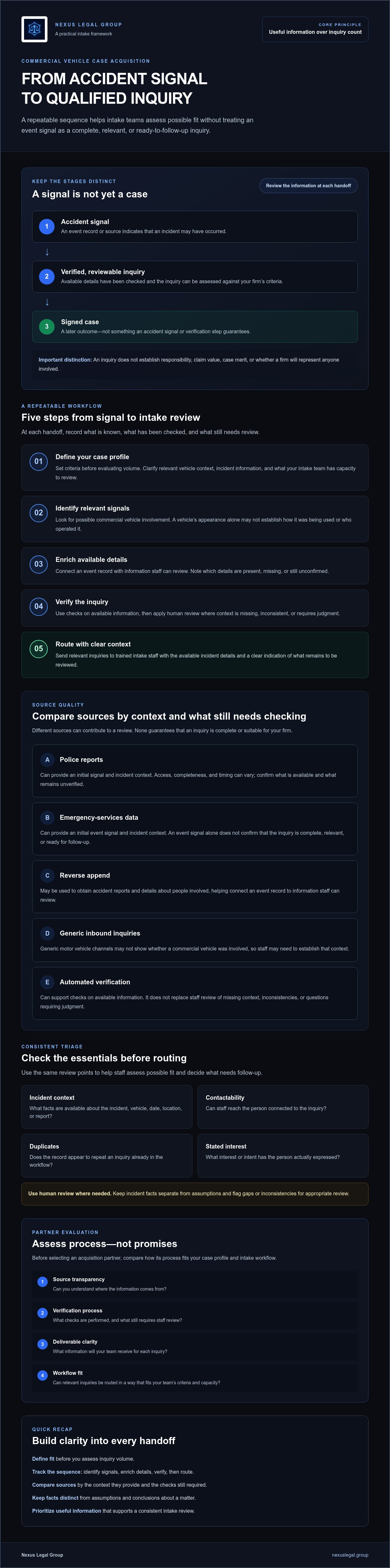
A defined case profile becomes useful when it guides each handoff, from the first accident signal to intake review. Use a consistent sequence: define fit, identify relevant signals, enrich available details, verify the inquiry, then route it according to your firm’s criteria. At each stage, record what is known, what has been checked, and what still needs review.
A commercial vehicle event becomes a reviewable inquiry through a documented sequence of source identification, detail enrichment, verification, and routing. Automated verification can support checks on available information. Staff review is still needed for missing context, inconsistencies, or questions that require judgment. Enrichment adds detail; it does not replace attorney evaluation of a matter.
To understand broader incident categories that may inform a case profile, firms can consult the FMCSA’s commercial vehicle accident statistics. Use such data as context for setting sourcing priorities, not as a substitute for reviewing an individual inquiry.
Move from an accident signal to a reviewable inquiry
Police reports and emergency-services data can provide initial signals and incident context. Reverse append may be used to obtain accident reports and details about people involved, helping connect an event record to information staff can review. Report access, completeness, and timing can vary, however. Confirm what source information is available and what remains unverified before treating an inquiry as ready for intake.
Assign a clear status at each stage, such as signal identified, details enriched, verification completed or pending, and routed for staff review. This makes it less likely that an event record will be mistaken for a qualified inquiry or signed case.
Route verified inquiries into a disciplined intake process
Record the source, available incident details, and verification status with each inquiry. Route it according to documented case-fit criteria, directing uncertain or incomplete records for appropriate staff review rather than treating them as confirmed fits. For additional process guidance, see verified MVA leads for law firms.
This structure also clarifies what an acquisition partner delivers. Nexus Legal Group describes case-acquisition infrastructure that can include police report and emergency-services data, reverse append, and automated verification. Firms assessing that workflow can review Nexus Legal Group’s case-acquisition approach and compare the stated deliverables with their own intake process.
Compare Commercial Vehicle Case-Finding Sources by Context and Verification
Finding commercial vehicle accident cases requires more than identifying a source that mentions a crash. Each source offers a different starting point, and none should be treated as a qualified inquiry without checking what information it actually provides. Use the comparison below to assess incident context, identity details, verification needs, and limitations.
| Source | Potential incident context | Identity detail | Verification needs and limitations |
|---|---|---|---|
| Police reports | May provide information recorded about the crash, vehicles, and involved parties. | May include names or other identifying details, depending on the report. | Confirm access, completeness, and available fields for each source. A report is an event record, not a determination of case merit. |
| Emergency-services data | May indicate an emergency response associated with an incident. | Identity detail can vary by the data available. | Confirm how the data was obtained, what it contains, and whether it can be connected to a reviewable inquiry. |
| General inbound inquiries | May include a person’s own account of the incident and vehicle context. | Contact details are typically supplied with the inquiry, but accuracy still needs checking. | Review the stated information, contactability, duplication, and interest. The account may lack independent incident documentation. |
What police reports and emergency-services data can contribute
These source categories can help establish that an incident was recorded or that emergency services were involved, but the available details are not uniform. A report may contain vehicle or participant information, while emergency-services data may offer a different view of the event. Treat each field as source-dependent, not guaranteed. For a closer look at one acquisition category, see police report generated MVA leads.
Source context also does not establish why a crash happened. The FMCSA’s truck crash causation factors study provides background on crash causation, but it cannot verify the facts of an individual inquiry or determine responsibility. Source categories may overlap, so confirm report access, detail, and availability rather than assuming them.
Questions to ask when comparing an acquisition source
Ask the provider to explain how each source is obtained and exactly what information is delivered. Clarify how identity, duplicate records, and inquiry accuracy are checked, and what verification status means in practice. Request documentation describing consent and permitted data use, then have appropriate reviewers confirm which requirements apply to your firm and the data involved.
Compare the documented process, not just the source label. A report signal, a verified inquiry, and a signed case are different deliverables. Make sure the source and verification details support the handoff your intake team expects.
Verify and Triage Commercial Vehicle Accident Inquiries Before Intake
Verification improves the information available to your team, but it cannot guarantee that an inquiry will be retained or become a case. Treat verification as a quality-control step: it helps distinguish confirmed details from gaps that need follow-up, while intake staff and attorneys make decisions that require human judgment.
Use a consistent checklist before routing an inquiry:
- Incident context: Do the available details appear to describe the same reported event, including the vehicle and incident information?
- Contactability: Are contact details present and usable, or does staff need to confirm them?
- Duplication: Does the record appear to match another inquiry already in the firm’s system?
- Stated interest: Is the person’s interest documented, or does the team need to clarify it?
- Information gaps: What is missing, conflicting, or unconfirmed, and who will follow up?
What to verify before an inquiry reaches an attorney
Check that the available details correspond to one incident rather than combining information from separate records. If a report detail conflicts with the person’s account, record the discrepancy and mark it for review instead of resolving it by assumption. Automated verification can support checks against defined criteria, but it does not establish liability, damages, or claim validity. Keep preliminary data clearly labeled as preliminary.
How to route inquiries without creating intake friction
Assign clear ownership for each status, such as awaiting staff review, follow-up needed, or ready for attorney evaluation. Define escalation criteria for conflicting details or other unresolved questions, and track status so inquiries do not stall between handoffs. Routing rules should reflect your documented case criteria and available staffing capacity. Guidance on automated intake for plaintiff firms can help frame how automation supports, rather than replaces, staff review.
The distinction matters: automated checks can help organize information, staff can review context and contactability, and attorney case evaluation remains a separate step. A verified inquiry is not the same as a retained client. In finding commercial vehicle accident cases, disciplined triage makes the information clearer for the next decision without promising what that decision will be.
For an example of how acquisition capabilities may support this workflow, review Nexus acquisition capabilities.
Select a Commercial Vehicle Case Acquisition Partner by Process, Not Promises
A provider’s claims are useful only when you can connect them to a defined process and a clear deliverable. As you evaluate options for finding commercial vehicle accident cases, use a scorecard to compare how each partner sources, verifies, and hands off inquiries. Then assess whether that process fits your firm’s intake criteria.
- Source transparency: Can the provider explain whether inquiries are sourced through police reports, emergency-services data, or another channel, and what source information is available?
- Verification: What does the provider check, how is verification status reported, and which details remain for your staff to confirm?
- Deliverable clarity: Is the output a qualified inquiry, a signed case, or another specifically defined deliverable? What documentation and incident details accompany it?
- Workflow fit: Can your team route, review, and track the handoff using its existing case-fit criteria and staffing capacity?
Questions to resolve before choosing a case-acquisition partner
Ask how the provider defines a qualified inquiry and what evidence or checks support that designation. Confirm the information your firm receives, including source details, available incident context, verification status, and known gaps. Also ask how the provider documents consent and permitted data use. Have appropriate reviewers confirm which privacy, data-use, and attorney-advertising requirements apply; do not rely on a general assurance in place of that review.
Look for process clarity, not outcome promises. A source record, a verified inquiry, and a signed case are distinct outputs. Defining which one a provider delivers helps your firm compare proposals accurately and establish an appropriate intake handoff.
How Nexus Legal Group fits the case-finding workflow
Nexus Legal Group provides case-acquisition infrastructure for plaintiff law firms, not direct legal representation. Its MVA acquisition uses police reports and emergency-services data as source inputs, reverse append technology to obtain accident report and involved-party details, and automated verification to support inquiry qualification. These are workflow components, not guarantees of case merit or outcome. For related process context, read the data-driven case acquisition framework.
Use the same scorecard to assess Nexus: confirm the source information and deliverable, understand what automated verification covers, and determine how the handoff aligns with your firm’s review process. You can discuss commercial MVA case acquisition as part of that evaluation.
Build a More Disciplined Commercial MVA Workflow
Effective finding commercial vehicle accident cases starts with clear case-fit criteria, then carries those criteria through sourcing, verification, and intake routing. The key is to distinguish an accident signal from a qualified inquiry and a signed case. Source information can guide review, but it does not establish case merit or predict retention.
Choose acquisition partners by examining how they identify and verify inquiries, what information they deliver, and how their process fits your team’s capacity. Nexus Legal Group supports MVA acquisition using police reports and emergency-services data, with reverse append and automated verification as components of its workflow. These capabilities can support inquiry qualification, not guarantee a particular case outcome.
A defined process gives your firm a clearer basis for assessing source quality and routing inquiries consistently. Refine the workflow around your criteria to help your team move forward with greater operational clarity.
Frequently Asked Questions
How can a law firm find commercial vehicle accident cases?
A law firm can use a defined case profile to guide sourcing, review, and intake routing. Identify the vehicle and incident context your firm considers relevant, then assess potential signals such as police reports, emergency-services data, and direct inquiries. Enrich available details, verify what can be confirmed, and route records according to your criteria. Finding commercial vehicle accident cases is a workflow, not simply a matter of increasing inquiry volume.
What information helps identify a commercial vehicle accident inquiry?
Useful information may include the incident date and location, vehicle description or commercial context, available report details, involved-party information, contact details, and the person’s stated interest. The specific fields available depend on the source, so do not assume every record contains the same information. Keep reported facts distinct from unconfirmed details, and document gaps or inconsistencies for staff follow-up rather than treating them as established facts.
Are police reports enough to qualify a commercial vehicle accident case?
No. A police report may provide useful incident context and details about vehicles or people involved, but availability and completeness vary. A report alone does not establish liability, damages, a person’s interest in representation, or whether a firm will accept the matter. Treat it as a source record that can inform inquiry review. Confirm relevant details, check for missing information, and leave case evaluation to the firm’s appropriate staff.
Can emergency-services data help law firms identify accident inquiries?
Yes. Emergency-services data can serve as a signal that responders were associated with an incident and may help identify inquiries for further review. The information it provides can differ from a police report, and it should not be assumed to include complete incident or participant details. Ask how the data is obtained, what information is delivered, and what verification is performed before routing an inquiry to intake.
How should a firm verify commercial vehicle accident leads?
Use automated checks to support defined verification steps, then have staff review context that requires judgment. Confirm that available details refer to the same incident, assess contactability, check for duplicate records, and document stated interest. Mark information as missing, conflicting, or unconfirmed when appropriate. Verification can improve information quality, but it cannot guarantee retention, establish legal merit, or replace attorney evaluation of a matter.
What is the difference between an MVA inquiry and a signed case?
An MVA inquiry is a contact or incident record indicating possible interest in a motor vehicle accident matter. A signed case is a distinct deliverable in which the prospective client has signed with the firm, according to the firm’s process. Between those stages, information may need verification and staff review, and an attorney may assess case fit. Ask acquisition providers to define exactly which output they deliver.
How do law firms evaluate a commercial vehicle case-acquisition provider?
Evaluate the provider’s source transparency, verification process, deliverable definition, and fit with your intake workflow. Ask whether inquiries use police reports or emergency-services data, what details are supplied, how identity and duplication are checked, and how gaps are flagged. Clarify whether the output is a qualified inquiry or signed case. Review documentation related to consent and data use, and confirm applicable requirements with appropriate reviewers.