Exclusive litigation ready inquiries Guide for Success
Stop wasting money on bad leads. Our guide shows you how to get exclusive litigation ready inquiries using AI to lower costs & scale your firm effectively.
What if your intake department stopped functioning as a filter for noise and began operating as a high-speed engine for conversion? Most elite firms recognize that the traditional lead generation model is fundamentally broken; it often results in high overhead from manual intake and wasted spend on non-exclusive data. You've likely felt the friction of standard accident leads that lack the depth needed to move a case forward. To scale effectively, you need exclusive litigation ready inquiries that are engineered for immediate litigation through rigorous data enrichment. In a market where AI adoption among legal professionals has surged to 30% as of 2026, technical precision is no longer optional for those seeking a competitive edge.
This guide examines how the intersection of AI-driven verification and real-time incident data creates a foundational layer for firm expansion. You'll discover how to leverage automated systems and police report integration to lower your cost-per-signed-case while ensuring a predictable flow of high-intent clients. We'll walk through the technical framework required to integrate these high-performance assets directly into your existing infrastructure for seamless, sustainable growth. By the end of this manual, you'll understand how to transform raw data into a sophisticated acquisition system that eliminates operational friction.
Key Takeaways
- Learn how to distinguish between generic MVA leads and litigation-ready standards by identifying the specific data points that signal high legal viability.
- Understand the mechanics of AI-driven verification and how reverse append technology uses incident data to enrich prospect profiles before they reach your intake team.
- Discover the operational efficiency gained by prioritizing exclusive litigation ready inquiries, which allows your firm to bypass the competitive friction of shared lead marketplaces.
- Follow a strategic roadmap to audit your current acquisition channels and seamlessly integrate high-intent data streams into your existing CRM.
- Explore how leveraging police-report-generated inquiries can significantly reduce overhead costs and stabilize your firm's growth through technical mastery.
Beyond Lead Generation: The Shift to Litigation-Ready Inquiries
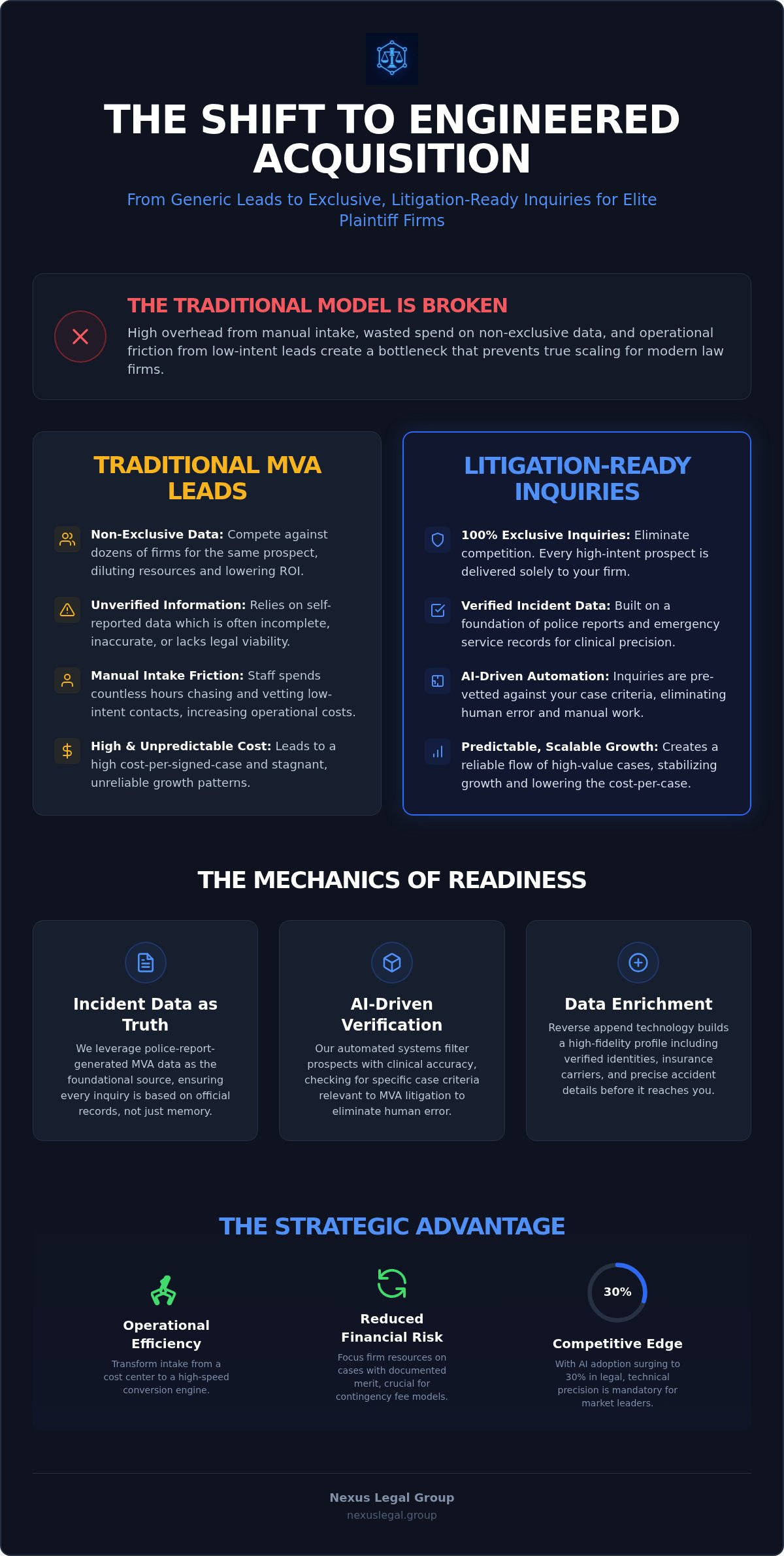
The 2026 legal market has reached a saturation point where mere lead volume often acts as a liability rather than an asset. Elite firms are increasingly finding that traditional, volume-based lead generation fails to account for the operational friction of manual intake. When your staff spends forty hours a week chasing unverified contacts, your overhead climbs while your conversion rates stagnate. This inefficiency creates a bottleneck that prevents true scaling. Shifting toward exclusive litigation ready inquiries represents a move from speculative marketing to a precise, engineered acquisition model.
The Crisis of Low-Intent Lead Volume
Non-exclusive leads dilute firm resources by forcing your team into a race against dozens of competitors for the same prospect. This environment lowers ROI and erodes attorney morale as high-value talent is forced to review low-intent data. Many firms are now prioritizing compliant legal lead generation to ensure every prospect meets strict ethical and quality benchmarks. This shift is essential because most plaintiff practices operate under contingency fee arrangements, where the firm carries the entire financial risk of the case. Accepting anything less than a high-intent inquiry increases that risk profile unnecessarily.
Establishing an Institutional Standard for Inquiries
A litigation-ready inquiry is more than a name and a phone number. It is a prospect verified against real-world incident data, such as police reports or emergency services records. This clinical precision ensures that the intake process is no longer a guessing game but a functional stage of case development. By integrating these inquiries into a robust law firm growth infrastructure, you create a system where growth is predictable. Exclusive litigation ready inquiries provide the foundational data depth required to authorize immediate legal action. This systemic approach moves your firm away from transactional lead buying and toward a sophisticated, automated acquisition engine that drives growth from behind the scenes.
The Mechanics of Readiness: AI Verification and Data Enrichment
The transition from a raw lead to a litigation-ready inquiry requires a fundamental shift in how data is processed. Most providers rely on self-reported information, which is often incomplete or entirely inaccurate. By contrast, exclusive litigation ready inquiries are built on a foundation of verified incident data. This rigorous process ensures that every claimant is pre-vetted for legal viability before they ever speak with your intake team. It eliminates the guesswork that typically plagues high-volume acquisition strategies and replaces it with clinical certainty.
Incident Data as the Source of Truth
To achieve this level of precision, the system leverages police report generated MVA leads. This method moves beyond what a prospect remembers about an accident and looks at what the official record states. Reverse append technology plays a critical role here; it allows for the retrieval of specific participant details and accident reports using minimal initial data points. This creates a high-fidelity profile that includes:
- Verified driver identities and insurance carrier information
- Precise accident location data and impact descriptions
- Official emergency services timestamps and reporting officer notes
By moving beyond self-reported data, firms can secure verified incident facts that stand up to the scrutiny of the litigation process. This technical mastery ensures that your intake resources are reserved for cases with documented merit.
AI-Driven Automated Intake Systems
The integration of automated intake for plaintiff firms ensures that these data points are processed with clinical accuracy. AI doesn't just collect information; it filters for specific case criteria relevant to MVA or Mass Tort litigation. This eliminates human error during the critical initial contact phase. By automating the verification of exclusive litigation ready inquiries, firms can drastically reduce the time between inquiry generation and case signing. This technical mastery allows your firm to focus on high-value claimants identified through predictive modeling rather than chasing dead ends. If you're looking to implement this level of precision, exploring a specialized growth infrastructure is the next logical step in your firm's evolution.
Exclusivity as a Competitive Advantage: Shared Leads vs. Direct Inquiries
Shared lead platforms create a high-friction environment that often commoditizes the claimant experience. When a single inquiry is sold to three or four different firms, the result is a frantic speed to lead race that prioritizes volume over clinical precision. This model forces firms into unsustainable price wars and erodes the quality of the initial interaction. By contrast, exclusive litigation ready inquiries provide a clear, unencumbered path to case acquisition. This exclusivity isn't just a luxury; it's a foundational requirement for any firm seeking to build a predictable and scalable growth engine.
The ROI of Zero Competition
The financial impact of switching from shared leads to an exclusive model is most evident in the cost-per-signed-case metric. Shared leads may appear cheaper on the surface, but the low conversion rates and high intake overhead often drive the actual cost of a signed retainer much higher. In an exclusive environment, your intake team can focus on building rapport and gathering technical details rather than merely trying to be the first to answer the phone. This shift is critical for securing high conversion MVA leads, as claimants are more likely to engage when they aren't being bombarded by multiple solicitations. Establishing this level of control is a core component of modern lead generation for trial lawyers, allowing for a sustainable acquisition cycle that doesn't rely on luck or timing.
Data Integrity in Exclusive Environments
Exclusivity also serves as a safeguard for data integrity and ethical compliance. In a shared model, the chain of custody for a claimant's information is often obscured, leading to potential trust issues and compliance risks. exclusive litigation ready inquiries ensure that the data enrichment process, from police report integration to AI verification, remains consistent and secure. This direct path is why verified MVA leads for law firms are increasingly becoming the industry standard. When a firm owns the entire inquiry lifecycle, they can guarantee that every interaction meets institutional standards of excellence. This builds immediate trust with the claimant, who feels like a priority rather than a line item in a shared database. This strategic ownership eliminates the noise of the marketplace and allows your firm to focus on its primary objective: litigation.
Implementing Growth Infrastructure: A Roadmap for Elite Plaintiff Firms
Transitioning to a high-performance acquisition system requires more than just purchasing better leads; it demands a structural overhaul of your intake philosophy. Elite firms must view their acquisition process as a foundational layer of their business architecture rather than a peripheral marketing expense. To start, you must audit your current acquisition channels to identify exactly where intent is lost and where conversion bottlenecks occur. This audit sets the stage for integrating data driven case acquisition directly into your firm's CRM. This integration ensures that exclusive litigation ready inquiries flow into your workflow with clinical precision, bypassing the need for manual data entry.
Once the data pipeline is established, the next phase involves transitioning to automated verification and intake systems. These tools act as a sophisticated filter, ensuring only cases that meet your specific legal criteria reach your staff. As the system stabilizes, you can begin scaling volume through AI-driven marketing precision. This progression allows your firm to increase case volume while maintaining the high-intent quality necessary for sustainable growth. It's a methodical move from speculative lead buying to an engineered state of case acquisition.
Aligning Infrastructure with Firm Objectives
Implementation is only successful if it aligns with your internal capacity. You must establish clear KPIs for the flow of exclusive litigation ready inquiries to prevent overwhelming your legal team. By matching acquisition volume to attorney capacity, you ensure that every high-value case receives the attention it deserves. Utilizing high-intent MVA case acquisition allows for targeted growth in specific practice areas, providing a surgical approach to firm expansion rather than a broad, inefficient marketing spend.
The Role of Technical Support and Training
A sophisticated system is only as effective as the team managing it. Your intake department must be trained to handle enriched inquiries with the same clinical precision used to generate them. Continuous optimization is a requirement, not an option, for maintaining a competitive edge. Leveraging instructional resources like Nexus Legal Group videos ensures your team stays updated on the latest verification methodologies. This commitment to training maintains systemic integrity even during phases of rapid expansion, preventing the operational friction that often accompanies firm growth.
Scaling with Nexus Legal Group: High-Intent MVA Case Acquisition
Choosing a partner for firm expansion shouldn't feel like a transactional purchase. Nexus Legal Group functions as a strategic architect, providing the growth infrastructure necessary for elite firms to dominate their markets. We don't just provide leads; we engineer exclusive litigation ready inquiries that are pre-verified through incident data enrichment. This systemic approach ensures that your firm operates as a high-performance engine, focusing only on cases with documented legal viability and high-intent potential.
The inclusion of police-report-enriched data provides a clinical level of precision that generic MVA leads simply cannot match. By utilizing reverse append technology and emergency services records, we establish a source of truth for every inquiry before it enters your workflow. This methodology is particularly effective for delivering ethical and compliant signed cases for mass tort litigation. It moves your firm away from the role of a lead buyer and into a partnership built on operational excellence and technical mastery.
The Nexus Methodology: Precision and Automation
Our system creates a seamless bridge between AI-driven marketing precision and rigorous automated verification. This isn't a peripheral tool; it's a foundational layer designed to eliminate operational friction and ensure your firm receives exclusive litigation ready inquiries that are already vetted for merit. Successfully executing a mass tort case acquisition strategy can drastically increase firm valuation by replacing speculative spending with predictable, data-driven growth. We provide the institutional reliability your firm needs to scale without compromising on quality or ethics.
Next Steps for Elite Plaintiff Firms
Beginning the transition to a litigation-ready model starts with an honest audit of your current intake efficiency. If your team is still chasing unverified inquiries, you're losing capital and attorney time every day. You can find technical frameworks and instructional guides on the Nexus Legal Group blog to help prepare your infrastructure for high-intent data streams. When you're ready to implement a professional, clinical acquisition system, a strategic consultation is the first step toward securing your firm's future. It's time to stop buying leads and start building a legacy of technical mastery through a sophisticated growth engine.
Engineering Your Firm's Future through Technical Mastery
Scaling an elite plaintiff practice requires a departure from traditional, high-friction lead acquisition models. You've seen how integrating national police report data and AI-driven automated verification transforms raw inquiries into verified legal assets. By prioritizing exclusive litigation ready inquiries, your firm eliminates the wasted marketing spend and high overhead associated with non-exclusive, low-intent data. This transition represents the implementation of a foundational growth infrastructure engineered specifically for the rigorous demands of elite plaintiff law firms.
The mechanics of this shift rely on clinical precision. When you replace manual intake with automated systems, you free your team to focus on high-value litigation rather than administrative filtering. This results in a lower cost-per-signed-case and a more predictable revenue stream. It's time to move beyond the limitations of shared leads and embrace a system designed for institutional reliability and technical mastery. Your firm is ready to dominate the market through data-driven excellence and systemic integrity.
Step into a new era of operational efficiency where growth is a predictable outcome of your infrastructure.
Frequently Asked Questions
What exactly defines an inquiry as 'litigation-ready'?
A litigation-ready inquiry is a prospect verified against incident data and pre-vetted for legal viability. It's not just a lead; it's an enriched profile that includes incident facts, insurance details, and confirmed intent. This ensures that exclusive litigation ready inquiries are prepared for immediate intake and case filing. By moving beyond self-reported data, firms receive a high-fidelity asset that reduces the time spent on manual screening and increases the speed to retainer.
How does Nexus Legal Group ensure inquiries are exclusive?
Nexus Legal Group ensures exclusivity by utilizing a direct inquiry model that bypasses shared lead marketplaces. Every inquiry is generated through proprietary AI-driven marketing and is routed exclusively to a single firm. This eliminates the competitive friction and price wars common with shared leads. By owning the entire inquiry lifecycle from generation to verification, the system guarantees that no other firm receives the same data, protecting your marketing investment and ensuring a clear conversion path.
What data sources are used for MVA case acquisition?
The system utilizes a combination of real-time incident data and official records to ensure accuracy. This includes police reports, emergency services data, and public incident filings. By integrating these authoritative sources, the acquisition process moves beyond speculative marketing. This data-driven approach allows for the identification of high-intent prospects based on documented accidents rather than just general search behavior, providing a more reliable foundation for case building and legal strategy across your entire practice.
Is the automated verification process compliant with legal ethics?
Yes, the automated verification process is engineered to maintain strict ethical and compliant standards. The system focuses on high-intent case acquisition that respects consumer privacy and legal advertising regulations. By utilizing objective data points like police reports and emergency services records, the process avoids aggressive or non-compliant solicitation tactics. This clinical approach ensures that all exclusive litigation ready inquiries meet the institutional standards of elite plaintiff firms while minimizing regulatory risk and protecting firm reputation.
How does reverse append technology improve case quality?
Reverse append technology improves case quality by filling in critical data gaps using minimal initial information. If a prospect provides only a name and a phone number, the system uses reverse append to retrieve detailed accident reports and participant information. This provides your intake team with insurance carrier details and officer notes before the first call. This technical mastery ensures that your staff only engages with high-fidelity inquiries that have a documented, verifiable path to litigation.
Can this infrastructure support both MVA and Mass Tort cases?
This growth infrastructure is specifically designed to support both high-intent MVA case acquisition and mass tort litigation. While MVA cases rely heavily on incident data enrichment, mass tort strategies utilize AI-driven marketing precision to identify and verify claimants at scale. The platform provides a unified systemic layer that manages the unique verification requirements of each case type, allowing firms to diversify their practice areas without needing to build entirely separate acquisition infrastructures from scratch.
What is the difference between an inquiry and a signed case in your system?
An inquiry is a qualified prospect who has been verified through incident data and AI screening, while a signed case is a prospect who has fully executed a retainer agreement. Nexus Legal Group provides both high-intent inquiries and fully signed cases depending on your firm's operational needs. Both assets are generated through the same rigorous verification process, ensuring that whether you handle the final signing or receive a completed retainer, the quality remains institutionally high.
How quickly can a firm integrate this growth infrastructure?
Most elite firms can begin integrating this growth infrastructure into their existing CRM within a few business days. The system is designed for seamless connectivity, allowing for a methodical transition that doesn't disrupt current operations. Once the data pipeline is established, firms can start receiving enriched inquiries almost immediately. This rapid deployment allows you to scale acquisition volume quickly while maintaining clinical precision across your entire intake and verification workflow without any significant operational downtime.