Data driven law firm expansion Guide for Success
Unlock data driven law firm expansion with our guide. Turn raw inquiries into litigation-ready cases using police report data and AI-powered verification sys...
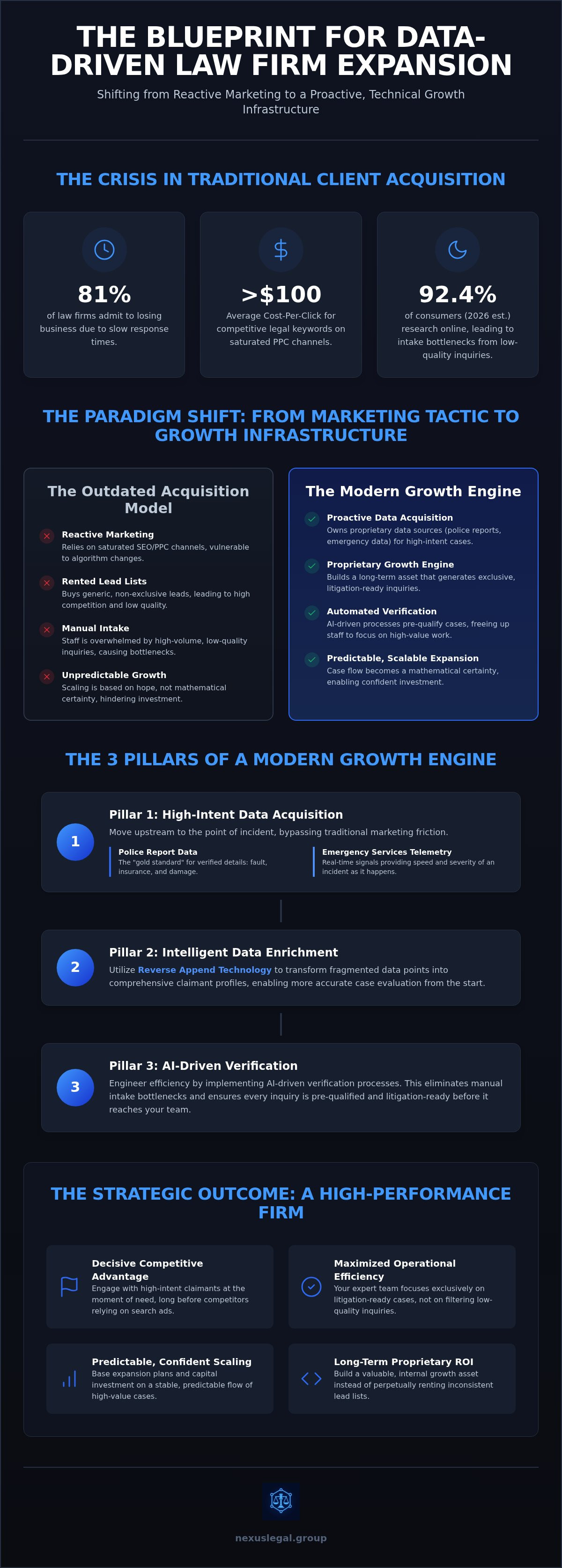
Did you know that 81% of law firms admit to losing business simply because their response times are too slow? In a 2026 market where 92.4% of consumers research online before making a call, the traditional reliance on generic SEO isn't just inefficient; it's a structural liability. To achieve true data driven law firm expansion, you can't rely on luck or bloated marketing budgets. You need a system that functions with the clinical precision of a strategic architect.
You likely agree that high costs per acquisition and low-quality inquiries are the primary barriers to your firm's growth. It's difficult to plan for the future when manual intake bottlenecks and inconsistent case flows dictate your monthly overhead. This guide promises to reveal how elite plaintiff firms leverage incident data and automated infrastructure to achieve predictable, scalable expansion. We'll preview the specific mechanisms of police report integration and automated verification that turn raw inquiries into litigation-ready cases, giving you a decisive advantage over competitors who remain tethered to outdated acquisition models.
Key Takeaways
- Learn why shifting from reactive marketing to a proactive, technical infrastructure is the foundation of data driven law firm expansion in 2026.
- Discover how to leverage police reports and emergency services data to secure high-intent MVA inquiries at the exact moment of need.
- Understand how reverse append technology transforms fragmented data points into comprehensive claimant profiles for more accurate case evaluation.
- Identify the AI-driven verification processes that eliminate manual intake bottlenecks and ensure every inquiry is litigation-ready.
- Evaluate the long-term ROI of building a proprietary growth engine rather than relying on the inconsistent flow of rented lead lists.
Defining Data-Driven Law Firm Expansion in a Competitive Landscape
In 2026, the competitive gap between elite plaintiff firms and those struggling with high acquisition costs is defined by their approach to technology. Most firms treat growth as a marketing problem, relying on the same saturated SEO and PPC channels as their competitors. However, true data driven law firm expansion is a technical infrastructure requirement. It's the systematic integration of incident-level data and automated verification to scale case volume predictably. While 54% of firms identify SEO as a primary source of business, the average CPC for competitive legal keywords often exceeds $100. Relying on these volatile channels creates a dependency on external algorithms rather than internal systems. Precision in data acquisition directly correlates with firm profitability by reducing the waste associated with non-qualified inquiries.
The Evolution from Marketing to Growth Infrastructure
Buying generic leads is a tactical dead-end. It's a model that forces firms into a cycle of high-volume, low-quality intake that overwhelms staff and erodes margins. A modern law firm growth infrastructure moves beyond simple lead acquisition to focus on data ownership and systemic integrity. This transition requires technical mastery to eliminate operational friction. By understanding the broader Legal Technology Overview, firms can build systems that verify inquiries before they ever reach a human intake specialist. This shift ensures your team only engages with litigation-ready cases, transforming your firm from a reactive marketing entity into a powerful, high-performance engine.
Predictability as the Core Metric of Expansion
Scaling an organization requires significant capital, and capital requires certainty. You can't scale based on the hope that search engine updates won't tank your traffic. Data-driven frameworks provide the stability needed for aggressive investment by establishing a baseline for data-driven case acquisition metrics. When you own the data source, such as police report feeds or emergency services data, your case flow becomes a mathematical certainty. This predictability allows partners to commit to expansion plans with the confidence that their infrastructure can support increased volume without a proportional increase in overhead. By 2026, the most successful firms have moved away from the volatility of algorithmic changes, focusing instead on clean, structured data that drives consistent revenue.
Primary Data Sources for High-Intent MVA Case Acquisition
The success of any data driven law firm expansion strategy depends entirely on the quality and timing of the underlying data. In a market where 81% of law firms acknowledge losing business due to slow response times, waiting for a potential client to find your firm through organic search is a structural weakness. High-intent acquisition requires moving upstream to the point of the incident. By identifying individuals at the exact moment of need, firms can bypass the friction of traditional marketing and engage with claimants before they are overwhelmed by competing advertisements. This proactive approach relies on two primary pillars: historical public records and real-time emergency telemetry.
Leveraging Police Report Data for Precision
Police reports represent the gold standard for verified incident details. Unlike self-reported lead forms that often contain inaccuracies, police report generated MVA leads provide a comprehensive overview of the accident, including fault determinations, insurance information, and specific vehicle damage. Accessing this data at scale requires a sophisticated infrastructure capable of processing public records across multiple jurisdictions simultaneously. This allows elite firms to transition from targeting broad demographics to identifying specific incident participants. When you possess the exact details of an accident, your intake team can approach the case with a level of authority that significantly increases conversion rates.
Real-Time Signals from Emergency Services
While police reports provide depth, emergency services data offers the advantage of speed. Identifying high-intent opportunities through emergency response telemetry allows firms to understand the severity of an incident as it happens. The technical challenge lies in integrating disparate data streams from various municipal and private emergency services into a unified dashboard. By applying AI-driven filters to this raw data, firms can isolate litigation-ready inquiries from minor incidents that don't meet their specific criteria. This real-time visibility ensures that your firm is the first point of contact for high-value cases, reinforcing your position as a strategic leader in the market.
Maintaining ethical and compliant standards is non-negotiable when sourcing incident-level data. As of 2026, regulations like the CCPA require rigorous privacy risk assessments for any firm processing sensitive consumer data. Success in this environment requires a partner who prioritizes systemic integrity and regulatory alignment. If you are ready to move beyond the unpredictability of traditional lead generation, you can explore high-intent acquisition systems designed for institutional growth. Owning these data sources transforms your firm from a participant in the market to a dominant force with a predictable, scalable case flow.
The Role of Reverse Append Technology in Lead Enrichment
Reverse append technology serves as the technical bridge between raw incident signals and actionable legal files. In the context of legal lead generation, it's the automated process of using a single verifiable data point, such as a phone number, license plate, or partial incident address, to query authoritative databases and retrieve a complete claimant profile. This capability is foundational to data driven law firm expansion because it removes the burden of discovery from your intake staff. Instead of asking a traumatized caller for their insurance policy number or the VIN of the other vehicle, your system arrives at the first interaction with these details already populated. This level of preparation doesn't just improve the caller experience; it establishes immediate authority and trust.
Transforming Inquiries into Comprehensive Accident Reports
The mechanics of lead enrichment involve cross-referencing real-time incident data with massive consumer and vehicle databases. By integrating these streams, firms can automatically secure participant details and insurance information that are often missing from initial inquiries. This process is critical for maintaining verified MVA leads for law firms standards. When your data is enriched at the source, you eliminate the risk of pursuing cases with inadequate coverage or unidentifiable defendants. It ensures that every entry in your CRM is backed by a comprehensive accident report, allowing your team to focus their energy on high-probability litigation rather than administrative investigation.
Enhancing Claimant Profiles for Trial Lawyers
For trial lawyers, the value of enriched data lies in its ability to predict case outcomes before a single hour is billed. Building a litigation-ready file before the first intake call allows your senior partners to vet cases based on hard data rather than anecdotal evidence. This sophisticated approach to lead generation for trial lawyers identifies high-value cases by analyzing behavioral data and historical incident patterns. It's a shift from reactive intake to strategic case selection. By the time your team picks up the phone, they already know the policy limits, the accident severity, and the claimant’s history. This level of insight ensures that your firm's growth is driven by high-margin cases that fit your specific trial profile, rather than a disorganized stream of generic inquiries.
Engineering Efficiency through Automated Intake and Verification
Manual intake is the primary bottleneck for scaling a modern practice. If your staff spends hours chasing unqualified inquiries, you're not expanding; you're just busy. In 2026, research shows that 72% of potential clients will contact a different firm if they don't receive a response within 24 hours. Speed-to-lead isn't a vanity metric. It's a structural requirement for conversion and a cornerstone of data driven law firm expansion. By automating the initial touchpoint, you ensure that high-intent claimants are engaged before they have the chance to browse a competitor's site.
Implementing Automated Legal Intake Verification
Implementing automated intake for plaintiff firms reduces overhead by removing the human element from the initial vetting process. AI-driven verification systems analyze incoming data against your specific case criteria in milliseconds. This isn't just about collecting contact info. It's about determining if the accident severity, insurance coverage, and liability factors align with your firm's trial profile. This process filters out the noise, ensuring your team only spends time on inquiries that have already been verified as litigation-ready cases. It eliminates the friction in the claimant journey, providing immediate responses that build trust during the critical minutes following an incident.
Securing Ethical and Compliant Signed Cases
Scaling mass tort and MVA volume requires a system that prioritizes compliant legal lead generation. Automated signing processes must be backed by rigorous audit trails to satisfy ethical standards and regulatory requirements. This is especially true in 2026, as new CCPA regulations demand comprehensive risk assessments for consumer data processing. An automated system provides a transparent, repeatable record of every interaction, from the first signal to the signed retainer. This systemic integrity allows you to manage thousands of inquiries across mass tort campaigns without compromising on ethics or data security.
True data driven law firm expansion requires more than just acquiring leads. It requires a high-performance engine that processes data with clinical precision. When your intake and verification are automated, you eliminate the friction that slows down case conversion and prevents scalable growth. This architectural approach turns your firm into a powerful engine capable of handling increased volume with predictable margins and absolute compliance.
Scaling Revenue with Integrated Growth Infrastructure
Scaling revenue in a high-stakes litigation environment requires more than a series of disconnected marketing tactics. It demands a unified growth engine that integrates incident data, technical enrichment, and automated verification into a single, high-performance workflow. This holistic approach is the ultimate expression of data driven law firm expansion. When these components function in synchronicity, the result is a predictable stream of litigation-ready cases that arrive with a lower overhead and higher conversion rate than traditional methods. Firms that invest in this level of systemic integrity move away from the uncertainty of the lead market and toward a model of institutional growth.
Moving from Tactical Lead Buying to Strategic Acquisition
Renting lead flow from third-party providers is a tactical trap that limits your firm's scalability. You're essentially subsidizing a competitor's infrastructure while receiving non-exclusive, often low-quality inquiries. Transitioning to a proprietary acquisition framework allows you to allocate capital toward systems that produce exclusive, high-intent cases. This is particularly vital when executing a mass tort case acquisition strategy, where volume and data precision are the primary drivers of ROI. By owning the infrastructure, you secure a competitive advantage that cannot be replicated by firms relying on generic SEO or shared lead lists.
The Future of Plaintiff Firm Expansion
As we move through 2026, the legal tech landscape is becoming increasingly bifurcated. Firms that continue to rely on manual intake and fragmented marketing will face unsustainable costs per acquisition. Conversely, the firms that control their data and automate their verification will dominate the plaintiff market. The strategic architect of a modern firm must view growth as a technical challenge rather than a creative one. Nexus Legal Group provides the foundational layer for these elite organizations, offering the end-to-end infrastructure needed to scale without friction. Your next step should be a rigorous audit of your current growth systems. Identifying the gaps in your data enrichment and intake automation is the first move toward achieving a truly scalable, data-driven practice.
Architecting a Scalable Foundation for Litigation Success
Transitioning your firm from a reactive marketing model to a proactive technical infrastructure is no longer optional; it's the only way to secure a predictable case flow in a competitive market. By integrating incident-level data and reverse append technology, you ensure your intake team only engages with exclusive, high-value claimants. This shift to data driven law firm expansion allows you to eliminate manual bottlenecks and reduce overhead while maintaining absolute compliance throughout the claimant journey. You've seen how precision data and technical mastery create a decisive advantage over firms relying on generic, shared lead lists.
As an elite plaintiff firm growth partner, Nexus Legal Group provides the foundational systems required for this level of scale. We specialize in AI-driven intake verification and the delivery of exclusive, litigation-ready inquiries that fit your specific trial profile. Our systems work as a powerful engine, driving growth from behind the scenes so you can focus on litigation. You've earned your reputation in the courtroom; let us provide the infrastructure that supports your next stage of expansion.
You've seen the blueprint for a modern, scalable practice that values technical mastery over generic marketing. Now is the time to audit your current systems and implement the automation necessary to dominate your market in 2026. The future of your firm depends on the integrity of your data and the efficiency of your growth engine. We're ready to help you build a practice that is as resilient as it is profitable.
Frequently Asked Questions
How does data-driven expansion differ from traditional law firm marketing?
Data-driven expansion shifts the focus from broad awareness to technical infrastructure. While traditional marketing relies on algorithmic search visibility, a data driven law firm expansion strategy prioritizes owning the source of high-intent inquiries. It uses incident-level data to identify claimants at the point of need. This systemic approach eliminates the unpredictability of SEO fluctuations and ensures that growth is based on measurable, litigation-ready volume rather than vanity metrics like website traffic.
What specific data points are most valuable for high-intent MVA case acquisition?
High-intent MVA case acquisition relies on specific incident indicators that suggest significant liability and damages. The most valuable data points include insurance policy limits, vehicle damage severity, and official fault determinations found in police reports. Additionally, emergency response telemetry provides real-time signals of high-value incidents. Combining these data points allows firms to filter for cases that meet their specific trial profile before any human contact occurs, ensuring a higher conversion rate.
How does reverse append technology improve the quality of legal inquiries?
Reverse append technology transforms fragmented inquiries into comprehensive claimant profiles by cross-referencing single data points with authoritative databases. This process retrieves missing insurance information, vehicle details, and secondary contact methods. By enriching the data before the intake call, firms reduce the burden on their staff and improve vetting accuracy. This ensures that every inquiry is backed by a complete accident report, significantly increasing the probability of a successful case conversion and reducing administrative discovery time.
Is automated intake verification compliant with legal ethics standards?
Automated intake verification is fully compliant with legal ethics standards when implemented with rigorous audit trails and data privacy guardrails. In 2026, systems must adhere to CCPA regulations requiring privacy risk assessments for consumer data. Automation actually enhances compliance by providing a transparent, repeatable record of every interaction. This systemic integrity ensures that all inquiries are handled ethically while protecting the firm from the risks associated with manual data entry or inconsistent intake procedures during the expansion process.
What infrastructure is required to support a data-driven expansion model?
A successful data driven law firm expansion requires a unified layer of technological tools. This infrastructure includes real-time police report data feeds, emergency services telemetry, and reverse append enrichment engines. Additionally, firms need AI-driven intake verification software that integrates directly with their CRM. This technical stack allows for the seamless flow of data from the moment of an incident to the delivery of a litigation-ready inquiry, creating a predictable engine for sustainable revenue growth.
Can data-driven strategies be applied to mass tort case acquisition?
Data-driven strategies are highly effective for mass tort case acquisition because they prioritize high-intent inquiries over generic lead lists. By using AI-driven marketing and automated verification, firms can scale their mass tort volume without a proportional increase in intake staff. These systems identify qualified claimants and manage the signing process through automated communication. This approach ensures that mass tort campaigns are both ethical and compliant while delivering the volume necessary for institutional growth and market dominance.
How does speed-to-lead impact the conversion of data-driven inquiries?
Speed-to-lead is a critical factor in case conversion; research indicates that 72% of potential clients will contact a different firm if they don't receive a response within 24 hours. Data-driven inquiries allow for immediate, automated engagement that captures the claimant’s attention during the initial window of need. By reducing the time between an incident and the first touchpoint, firms can significantly increase their conversion rates and secure high-value cases before competitors have a chance to intervene.
Why is police report data considered a gold standard for MVA leads?
Police report data is considered the gold standard because it provides a verified, third-party account of an accident. Unlike self-reported web forms that may contain inaccuracies, police reports include objective details regarding fault, insurance coverage, and vehicle damage. Utilizing these reports allows firms to build a litigation-ready file with the authority of an official public record. This precision ensures that intake teams are working with high-quality, verified inquiries that have a significantly higher probability of successful litigation.