Consent Based Marketing: Guide to Compliant Lead Gen

Explore consent based marketing for compliant lead generation: clear permission, privacy-first data use, relevant outreach, and lasting customer trust.
What if lead generation began with permission instead of interruption? Consent-based marketing puts the choice with the individual: a business asks before sending promotional messages or collecting personal information for marketing, then uses the permission given to make communications relevant.
This approach reflects a practical reality: people expect to know what data is collected and how it will be used. Transparent consent and respect for preferences give marketing a stronger foundation for trust and meaningful engagement.
This guide explains how consent-based marketing works, how privacy considerations shape the use of customer data, and how first-party information can support more relevant outreach. It also covers how consistent, useful communication can build trust, engagement, and loyalty, and what these principles mean for lead generation.
Key Takeaways
- Make permission clear by explaining what communications people are choosing to receive and how their preferences shape outreach.
- Build privacy into marketing processes with transparent data-use explanations and accessible ways to manage consent.
- Distinguish information gathered through customer interactions from details people choose to share directly, then use each for relevant communication.
- Use consented data to support more relevant personalization while respecting privacy choices, including the CCPA rule for consumers under 16 who decline the sale or sharing of their personal information.
- For plaintiff law firms seeking MVA lead acquisition, understand how accident-based leads, emergency services-generated leads, and automated verification fit into a compliant growth strategy.
Consent-Based Marketing Definition
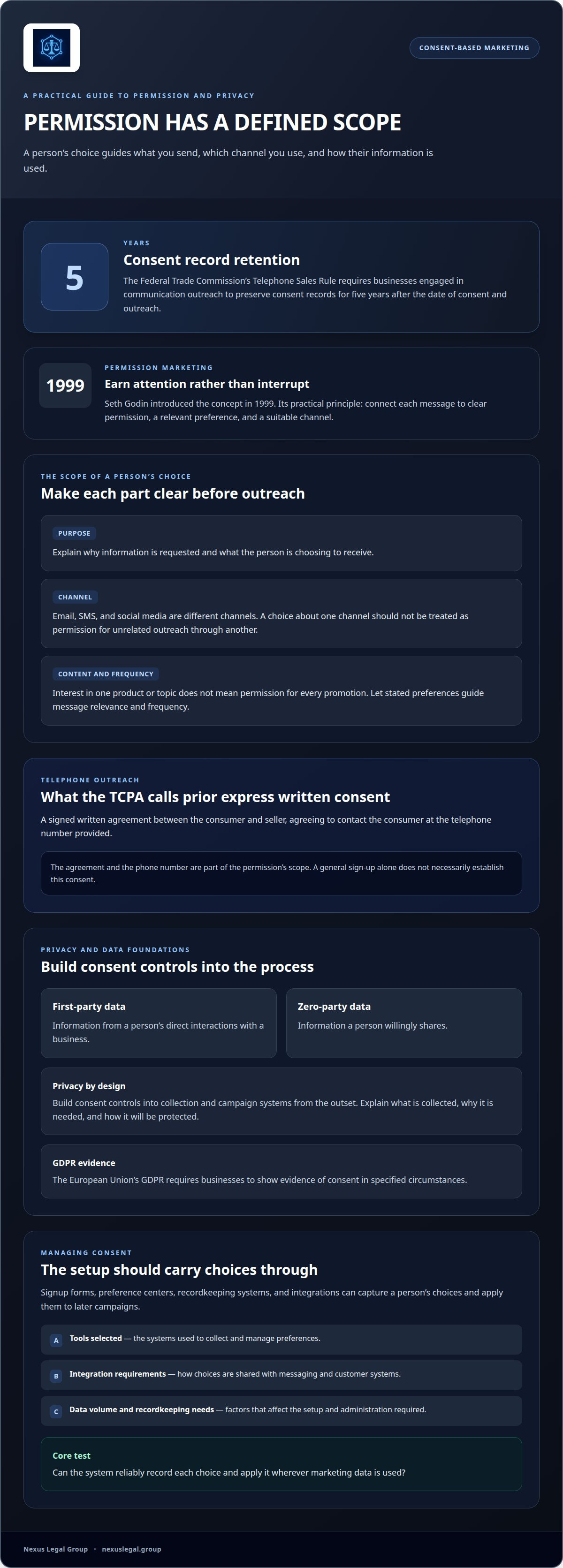
Consent-based marketing begins when a person gives permission to receive promotional messages or to have personal data collected for a stated purpose. That permission defines what a business may send and how it may use the information. The request should explain its purpose and make the choice clear. This distinguishes permission-based outreach from cold calls and unsolicited emails, which contact people without first establishing their interest.
Permission reflects a person’s stated preferences, not a general signal to send every promotion. For example, a subscription form can explain that someone is signing up for product updates by email. If the business also plans to send SMS promotions, the request should identify that channel too. Email, SMS, and social media can all support marketing, but people’s choices should guide which channels are used.
Preferences also guide advertising content and frequency. A person who requests information about one product has expressed interest in that subject, not necessarily every offer a business makes. Tailoring messages to that interest can make advertising more relevant. For example, a subscriber who chooses educational updates may receive useful information before promotional offers. The practical rule is to use the preference provided, not treat a sign-up as permission for unrelated messages.
Relevant messages can give people a clearer reason to act. Someone who asks for details about a service may be more receptive to a follow-up about that service than to a general promotion. Consent does not guarantee a purchase. It provides a basis for communicating with people who have expressed interest, while keeping outreach within the scope of their choice.
That exchange can also shape loyalty over time. When a person’s stated preferences continue to guide communications, each interaction reinforces that their choice matters. Seth Godin introduced the concept of permission marketing in 1999, emphasizing the difference between earning attention and interrupting people. The practical takeaway is to connect each message to a clear permission, relevant preference, and suitable channel. That alignment makes consent a marketing framework, not merely a form field.
The TCPA defines prior express written consent as a signed written agreement between the consumer and seller agreeing to contact the consumer at the telephone number provided. For telephone outreach, the agreement and number are part of the permission’s scope. A general sign-up alone does not necessarily establish this consent.
Consent-Based Marketing and Privacy by Design
Privacy by design means building consent controls into data collection and campaign systems from the outset. This helps align marketing operations with consumer expectations instead of treating privacy as a later fix.
Customer Trust and Privacy Expectations
Privacy expectations concern how consumers expect businesses to explain and handle personal information. Meeting those expectations can build trust by making the meaning of opting in clear before people share data. For example, a signup form can identify the messages a person will receive, explain how contact details will be used, and provide a clear way to change preferences. This gives consumers a meaningful choice and avoids surprises later.
Privacy-Compliant Marketing Technology
Privacy-conscious marketing technology helps record, use, and manage permission across campaigns. A preference-management system, for example, can store a person’s selected channels and share those choices with the tools that send messages. This helps prevent an email preference from being mistaken for permission for unrelated outreach. Connected systems can also apply changes consistently, giving marketing teams better control as they use customer data to make communications more relevant.
Privacy Compliance for Marketers
Privacy compliance means aligning data collection and marketing activity with applicable requirements and the permission received. In the United States, rules can vary by channel and type of communication, so marketers need processes suited to their campaigns. The Federal Trade Commission’s Telephone Sales Rule requires businesses engaged in communication outreach to preserve consent records for five years after the date of consent and outreach. The European Union’s GDPR requires businesses to show evidence of consent in specified circumstances. Clear records help teams demonstrate how permission was obtained and used.
Tools and Costs for Managing Consent
Consent management can involve signup forms, preference centers, recordkeeping systems, and integrations with email or customer databases. These tools capture a person’s choice and help carry it through to later campaigns. Costs depend on the tools selected, integration requirements, data volume, and recordkeeping needs. A small operation may manage preferences in existing systems, while a complex, multi-channel program may need connected platforms and more administration. The key question is whether the setup can reliably record choices and apply them wherever marketing data is used.
First-Party and Zero-Party Data
First-party data comes from a person’s direct interactions with a business; zero-party data is information they willingly share. Both can support more relevant marketing when their purpose and use are clear.
Transparency in Data Use
A transparent data-use disclosure explains what a business will collect, why it needs the information, and how it will protect it. For example, a form requesting an email address can state that it will be used to deliver a requested report and related updates. This helps people understand the exchange before sharing information and gives marketers a clearer basis for building relationships.
Data protection also means limiting access to information and using it for the purpose disclosed. A business can separate report delivery from promotional subscriptions, so requesting one resource does not silently enroll someone in every campaign. This distinction helps address privacy challenges and keeps consented information organized around a person’s stated interest.
Valid Consent Across Marketing Channels
Valid consent is a clear, informed choice tied to a specific communication or data use. For email, a person might select a box requesting updates; for SMS, the request should clearly describe the text messages. For data uses such as cookies and targeted advertising, clear explanations and a meaningful choice can help people understand what they are agreeing to. Visiting a website alone should not be treated as opting in.
In the United States, CAN-SPAM, the TCPA, the CCPA, and applicable state privacy laws govern different aspects of marketing and data practices. Requirements depend on the channel, information, and activity involved, so one permission record should not automatically be treated as covering every use.
There is no single penalty for every consent-related violation. Potential consequences depend on the law, conduct, and circumstances, making accurate records and channel-specific controls important safeguards.
Consent Withdrawal and Unsubscribing
Consent withdrawal is a person’s decision to stop a previously permitted communication or data use. Consumers should be able to revoke consent through reasonable means, such as an unsubscribe option in an email or a clear preference control. Marketers should apply that choice to the relevant channel and prevent future campaigns from relying on outdated permission.
Common risks include unclear disclosures, records that do not reflect a person’s latest choice, and messages sent through channels they did not select. For example, an email opt-out should update campaign systems so subsequent email sends respect the request. Regularly reviewing records helps teams address deliverability concerns and reduce compliance errors.
Benefits of Consent-Based Marketing
Permission gives marketers a clearer basis for matching messages to expressed interests. Used carefully, consented data can make audiences more relevant without treating every action as permission for every campaign.
Personalization and Data Quality
Consent supports personalization by connecting information a customer provides with communication that reflects their stated interests. For example, someone who requests information about one service can receive related educational material instead of unrelated promotions. This context also helps teams interpret data more accurately: a stated preference has clearer meaning than an assumption based on a single interaction.
First-party data, collected through direct interactions, can help marketers understand patterns in customer behavior and preferences. A business might use subscribers’ selected topics to segment an audience, then send each group relevant messages. The value comes from matching the information collected to the message, not from collecting more data than a campaign needs.
Balancing Personalisation and Privacy
Personalization and privacy work together when data use stays within the purpose people understood and accepted. A business can use selected interests to tailor content while avoiding unnecessary tracking or unrelated inferences. A relevant message can lose its value if the method behind it surprises the recipient.
Consent also sets boundaries for data use. Marketers can review whether each audience segment reflects an explicit preference, whether the information is still useful, and whether the communication fits its original purpose. The European Union’s GDPR requires users to opt in for applicable data processing, illustrating how consent can shape personalization practices.
For example, a person who opts in to updates about a specific topic can receive content related to that choice. The business can refine the audience using those expressed interests, then assess whether the messages remain useful. This supports personalization while keeping the customer’s choice central to campaign decisions.
Privacy also affects how often a business may renew a request after someone declines. Under the CCPA, businesses must wait at least 12 months before again requesting consent from consumers under 16 who declined the sale or sharing of their personal information, according to the California Privacy Protection Agency. That rule makes respecting a refusal an essential part of audience management.
When a segment no longer reflects current preferences, marketers can adjust it or stop using it rather than continue sending stale messages. Reviewing the purpose, relevance, and source of consented data helps maintain useful personalization and avoids increasingly intrusive tracking. The practical benefit is focused communication: actions and preferences inform outreach without replacing the consumer’s choice.
Customer Trust, Engagement, and Loyalty
Trust grows through repeated interactions that show a business respects customer choices. Useful messages and clear preference controls can turn an initial opt-in into an ongoing relationship.
Trust and User Engagement
Customer trust means confidence that a business will use information and communication preferences responsibly. That confidence matters because people who find messages relevant may engage more and continue the relationship. For example, a subscriber who requests educational updates can receive practical guidance before a sales invitation. Each communication should match the interest expressed when permission was obtained.
Engagement also depends on giving people useful ways to participate. A poll about preferred topics, for example, lets subscribers shape future campaigns and share feedback directly. Marketers can use those responses to adjust content and frequency instead of assuming everyone wants the same messages. Respecting those choices gives each interaction a clear purpose.
Trust can support loyalty when a business continues to provide value after signup. A subscriber who receives useful tips, relevant recommendations, and consistent preference options has reasons to stay engaged. If someone selects fewer messages, honoring that choice can preserve the relationship instead of treating reduced communication as lost interest.
Transparency and Customer Trust
Transparency means making data use and communication choices understandable to the people affected. For example, an app can explain how tracking improves a feature and what happens if someone declines. HelloFresh, Nike, and Domino’s are identified as brands that educate users about how data enhances app experiences. Clear explanations help people make informed choices.
What happens after a choice matters as much as the request itself. If a person declines tracking, maintaining a useful app experience shows that opting out does not remove the service’s core value. This respects the decision and helps prevent a consent prompt from pressuring people to accept data collection.
Businesses can make transparency an ongoing practice. After obtaining feedback through a quiz or poll, they can explain how responses shape upcoming campaigns, such as by selecting more relevant educational topics. When messages reflect what people requested and preference changes are respected, customers can see how their input affects the relationship. That visible connection supports continued engagement and loyalty.
Customers who trust a brand may become repeat purchasers and advocates who promote it to others, and may forgive occasional mistakes. Quizzes or polls can make consent engaging.
Nexus Legal Group
Nexus Legal Group is a relevant next step for plaintiff law firms seeking lead acquisition grounded in ethical, compliant practices. Consent principles matter in lead generation because they shape how a person’s interest is gathered, represented, and carried into follow-up. For firms focused on motor vehicle accident cases, the challenge is connecting that interest with useful case information while keeping acquisition aligned with clear expectations.
Nexus Legal Group offers High-Intent MVA Case Acquisition, including Nexus Crash and Emergency Services Generated MVA Leads. These offerings suit firms whose growth strategy centers on motor vehicle accident cases and whose intake process depends on identifying people connected to those incidents. Automated Verification is also part of the lead acquisition offering. Marketing consent does not replace a firm’s own compliance responsibilities.
Leads built around accident information can provide more specific context than a general expression of interest. Nexus Legal Group also offers Data Enrichment MVA Leads To Obtain Accident Reports and Details of those involved. In a consent-focused acquisition strategy, both the relevance of the information and expectations around outreach matter. Firms can assess how these lead sources fit their intake process and communications with prospective clients.
Nexus Legal Group also serves firms that prioritize ethical and compliant leads and signed cases. This is especially relevant when lead generation must fit into a broader system for reviewing inquiries, managing follow-up, and keeping clear communication records. Consent-based principles help frame relationships with prospective clients; case acquisition infrastructure addresses the separate operational need to connect firms with relevant inquiries. The two roles should remain distinct.
Consider Nexus Legal Group when your firm is evaluating MVA case acquisition and wants lead sources connected to accident reports, emergency services data, or automated verification. The fit depends on whether these offerings support your firm’s case focus and intake model. To discuss the company’s offerings, contact Nexus Legal Group.
Frequently Asked Questions
What is permission marketing?
Permission marketing is an approach in which a business earns the opportunity to communicate by inviting people to opt in. A consent-based marketing program, for example, might offer a guide while separately asking whether readers want follow-up updates. Separating the resource request from the subscription makes the choice clear. People can decide whether they want the requested item, ongoing messages, or both.
Why should marketers care about data privacy compliance?
Privacy compliance helps marketers align campaigns with applicable requirements and people’s choices. In a consent-based marketing process, a team can document which channel a person selected and apply changes across the systems managing future campaigns. For example, an email preference update should reach the relevant audience before its next scheduled send. Marketers should consider the channel, data use, and rules that apply to each activity.
What are the benefits of consent-based marketing for businesses and consumers?
Businesses can focus campaign planning on people who have expressed relevant interests, while consumers gain more control over the messages they receive. For example, a subscriber who selects updates about one subject can receive related content instead of a broad mix of promotions. Teams can also assess whether a campaign matched audience interests by reviewing engagement with the specific messages sent.
How should businesses collect, document, and manage marketing consent?
Record an affirmative choice with enough context to interpret it later. A record can include the date, collection method, stated purpose, selected channel, and wording shown when permission was obtained. Store preference changes alongside it, then make them available to campaign systems. For example, update an email audience when a subscriber changes communication preferences, before sending the next campaign.
How does consent-based marketing compare with permission marketing and opt-out marketing?
Consent-based marketing and permission marketing generally describe communication based on a person’s expressed choice. Opt-out marketing instead relies on a person declining or stopping certain communications, subject to applicable rules. The CCPA/CPRA is identified as an opt-out privacy framework, while the GDPR requires opt-in consent for applicable processing. Businesses need to align their processes with the relevant activity and governing requirements.
What are best practices for consent forms, opt-in language, and double opt-in?
Use plain language to identify the sender, type of communication, and purpose for collecting contact details. Keep marketing choices separate from requests needed to deliver a service, and avoid preselected marketing options. Double opt-in adds a confirmation step: after submitting an email address, a person is asked to click a confirmation message. This can help identify typing errors and document a confirmed subscription.