Calculating Cost Per Signed MVA Case: The 2026 Law Firm Framework
Stop wasting money on bad leads. Learn the 2026 framework for calculating cost per signed MVA case and build a truly scalable litigation engine.
Industry data for 2026 shows that law firms adopting AI are growing revenue four times faster than their headcount, yet many still struggle with the false economy of cheap, shared leads. If your intake team is burning out on low-intent inquiries while your vendor reports look healthy, you're likely measuring the wrong variable. Accurately calculating cost per signed MVA case is the only way to move beyond vanity metrics and build a truly scalable litigation engine.
You've likely felt the frustration of opaque pricing models that fail to account for the hours your staff spends chasing leads that never convert. This guide provides the precise mathematical framework needed to determine the true operational cost of acquiring a signed retainer. We'll break down the impact of the 2025 TCPA consent regulations, the hidden drain of lead decay, and how to transition toward a predictable model that delivers high-quality, litigation-ready cases.
Key Takeaways
- Shift your focus from vanity lead metrics to Cost Per Signed Case (CPSC) to uncover the actual profitability of your acquisition channels.
- Master the 2026 mathematical framework for calculating cost per signed MVA case by accounting for both marketing investment and intake labor overhead.
- Identify why incident-driven data from police and emergency services produces higher-quality, litigation-ready cases compared to traditional social media leads.
- Learn how automated verification and AI-driven filtering can drastically reduce operational drag and intake staff burnout.
- Discover the essential infrastructure components needed to build a predictable and scalable model for high-intent MVA case acquisition.
Beyond Lead Cost: Why Cost Per Signed Case (CPSC) is the Only Metric That Matters
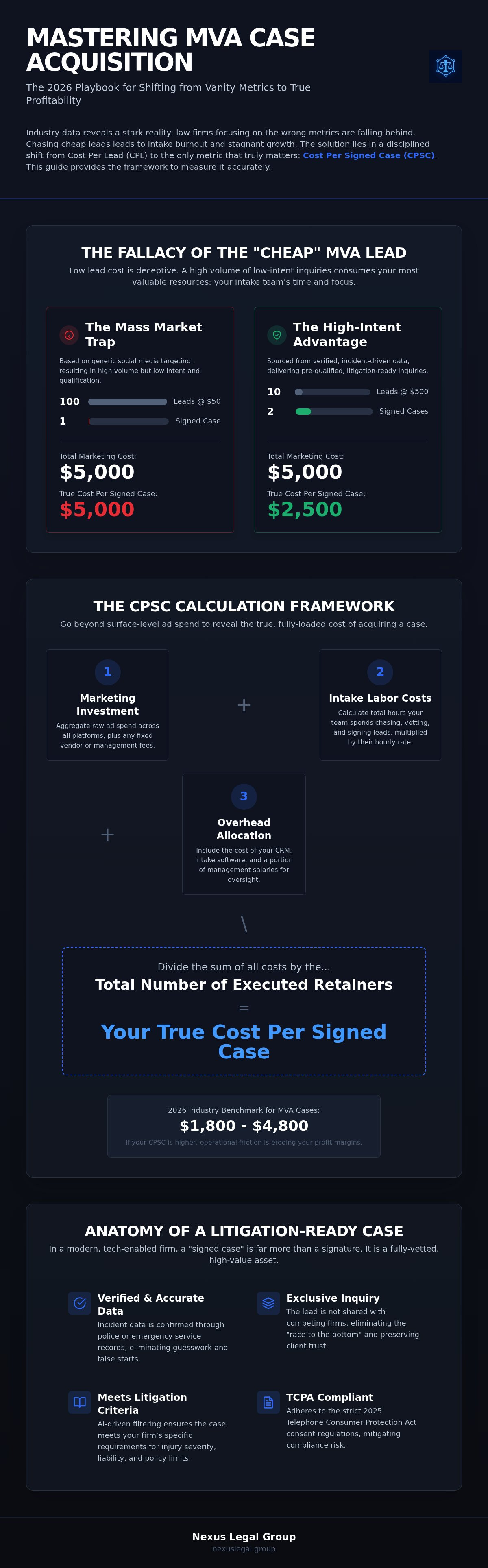
In the 2026 legal market, relying on Cost Per Lead (CPL) as your primary success metric is an operational liability. While CPL measures the price of an entry point, it fails to account for the systemic friction that occurs between a click and a signed retainer. To achieve true scalability, elite firms have pivoted toward Cost Per Signed Case (CPSC). This metric provides a clinical overview of your growth engine by aggregating your total marketing investment and intake labor costs, then dividing that sum by the number of actual retainers secured. It's a specialized application of the broader Customer Acquisition Cost (CAC) framework, tailored specifically for the high-stakes environment of personal injury litigation.
Focusing on CPSC allows you to identify the "Lead Decay" phenomenon that quietly erodes your margins. Lead decay refers to the rapid depreciation of a lead's value based on time-to-contact and the quality of the initial inquiry. A lead that requires six follow-up calls over three days carries a significantly higher operational burden than a "Litigation-Ready" inquiry. These high-intent inquiries arrive with verified data, allowing your team to bypass the noise and move straight to the retainer. When calculating cost per signed MVA case, you must treat your intake team's time as a finite, expensive resource rather than a sunk cost.
The Fallacy of the Cheap MVA Lead
Low-cost leads often present a "noise ratio" that is mathematically unsustainable for growing firms. If you purchase 100 social media leads at $50 each but your intake team only converts one into a signed case, your raw acquisition cost is $5,000. Contrast this with ten high-intent, incident-driven leads at $500 each that result in two signed cases. In the second scenario, your CPSC drops to $2,500. The "cheap" leads actually cost you double in ad spend and ten times more in wasted intake labor. Chasing unqualified inquiries doesn't just waste money; it creates an opportunity cost that prevents your staff from focusing on high-value, litigation-ready files.
Defining the 'Signed Case' Benchmark for 2026
A "signed case" in a modern, tech-enabled firm is defined by more than just a signature on a digital retainer. It represents a verified, exclusive, and compliant inquiry that meets your specific litigation criteria. Shared leads, which are often sold to three or more competing firms, create a "race to the bottom" that artificially inflates your CPSC. When multiple firms call the same accident victim, contact rates plummet and consumer frustration rises. For calculating cost per signed MVA case accurately, exclusivity is the foundational requirement. Without it, your data is skewed by variables you cannot control, making it impossible to forecast ROI or scale your operations with confidence.
The transition to a data-driven model requires a rigorous mathematical approach that accounts for every dollar spent throughout the acquisition lifecycle. To begin calculating cost per signed MVA case, you must aggregate four distinct financial layers into a single operational total. This process moves beyond the surface-level ad spend to reveal the true cost of growth.
- Step 1: Total Marketing Investment. Aggregate your raw ad spend across all platforms and include any fixed vendor management fees. These fees are often overlooked but are essential to the total investment.
- Step 2: Intake Labor Costs. Calculate the total hours your team spends chasing, vetting, and signing leads. Multiply these hours by their fully loaded hourly rate to find the hidden labor cost.
- Step 3: Overhead Allocation. Include the monthly cost of your CRM, intake software, and a portion of management salaries dedicated to oversight.
- Step 4: The Final Division. Divide the sum of steps 1 through 3 by the total number of executed retainers within that specific period.
Comparing your results against current Cost per signed case benchmarks helps determine if your acquisition engine is performing within industry standards. If your CPSC is significantly higher than the 2026 average of $1,800 to $4,800 for standard MVA cases, your margins are likely being consumed by operational friction.
Calculating the Intake Friction Coefficient
Measuring intake friction is essential for identifying where your budget is leaking. This coefficient represents the ratio of labor hours spent relative to the number of signed cases produced. Manual vetting is a primary driver of friction, often requiring multiple "no-contact" attempts that yield zero ROI. Implementing automated intake for plaintiff firms can significantly reduce these labor hours by filtering out non-litigable inquiries before they ever reach a human agent. By quantifying the cost of "no-contact" leads, you can see exactly how much of your budget is spent on silence rather than signatures.
Factoring in Data Enrichment Costs
While data enrichment adds an upfront cost, its impact on reducing vetting time is profound. Utilizing police report generated MVA leads provides your team with verified incident details, such as fault and insurance coverage, before the first call is made. This technology eliminates the need for lengthy discovery calls and reduces the risk of pursuing "junk" leads. Data Enrichment ROI is the ratio of enrichment cost to saved intake hours. High-performing firms recognize that paying more for enriched data often results in a lower overall CPSC. If you're looking to streamline this process, exploring a verified acquisition infrastructure is the next logical step for your firm.
High-Intent Sourcing vs. Mass-Market Leads: Impact on Bottom-Line ROI
The source of your data is the single most influential variable when calculating cost per signed MVA case. While mass-market social media campaigns rely on "scroll-stop" interruption, incident-driven sourcing leverages objective data from police and emergency services. This distinction creates a fundamental shift in your firm's ROI. Social media leads often suffer from a high "noise ratio," where claimants are merely curious or lack a viable case. In contrast, leveraging high conversion MVA leads ensures your intake team is engaging with individuals who are in the immediate aftermath of a verified accident. Quality dictates your margins.
The Power of Incident-Driven Data
Emergency services data provides a chronological precision that digital ad platforms cannot match. While a social media lead might be several days removed from the incident, police and emergency services data allows for near-immediate identification of the event. By utilizing reverse append technology, firms can identify vehicle details and accident participants before the first contact attempt. This level of data driven case acquisition allows elite practices to scale by focusing only on inquiries that meet strict litigation criteria. It's about reducing the "Qualification Gap"—the distance between an initial inquiry and a verified, actionable file. Data eliminates the guesswork.
Intent vs. Interruption: A Conversion Analysis
The psychological state of a claimant significantly dictates their conversion potential. A person who encounters an ad while scrolling social media is in a state of passive consumption. They aren't looking for a lawyer; they're looking for content. Conversely, a claimant who has just received a police report is in an active state of resolution. This difference in intent is why incident-based leads consistently outperform interruption-based ads. By using pre-verified data, you eliminate the need for lengthy discovery calls, directly lowering the labor costs involved in calculating cost per signed MVA case. Intent drives the retainer.
In 2026, ethical compliance is a non-negotiable component of high-intent sourcing. New regulations, such as the modernized advertising rules in Alabama and proposed amendments in New York, demand higher accountability for advertised content. Firms must ensure their sourcing methods are transparent and compliant with evolving TCPA consent revocation rules to avoid significant legal exposure. Compliance protects your reputation.
Reducing Operational Drag: How Automated Verification Lowers CPSC
The intake bottleneck is where firm profitability often goes to die. When high-value staff members spend their hours manually vetting inquiries that lack insurance coverage or a clear liability path, your operational costs skyrocket. This inefficiency creates a significant drag on your margins. AI-driven marketing precision solves this by filtering out non-litigable inquiries before they ever reach your intake desk. By focusing your human capital only on verified MVA leads for law firms, you eliminate the need for expensive "first-pass" vetting and redundant discovery calls.
When you're calculating cost per signed MVA case, you must account for the "Cost Per Minute of Intake." This metric reveals how much you're paying in wages for every minute a lead stays in the vetting phase. Automation slashes this number by providing a pre-qualified data set that moves directly to the retainer stage. High-performing firms use these systems to ensure their staff only engages with inquiries that have already cleared foundational hurdles, such as incident verification and insurance status confirmation. It's about engineering a system where signatures happen in minutes, not days.
Implementing Automated Vetting Frameworks
Modern growth infrastructure uses AI to cross-reference police report data with claimant statements in real-time. This algorithmic approach identifies discrepancies instantly, allowing your team to prioritize high-intent cases with surgical precision. Automated Verification is the process of algorithmically confirming case viability before human intervention. Beyond the financial benefits, this framework significantly improves staff morale. Your team stays focused on winning cases rather than chasing dead-end phone numbers. This reduction in friction is a critical, yet often overlooked, component of calculating cost per signed MVA case accurately.
The ROI of 'Litigation-Ready' Inquiries
A "litigation-ready" inquiry is one where the data enrichment is complete and the claimant's intent is high. When your intake team only speaks to these qualified individuals, your conversion rates climb while your labor costs drop. This creates a massive speed-to-lead advantage. In a market where the first firm to call often wins the case, automated verification ensures you're calling the right person first. You can explore Nexus Legal Group's methodology to see how this automated infrastructure functions in a live environment. By removing the manual vetting hurdle, you transform your intake department from a cost center into a high-speed conversion engine.
Engineering Scalable Growth: The Nexus Legal Group Infrastructure
Nexus Legal Group functions as the foundational layer for elite plaintiff firms seeking to decouple revenue growth from headcount expansion. While traditional lead vendors offer fragmented, transactional services, our end-to-end infrastructure provides a unified system for sourcing, enrichment, and verification. This architectural approach ensures that every inquiry entering your CRM is high-intent and litigation-ready. When calculating cost per signed MVA case, firms using this integrated model benefit from a predictable acquisition cost that remains stable even as ad markets fluctuate. By centralizing the acquisition lifecycle, we remove the friction that typically occurs between marketing spend and a signed retainer.
The Nexus Advantage: High-Intent Precision
Precision starts with the data source. We combine AI-driven marketing with real-time police report and emergency services data to identify accident participants with unmatched accuracy. This growth infrastructure doesn't just provide contact information; it provides context. By utilizing reverse append technology to verify vehicle details and insurance coverage upfront, we eliminate the manual vetting that typically inflates acquisition costs. Our system integrates seamlessly with existing firm workflows, pushing enriched data directly into your case management software. Implementing this level of law firm growth infrastructure allows your partners to focus on litigation strategy rather than intake management. It transforms your firm into a high-speed engine designed for volume without the associated overhead of manual labor.
Partnering for Performance in 2026
The 2026 regulatory landscape, defined by stricter TCPA consent rules and modernized advertising standards in states like Alabama, makes compliance a core operational requirement. Nexus Legal Group prioritizes ethical sourcing, ensuring that every signed case meets the highest standards of transparency and consent. Moving from a "lead vendor" model to a "growth infrastructure" model means your firm is no longer at the mercy of "junk" leads or opaque vendor pricing. You gain a scalable, transparent system that delivers exclusive retainers while maintaining rigorous compliance with state bar ethics guidance regarding AI in advertising. This partnership ensures your firm stays ahead of the 27% rise in TCPA-related litigation seen in early 2026. If you're ready to master the math of calculating cost per signed MVA case and transition to a high-performance acquisition engine, the next step is a systemic upgrade.
Mastering the Economics of MVA Case Acquisition
Transitioning your firm from a reactive lead-buying model to a proactive growth infrastructure is the only way to maintain healthy margins in 2026. By focusing on the clinical precision of Cost Per Signed Case (CPSC), you eliminate the vanity metrics that often mask operational inefficiencies. This shift allows you to treat your marketing spend as a predictable investment rather than a speculative expense.
Mastering the math behind calculating cost per signed MVA case allows you to identify exactly where intake friction is eroding your budget. Leveraging incident-driven data from police and emergency services ensures your team only engages with exclusive, litigation-ready inquiries that have already been verified for viability. This approach minimizes the "noise ratio" and maximizes the output of your existing staff.
Scaling your practice doesn't have to mean increasing your overhead. By implementing a system rooted in technical mastery and data integrity, you can secure high-quality cases with confidence and precision. It's time to build a growth engine that works as hard as your legal team.
Frequently Asked Questions
What is a good cost per signed MVA case in 2026?
A competitive benchmark for a standard auto accident case typically ranges between $1,800 and $4,800. For more complex litigation involving commercial trucks or wrongful death, the cost per signed case can exceed $20,000. These figures represent the total investment, including ad spend and the labor costs associated with intake and verification.
How does police report data improve MVA lead conversion?
Police report data improves conversion by providing verified incident details, such as fault and insurance coverage, before your team makes the first call. This enrichment allows your intake staff to bypass the discovery phase and move directly to the retainer. By using incident-driven data, you reduce the time spent on unqualified inquiries and increase your speed-to-lead advantage.
What is the difference between CPL and CPSC for personal injury firms?
Cost Per Lead (CPL) measures the raw price of an inquiry, while Cost Per Signed Case (CPSC) tracks the total operational expense of securing a retainer. When calculating cost per signed MVA case, you must include marketing spend, vendor fees, and intake labor. CPSC is the only metric that accurately reflects the true ROI of your acquisition engine.
Can automated intake really reduce my law firm's overhead?
Automated intake reduces overhead by algorithmically filtering out non-litigable inquiries before they reach a human agent. This process slashes the labor hours your team spends on manual vetting and "no-contact" leads. By removing this operational drag, you lower your acquisition costs and allow your high-value staff to focus on litigation-ready files.
Are exclusive MVA leads worth the higher upfront cost?
Exclusive leads are nearly always more cost-effective because they eliminate the "race to the bottom" found with shared leads. While shared leads have a lower sticker price, they often result in a higher effective CPSC due to low contact rates. Exclusivity ensures that your firm is the only point of contact, which significantly improves conversion and consumer trust.
How do I measure the 'Intake Friction' in my current acquisition model?
You measure intake friction by calculating the ratio of total labor hours spent on vetting relative to the number of signed retainers produced. This metric is a vital component when calculating cost per signed MVA case for your firm. High friction levels usually indicate that your team is wasting too much time on low-intent inquiries or manual data entry.
What role does AI play in verifying MVA inquiries?
AI-driven systems cross-reference claimant statements with police report and emergency services data in real-time to confirm case viability. This automated verification identifies discrepancies instantly, allowing your firm to prioritize high-value cases with surgical precision. AI ensures that your intake department functions as a high-speed conversion engine rather than a manual vetting center.
How can I ensure the MVA leads I buy are ethical and compliant?
Verify that your lead source adheres to the 2025 FCC rule requiring businesses to honor consent revocation within 10 business days. Your provider should also follow ABA Model Rule 7.1 and specific state bar advertising regulations, such as the modernized rules in Alabama and New York. Ethical sourcing protects your firm's reputation and shields you from TCPA-related litigation.