Verified Litigation Inquiries: The Data Standard for Elite Plaintiff Firms in 2026
Move beyond raw leads. Discover how verified litigation inquiries act as the new data standard for elite firms, eliminating friction and securing high-value ...
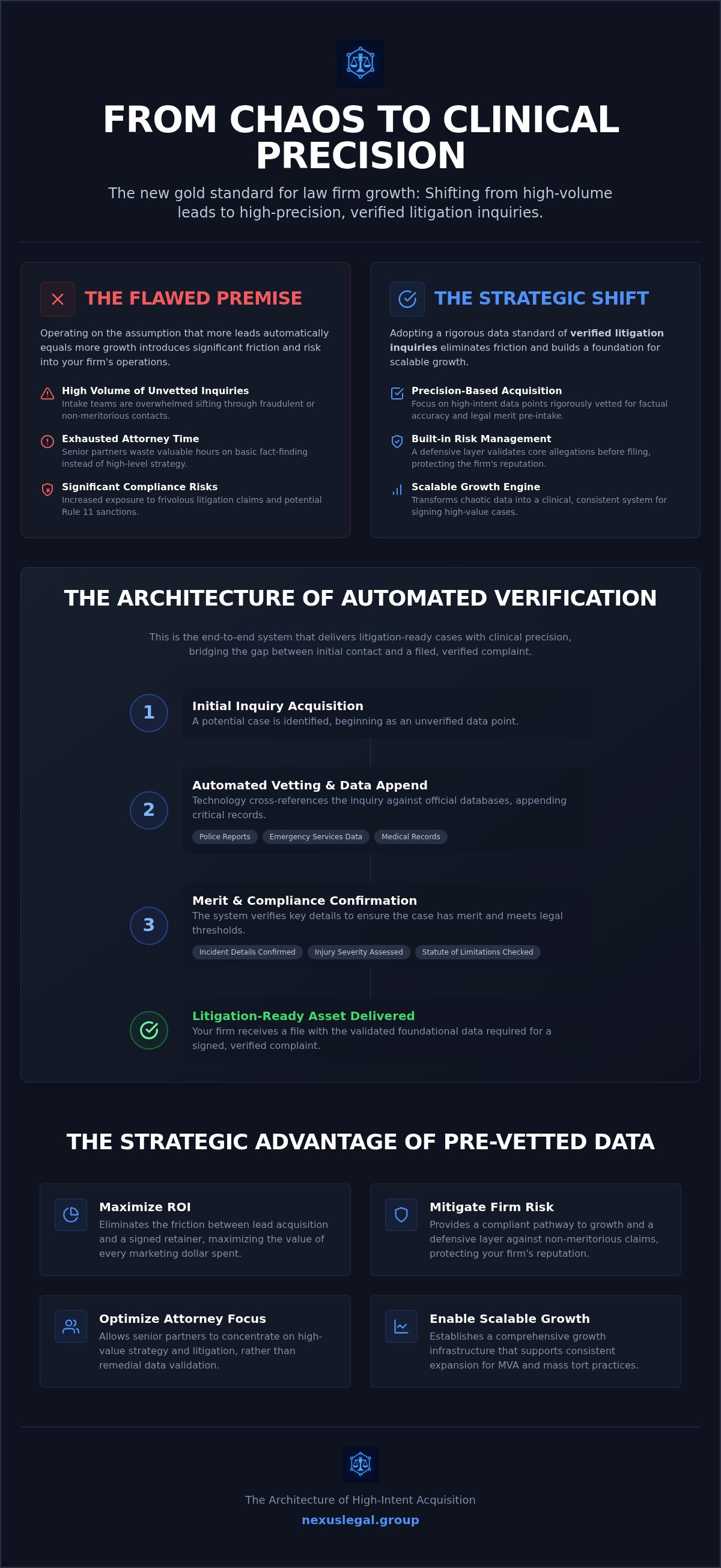
Most plaintiff firms are currently operating on a flawed premise: that more leads equate to more growth. You likely recognize that the reality is far more taxing, as your intake team sifts through a high volume of unvetted or fraudulent inquiries that exhaust attorney time and introduce significant compliance risks. Transitioning to a model built on verified litigation inquiries isn't just a tactical shift; it's the adoption of a rigorous data standard designed to eliminate operational friction between initial acquisition and the filed complaint.
You're about to discover how high-precision inquiry verification bridges the gap between raw lead generation and litigation-ready case acquisition. We'll examine the technical mechanics of automated verification and reverse-append technology, providing a clear blueprint for building a consistent, high-conversion growth infrastructure for your firm. By the end of this guide, you'll understand how to transform chaotic data into a clinical, scalable engine for signing cases. This approach ensures your firm doesn't just collect contacts, but secures the foundational data required for elite-level litigation in 2026.
Key Takeaways
- Shift your firm's focus from high-volume lead generation to precision-based acquisition to eliminate the burden of unvetted data on your intake team.
- Understand how verified litigation inquiries serve as the critical evidentiary foundation for transitioning raw data into a signed, verified complaint.
- Learn how to leverage automated verification tools that integrate police reports and emergency services data to confirm the merit of every potential case.
- Transition from a traditional lead-vendor model to a comprehensive growth infrastructure that supports scalable expansion for MVA and mass tort practices.
- Discover the mechanics of an end-to-end intake system that delivers litigation-ready cases with clinical precision and full ethical compliance.
The Evolution of Verified Litigation Inquiries in Modern Practice
The transition from mass-market lead generation to precision-based case acquisition marks a fundamental shift in how elite plaintiff firms operate. In 2026, the industry has reached a saturation point where raw inquiry volume often functions as a bottleneck rather than a catalyst for growth. Verified litigation inquiries have emerged as the new gold standard; these are high-intent data points rigorously vetted for factual accuracy and legal merit prior to intake. This clinical approach to data allows firms to prioritize integrity over sheer numbers, ensuring every file entering the system has a high probability of conversion into a signed case.
Beyond operational efficiency, this strategic shift addresses critical risk management. Attorneys face increasing scrutiny regarding frivolous litigation and potential Rule 11 sanctions. By utilizing pre-verified data, firms create a defensive layer that validates the core allegations of a claim before it ever reaches the stage of a formal Pleading. This systematic vetting process protects the firm's reputation and financial resources from being drained by non-meritorious claims that don't meet basic filing thresholds.
From Raw Leads to Verified Inquiries
Traditional marketing leads are often little more than unverified contact information, requiring extensive manual follow-up to determine viability. In contrast, the implementation of verified litigation inquiries transforms a potential contact into a litigation-ready asset by confirming specific incident details, injury severity, and statute of limitations compliance. This high-fidelity data drastically improves initial case evaluation speed. It allows your senior partners to focus on high-value strategy rather than basic fact-finding, moving the firm closer to its goal of high-precision acquisition without the noise of fraudulent data.
The Strategic Advantage of Pre-Vetted Data
Implementing an outsourced verification infrastructure through partners like Nexus Legal Group significantly reduces the administrative burden on internal intake teams. This model ensures every inquiry meets strict ethical standards for case solicitation and acquisition, providing a compliant pathway to growth. When a firm receives information that's already filtered through police reports and emergency services data, it's positioned for immediate filing. This level of preparation eliminates the typical friction found in the gap between lead acquisition and a signed retainer, maximizing the ROI of every marketing dollar spent.
Verified Complaints vs. Verified Inquiries: Bridging the Gap
Legal literature frequently analyzes the verified complaint as a final procedural step, yet elite firms recognize that the integrity of that document depends entirely on the data gathered during the initial intake phase. Swearing to allegations under penalty of perjury isn't a mere formality; it's a significant legal commitment that demands absolute factual certainty. This is where verified litigation inquiries serve as the critical bridge. They provide the clinical data points required to satisfy the standards established in the Federal Rules of Civil Procedure, ensuring that every assertion in a pleading is backed by corroborated evidence from the very first contact.
When firms rely on unverified data, they introduce operational friction that compounds during the drafting phase. Attorneys often find themselves trapped in a cycle of data repair, attempting to reconcile conflicting claimant statements with late-arriving evidence. This friction doesn't just waste time; it creates a liability gap. By securing high-fidelity data at the point of acquisition, you eliminate the uncertainty that typically plagues the transition from lead to filed case.
The Evidentiary Burden of Verification
Litigators often hesitate to verify complaints when they rely solely on unvetted claimant statements. The risk of inadvertent perjury is high when a plaintiff's memory hasn't been cross-referenced with objective records. Using reverse append technology to secure police reports and emergency services data provides the necessary corroboration for pleadings. This layer of verification allows attorneys to sign off on filings with professional confidence, knowing the foundational facts are established through independent, third-party sources rather than subjective anecdotes.
Operational Efficiency in Case Filing
Unverified data slows down case velocity and drains your firm's resources. When your team spends hours chasing non-responsive leads or correcting factual errors in a file, your ROI plummets. Transitioning to verified MVA leads for law firms eliminates "ghosting" by ensuring the claimant is reachable and the incident is officially documented. This streamlined path from intake to active litigation reduces the attorney hours spent on administrative cleanup and increases the rate at which inquiries convert to complaints.
Calculating the ROI of verified litigation inquiries involves measuring the reduction in time-to-file and the elimination of non-meritorious cases before they drain your overhead. By implementing a high-performance engine like the growth infrastructure at Nexus Legal Group, your firm can focus on high-stakes strategy rather than data validation. This systemic integrity ensures that your firm's growth is both rapid and ethically compliant, providing a clear path to market leadership in 2026.
The Mechanics of Automated Verification Infrastructure
The transition from subjective intake to clinical data verification requires a sophisticated technological stack. High-intent claimant identification begins with AI-driven marketing precision, which filters for specific behavioral signals that indicate a genuine legal need. Once a potential inquiry is captured, the system initiates a series of automated checks to transform a raw lead into one of many verified litigation inquiries. This process involves the immediate integration of police reports and emergency services data to cross-reference claimant statements with official records.
Utilizing reverse append technology allows the system to secure comprehensive participant details and accident reports without manual intervention. This infrastructure acts as a rigorous filter for both merit and jurisdiction, ensuring that cases meet the stringent standards required by the Federal Rules of Civil Procedure before they ever reach an attorney's desk. By automating these foundational steps, firms can maintain a high-velocity workflow while eliminating the risk of pursuing non-meritorious claims. It's a system designed to replace human error with algorithmic certainty.
Data Enrichment Through Incident Reports
The technical process of matching inquiries to official data is a cornerstone of modern case acquisition. By programmatically accessing incident reports, the system validates accident dynamics and participant roles with clinical precision. This ensures that the claimant's account aligns with the documented evidence from law enforcement. Transitioning to Police Report Generated MVA Leads allows your firm to bypass the traditional intake phase, providing a clear, evidence-backed narrative for every new file.
AI and Behavioral Data Verification
Identifying high-intent signals involves analyzing how a user interacts with digital assets. AI models detect patterns of urgency and consistency that distinguish a serious claimant from a casual inquirer. This automated vetting serves several functions:
- Reduces firm overhead by minimizing manual intake hours.
- Eliminates friction between the initial inquiry and the signed retainer.
- Ensures full compliance with ethical standards for case acquisition.
This technological approach ensures the ethical acquisition of signed cases through compliant technology. It creates a seamless bridge between the digital marketing landscape and the practical realities of a high-volume plaintiff practice. By the time an inquiry is delivered, the heavy lifting of verification is complete, allowing your team to focus on litigation strategy rather than administrative fact-checking. Don't waste time on data that hasn't been through this rigorous process.
Scaling Your Firm with Growth Infrastructure
Scaling a plaintiff practice requires a fundamental departure from the traditional, transactional lead-vendor model. Instead of purchasing raw data and hoping for a return, elite firms implement a comprehensive growth infrastructure that treats verified litigation inquiries as high-value systemic assets. This shift allows your organization to move beyond "lead buying" and toward a predictable acquisition engine. By integrating these high-fidelity data streams directly into existing case management systems, you eliminate the manual bottlenecks that typically paralyze intake teams during high-volume phases.
Maintaining clinical precision is the primary challenge when increasing case volume. Without a rigorous verification standard, scaling often leads to a diluted portfolio filled with non-meritorious claims. Litigation-ready inquiries solve this problem by ensuring that every case entering your workflow has already passed through a multi-stage vetting process. This consistency is particularly vital for building a scalable mass tort practice, where the sheer volume of data can easily overwhelm traditional intake methods if the foundational inquiries aren't pre-verified for accuracy and merit.
Engineering Scalable Case Flow
Automated systems allow your firm to compete for high-value Motor Vehicle Accident (MVA) cases on a national level, bypassing the limitations of local market saturation. The key to this expansion is the utilization of "exclusive" inquiries. Unlike shared leads that convert at significantly lower rates, exclusive data points maintain their value and protect your firm's reputation. Implementing a Law Firm Growth Infrastructure provides the blueprint for this transition, moving your firm away from reactive marketing and toward a proactive, data-driven acquisition strategy.
Risk Mitigation and Compliance
Elite plaintiff firms must prioritize transparency in data sourcing to satisfy both internal standards and external regulatory requirements. Every inquiry acquired must meet the highest ethical benchmarks for solicitation. Establishing a "no-nonsense" framework for case vetting ensures that compliance is baked into the acquisition process rather than treated as an afterthought. This rigorous approach to verified litigation inquiries mitigates the risk of ethical violations and ensures that your firm's growth is built on a foundation of integrity and technical mastery.
Nexus Legal Group: The Architecture of High-Intent Acquisition
Nexus Legal Group operates as the strategic architect for firms ready to transition from fragmented lead buying to a unified growth infrastructure. Through Nexus CaseFlow, we provide an end-to-end system that delivers verified litigation inquiries with surgical accuracy. This platform isn't a peripheral tool; it's the foundational layer that ensures your firm's expansion is grounded in high-fidelity data rather than speculative volume. Our specialization in MVA and mass tort inquiries allows us to apply rigorous, automated verification to every file before it enters your workflow. It's about results, not just numbers.
By eliminating data gaps and intake friction, our technology drives growth by delivering what we call litigation-ready inquiries. These aren't just contact details. They're comprehensive data packages that allow your attorneys to focus on high-level strategy from day one. We've built a steady, predictable engine that filters cases based on your specific merit and jurisdictional criteria. This level of technical mastery ensures your firm doesn't waste resources on non-meritorious claims.
Precision-Engineered Case Acquisition
Our commitment to clinical precision involves the strategic use of reverse append technology and police report data for every MVA inquiry. This ensures that every signed case we deliver is backed by objective, third-party documentation. Top-tier firms trust Nexus because we don't just provide leads; we provide the evidentiary foundation required for immediate litigation. When you receive a signed case through our infrastructure, the heavy lifting of verification is already complete. This allows for an immediate transition from intake to active pleading, maximizing your firm's case velocity and overall ROI. We focus on the mechanics of growth so you can focus on the law.
Next Steps for Strategic Growth
To begin implementing this standard, start by evaluating your firm's current inquiry-to-case conversion metrics. If your intake team is bogged down by unvetted data, it's time to consider a more sophisticated approach. Integrating Nexus infrastructure into your 2026 growth plan starts with a consultation to define your acquisition framework. We'll work with you to align our systems with your specific practice goals, ensuring a seamless integration with your existing case management software. Every second spent on unverified data is a second lost on a high-value case.
Don't let unverified data dictate your firm's ceiling. You can explore our methodologies further at our legal growth blog or view our systems in action through our video resource library. Our team is ready to help you architect a scalable, high-intent acquisition engine that secures your firm's position as a national market leader. Contact Nexus Legal Group today to secure your firm's growth infrastructure.
Securing Your Firm's Competitive Advantage in 2026
The transition from purchasing raw leads to implementing a comprehensive growth infrastructure is no longer optional for firms seeking national market leadership. You've seen how high-precision verification bridges the gap between initial contact and a signed, litigation-ready case. By leveraging AI-driven marketing and rigorous automated intake, you eliminate the friction that typically drains attorney time and firm overhead. This systematic approach allows your team to focus on high-stakes strategy rather than administrative fact-checking.
Adopting a standard centered on verified litigation inquiries ensures that your docket is built on a foundation of clinical accuracy and ethical compliance. Moving beyond transactional lead buying toward a scalable engine for case acquisition provides the stability required to dominate competitive MVA and mass tort markets. It's about securing high-intent data that stands up to the scrutiny of any pleading while maintaining the highest standards of professional conduct.
It's time to replace guesswork with algorithmic certainty and build the high-performance practice your team deserves. Your firm's future depends on the integrity of the data you acquire today; make sure it's built to last.
Frequently Asked Questions
What is the difference between a verified complaint and a verified litigation inquiry?
A verified complaint is a formal legal document filed with the court where the plaintiff swears to the truth of the allegations under penalty of perjury. In contrast, verified litigation inquiries are pre-vetted data points acquired during the intake phase. These inquiries provide the evidentiary foundation required to draft a complaint with confidence, ensuring that the facts are cross-referenced with official records before any formal legal commitment is made.
How does automated verification improve a law firm’s conversion rate?
Automated verification increases conversion rates by filtering out fraudulent entries and non-meritorious claims before they reach your intake team. By using algorithmic vetting to identify high-intent claimants, firms can focus their resources on inquiries that meet specific legal criteria. This reduction in administrative noise allows for faster response times, which is a critical factor in converting a raw inquiry into a signed retainer.
Why is police report data critical for verified MVA inquiries?
Police report data provides an objective, third-party account of accident dynamics, participant roles, and insurance information. Relying solely on a claimant's memory can lead to factual inconsistencies that weaken a case during discovery. By integrating official reports into the inquiry, firms can validate liability and injury severity with clinical precision, ensuring the data supports a high-value motor vehicle accident claim from the outset.
Are verified litigation inquiries compliant with ethical legal standards?
Yes, these inquiries are designed to meet the highest ethical and regulatory standards for case acquisition. Nexus Legal Group provides ethical and compliant leads and signed cases by ensuring all marketing and intake processes adhere to established solicitation rules. This commitment to transparency and data integrity protects the firm's reputation while providing a compliant pathway for national practice expansion and high-volume case acquisition.
Can automated verification replace a firm’s internal intake department?
Automated verification functions as a foundational growth infrastructure rather than a total replacement for human staff. It augments your internal intake department by handling the heavy lifting of data validation, reverse append searches, and merit filtering. This allows your team to shift from administrative fact-checking to high-value client communication, significantly reducing firm overhead and eliminating the operational friction associated with unvetted inquiry streams.
How does reverse append technology work in the context of litigation leads?
Reverse append technology utilizes a single verified data point, such as a name or contact number, to retrieve comprehensive background information from official databases. In litigation, this process is used to secure detailed accident reports and participant identities that the claimant may not have readily available. This technological approach ensures that every inquiry is enriched with the high-fidelity data necessary for immediate case evaluation and filing.
What makes an inquiry "litigation-ready" for a plaintiff firm?
An inquiry is considered litigation-ready when it includes all the corroborated data points required to move directly to a signed retainer and subsequent complaint. This includes verified injury status, established liability through third-party records, and confirmed jurisdiction. Verified litigation inquiries eliminate the "discovery gap" that often occurs during intake, providing a clear, evidence-backed narrative that allows attorneys to begin strategic work immediately upon acquisition.
How do verified inquiries help in securing injunctive relief?
Securing injunctive relief requires meeting a high evidentiary burden early in the litigation process. Verified inquiries provide the documented facts and high-intent claimant data needed to demonstrate immediate and irreparable harm. By having pre-vetted evidence and corroborated incident details at the point of filing, firms can present a more compelling case for emergency relief, as the foundational allegations are already supported by objective data.