Qualified motor vehicle accident leads Best Practices and Expert Advice
Stop wasting money on generic inquiries. Learn how to source qualified motor vehicle accident leads with data-driven strategies and lower your cost-per-case.
If your firm is spending upwards of $11,050 to sign a single standard auto case in 2026, you aren't just fighting a competitive market; you're likely battling a fragmented acquisition system. Most practitioners accept high overhead and overwhelmed intake teams as the inevitable cost of sourcing qualified motor vehicle accident leads. You know that the traditional model of chasing generic, unverified inquiries is becoming unsustainable under the weight of new FCC one-to-one consent rules and rising competition. The diversion of internal resources toward low-intent noise creates significant operational drag when the objective is high-value litigation.
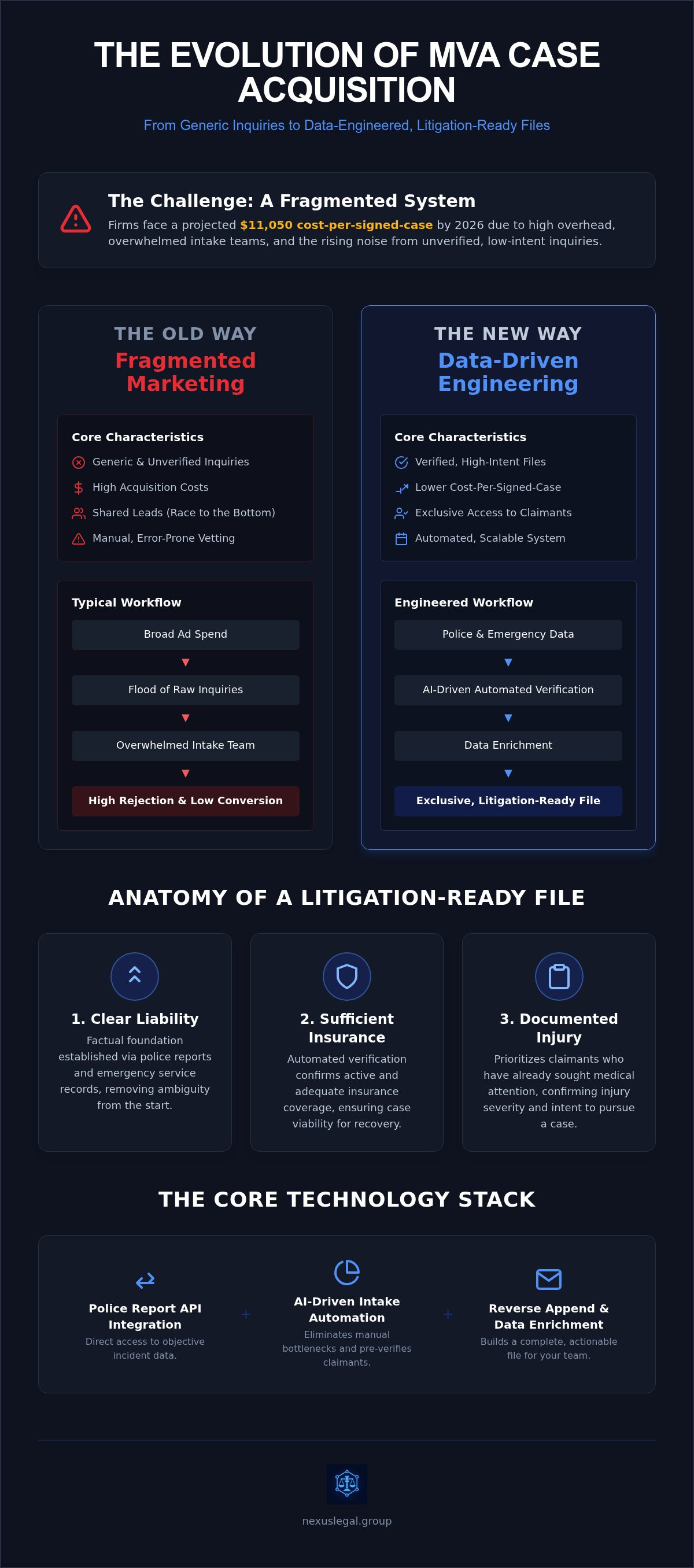
This guide will teach you how to engineer a high-intent MVA case acquisition system that replaces generic marketing with data-driven, litigation-ready inquiries. By shifting your focus toward inquiries backed by objective data, you can eliminate the friction in your growth strategy. We'll examine the technical mechanics of using police report integration, reverse append technology, and automated verification to secure exclusive cases. This overview provides the strategic architecture needed to lower your cost-per-signed-case while ensuring your intake team focuses only on verified, high-intent opportunities.
Key Takeaways
- Learn to distinguish between raw inquiries and litigation-ready files by prioritizing objective metrics like liability and insurance coverage.
- Discover how to source qualified motor vehicle accident leads using police report data and emergency services records to establish a factual foundation for fault.
- Implement AI-driven automated intake systems to eliminate manual bottlenecks and ensure your team only speaks with pre-verified claimants.
- Master the integration of reverse append technology and data enrichment to build a scalable, high-intent acquisition framework for 2026.
- Transition from generic marketing to a clinical growth infrastructure that delivers a consistent flow of exclusive, litigation-ready files for your firm.
Defining the Standard for Qualified Motor Vehicle Accident Leads
In the plaintiff litigation space, the term "lead" is often used loosely to describe any contact record. For elite firms, this ambiguity is a source of operational friction. A raw inquiry is merely a signal of interest; a litigation-ready lead is a verified asset. To maintain a high-performance growth engine, your firm must shift from broad marketing to a focus on qualified motor vehicle accident leads. This transition requires a clinical assessment of liability, insurance coverage, and injury severity before a file ever reaches your intake team.
Securing a consistent flow of these inquiries isn't about increasing your ad spend; it's about refining your engineering. Many firms struggle with high overhead because their intake teams are buried in unverified noise. To solve this, you need a clear distinction between a simple inquiry and a litigation-ready file. A litigation-ready file contains three foundational pillars: clear liability, sufficient insurance coverage, and documented injury severity. Without these, you're merely managing a database of possibilities rather than a pipeline of cases.
Exclusivity serves as the bedrock of this system. When a lead is shared among multiple firms, it creates a "race to the bottom" environment that devalues the claimant's experience and forces your team into a frantic, low-conversion workflow. Elite plaintiff firms demand exclusive access to ensure they can provide a sophisticated, professional first contact. This methodical approach establishes trust and secures the case before the claimant is overwhelmed by competing solicitations.
The Anatomy of a High-Intent Inquiry
High-intent inquiries are characterized by immediate post-accident behavioral triggers. When an individual searches for legal assistance within hours of a Traffic collision overview, their intent is at its peak. Real-time data delivery is critical here because conversion rates drop significantly as time passes. Behavioral data analysis allows us to identify these "hot" signals, ensuring that the system prioritizes individuals who have already sought medical attention or have documented police reports. This level of precision reduces the cost-per-signed-case by eliminating the need to chase cold or unverified prospects.
Qualified vs. Unqualified: A Precision Framework
A precision framework moves beyond the vague assessments used by generic agencies. It establishes firm-specific criteria that filter out "junk" inquiries, such as those involving property-damage-only incidents or cases where the statute of limitations has expired. By implementing pre-intake filtering, you ensure your staff doesn't waste hours on unrecoverable files. A qualified MVA lead is a verified, exclusive inquiry with confirmed incident data. This standard ensures that every record entering your CRM has a high probability of conversion into a viable case. Implementing a data-driven growth infrastructure with Nexus Legal Group allows you to bypass these common pitfalls and focus on high-value litigation.
Engineering Acquisition via Police and Emergency Data
Engineering a case acquisition pipeline requires moving beyond the volatility of traditional digital advertising. While search engine marketing relies on user-triggered queries, data-driven acquisition identifies qualified motor vehicle accident leads through objective, third-party records. This shift eliminates the junk volume associated with broad-match keywords and social media clicks. By focusing on incident-level data, firms can target high-intent claimants based on the physical reality of the accident rather than just their search history. This method creates a more predictable and scalable growth engine for elite plaintiff firms in 2026.
Police reports provide the most reliable factual foundation for determining liability and case viability. Integrating these official records into your acquisition flow ensures that every inquiry is backed by an objective third-party account. When you leverage police report generated MVA leads, you're filtering for incidents that meet the legal definition of a motor vehicle accident. This process prioritizes accuracy and ethical compliance, providing your team with the data necessary to assess fault immediately. Emergency services data adds another layer of precision, identifying high-severity incidents where medical transport was required, which often correlates with higher settlement values.
Enriching Leads with Reverse Append Technology
Raw incident data is frequently fragmented, leaving intake teams with missing contact information or unverified insurance details. Reverse append technology solves this by cross-referencing available incident data with extensive databases to retrieve missing participant details. This enrichment process prepares your attorneys for the initial consultation by providing a comprehensive view of the accident's mechanics and the parties involved. You don't have to wait for the claimant to find their paperwork; the data is already in your hands.
Access to detailed accident reports before the first call significantly impacts case valuation and conversion rates. When your intake team can confirm insurance carriers and vehicle impact points instantly, the conversation shifts from discovery to retention. Implementing these sophisticated technological solutions allows your firm to operate with clinical precision, transforming raw data into litigation-ready files. This systemic approach reduces the time spent on administrative verification and accelerates the path to a signed retainer.
The Role of Automated Verification in Eliminating Intake Friction
Manual intake operations represent the primary bottleneck for plaintiff firms attempting to scale in 2026. When your staff spends hours chasing unverified inquiries, your cost-per-signed-case, which can average between $3,900 and $11,050 for standard auto accidents, skyrockets due to operational inefficiency. Automated verification replaces this friction with a clinical, AI-driven process that qualifies inquiries in seconds. By filtering out non-viable cases before they reach a human agent, you ensure that your team only engages with qualified motor vehicle accident leads that meet your specific litigation criteria. This systematic approach reduces overhead and eliminates the fatigue associated with "junk" lead management.
The mechanics of AI-driven verification involve cross-referencing claimant statements with real-time incident data and insurance records. This isn't a simple chatbot interaction; it's a sophisticated data-matching engine that confirms the presence of a police report and the validity of insurance coverage. Maintaining a professional, clinical tone during this stage is essential. The system must guide the claimant through the process with instructional clarity, instilling confidence that their case is being evaluated with technical mastery from the very first touchpoint.
Engineering High-Intent Case Growth
Automation acts as a foundational layer for automated intake for plaintiff firms, ensuring every lead surpasses a strict quality threshold. In a market where speed is the dominant factor in retention, rapid verification is essential. Claimants expect immediate confirmation that their case is being handled with professional urgency. A delay of even thirty minutes can result in a lost opportunity, as competitors with more efficient systems capture the prospect first. By automating the verification of insurance and liability data, you secure the claimant's commitment while their intent is at its peak.
Quality Metrics for Verified Inquiries
A successful automated intake system is measured by its ability to balance clinical precision with an instructional dialogue. Key Performance Indicators (KPIs) should focus on the accuracy of data extraction and the conversion rate from verified inquiry to signed retainer. Modern AI models go beyond simple filtering; they utilize historical data to predict potential case outcomes during the initial interaction. This predictive capability allows firms to prioritize resources toward high-value files, such as catastrophic injury cases, where the cost-per-signed-case can exceed $22,100. This systemic approach ensures that your growth is driven by data rather than volume.
Scaling Your MVA Case Flow: From Inquiry to Litigation-Ready File
Scaling a practice in 2026 requires a fundamental shift in how you view acquisition. Most firms treat lead generation as a peripheral expense, but elite practices treat it as a core technological asset. This transition from a lead-purchase model to a growth infrastructure model allows you to manage high-volume acquisition while maintaining the rigorous standards required for litigation. When you treat qualified motor vehicle accident leads as a raw material for a sophisticated processing engine, you achieve a level of consistency that traditional marketing agencies cannot match. It's about moving away from the volatility of raw inquiries and toward a predictable flow of litigation-ready files that drive sustainable firm expansion. This systemic approach ensures that your marketing spend is an investment in institutional growth rather than a recurring cost.
Law Firm Growth Infrastructure as a Foundational Layer
Elite plaintiff firms don't just buy leads; they invest in law firm growth infrastructure. This system acts as a foundational layer that integrates marketing precision with automated verification. Unlike a standard agency that delivers volume and leaves filtering to your staff, this model ensures every record is litigation-ready. The long-term ROI is realized through lower overhead and a higher percentage of signed retainers, as your intake team focuses only on high-value claimant interactions.
Sourcing Litigation-Ready MVA Inquiries
Preparing your firm for high-intent volume requires more than just hiring intake specialists. It involves implementing a framework that ensures ethical compliance and data integrity at scale. By utilizing high conversion MVA leads, you leverage behavioral trends and data enrichment to anticipate claimant needs. This proactive stance is essential for maintaining standards during rapid expansion. A robust system ensures that as volume increases, the precision of your filtering remains constant, protecting your firm's profitability.
Managing high-volume acquisition without compromising your firm's standards is a technical engineering challenge. It requires a system that can process qualified motor vehicle accident leads with clinical precision, ensuring that growth doesn't come at the expense of case quality. By integrating these systemic tools, you create a scalable framework that transforms the intake process from a source of friction into a high-performance engine for business growth.
Implementing a Data-Driven Growth Infrastructure with Nexus Legal Group
Nexus Legal Group provides the end-to-end growth infrastructure necessary to secure qualified motor vehicle accident leads at scale. In 2026, the distinction between a standard practice and a high-performance litigation business is the quality of its foundational systems. We don't just deliver inquiries; we build the technical layers that transform raw data into signed retainers. The Nexus CaseFlow system operates with clinical precision, ensuring that every file delivered to your firm is litigation-ready and exclusive. This transition to a frictionless, automated acquisition model allows your partners to focus on case strategy rather than the logistical burden of intake management. It's a shift toward operational excellence that treats growth as an engineering challenge rather than a marketing expense.
By centralizing data acquisition and intake verification into a single, cohesive environment, firms can eliminate the operational drag that typically accompanies rapid expansion. This infrastructure acts as a foundational layer for your organization, providing the stability needed to pursue aggressive growth targets without compromising case quality. The result is a predictable, scalable engine that delivers consistent results in a volatile market.
The Nexus Advantage: Data, AI, and Verification
Our platform represents the intersection of technological mastery and legal industry expertise. By integrating real-time incident data with sophisticated AI models, we eliminate the guesswork from the acquisition process. It's a system designed for elite performance in the most competitive national markets. Nexus combines police reports and AI to deliver signed cases, providing a level of verification that manual intake teams simply can't achieve. This ensures that your firm receives qualified motor vehicle accident leads that have already been vetted for liability, insurance coverage, and injury severity. We prioritize systemic integrity, ensuring that every record meets your firm's specific litigation threshold before it enters your workflow.
Getting Started with Institutional Growth
The onboarding process for elite plaintiff firms is designed to be as methodical as the system itself. We begin by setting specific parameters for exclusive case acquisition, tailoring the flow to your firm's capacity and target practice areas. This ensures that your growth is sustainable and remains aligned with your internal operational standards. Whether your firm is targeting high-volume MVA inquiries or complex mass tort cases, the infrastructure is built to scale with your needs. It's time to move beyond the limitations of traditional marketing and adopt a data-driven growth model that delivers clinical results.
Engineering Your Firm's Competitive Advantage for 2026
The transition to a data-driven acquisition model is a structural necessity for firms that want to scale efficiently. By integrating police report and emergency services data, you move beyond the uncertainty of generic marketing and into a realm of technical mastery. You've seen that qualified motor vehicle accident leads are the result of rigorous engineering rather than simple ad spend. Implementing automated intake verification allows your team to focus on litigating high-value cases while the system handles the heavy lifting of data enrichment and filtering. This approach eliminates friction and builds a sustainable pipeline.
Building this foundational layer requires a partner that understands the mechanics of business expansion. Through AI-driven marketing precision and seamless data integration, you can transform your intake department into a high-performance engine. It's time to replace fragmented processes with a cohesive growth infrastructure that delivers predictable, litigation-ready inquiries. This strategy ensures your firm remains authoritative and profitable in an increasingly competitive landscape.
Your firm's potential for expansion is limited only by the strength of its systems. Take the lead in your market by adopting a clinical, results-oriented approach to case acquisition today.
Frequently Asked Questions
What defines a qualified motor vehicle accident lead in 2026?
A qualified motor vehicle accident lead in 2026 is defined as an exclusive, verified inquiry that includes confirmed incident data, established liability, and insurance coverage information. Unlike raw marketing inquiries, these files are litigation-ready assets. The qualification process uses objective metrics to ensure the claimant has sought medical attention and that the statute of limitations remains valid. This technical standard eliminates the operational drag caused by unverified volume.
How does police report data improve MVA lead quality?
Police report data improves lead quality by providing an objective, third-party factual foundation for every claim. By integrating official incident records, your firm can confirm fault and liability before the first contact. This data-driven approach removes the ambiguity of self-reported claimant statements. It ensures that qualified motor vehicle accident leads are backed by documented evidence, which significantly increases the predictability of case outcomes and settlement values.
Can automated verification replace a manual intake team?
Automated verification doesn't replace the need for legal expertise; it eliminates the intake bottleneck by filtering out non-viable inquiries before they reach your staff. In 2026, AI-driven systems handle the heavy lifting of confirming insurance and incident details. This allows your intake team to focus exclusively on high-value, litigation-ready files. By automating the verification layer, you reduce overhead and ensure your professionals aren't wasting time on property-damage-only incidents.
What is reverse append technology in the context of legal leads?
Reverse append technology is a data enrichment process that cross-references fragmented incident data with extensive databases to retrieve missing participant details and insurance information. This system fills the gaps in raw reports, providing a comprehensive view of the accident mechanics. It prepares your firm for the initial consultation by delivering a complete file. Attorneys use this enriched data to assess case valuation instantly, bypassing the delays of manual discovery.
Are these MVA leads exclusive to my law firm?
Yes, exclusivity is a foundational requirement for high-intent MVA case acquisition through Nexus Legal Group. Shared leads create a frantic environment that devalues the claimant's experience and lowers conversion rates. By providing exclusive access, the system ensures your firm is the sole point of contact. This allows for a sophisticated, professional engagement that secures the case before the claimant is overwhelmed by competing solicitations from other practices.
How does Nexus Legal Group ensure ethical and compliant lead generation?
Nexus Legal Group ensures compliance by strictly adhering to the 2025 FCC one-to-one consent rules and a patchwork of state-level privacy laws like the CPRA. Our infrastructure is designed to maintain systemic integrity at every stage of the acquisition process. We prioritize ethical standards as a baseline, ensuring that every inquiry is obtained through transparent, documented consent. This clinical approach protects your firm's reputation while providing high-intent, litigation-ready inquiries.
What is the typical conversion rate for high-intent MVA inquiries?
In 2026, firms using AI-driven automated intake see conversion rates that significantly outperform traditional marketing benchmarks. While industry engagement rates suggest only 15-25% of injured individuals seek representation, high-intent systems capture a larger share by filtering for litigation-readiness. The focus is on the quality of the file rather than raw volume. By targeting individuals with confirmed injuries and liability, your firm can achieve a more predictable and efficient cost-per-signed-case.
How quickly are leads delivered after an accident occurs?
Leads are delivered in real-time, often within seconds of the data being verified through our growth infrastructure. Speed is a critical factor in claimant retention; conversion rates drop as time passes after the initial incident. Our system identifies behavioral triggers and processes incident data with controlled urgency. This ensures your firm can engage with the claimant while their intent is at its peak, providing a seamless transition from the accident to legal representation.