Precision legal case targeting Guide for Success
Stop filtering unqualified leads. Our guide to precision legal case targeting uses data to deliver litigation-ready MVA & mass tort cases to your firm.
Generic lead generation is no longer a viable growth strategy for elite plaintiff firms; it is a drain on operational efficiency that compromises your bottom line. You've likely experienced the exhaustion of manual intake, where your staff spends hours filtering through unqualified inquiries and unverified data. It's a common frustration to see inconsistent case flow disrupt your revenue predictability while competitors seem to secure the most valuable claims. Transitioning to precision legal case targeting allows you to move beyond these antiquated methods and adopt a clinical, data-driven approach to firm expansion.
In this guide, you'll discover how to implement a high-precision acquisition infrastructure designed to deliver litigation-ready MVA and mass tort cases with technical mastery. We'll demonstrate how to leverage police report data and automated verification to eliminate intake friction and provide direct access to accident participants. We will outline the mechanics of building a predictable, high-volume stream of cases by using sophisticated tools like reverse append technology and emergency services data. This is your roadmap to replacing manual guesswork with a foundational layer of systemic integrity that ensures every inquiry is ready for immediate legal action.
Key Takeaways
- Shift your perspective from traditional lead generation to a data-engineered infrastructure that prioritizes claimant intent over simple inquiry volume.
- Learn how to leverage police reports and emergency services data to identify and verify specific accident participants with clinical accuracy.
- Implement precision legal case targeting to automate your intake funnel, ensuring every inquiry is litigation-ready before it reaches your staff.
- Follow a structural blueprint to integrate high-intent acquisition systems directly into your firm's workflow for sustainable and predictable growth.
- Discover how advanced data enrichment and reverse append technology provide a foundational layer for sourcing exclusive MVA and mass tort cases.
The Evolution of Intake: Defining Precision Legal Case Targeting
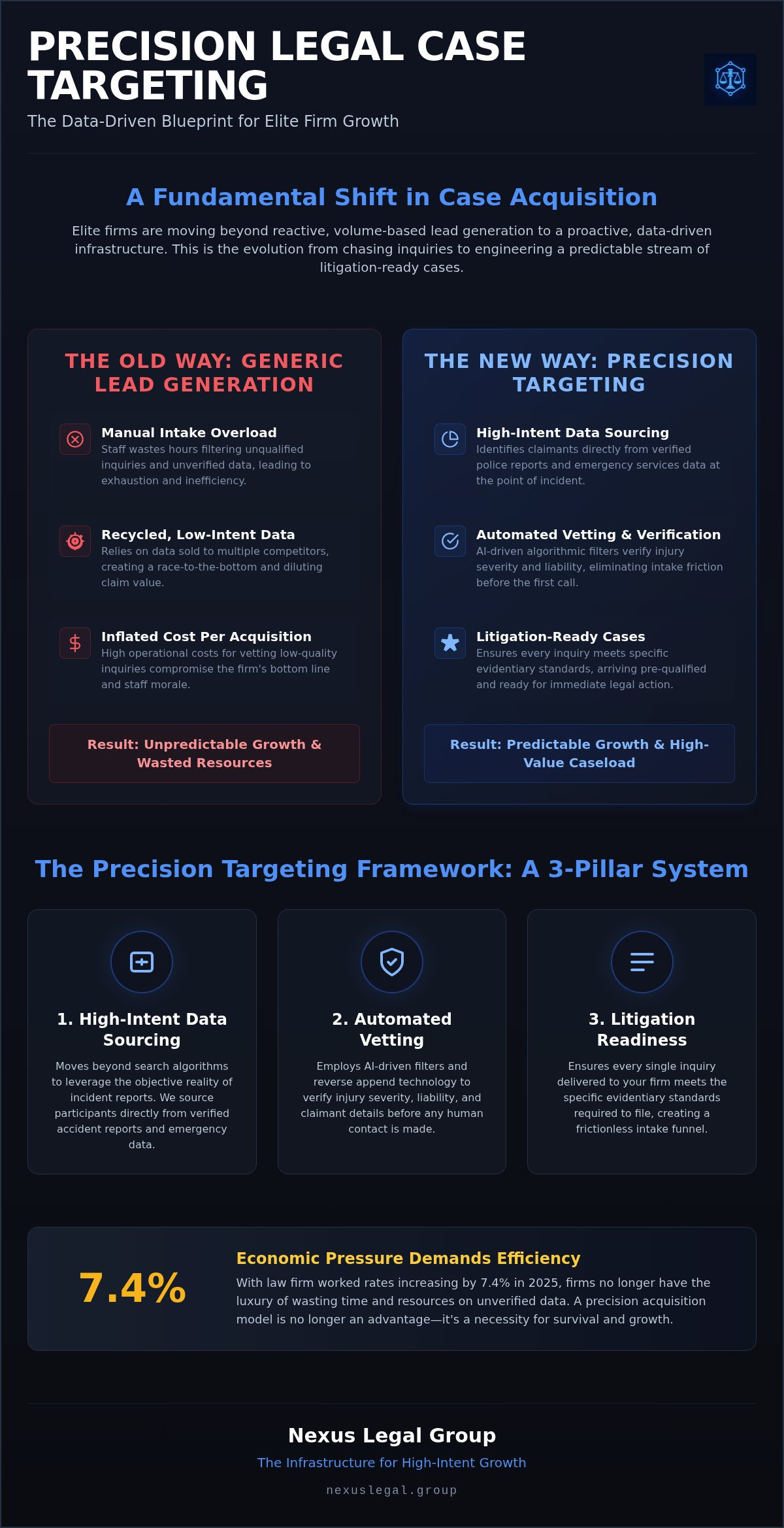
Precision legal case targeting represents a fundamental departure from the reactive marketing models of the past. It's a sophisticated, data-driven infrastructure designed to identify high-intent claimants with clinical accuracy. While traditional lead generation focuses on the sheer volume of inquiries, this precision-based model prioritizes the intent and litigation readiness of the individual. For elite plaintiff firms, this isn't just a marketing preference; it's a necessary evolution to maintain high conversion rates without bloating overhead. By treating case acquisition as a foundational growth infrastructure rather than a fluctuating expense, firms can build a predictable engine for expansion.
Why Traditional Lead Generation Is Obsolete for Elite Firms
The reliance on non-exclusive, low-intent inquiries has become a primary bottleneck for modern practices. When your intake department is forced to vet "junk leads," your Cost Per Acquisition (CPA) inflates while staff morale plummets. It's an inefficient use of resources to have highly trained professionals manual-vetting inquiries that lack the basic criteria for a viable claim. We've seen a decisive shift in 2026 toward institutional-grade sourcing models that favor technical mastery over mass-market reach.
With law firm worked rates increasing by 7.4% in 2025, firms don't have the luxury of wasting time on unverified data. This economic pressure demands a system that eliminates friction. Traditional lead generation often delivers recycled data that's been sold to multiple competitors, creating a race to the bottom. Elite firms are now opting for exclusive data streams that integrate directly into their workflow, ensuring they are the first and only point of contact for high-value claimants. This shift is a key component of modern Legal technology, where automation ensures that only the most qualified cases reach the intake desk.
The Precision Targeting Framework: Intent, Data, and Verification
The precision legal case targeting framework relies on three pillars to ensure systemic integrity: high-intent data sourcing, automated vetting, and litigation readiness. Instead of waiting for a claimant to find a lawyer, AI-driven marketing now identifies behavioral signals that suggest a need for legal representation before the claimant even begins a search. This allows your firm to engage participants at the precise moment their intent is highest.
- High-Intent Data: Sourcing participants directly from verified accident reports and emergency data.
- Automated Vetting: Using algorithmic filters to verify injury severity and liability before the first call.
- Litigation Readiness: Ensuring every inquiry meets the specific evidentiary standards required to file.
Precision Case Targeting is the strategic application of data enrichment to law firm growth. By utilizing precision legal case targeting, you ensure that every inquiry entering your funnel is already verified and ready for immediate action. This allows your firm to scale its caseload with surgical precision, focusing only on the high-value MVA and mass tort opportunities that drive significant revenue.
The Mechanics of High-Intent MVA Data Sourcing
Relying on search engine algorithms to find claimants is a reactive strategy that often leads to recycled, low-intent data. Instead, precision legal case targeting utilizes the objective reality of incident reports to identify high-intent participants at the source. This methodology shifts the focus from who is searching for a lawyer to who has actually been involved in a verified, high-value accident. By sourcing directly from the events themselves, firms can secure a primary position in the claimant's journey, ensuring they aren't competing for a lead that's already been shopped to five other practices.
Leveraging Police Reports and Emergency Services Data
The foundation of a high-precision acquisition model lies in the ingestion of raw incident data. Automated systems now allow firms to monitor police reports and emergency services dispatches in real time. This technical approach identifies motor vehicle accidents based on specific severity markers and liability indicators before the parties involved even consider their legal options. There's a massive strategic difference between a generic "car accident lawyer" search and targeted incident-based sourcing. While searchers might be looking for general information, accident participants identified through police data represent a verified, high-intent pool of potential cases. Explore our growth infrastructure videos for a deep dive into how this data sourcing functions as a foundational layer for elite firms.
Reverse Append Technology: The Key to Case Enrichment
Raw incident data is often incomplete, providing only a fragment of the information needed to file a claim. Reverse append technology serves as the bridge between a simple accident report and a litigation-ready inquiry. This process involves taking limited identifiers from a police report, such as a license plate or a partial name, and cross-referencing them against massive databases to return comprehensive participant profiles. This enrichment ensures your firm has contact details, insurance information, and vehicle history before the first intake call is even placed.
- Profile Completion: Turning a report number into a full claimant dossier.
- Verification: Confirming the accuracy of participant details through multi-source cross-referencing.
- Filing Speed: Reducing the time from incident to signed case by having all necessary data points upfront.
Enriched data doesn't just improve efficiency; it builds immediate claimant trust. When your intake team reaches out with a clear understanding of the incident's specifics, it demonstrates a level of technical mastery that generic marketing can't match. This clinical precision is essential for implementing a data-driven acquisition model that scales without increasing intake friction. By securing exclusivity through incident-based sourcing, your firm becomes the strategic architect of its own growth, operating on a proprietary stream of high-value MVA opportunities.
Automated Verification: Engineering a Frictionless Intake Funnel
Engineering a frictionless funnel requires more than just high-volume data; it demands a clinical verification process that separates raw inquiries from actionable claims. Traditional firms often struggle with the manual labor of vetting, but precision legal case targeting integrates automated verification to ensure only the highest-quality data reaches the intake desk. This systemic approach eliminates the noise of unqualified leads, allowing your team to focus exclusively on high-intent opportunities that are ready for immediate legal action.
Manual Vetting vs. Automated Legal Intake Verification
| Operational Metric | Manual Vetting Process | Automated Verification System |
|---|---|---|
| Response Latency | High (Hours to Days) | Instantaneous (Seconds) |
| Staff Overhead | Substantial (Manual Review) | Minimal (Algorithmic) |
| Scalability | Limited by Headcount | Unlimited Technical Capacity |
Automated systems don't just work faster; they provide a level of data integrity that manual processes can't match. By cross-referencing incident data with existing firm records, these systems identify conflicts of interest and case viability issues instantly. This reduction in overhead is a critical component of institutional-grade growth. For more on these systems, read about Automated intake for plaintiff firms: engineering high-intent case growth.
Achieving Litigation-Readiness Through Algorithmic Qualification
Algorithmic qualification applies rigorous filters to every inquiry, assessing liability, injury severity, and statutes of limitations in real-time. By the time a claimant speaks with your staff, the infrastructure has already confirmed they meet your specific litigation criteria. This ensures that precision legal case targeting results in a higher conversion rate from inquiry to signed case. It's a methodical process that removes the guesswork from intake. Litigation-readiness is the ultimate metric for firm efficiency.
Focusing on ethical and compliant verification ensures that your firm maintains the highest standards in personal injury and mass tort acquisition. By 2026, the proliferation of AI in legal practice has made these automated safeguards essential for managing the increased volume of AI-driven litigation. This isn't just about speed; it's about building a foundational layer of systemic integrity that protects the firm's reputation while driving aggressive growth. When your intake team only handles cases that have already been algorithmically qualified, they operate with a higher degree of professional confidence and efficiency.
Operationalizing Precision: A Blueprint for Firm Scalability
Scalability in a high-stakes legal environment isn't achieved through larger marketing budgets, but through superior operational frameworks. You must view case acquisition as a growth infrastructure rather than a discretionary marketing expense. By owning your data-driven acquisition pipeline, you eliminate reliance on third-party lead aggregators and ensure a consistent flow of high-value cases. This systemic shift allows elite firms to manage massive MVA and mass tort dockets with clinical precision, focusing resources where they generate the highest return.
Integrating Data-Driven Sourcing into Law Firm Workflows
Transitioning your firm to a high-precision model requires a methodical approach that prioritizes automation over manual labor. You can't scale an intake department that relies on human intuition to vet thousands of raw leads. Instead, follow this blueprint to modernize your acquisition engine:
- Step 1: Audit your existing intake process to identify specific friction points where manual vetting causes delays or data loss.
- Step 2: Implement automated verification layers that algorithmically filter inquiries based on your specific litigation criteria.
- Step 3: Transition from reactive strategies like general SEO or PPC to proactive, incident-based precision legal case targeting.
This proactive method ensures your team only engages with verified accident participants who have a high probability of conversion. It moves the firm from a defensive posture to an offensive one, where you control the quality of the docket. Visit the Nexus Legal Group blog for more tactical growth insights on optimizing these internal systems.
Measuring ROI on Precision vs. Volume
Traditional metrics like Cost Per Lead (CPL) are often misleading because they don't account for the labor required to filter out noise. The gold standard for elite practices is the Cost Per Signed Case. When you implement precision legal case targeting, you're investing in a system that prioritizes signed cases over raw inquiry volume. This infrastructure reduces the time-to-settlement by providing enriched case data, such as insurance details and accident specifics, before the first filing is even drafted.
Firms that adopt this framework operate as strategic architects of their own expansion. They don't just buy leads; they build a foundational layer of systemic integrity that drives predictable revenue. For a deeper look at this model, review the law firm growth infrastructure: the blueprint for scaling plaintiff practices. This approach ensures your firm remains competitive in a market where law firm worked rates increased by 7.4% in 2025, demanding maximum efficiency from every operational dollar.
Nexus Legal Group: The Infrastructure for High-Intent Growth
Nexus Legal Group functions as the foundational layer for elite plaintiff firms that require more than peripheral marketing tools. We provide an end-to-end growth infrastructure that replaces the fragmented nature of traditional lead generation with a unified, high-performance engine. By integrating AI-driven marketing with verified police report data, we ensure that every inquiry entering your system is litigation-ready and exclusive to your practice. Our CaseFlow model is built on three pillars: AI precision, data enrichment, and automated verification. This framework allows firms to adopt a system of precision legal case targeting focused on the mechanics of aggressive business expansion and the elimination of operational friction.
End-to-End Growth Infrastructure for Modern Trial Lawyers
Our methodology manages the entire acquisition lifecycle, starting with the immediate ingestion of emergency services data and concluding with the delivery of signed, litigation-ready cases. This clinical process utilizes reverse append technology to enrich participant profiles, providing your team with the technical mastery needed to convert inquiries at a significantly higher rate. In 2026, maintaining ethical and compliant standards is not just a regulatory requirement but a core component of systemic integrity. Elite firms use our platform to eliminate the intake friction that typically bottlenecks high-volume practices, allowing them to focus on trial results rather than administrative vetting. For a deeper analysis of these systems, see our guide on AI-driven legal case acquisition: growth infrastructure for elite firms.
Securing Your Firm's Future with Litigation-Ready Inquiries
Securing your firm's future requires a decisive move away from the volatility of generic lead sources. precision legal case targeting provides the strategic advantage of an exclusive acquisition pipeline, allowing you to scale your MVA and mass tort dockets without increasing manual overhead or wasting resources on unqualified data. When you own the data-engineering process, you eliminate the middleman and the associated noise of recycled, low-intent inquiries. This focus on litigation-ready inquiries ensures that your firm operates with maximum efficiency, even as law firm worked rates continue to rise and competition intensifies. Success in a crowded national market is a direct result of operational excellence and the implementation of a powerful, high-performance growth engine that drives results from behind the scenes.
Scaling Your Practice Through Technical Mastery
Transitioning from reactive lead generation to a clinical data-engineering model is the definitive step toward sustainable firm expansion. You've seen how leveraging exclusive police report data and reverse append technology allows you to identify accident participants with absolute accuracy. By adopting precision legal case targeting, you replace the high overhead of manual vetting with an automated verification system that delivers litigation-ready inquiries directly to your docket. This systemic shift ensures that your intake team focuses only on high-intent cases that are ready for immediate legal action.
Treating your acquisition pipeline as an end-to-end growth infrastructure provides the predictability and security required in a modern legal market. It's about moving beyond peripheral marketing tools and installing a high-performance engine that works behind the scenes to eliminate friction and drive revenue. This foundational layer of technical mastery allows elite firms to scale their MVA and mass tort practices with surgical precision. You have the blueprint to move from inconsistent lead flow to a robust, data-driven acquisition engine that fuels long-term success.
Your firm is ready to move beyond the limitations of traditional marketing and embrace a future defined by operational excellence. It is time to architect a more efficient, high-volume practice through the power of precision systems.
Frequently Asked Questions
What is precision legal case targeting?
Precision legal case targeting is a data-driven methodology that identifies and acquires high-intent claimants using AI precision and verified incident data. Unlike broad marketing, it focuses on technical mastery to deliver litigation-ready cases. It functions as a foundational layer for elite firms, moving away from generic lead generation. By using systemic integrity, firms can target specific participants from verified events, ensuring every inquiry meets rigorous litigation standards before intake begins.
How does automated verification improve law firm efficiency?
Automated verification eliminates manual vetting of low-quality inquiries by algorithmically qualifying every claimant based on liability and injury severity. This technical process reduces firm overhead by ensuring intake teams only handle litigation-ready inquiries. It removes the friction of junk leads and manual data entry errors. Firms can scale their caseload mechanically because the system checks for conflicts of interest and case viability instantly, providing a high-performance engine for growth.
Can firms use police report data for MVA case acquisition?
Yes, firms can leverage police report data to identify accident participants at the source with clinical precision. This incident-based sourcing provides a primary position in the claimant's journey, avoiding the competition associated with shared leads. Automated systems ingest reports and emergency services data to find high-value motor vehicle accidents. This ensures the firm is the first point of contact for verified participants, providing an exclusive and reliable stream of high-intent MVA cases.
What makes an MVA inquiry 'litigation-ready'?
An MVA inquiry is considered litigation-ready when it's been algorithmically qualified for liability, injury severity, and insurance coverage. It must meet the specific evidentiary standards required to file a claim immediately. This status ensures that the intake department doesn't waste time on unverified data. By the time a claimant speaks with your staff, the system has already confirmed they meet the firm's specific litigation criteria, which helps maximize conversion rates.
How does reverse append technology help personal injury lawyers?
Reverse append technology turns raw incident data, like a license plate or partial name from a police report, into a comprehensive participant profile. It enriches the case file with contact details and insurance information before the first call. This enrichment allows personal injury lawyers to establish immediate trust with claimants. Having all litigation-ready details upfront reduces the time-to-settlement and ensures the firm operates with technical mastery throughout the acquisition lifecycle.
Is precision case targeting compliant with legal ethics standards?
Yes, precision case targeting is designed to be ethical and compliant with legal standards by prioritizing verified incident data and transparent acquisition processes. It focuses on high-intent claimants who've been involved in documented accidents. By 2026, the use of AI in legal practice requires these rigorous, data-driven safeguards. Elite firms use this infrastructure to ensure their growth strategies remain respectful and professional while maintaining institutional-grade sourcing for MVA and mass tort cases.
What is the difference between a lead and a high-intent inquiry?
A lead is often a broad, unverified inquiry from general marketing, whereas a high-intent inquiry is a verified participant from a specific incident. High-intent inquiries are characterized by behavioral signals and documented involvement in high-value accidents. Leads often result in high intake friction and low conversion rates. In contrast, high-intent inquiries are litigation-ready, meaning they've already passed through automated verification and data enrichment, making them ready for immediate legal action.
How do elite plaintiff firms scale their mass tort dockets in 2026?
Elite firms scale their mass tort dockets by implementing end-to-end growth infrastructure that utilizes precision legal case targeting. This model combines AI precision with automated intake verification to manage high-volume dockets with clinical accuracy. With law firm worked rates increasing by 7.4% in 2025, firms must optimize their acquisition pipelines. By owning the data-engineering process, firms can secure a predictable stream of signed cases without increasing manual overhead or relying on third-party aggregators.