Personal Injury Intake KPIs: The Strategic Framework for High-Intent Case Acquisition
Master your personal injury intake KPIs to reduce cost per signed case, eliminate lead response delays, and reliably acquire high-intent plaintiff cases now.
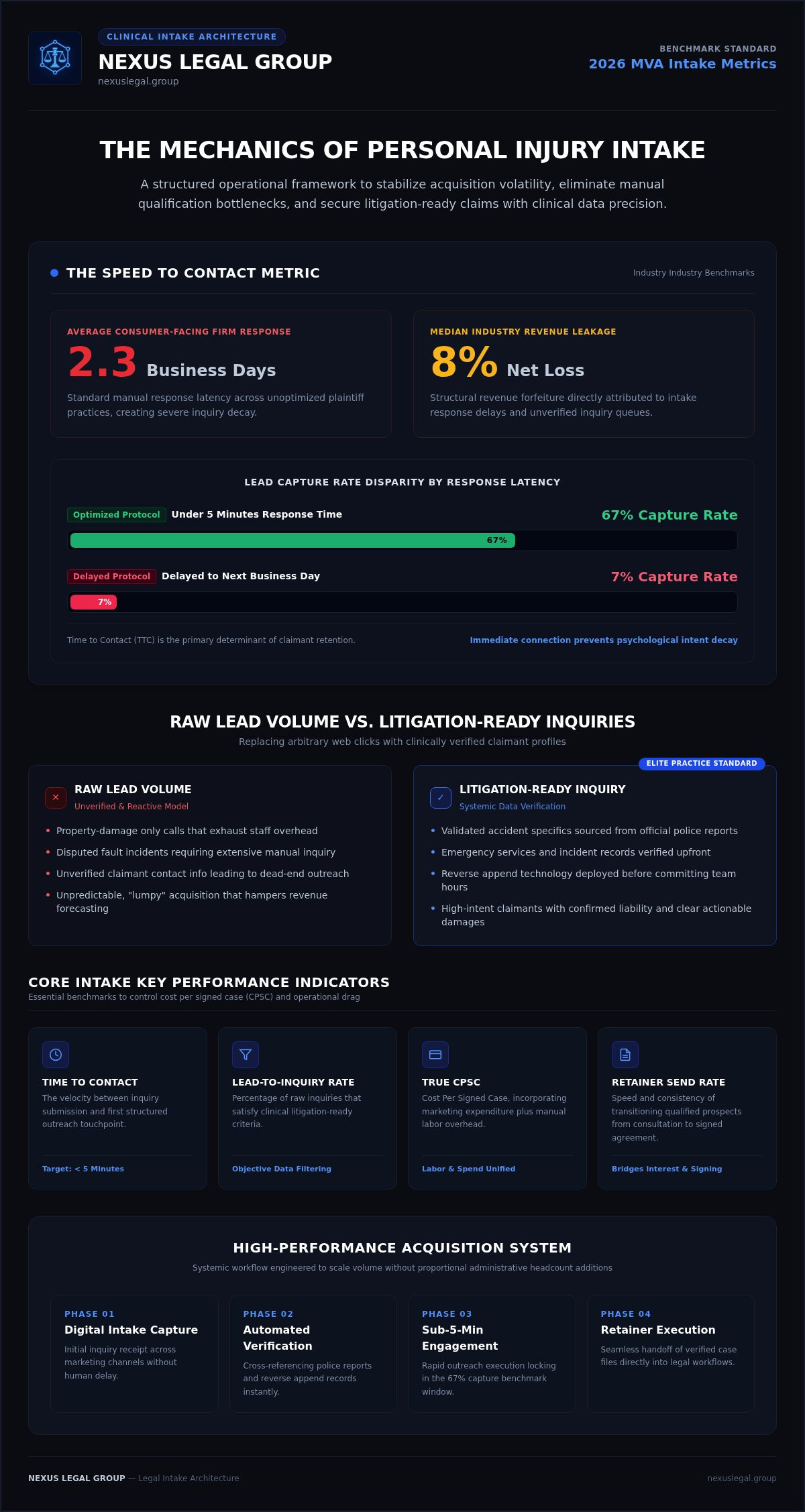
Did you know that the average consumer-facing law firm takes 2.3 business days to respond to a digital inquiry? In a high-stakes environment, that delay is more than a simple bottleneck; it's a structural failure that results in a median revenue leakage of 8% across the industry. You're likely exhausted by the friction between your marketing spend and signed case volume, especially when manual verification of low-quality leads drains your overhead. It's frustrating to struggle with "lumpy" acquisition that makes revenue forecasting feel like guesswork instead of a science. Mastering your personal injury intake KPIs is the only way to stabilize this volatility.
This guide will teach you how to transform raw inquiries into a clinical, scalable growth engine for your firm. We'll show you how to move beyond generic lead tracking toward a sophisticated system of litigation-ready inquiry verification. This article provides the strategic architecture needed to lower your cost per signed case, eliminate operational friction, and secure high-intent MVA acquisitions with the technical mastery required of an elite plaintiff firm. By the end of this deep dive, you'll have the framework to replace guesswork with predictable, data-driven expansion.
Key Takeaways
- Shift your focus from raw lead volume to sophisticated personal injury intake KPIs that prioritize high-intent, litigation-ready inquiries for predictable growth.
- Master the mechanics of intake velocity by optimizing your "Time to Contact" and measuring how effectively your filters identify viable cases.
- Leverage objective data like police reports and reverse append technology to verify accident details with clinical precision before committing firm resources.
- Identify your true Cost Per Signed Case (CPSC) and implement automated verification to reduce human overhead and eliminate operational friction.
- Follow a structured framework to audit manual bottlenecks and integrate high-performance acquisition systems into your existing case management workflow.
Defining Personal Injury Intake KPIs for Scalable Growth
Scaling an elite plaintiff practice requires more than just a high marketing budget; it demands a clinical approach to data. For years, firms treated intake as a back-office administrative task, but in 2026, the most successful organizations view it as the primary engine for business expansion. By establishing rigorous Key Performance Indicators (KPIs), you transition from reactive management to a strategic architecture that eliminates operational friction. This isn't just about counting calls. It's about designing a system that identifies high-intent opportunities with technical mastery and systemic integrity.
The Role of Growth Infrastructure in KPI Tracking
Elite firms don't just track data; they build systems that make data visible and actionable. This is where Law Firm Growth Infrastructure becomes essential. It acts as the foundational layer that connects AI-driven marketing precision with your internal case management workflows. When your personal injury intake KPIs are integrated into this infrastructure, you gain a clear view of where inquiries stall and where they accelerate. It’s about moving beyond manual spreadsheets to a high-performance engine that utilizes automated verification to ensure every dollar spent on acquisition yields a litigation-ready inquiry. This connectivity provides the operational excellence needed to scale without increasing headcount proportionally.
Inquiry vs. Case: The Primary Distinction
The most significant mistake a firm can make is valuing raw lead volume over inquiry quality. In the current legal market, "leads" are often just noise, consisting of property damage calls, fault-disputed incidents, or low-intent web clicks that drain your staff's time and inflate overhead. Elite firms prioritize precision over quantity. We define a "Litigation-Ready Inquiry" as the new baseline for success. This shift in mindset completely changes how you evaluate your personal injury intake KPIs. Instead of tracking how many calls hit the desk, you're measuring the percentage of inquiries that meet specific, high-intent criteria verified by objective police report data. High-intent data dramatically improves conversion ratios because it filters out the friction of unviable cases before they reach your legal team. By focusing on these high-performance metrics, you ensure your firm operates as a strategic architect of growth rather than a reactive participant in a crowded market.
Velocity and Volume: The Mechanics of Legal Intake
Speed is not just a preference; it is a mathematical requirement for retention. In the motor vehicle accident (MVA) sector, prospective clients often contact multiple firms simultaneously. The first organization to establish a connection usually secures the case. Industry benchmarking data for 2026 indicates that law firms responding to inquiries within five minutes achieve a 67% capture rate. Conversely, firms that delay contact until the next business day see that number plummet to just 7%. This disparity highlights why speed metrics are foundational to your personal injury intake KPIs.
Optimizing Time to Contact for MVA Cases
The psychological decay of intent in accident victims happens rapidly. Immediately following an incident, a victim's focus is on resolution; as hours pass, hesitation and competing distractions set in. Comparing automated contact strategies to manual outreach reveals a stark difference in performance. Manual systems often take an average of 2.3 business days to respond, which is effectively a death sentence for high-intent acquisition. Time to Contact (TTC) is the oxygen of personal injury intake. Without an immediate response, the inquiry suffocates before it ever reaches a qualified specialist.
Scaling Volume Without Increasing Overhead
Managing "lumpy" case acquisition requires a system that can handle spikes without requiring additional staff. By implementing Automated Intake for Plaintiff Firms, you can process high volumes of inquiries through instant verification protocols. This approach allows you to measure your Lead-to-Inquiry Conversion Rate with clinical precision. Instead of overwhelming your staff with low-quality traffic, the system filters for litigation-ready inquiries based on police report and emergency services data. This ensures your team focuses only on cases with the highest probability of conversion.
To bridge the gap between interest and commitment, you must monitor your Appointment and Retainer Send Rate. High-performing intake desks maintain a 95% live answer rate and aim for same-call e-signature delivery. Delivering a retainer agreement via SMS while the client is still on the phone can boost conversion to over 80%, compared to less than 50% when documents are sent asynchronously. If your current workflow feels fragmented, consider how a high-intent MVA case acquisition strategy could smooth your growth curve and stabilize your revenue. By eliminating friction in the handoff process, you turn raw volume into a predictable, high-performance engine.
Intent and Verification Metrics: The Data-Driven Advantage
Speed and volume create the foundation, but clinical precision in verification determines your ultimate ROI. High-performance firms don't rely on self-reported claimant data alone; instead, they implement personal injury intake KPIs that measure Verification Accuracy against objective third-party sources. By cross-referencing inquiries with emergency services and police data, you eliminate the friction caused by fault-disputed or property-damage-only calls. This data-driven advantage ensures your intake engine only processes inquiries with a high Qualified Inquiry Rate (QIR), protecting your team's time for the most viable cases.
Leveraging Police Report Data for Precision
Relying on a caller's memory is a strategic liability. Police Report Generated MVA Leads redefine quality by grounding every inquiry in objective reality. When you use incident data to verify statements instantly, you significantly reduce the risk of "ghosting." Prospective clients are more likely to commit when they realize your firm already possesses the technical details of their accident. This approach sources litigation-ready inquiries from verified events, ensuring your team isn't chasing phantoms or unviable claims.
The Power of Data Enrichment and Reverse Append
Data enrichment is the process of transforming a raw inquiry into a comprehensive case profile. Through reverse append technology, you can source detailed accident reports to build early case strength before the first consultation even occurs. This allows you to identify key participants and insurance carriers immediately, which streamlines the vetting process. Utilizing Verified MVA Leads lowers the administrative burden on your paralegals, as the heavy lifting of data collection is handled by the growth infrastructure itself. It's a shift from manual data entry to strategic case assessment.
Beyond static data, elite firms now track high-intent behavioral signals through AI analysis. This involves measuring the "readiness to sue" by analyzing how an inquirer interacts with your digital touchpoints. When combined with traditional personal injury intake KPIs, these metrics provide a clinical view of your acquisition pipeline. You aren't just signing cases; you're architecting a high-performance system that filters for the most viable, high-value opportunities in the national market. This level of technical mastery ensures that every inquiry you touch has a clear path toward a successful resolution.
Operational Efficiency: Cost and Compliance KPIs
High-performance firms look beyond the acquisition of an inquiry to the operational cost of converting that inquiry into a retainer. This is where your personal injury intake KPIs must account for the actual economic impact on your firm's overhead. Scaling a practice requires a clinical understanding of how human labor and automated systems intersect to produce a signed case. If your intake team is bogged down by manual verification of low-intent leads, your margins will suffer regardless of your settlement volume. By measuring metrics like the Verification Automation Rate, you can identify exactly how much friction remains in your vetting process.
Calculating the True Cost Per Signed Case
Many firms focus exclusively on "Cost Per Lead," but this is often a vanity metric that hides structural inefficiency. The definitive metric for marketing ROI is the Cost Per Signed Case (CPSC), which includes your total marketing spend plus the labor and technology costs required to verify and sign that client. Implementing Data-Driven Case Acquisition models helps drive down CPSC by filtering out unviable inquiries before they reach your expensive intake staff. This allows you to pinpoint "marketing leaks" where specific channels may be generating high volumes of noise that actually cost you more in staff wages than they yield in revenue.
Ethical and Compliant Acquisition Standards
In 2026, compliance isn't just a legal requirement; it's a critical operational KPI. With statutory damages under the TCPA remaining at $500 to $1,500 per violation, a single mistake in automated outreach can be devastating. An elite practice must maintain a high Intake Compliance Score, ensuring all acquisition activities meet Compliant Legal Lead Generation standards. This involves documenting express written consent and strictly adhering to ABA Model Rule 7.3 regarding live person-to-person solicitation. By treating risk mitigation as a performance metric, you protect your firm's reputation and financial stability from regulatory litigation.
Operational efficiency also extends to Paralegal Utilization. When your growth infrastructure delivers litigation-ready inquiries, your paralegals spend less time chasing police reports and more time building case value. Measuring the time saved through automated reverse-append technology provides a clear picture of your system's technical mastery. You're no longer just managing a desk; you're architecting a high-performance engine designed for systemic integrity and maximum profitability.
Implementing a High-Performance Intake Infrastructure
Transitioning from a reactive intake desk to a proactive case acquisition engine requires a methodical implementation strategy. It begins with a comprehensive audit of your current manual bottlenecks and data gaps. You'll likely find that critical information is lost in the handoff between marketing and intake, or that your staff is wasting hours on unviable inquiries. By identifying these friction points, you can establish the baseline for your personal injury intake KPIs and begin the process of structural refinement. This isn't just about changing software; it's about shifting the firm's operational DNA toward data-driven precision.
Once the audit is complete, the focus shifts to integration and automation. Your growth infrastructure must connect directly with your case management system to ensure a seamless, bidirectional data flow. This connectivity allows for the deployment of verification tools that eliminate low-intent noise before it ever reaches a human specialist. Automation doesn't just save time; it ensures that every inquiry is vetted against objective accident data with absolute consistency. It's about building a system that values technical mastery over raw effort, ensuring that your team's energy is reserved for litigation-ready opportunities.
The Blueprint for Elite Firm Expansion
Elite expansion is built on the strategic alignment of your firm's growth goals with your intake metrics. You aren't just looking for "potential clients"; you're building a system that produces signed cases with clinical efficiency. This proactive approach allows you to predict revenue and scale your operations without the volatility of "lumpy" acquisition. By focusing on high-intent behavioral signals and litigation readiness, you ensure that every resource is directed toward cases with the highest probability of a significant settlement. It's a foundational layer that supports long-term institutional growth.
Next Steps: Sourcing Litigation-Ready Inquiries
Closing the loop between data acquisition and trial readiness requires a partner who understands the mechanics of high-performance growth. Elite firms partner with Nexus Legal Group to access a sophisticated infrastructure that delivers High-Intent MVA Case Acquisition. By leveraging AI-driven marketing precision and police report data, you can bypass the noise of traditional lead generation. This technical advantage allows your firm to focus on what it does best: litigating high-value cases. Optimization is a continuous process, and with the right infrastructure, your personal injury intake KPIs will drive institutional growth and technical mastery for years to come.
Architecting the Future of High-Performance Plaintiff Practices
Mastering your personal injury intake KPIs is the definitive step toward transforming a fragmented intake desk into a high-performance growth engine. By shifting your focus from vanity lead volume to litigation-ready MVA inquiries, you eliminate the overhead of manual vetting and create a predictable revenue stream. We've explored how AI-driven verification precision and automated data enrichment provide the technical mastery needed to scale nationally without sacrificing operational integrity.
Elite firms don't guess at their acquisition costs; they build systems that ensure every inquiry is verified against objective incident data. This clinical approach reduces friction, lowers your cost per signed case, and secures your position as a strategic architect in the legal market. Integrating these metrics into a cohesive national growth infrastructure is the only way to maintain a competitive edge in 2026.
The path to a scalable, litigation-ready practice is clear when you prioritize data over noise. It's time to build the foundation your firm deserves.
Frequently Asked Questions
What are the most important KPIs for a personal injury law firm?
The most critical personal injury intake KPIs for elite firms include Time to Contact (TTC), Qualified Inquiry Rate (QIR), and Cost Per Signed Case (CPSC). While raw volume provides a baseline, these specific metrics track the velocity and quality of your acquisition pipeline. Monitoring your live answer rate and retainer send rate allows you to identify structural bottlenecks, ensuring your growth infrastructure converts high-intent inquiries into signed cases with clinical precision.
How do I calculate the Cost Per Signed Case (CPSC) accurately?
Calculating CPSC accurately requires totaling your aggregate marketing expenditure, intake department labor costs, and technology overhead, then dividing that figure by the number of signed retainers. Many firms mistakenly only track cost per lead, which obscures the true cost of human vetting and manual follow-up. By including every operational touchpoint, you gain a clinical view of your actual ROI and can identify specific marketing channels that produce excessive noise rather than litigation-ready inquiries.
Can AI-driven intake verification really replace manual vetting?
AI-driven verification is designed to augment and streamline the vetting process by eliminating low-intent noise before it reaches your staff. While final legal assessments remain human-centric, automated systems can cross-reference inquiries with police reports and emergency services data with a speed that manual vetting cannot match. This reduces human error and ensures your intake specialists only focus their energy on inquiries that meet your firm's specific litigation-ready criteria.
What is the difference between a lead and a high-intent inquiry?
A lead is merely raw contact information that requires extensive manual vetting to determine viability. Conversely, a high-intent inquiry is grounded in objective data, such as police or emergency services reports, and represents a litigation-ready opportunity. Focusing your personal injury intake KPIs on high-intent inquiries allows your firm to eliminate the friction of unverified traffic. This distinction ensures your staff focuses exclusively on cases with verified liability and significant injury potential.
How does police report data improve intake conversion rates?
Sourcing inquiries from police report data improves conversion rates by providing immediate, objective verification of liability and accident severity. When your intake team has access to the accident report during the initial call, they can establish authority and reduce the friction of repetitive data collection. This technical mastery instills confidence in the prospective client, significantly reducing the likelihood of ghosting and increasing the probability of a same-call retainer signature.
Is automated legal intake compliant with ethical standards?
Automated intake systems are fully compliant with ethical standards when they prioritize documented consent and adhere to ABA Model Rule 7.3. High-performance systems utilize visual compliance certificates to prove prior express written consent before initiating contact. By automating these safeguards, your firm mitigates the risk of TCPA violations and ensures that all acquisition activities meet the rigorous ethical requirements expected of elite plaintiff law firms seeking national growth.
How often should my firm audit our intake KPIs?
Your firm should engage in continuous, real-time monitoring of performance dashboards, supplemented by rigorous monthly audits. A deep-dive monthly review allows you to identify marketing leaks where specific lead sources fail to convert into signed cases despite high initial volume. Regular audits ensure your growth infrastructure remains aligned with your long-term expansion goals and allow for the clinical refinement of your automation protocols to maintain high-intent case acquisition standards.
What is a 'good' time-to-contact metric for MVA cases in 2026?
In 2026, the gold standard for Time to Contact is five minutes or less. Industry-wide legal benchmarking data indicates that firms responding within this window achieve a 67% capture rate, whereas those waiting until the next business day see conversion drop to just 7%. For high-intent MVA cases, speed is a structural requirement. Utilizing automated outreach ensures that your firm remains the first point of contact, effectively securing the case before the victim contacts a competitor.