Navigating the Structural Challenges in Mass Tort Client Acquisition
Facing challenges in mass tort client acquisition? Learn to replace high-volume, low-quality leads with an automated system for predictable, litigation-ready...
Why is your firm paying a premium for mass tort leads that never actually reach the litigation stage? It's a question many partners ask when they see their cost-per-acquisition climb while conversion rates remain stagnant. You've likely experienced the frustration of a pipeline clogged by lead fraud and duplicate inquiries. These operational bottlenecks don't just waste capital; they drain the momentum of your entire legal team. It's clear that the traditional model of high-volume, low-quality lead generation is no longer sustainable for elite firms.
This article analyzes the structural challenges in mass tort client acquisition and details the technical infrastructure needed to secure high-intent, litigation-ready cases. You'll learn how to replace manual, high-friction processes with automated verification systems that reduce intake overhead. We'll examine the mechanics of building a predictable flow of cases that meet strict ethical and regulatory standards. By the end, you'll understand how to transform your acquisition strategy from a marketing gamble into a high-performance engine for firm expansion.
Key Takeaways
- Transition from broad marketing tactics to a specialized growth mechanism that prioritizes high-intent litigation over raw lead volume.
- Identify the structural challenges in mass tort client acquisition that create an inverse relationship between lead quantity and intake efficiency.
- Implement clinical precision in your regulatory compliance strategy to mitigate ethical risks and navigate complex TCPA standards.
- Leverage automated verification and AI-driven intake systems to eliminate pipeline friction and reduce operational overhead.
- Establish a scalable infrastructure that delivers a predictable flow of litigation-ready cases through rigorous, systems-based acquisition.
The Shifting Landscape of Mass Tort Client Acquisition
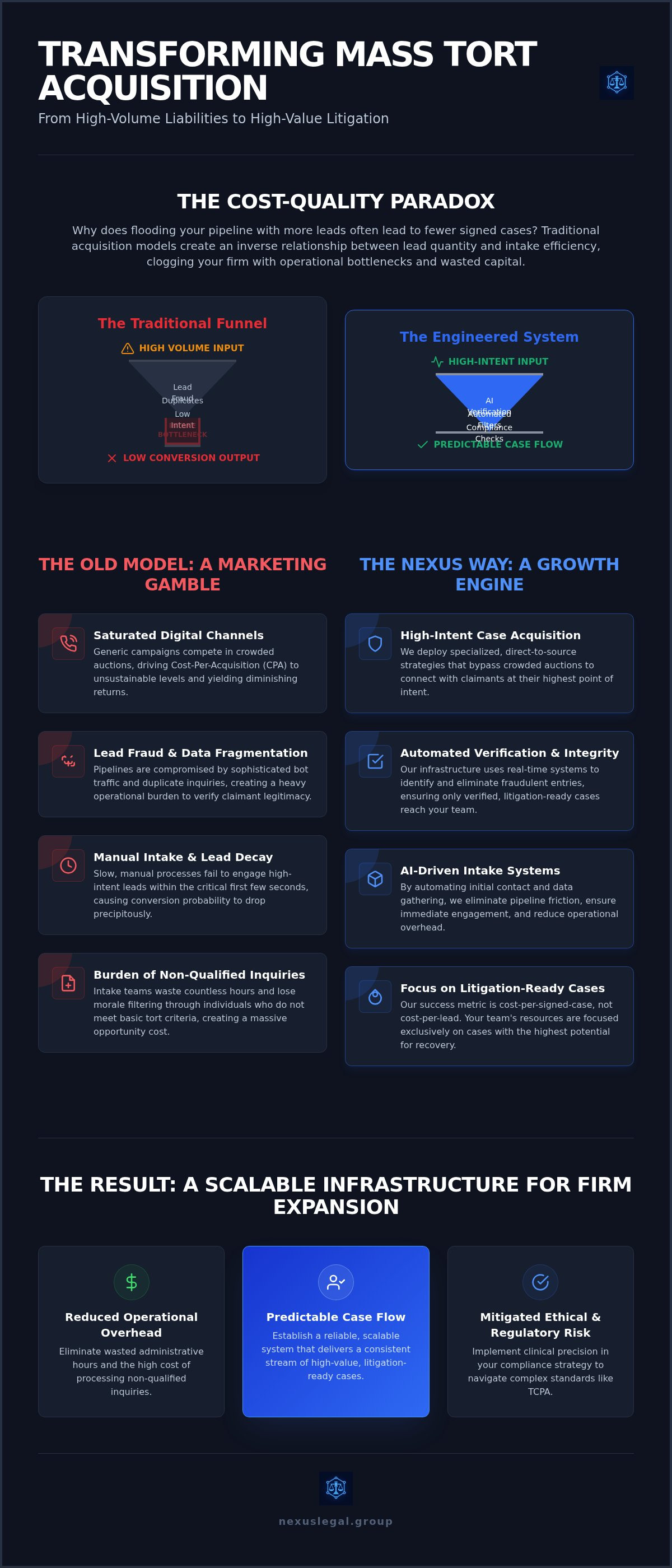
Mass tort client acquisition functions as a specialized growth mechanism rather than a simple lead generation channel. For elite plaintiff firms, this process represents a foundational layer of business expansion that demands clinical precision and a focus on systemic integrity. Understanding What is a Mass Tort? involves recognizing that these complex litigations require a transition from broad-spectrum marketing to high-intent case acquisition. Traditional models that prioritize raw lead volume often fail because they lack the technical infrastructure to filter out low-value inquiries and verify claimant eligibility at scale.
The core challenges in mass tort client acquisition stem from a reliance on outdated methodologies that treat mass torts like standard personal injury leads. Elite firms recognize that these cases demand a different level of scrutiny and a more robust technological infrastructure. By focusing on high-intent inquiries from the start, firms can reduce the noise in their pipeline and focus their resources on cases with the highest potential for recovery. This transition is a necessity for survival in a landscape where operational inefficiency leads directly to financial loss.
The Saturation of Digital Advertising Channels
Increased competition within search and social media auctions has fundamentally altered the economics of case acquisition. Generic lead generation tactics now yield diminishing returns as multiple firms bid on the same high-value keywords. This intense market saturation drives up the cost-per-acquisition (CPA) to levels that can quickly erode the profitability of a campaign. Success now depends on bypassing these crowded auctions through more sophisticated, direct-to-source strategies that prioritize high-intent interactions over generic clicks.
The Rise of Lead Fraud and Data Fragmentation
Data integrity has become the primary hurdle for firms in 2026. Sophisticated bot traffic and duplicate inquiry patterns often compromise the quality of the intake pipeline, leading to wasted overhead and missed opportunities. When data is fragmented across various platforms, verifying the legitimacy of a claimant becomes a heavy operational burden. Firms must implement systems that can identify and eliminate fraudulent entries in real-time to ensure that only litigation-ready cases reach their legal teams. Without these automated safeguards, the intake-to-signed-case pipeline remains vulnerable to friction and data decay.
The Cost-Quality Paradox in Mass Tort Marketing
The assumption that higher lead volume automatically translates to firm growth is a fundamental error in strategic planning. In reality, an inverse relationship often exists between raw inquiry volume and the operational efficiency of a legal practice. When firms flood their intake departments with low-intent leads, they inadvertently create a bottleneck that prevents high-value cases from surfacing. This paradox is one of the most persistent challenges in mass tort client acquisition, as it forces teams to spend more time filtering noise than litigating cases.
Cheap leads often carry a high hidden cost that doesn't appear on a marketing invoice. These costs manifest as wasted administrative hours, increased churn in intake staff, and the technical debt of managing a bloated database. Elite firms avoid this trap by shifting their focus toward litigation-ready inquiries. They understand that the real metric of success isn't the cost-per-lead, but the cost-per-signed-case. To achieve this, firms must integrate a growth infrastructure that prioritizes verification over sheer numbers.
Lead Decay and the Speed-to-Lead Requirement
Lead depreciation is a mechanical reality in the digital age. The moment a potential claimant submits an inquiry, the clock starts ticking on their intent level. Manual intake processes simply can't keep pace with the expectations of modern consumers. If a firm doesn't engage a high-intent lead within seconds, the probability of conversion drops precipitously. Automated systems are no longer an optional luxury; they're a requirement for maintaining the integrity of your acquisition funnel.
The Burden of Non-Qualified Inquiries
Processing non-qualified inquiries does more than just waste money; it erodes the morale of your intake team. When staff members spend their days speaking with individuals who don't meet the basic criteria for a tort, their productivity and focus decline. This creates a significant opportunity cost, as every minute spent on a dead-end lead is a minute taken away from a legitimate claimant. The impact of these low-quality claims is well-documented in research regarding Regulatory Compliance and Ethical Risk Mitigation, highlighting how aggressive advertising can compromise the legal framework. Solving these challenges in mass tort client acquisition requires transitioning to a model that delivers pre-verified, high-intent cases, allowing firms to reclaim their time and focus on high-impact litigation.
Regulatory Compliance and Ethical Risk Mitigation
Regulatory compliance serves as the structural foundation of any elite plaintiff firm's expansion strategy. In the current legal environment, ethical risk mitigation is not a peripheral administrative task but a core operational requirement. The most significant challenges in mass tort client acquisition occur when firms fail to integrate compliance directly into their technological stack. Achieving clinical precision in lead generation requires a system that monitors Bar rule adherence across diverse jurisdictions simultaneously. This ensures that every litigation-ready case file is built upon a transparent, ethically sourced foundation that can withstand the scrutiny of the court.
TCPA and Consumer Privacy Frameworks
Navigating TCPA regulations in a high-volume acquisition environment requires a move away from manual oversight toward automated verification systems. By 2026, the complexity of consumer privacy laws has made manual compliance checks obsolete and dangerous. Elite firms utilize growth infrastructure that implements real-time validation at the point of entry, ensuring that every claimant interaction is fully documented and legally sound. This systemic integrity prevents the data fragmentation that often leads to costly litigation against the firm itself. Manual oversight is obsolete. Without these automated safeguards, firms risk significant financial exposure and the loss of institutional credibility.
Ethical Standards for Signed Case Acquisition
There is a fundamental distinction between a vendor-client lead purchase and the implementation of legal growth infrastructure. Elite firms demand a level of transparency that generic lead providers cannot offer, particularly regarding the claimant-firm relationship. This focus on ethical standards is a key component when Engineering Growth in Mass Torts, as it ensures that the transition from inquiry to signed case is seamless and compliant. It optimizes the entire pipeline. By prioritizing ethical signed cases, firms eliminate the friction associated with common challenges in mass tort client acquisition, such as non-qualified or poorly vetted inquiries. This approach doesn't just mitigate risk; it optimizes the entire pipeline for high-intent, high-value outcomes.
Overcoming Intake Bottlenecks with Automated Verification
The primary bottleneck in most firms isn't the volume of inquiries; it's the speed and accuracy of the vetting process. Traditional human-centric models are inherently limited by staff bandwidth and the high probability of human error during peak inquiry cycles. By implementing the mechanics of automated intake for plaintiff firms, organizations can eliminate the friction that typically stalls the transition from lead to signed case. This shift addresses the core challenges in mass tort client acquisition by replacing subjective assessment with AI-driven precision, ensuring that no high-value claimant is lost to a slower intake process.
AI-Driven Vetting and Qualification
Automated systems allow firms to scale intake capacity without the proportional increase in headcount that usually drains profitability. Implementing automated legal intake verification ensures that every inquiry is screened against rigorous criteria before it ever reaches a legal assistant. This clinical approach to quality control filters out non-qualified claimants in real-time, which is a necessity in high-volume mass tort litigation. It protects the firm's resources and ensures that attorneys focus exclusively on high-intent litigation. Scaling your intake shouldn't mean doubling your payroll; it should mean perfecting your technology.
Data Enrichment and Incident Verification
Securing litigation-ready details requires more than just a claimant's statement; it demands empirical evidence. Utilizing data-driven case acquisition strategies allows firms to confirm incident details through third-party data sources immediately. This process involves using reverse append technology to secure accident reports and emergency service records, transforming a simple inquiry into a verified case file.
Key benefits of automated verification include:
- Reduced Intake Overhead: Automation handles the repetitive vetting tasks that typically consume the majority of an intake team's daily bandwidth.
- Increased Case Conversion: Immediate engagement captures high-intent claimants while their motivation is at its peak, preventing them from seeking other representation.
- Superior Data Integrity: Reverse append technology populates missing details, providing trial lawyers with the specific accident report data needed for litigation.
This level of enrichment is critical for modern challenges in mass tort client acquisition, as it provides the technical mastery needed to stay competitive. By the time a lawyer reviews the file, the case is already pre-qualified and enriched with the necessary documentation. It's a system designed for efficiency and results.
Engineering Growth: The Nexus Legal Group Infrastructure
Nexus Legal Group operates as the foundational infrastructure layer for elite plaintiff law firms, moving beyond the traditional vendor-client relationship to provide a comprehensive growth engine. By integrating AI-driven marketing precision with rigorous, multi-stage verification, the system addresses the most persistent challenges in mass tort client acquisition at their source. This mechanical approach ensures that firms receive a consistent stream of exclusive, litigation-ready inquiries and signed cases without the friction typical of generic lead generation. It's a system designed to instill security through technical mastery and operational excellence.
To scale a modern practice, you need more than just a high volume of inquiries; you need a predictable flow of cases that meet strict eligibility requirements. The Nexus infrastructure is built to eliminate the noise of non-qualified leads, allowing your legal team to focus on high-impact litigation. By positioning itself as a foundational layer, Nexus provides the stability required for long-term firm expansion and systemic integrity.
The Mechanics of High-Intent Acquisition
Identifying high-quality mass tort claimants requires a mass tort case acquisition strategy built on data-driven precision rather than broad-spectrum advertising. Nexus utilizes sophisticated algorithms to target individuals with high intent, ensuring that every inquiry delivered to your firm is already pre-qualified and litigation-ready. This process utilizes technical mastery to bypass the crowded auctions of generic search terms, securing exclusive access to claimants who are actively seeking representation.
Every inquiry delivered through this infrastructure undergoes a clinical verification process that confirms specific incident details and eligibility criteria. This level of scrutiny ensures that your intake team isn't bogged down by the typical data fragmentation issues that plague the industry. When you receive a case from Nexus, you're receiving a verified opportunity that is ready for immediate legal action.
Scalability for Elite Plaintiff Firms
Building a predictable pipeline of mass tort cases is the only way to ensure sustainable growth in a competitive market. Implementing a robust law firm growth infrastructure allows you to scale your practice without the typical overhead associated with manual intake and vetting. This blueprint for expansion relies on mechanical efficiency and the elimination of operational bottlenecks, providing a clear path from inquiry to signed case.
Integrating the Nexus CaseFlow system allows your firm to automate the most labor-intensive stages of client acquisition. This system functions as a high-performance engine, driving growth from behind the scenes while maintaining full ethical and regulatory compliance. Overcoming the structural challenges in mass tort client acquisition requires more than just marketing; it requires a commitment to a sophisticated, integrated system that prioritizes results over raw volume. By leveraging this infrastructure, you can transform your firm into a leader in high-stakes mass tort litigation.
Mastering the Mechanics of Mass Tort Expansion
Successfully addressing the structural challenges in mass tort client acquisition requires a departure from outdated, high-volume marketing tactics. Raw volume isn't enough. You've seen how generic lead quantity often creates operational friction that drains firm resources and slows conversion. By shifting your focus toward a system-based approach, you can prioritize litigation-ready inquiries that arrive pre-qualified and fully enriched with verified accident data.
Implementing a robust growth infrastructure isn't just about scaling; it's about securing your firm's future through technical mastery. AI-driven marketing precision and rigorous intake verification ensure that your pipeline remains ethical, compliant, and highly efficient. When you eliminate the noise of non-qualified inquiries, your legal team can focus on securing high-impact recoveries. This transition from manual vetting to automated acquisition is the key to maintaining a competitive edge.
It's time to transform your acquisition strategy into a high-performance engine. With the right systems in place, your firm is positioned for sustainable, predictable growth in the evolving legal landscape.
Frequently Asked Questions
What are the primary challenges in mass tort client acquisition in 2026?
Market saturation, escalating costs, and sophisticated lead fraud represent the primary challenges in mass tort client acquisition. High competition in digital auctions has diminished the returns of generic marketing, while data fragmentation complicates claimant verification. Firms also face increased regulatory pressure regarding TCPA and Bar rule compliance. Overcoming these hurdles requires a shift toward automated verification systems and high-intent acquisition strategies that prioritize litigation-ready cases over raw inquiry volume.
How does automated verification improve mass tort lead quality?
Automated verification improves lead quality by applying objective, real-time screening criteria to every incoming inquiry. These systems filter out duplicate entries, bot-generated traffic, and non-qualified claimants before they reach your intake staff. By utilizing reverse append technology and data enrichment, automation confirms incident details and eligibility instantly. This clinical approach ensures that your legal team spends their time exclusively on high-intent, litigation-ready cases rather than vetting low-value inquiries.
Why is cost-per-acquisition rising for mass tort cases?
Rising cost-per-acquisition is driven by intense competition within search and social media auctions for high-value mass tort keywords. As more firms bid on the same limited pool of claimants, generic digital advertising costs escalate while conversion rates often stagnate. The operational overhead of processing a high volume of low-quality leads also contributes to a higher effective CPA. Elite firms mitigate this by investing in growth infrastructure that bypasses crowded auctions for direct-to-source acquisition.
How can law firms ensure ethical compliance in mass tort lead generation?
Law firms ensure ethical compliance by integrating automated compliance checks directly into their acquisition systems. This includes real-time TCPA consent verification and monitoring for Bar rule adherence across national campaigns. Maintaining transparency in the claimant-firm relationship and utilizing growth infrastructure that provides a clear audit trail for every lead is essential. By prioritizing ethically sourced signed cases, firms protect their institutional credibility and avoid the risks associated with non-compliant lead generation.
What is the difference between a qualified inquiry and a litigation-ready case?
A qualified inquiry is a lead that meets basic demographic or incident criteria but lacks verified proof of eligibility. In contrast, a litigation-ready case is a fully vetted claimant with confirmed incident details, enriched accident reports, and a signed retainer. Moving from inquiries to litigation-ready cases reduces intake friction and overhead. This distinction is critical for elite firms that value predictable outcomes and high-intent growth over the high-maintenance noise of raw lead volume.
Can AI-driven systems effectively vet mass tort claimants?
AI-driven systems vet mass tort claimants with a level of speed and precision that human intake teams can't match. These systems analyze complex data sets to identify eligibility patterns and flag fraudulent inquiries in real-time. By automating the preliminary vetting stages, AI ensures that only high-intent claimants move forward in the pipeline. This clinical efficiency allows firms to scale their intake capacity without increasing headcount, providing a more reliable foundation for practice expansion.
How does Nexus Legal Group mitigate lead fraud in mass tort campaigns?
Nexus Legal Group mitigates lead fraud through a multi-layered verification infrastructure that identifies bot traffic and duplicate patterns at the point of entry. Our systems utilize AI-driven marketing precision to target high-intent claimants while filtering out fraudulent activity instantly. By incorporating rigorous intake verification and reverse append technology, we ensure that every inquiry is cross-referenced with empirical data. This structural approach protects firms from the financial drain of processing illegitimate or non-qualified inquiries.
What infrastructure is needed to scale a mass tort practice?
Scaling a mass tort practice requires a robust growth infrastructure that integrates automated verification with AI-driven marketing. Firms need a predictable pipeline of litigation-ready cases and a system that eliminates the friction of manual intake. This foundational layer should include real-time compliance monitoring, data enrichment tools, and seamless CRM integration. By adopting a mechanical approach to acquisition, firms can drive expansion through efficiency rather than relying on the diminishing returns of generic marketing tactics.