Mass Tort Case Acquisition Infrastructure: The 2026 Blueprint for Elite Plaintiff Firms
Master your mass tort case acquisition infrastructure. Our 2026 blueprint shows how to use AI and automation to secure high-intent cases and ensure compliance.
In 2026, the era of buying raw leads is over; if your firm doesn't own the technical architecture behind its growth, you're likely subsidizing your competitors' inefficiency. You've probably felt the mounting pressure of California’s SB 37 and the rising costs of mature torts, where the lack of transparency in your pipeline creates both financial and ethical risks. It's a common struggle to balance high-volume intake with the precision required for litigation-ready cases. This guide will help you master the systemic engineering required to scale through a high-intent mass tort case acquisition infrastructure.
You'll learn how to replace manual friction with AI-driven verification and rigorous data protocols. We'll explore how elite firms are utilizing automated verification and high-intent sourcing to secure qualified inquiries while lowering overhead through intelligent automation. This blueprint provides a clear path to achieving predictable case flow and maintaining the strict compliance standards demanded by today's regulatory environment. By the end of this article, you'll understand how to transform your intake process into a high-performance engine that operates with clinical precision.
Key Takeaways
- Learn why moving away from traditional lead brokers to a comprehensive mass tort case acquisition infrastructure is the only way to maintain profitability in the 2026 regulatory environment.
- Identify the specific behavioral intent data points that allow AI to distinguish between casual browsers and high-intent claimants ready for litigation.
- Discover how automated verification systems act as a primary defense to eliminate operational friction and reduce the high cost-per-acquisition associated with manual intake.
- Gain a step-by-step framework for auditing your current acquisition funnel to find and fix "intent leakage" that wastes your marketing budget.
- Understand how integrating police report data and emergency services records ensures your firm meets the highest ethical and compliant lead generation standards.
The Evolution of Mass Tort Case Acquisition Infrastructure
The legal industry has reached a tipping point where traditional lead procurement is no longer a viable strategy for scale. In the 2026 environment, characterized by rising costs and intense regulatory scrutiny like California’s SB 37, the distinction between a simple lead and a robust mass tort case acquisition infrastructure has become the primary differentiator for elite firms. Successful practitioners have moved beyond treating marketing as a peripheral activity. Instead, they view it as a foundational, closed-loop system where every data point informs the next stage of growth. This evolution prioritizes high-intent signals over high-volume noise, ensuring that the resources of a mass tort practice are allocated with maximum efficiency and clinical precision.
Why 'Leads' Are No Longer Sufficient
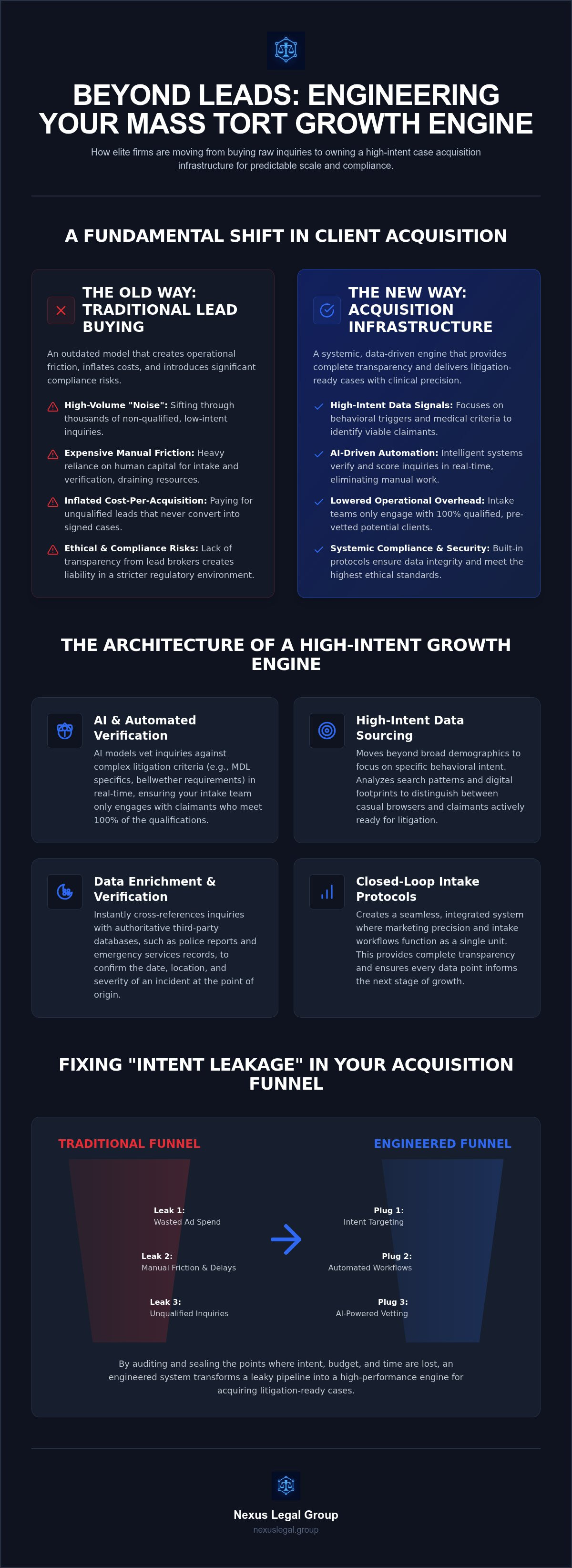
Raw inquiries often represent little more than digital curiosity. Relying on these top-of-funnel contacts creates immense operational friction, as intake teams must sift through thousands of non-qualified entries to find a single viable claimant. This "noise" is expensive; it drains human capital and inflates the cost-per-signed-case. Modern acquisition focuses on intent-based targeting rather than broad demographics. By filtering for specific behavioral triggers and medical criteria before a lead ever reaches a human, firms can focus their energy exclusively on litigation-ready inquiries. This shift reduces overhead and eliminates the ethical risks associated with aggressive, non-compliant lead sources that often fail to meet the transparency requirements of 2026 advertising standards.
The Architecture of a Growth Engine
Building an institutional-grade system requires the seamless integration of marketing precision, automated verification, and rigorous intake protocols. It's about connectivity between data sources and legal workflows. By utilizing police report generated leads and emergency services data, firms can verify the validity of a claim at the point of origin. This level of systemic integrity ensures ethical compliance and high-level data security throughout the pipeline. Implementing a sophisticated mass tort case acquisition infrastructure allows a firm to scale without losing control over data security or compliance standards. When marketing and intake function as a single unit, the result is a high-performance engine that provides complete transparency into the lead-to-case journey. Acquisition infrastructure is the foundational layer for law firm scalability. At Nexus Legal Group, we provide the technical framework that allows elite firms to move beyond manual friction and focus on high-stakes litigation.
Core Components of a High-Intent Growth Engine
To maintain a competitive edge in 2026, firms must move beyond the era of passive lead acquisition. An elite mass tort case acquisition infrastructure operates with algorithmic certainty, functioning as a multi-layered filter that prioritizes high-intent signals over high-volume noise. Instead of targeting broad demographics, this technical framework utilizes behavioral intent data to identify potential claimants based on search patterns, specific digital footprints, and medical history interactions. This approach ensures your marketing spend isn't wasted on individuals who are merely curious, but is instead focused on those whose behavior indicates a high probability of a valid claim.
AI and Automated Verification Systems
Human intake remains the most significant overhead expense for most plaintiff firms. By deploying AI-Driven Legal Case Acquisition protocols, you can filter for specific litigation criteria before a single human minute is spent. AI models now vet inquiries against complex bellwether trial requirements or MDL-specific criteria in real-time. This automated scoring reduces your cost-per-case by ensuring your intake team only speaks to individuals who meet 100% of the qualified criteria. It's a method designed to eliminate the operational friction that typically kills conversion rates in manual systems.
Beyond simple filtering, modern systems focus on data enrichment and reverse append technology. This involves taking a raw inquiry and instantly cross-referencing it with authoritative third-party databases. By utilizing police report generated leads and emergency services data, you can confirm the date, location, and severity of an incident without waiting for the claimant to recall details accurately. This level of technical mastery ensures that every entry in your docket is built on a foundation of verifiable facts rather than self-reported claims.
Incident Data and Reverse Append Mechanics
The strategic value of police report data for attorneys in mass tort vetting cannot be overstated. It provides a factual anchor for every potential case, which is critical during the early stages of litigation. Historical Trends in Tort Litigation show that cases backed by verified incident reports have higher settlement potential and move through the pipeline with significantly less friction. Reverse append mechanics allow your system to automatically secure accident reports and participant history, transforming a basic lead into a verified case file almost instantly. If you're looking to upgrade your firm's capabilities, exploring a sophisticated growth infrastructure is the next logical step in your firm's evolution. Using emergency services data to identify high-potential claimants early allows your firm to build a more robust docket while maintaining the highest standards of data security and systemic integrity.
Lead Generation vs. Acquisition Infrastructure: A Strategic Analysis
Choosing between a lead broker and a proprietary system isn't just a marketing decision; it's a choice between a commodity and a competitive advantage. The traditional brokerage model, where firms purchase raw inquiries from third-party aggregators, often leaves attorneys in the dark regarding the origin and intent of their potential clients. In contrast, a mass tort case acquisition infrastructure provides a transparent, closed-loop system that gives firms total control over the claimant journey. This distinction is critical in 2026, where regulatory shifts like California's SB 37 demand that attorney names and bona fide office locations be clearly disclosed, effectively ending the era of anonymous lead funnels.
Transparency and Data Visibility
Trial lawyers require a verifiable "source of truth" for every case in their docket to ensure long-term settlement success. When you own the infrastructure, you gain real-time visibility into the metrics that drive campaign ROI, from the initial digital touchpoint to the final signed retainer. This visibility is essential for navigating the complexities of modern litigation, as explored in The New Mass Torts Bargain, which highlights how aggregation and resolution strategies now depend on high-level data integrity. Systems that offer granular data allows you to identify high-value claims early, ensuring your capital is allocated to the torts with the highest potential for recovery.
Exclusive vs. Shared Lead Ecosystems
The hidden costs of shared lead ecosystems often outweigh the lower entry price. When multiple firms compete for the same inquiry, a "speed-to-lead" war ensues, often resulting in lower conversion rates and high operational friction. Data from July 2026 shows that across active tort campaigns, only about 12% of qualified leads typically convert into a signed retainer. This percentage drops significantly when leads are shared. Exclusive, litigation-ready inquiries are the only path to sustainable growth because they eliminate the race to the phone and allow for a more professional, sophisticated intake experience. Developing a custom Mass Tort Case Acquisition Strategy ensures that every inquiry is filtered through your specific criteria, preventing "intent leakage" and protecting your firm's reputation.
Firms often hesitate at the perceived cost of building an infrastructure versus buying leads. However, when you factor in the blended cost per signed case—which averaged $531.14 in mid-2026—the efficiency of a proprietary system becomes clear. Owning your mass tort case acquisition infrastructure reduces the long-term cost-per-case by eliminating middleman markups and increasing the percentage of inquiries that are actually litigation-ready. It's an investment in systemic integrity that pays dividends through higher-quality dockets and reduced overhead. By shifting from a "buying" mindset to a "building" mindset, elite firms secure their position as masters of their own growth rather than being dependent on external brokers.
Implementing Scalable Infrastructure for Mass Tort Litigation
Implementing a robust mass tort case acquisition infrastructure requires a transition from manual oversight to systemic engineering. You can't simply add more leads to a flawed intake process and expect a higher ROI. Instead, you must treat your growth pipeline as a technical framework where every component is optimized for speed, accuracy, and compliance. This starts with a clinical assessment of your current workflow to ensure that your firm is prepared for the high-velocity demands of 2026 litigation.
The Audit: Identifying Operational Friction
Efficiency in your intake department is the primary driver of your blended cost-per-case. To measure this, you must look beyond raw volume and focus on the time-to-retainer for high-intent inquiries. If your current system relies on manual data entry or repetitive screening calls, you're likely suffering from "intent leakage," where qualified claimants lose interest due to operational delays. You should audit your intake process to identify and eliminate manual bottlenecks that prevent immediate engagement. By identifying where the friction is highest, you can strategically deploy automation to capture interest while it's at its peak.
Scaling for National Litigation
Moving from a local or regional focus to a national docket demands a shift in how you utilize data. Elite firms leverage national data sets to identify emerging tort trends, such as GLP-1 agonists or Bard PowerPort cases, before the cost-per-lead spikes. Maintaining quality control at this scale is impossible without AI-driven verification. This technology ensures that as your volume increases, the integrity of your signed cases remains constant. For a deeper look at these scaling tactics, review our insights on Lead Generation for Trial Lawyers.
Ethical standards must be hard-coded into your mass tort case acquisition infrastructure. With the implementation of California’s SB 37, the era of anonymous lead generation has ended; your system must ensure that every digital touchpoint includes mandatory disclosures. This includes the name of a responsible licensed attorney and a bona fide office location. Failure to do so exposes your firm to civil penalties ranging from $5,000 to $100,000 per unique advertisement violation. Utilizing police report generated leads and emergency services data provides an additional layer of verification that ensures your cases are built on factual incident records rather than unverified claims.
Nexus Legal Group: Engineering Growth for Elite Plaintiff Firms
Nexus Legal Group functions as a strategic architect for firms that have outgrown the limitations of traditional lead generation. We don't just provide contacts; we engineer the entire mass tort case acquisition infrastructure required to sustain an elite plaintiff practice. By positioning our technology as the foundational layer of your firm, we eliminate the volatility of the lead market and replace it with a high-performance engine that drives growth from behind the scenes. Our focus remains on the mechanics of expansion, ensuring that every inquiry delivered is a litigation-ready asset rather than a raw data point. This sophisticated approach allows your partners to focus on trial strategy while we manage the technical complexities of claimant sourcing and verification.
Our End-to-End Growth Framework
Our framework is built on a closed-loop system that begins with high-intent data sourcing and ends with the delivery of a verified, signed case. We utilize police report generated leads and emergency services data to create a "source of truth" for every claimant, a level of precision that raw digital marketing cannot match. The Nexus advantage lies in our ability to combine AI-driven marketing precision with a rigorous human-verified intake layer, creating a dual-filter system that is virtually impenetrable to non-qualified inquiries. This technical mastery allows us to provide exclusive inquiries that are already vetted against your specific litigation criteria. Elite firms choose to partner with us for long-term scalability because our systems are designed to handle the rigorous realities of national litigation while maintaining total data integrity. You can learn more about our infrastructure solutions on our homepage.
The Path to Predictable Case Flow
Achieving a predictable case flow requires a shift from reactive buying to proactive engineering. The first step in this journey is a comprehensive audit of your current acquisition funnel to identify where operational friction is draining your resources. We analyze your time-to-retainer metrics and identify the specific points where high-intent claimants are lost to manual delays or inefficient screening. By moving to a growth infrastructure model, you achieve lower overhead through automation and a higher volume of inquiries that are ready for immediate filing. This transition isn't just about efficiency; it's about securing your firm's future in a regulatory environment that no longer tolerates anonymous or non-compliant sourcing.
Our commitment to ethical and compliant growth ensures that your firm stays ahead of 2026 standards, such as California's SB 37, while maximizing your settlement potential. We provide the transparency you need to verify the origin of every case in your docket, protecting your reputation and your ROI. By integrating our mass tort case acquisition infrastructure, you gain a foundational layer that supports rapid expansion without compromising the quality of your signed cases. To see our systems in motion and understand how we transform raw data into litigation-ready dockets, view our growth videos or contact us to schedule your strategic consultation.
Future-Proofing Your Firm’s Growth Strategy
The transition from purchasing raw leads to engineering a systemic growth engine is no longer optional for elite firms. By prioritizing high-intent signals and technical mastery, you can eliminate the operational friction that typically erodes margins. You now understand how integrating police report data and AI-driven verification precision creates a transparent, exclusive pipeline of litigation-ready inquiries. This approach doesn't just lower your overhead; it ensures that your growth remains both ethical and compliant with the stringent transparency standards of the 2026 legal landscape.
Implementing a robust mass tort case acquisition infrastructure allows you to focus on the high-stakes work of litigating while your growth engine runs with clinical precision. It's about moving from a reactive "buying" mindset to a proactive, data-driven strategy that secures your firm's place among the elite. The talent exists. Now, provide the technical foundation it deserves.
We look forward to helping you engineer a future of predictable, sustainable success.
Frequently Asked Questions
What is mass tort case acquisition infrastructure?
Mass tort case acquisition infrastructure is a closed-loop technological framework that integrates marketing precision, automated verification, and intake into a single, cohesive system. Unlike fragmented lead buying, this infrastructure provides a foundational layer for law firm expansion by ensuring total data visibility and systemic integrity across the entire claimant journey. It allows elite firms to control the acquisition process from the initial digital touchpoint to the final signed retainer.
How does AI-driven verification improve mass tort lead quality?
AI-driven verification improves quality by filtering inquiries against complex litigation criteria in real-time before human contact occurs. By scoring potential claimants based on behavioral intent data and medical history triggers, the system eliminates low-intent noise. This technical precision ensures that your intake team only engages with individuals who meet 100% of the qualified criteria, which significantly reduces your blended cost-per-signed-case.
Why is police report data important for mass tort acquisition?
Police report data provides a factual anchor that verifies the validity of a claim at its point of origin. Using incident data allows firms to bypass the unreliability of self-reported claimant memories, securing a verifiable source of truth regarding incident dates, locations, and participant details. This level of data enrichment is critical for meeting the transparency requirements of 2026 advertising standards and building a more robust, trial-ready docket.
Is automated intake compliant with ABA ethical standards?
Automated intake is compliant as long as it adheres to mandatory disclosure rules and maintains attorney oversight of the final qualification process. In 2026, systems must clearly state the responsible licensed attorney and bona fide office location to remain ethical. Our infrastructure is engineered to ensure all digital touchpoints meet these rigorous standards, protecting firms from the civil penalties associated with non-compliant advertising.
What is the difference between a lead and a litigation-ready inquiry?
A lead is a raw inquiry with unverified intent, whereas a litigation-ready inquiry is a fully vetted claimant who has cleared all automated and human verification hurdles. While raw leads often create operational friction and intent leakage, litigation-ready inquiries are backed by enriched data like incident reports. This distinction is vital for an effective mass tort case acquisition infrastructure, as it allows firms to focus exclusively on high-value cases.
How can a firm scale mass tort acquisition without increasing intake staff?
Firms scale through the implementation of automated verification and AI-driven scoring systems that handle the heavy lifting of initial vetting. By automating the screening of thousands of entries, you remove the need for a massive call center. This technical framework allows your existing team to focus solely on closing high-intent claimants who have already been pre-qualified by the system's algorithmic filters, effectively lowering your overhead.
What role does reverse append technology play in case vetting?
Reverse append technology automatically cross-references raw inquiries with third-party databases to secure detailed accident reports and participant history. This allows firms to instantly enrich a basic inquiry with factual data, transforming it into a verified case file. It eliminates the need for manual record requests during the initial vetting phase, providing a high-performance engine for rapid docket expansion and improved settlement leverage.
How does Nexus Legal Group ensure lead exclusivity?
Nexus Legal Group ensures exclusivity by delivering inquiries through a proprietary mass tort case acquisition infrastructure that bypasses shared lead brokers. Every inquiry generated is routed directly to your firm's unique pipeline, preventing the speed-to-lead wars that typically lower conversion rates. This exclusive environment protects your firm's reputation and ensures that your capital is invested in dockets that you own entirely without competition from other firms.