Legal Intake Workflow Management: Engineering Growth Infrastructure for Elite Plaintiff Firms
Stop losing cases to slow intake. Learn to engineer your legal intake workflow management with automation and data to maximize ROI and sign more clients.
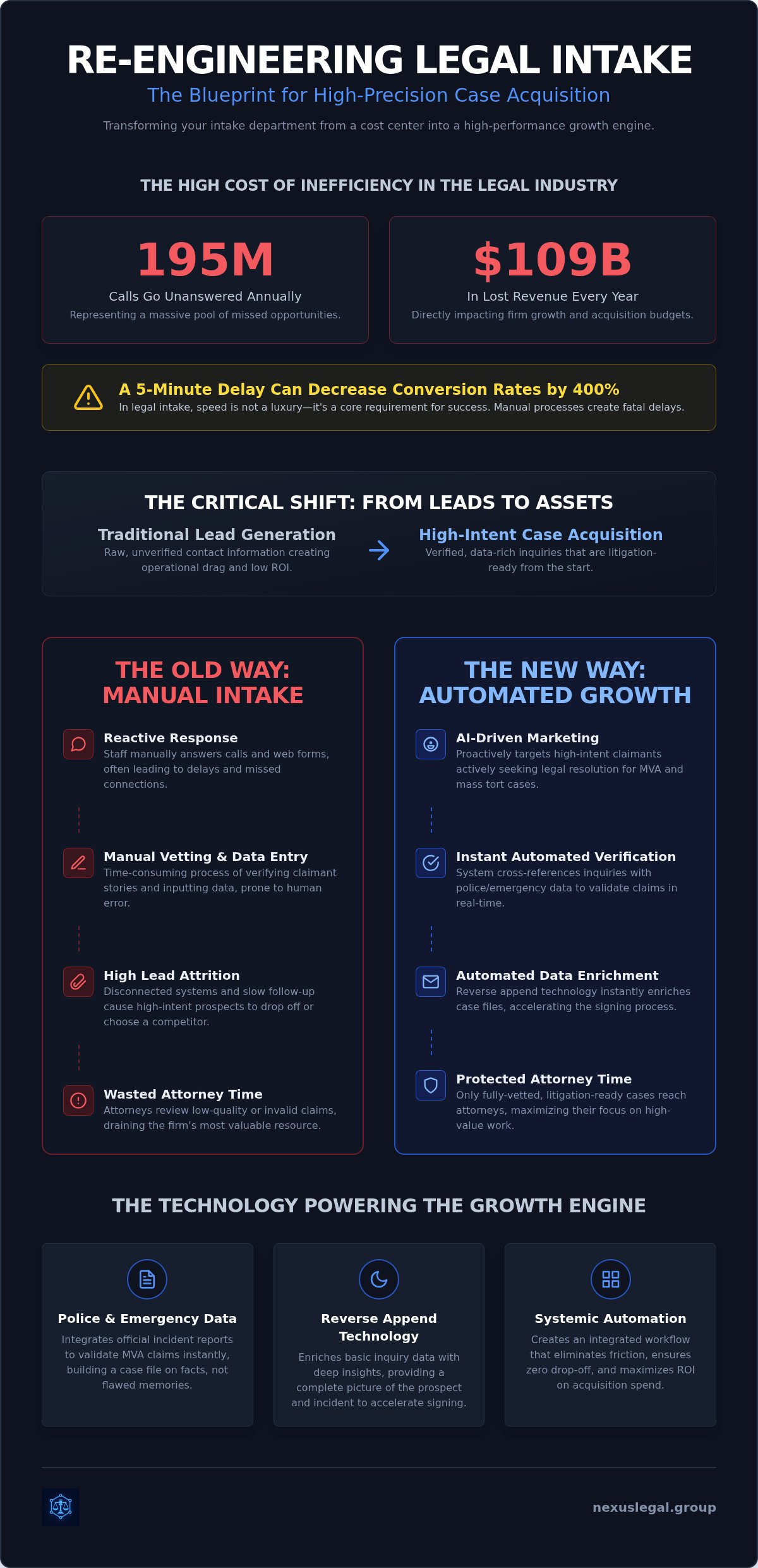
Did you know that an estimated 195 million calls go unanswered across the legal industry every year, resulting in nearly $109 billion in lost revenue? For elite plaintiff firms, these figures represent a fundamental failure in legal intake workflow management that drains acquisition budgets and stalls organizational growth. You've likely felt the frustration of watching high-intent MVA or mass tort inquiries dissolve into attrition because your manual verification processes can't keep pace with market demands. It's a common bottleneck where administrative friction and low-quality leads clog your litigation pipeline, preventing your attorneys from focusing on high-value casework.
We're going to change that by mastering the mechanics of high-performance growth infrastructure. This article provides a technical blueprint to help you implement automated verification and data-rich acquisition strategies that eliminate operational drag. You'll learn how to leverage police report data and systemic automation to ensure a predictable flow of signed cases. By the end of this guide, you'll understand how to transform your intake department from a cost center into a high-precision engine that maximizes ROI on every dollar of acquisition spend.
Key Takeaways
- Shift your perspective from simple lead generation to a systemic engineering approach that treats intake as a high-precision verification engine.
- Optimize your legal intake workflow management by leveraging police reports and emergency services data to validate high-intent inquiries before they reach your attorneys.
- Eliminate administrative friction and lead attrition using reverse append technology to instantly enrich accident data and accelerate the signing process.
- Implement a two-step framework for deploying AI-driven marketing and automated communication protocols that ensure no litigation-ready prospect goes unanswered.
- Master the mechanics of scaling your mass tort and MVA campaigns through a clinical, automated growth infrastructure that maximizes ROI on every acquisition dollar.
Defining Legal Intake Workflow Management in the Plaintiff Context
Think of your intake process as a high-performance engine rather than a simple gateway. In the context of elite plaintiff firms, legal intake workflow management is the systemic engineering of case acquisition. It isn't just about answering phones or filing digital forms; it's about building a foundational layer that identifies and secures high-value litigation opportunities with clinical precision. For firms operating at scale, this system acts as the primary filter that separates raw market noise from actionable legal assets.
There's a critical distinction between traditional lead generation and high-intent inquiry verification. A lead is often nothing more than a name and a phone number with an unverified claim. In contrast, a litigation-ready inquiry is a verified asset backed by specific data points. Elite firms require institutional-grade growth infrastructure to manage this distinction. The core metric of your success isn't the number of leads you generate, but the speed and accuracy with which you transition a prospect into a litigation-ready inquiry.
The Shift from Lead Generation to Case Acquisition
Traditional lead generation often creates significant operational drag for trial lawyers. When you focus on raw lead volume, your staff spends hours chasing low-intent prospects who may not even have a valid claim. This process is inefficient and expensive. By deploying AI-driven marketing, you can target high-intent claimants who are actively seeking legal resolution. This shift transforms your intake from a passive reception desk into an active acquisition department. You aren't just collecting names; you're acquiring exclusive, high-intent MVA and mass tort inquiries that are ready for immediate attorney review.
The Operational Cost of Disconnected Systems
Disconnected systems create a "friction gap" between your marketing spend and your signed cases. If your verification process is manual, your response times will naturally lag. In an industry where a five-minute delay can decrease conversion rates by 400%, slow response times are a luxury you can't afford. Manual vetting increases overhead and leads to high attrition. To eliminate this friction, you need a robust Law Firm Growth Infrastructure. This systemic approach uses legal intake workflow management and Automated Verification to ensure that only the most qualified cases reach your pipeline, protecting your firm's most valuable resource: your attorneys' time.
The Mechanics of High-Intent Case Verification and Data Enrichment
Precision in the verification stage is what separates elite plaintiff firms from those struggling with high lead-to-case attrition. While basic intake relies on subjective claimant testimony, a sophisticated legal intake workflow management system uses objective data points to validate a claim instantly. This clinical approach involves cross-referencing incoming inquiries against real-world incident records to ensure every case in your pipeline is backed by verifiable facts. By the time a case reaches an attorney, it shouldn't just be an "interest"; it should be a litigation-ready asset.
Automated Verification acts as the primary filter for eliminating fraudulent or weak claims before they consume your staff's time. By integrating third-party data sets directly into the intake flow, firms can confirm the date, location, and severity of an accident in real time. This technical rigor ensures that your resources are focused exclusively on high-intent inquiries with a high probability of successful litigation.
Leveraging Police and Emergency Services Data
The technical process of sourcing incident data begins with the integration of police and emergency services records. Instead of asking a traumatized claimant to recall the exact badge number of a responding officer or the precise GPS coordinates of a collision, the system retrieves this information automatically. This reduces the cognitive burden on the claimant, which significantly improves the user experience and reduces drop-off rates. Utilizing Police Report Generated MVA Leads allows your firm to build a case file based on official documentation rather than potentially flawed memories.
Reverse Append Technology for Deep Inquiry Insights
Reverse append technology is a powerful tool in personal injury litigation that allows firms to fill in the blanks of a partial inquiry. If a claimant provides only a phone number or a license plate, the system can "reverse append" that data to find accident reports, vehicle details, and participant information. This deep enrichment increases the conversion rate of signed cases because your team enters every conversation with a complete understanding of the incident's mechanics.
It's vital to maintain ethical and compliant standards throughout this data-driven acquisition process. Every piece of enriched data must be handled with strict adherence to privacy regulations, ensuring that your growth infrastructure remains as secure as it is efficient. If you're looking to upgrade your current systems, exploring advanced verification frameworks can help you secure the participant details you need with clinical precision. This level of detail doesn't just improve your intake; it builds the foundation for a more persuasive legal argument from day one.
Manual Intake vs. Automated Growth Infrastructure
The difference between a manual intake process and an automated growth infrastructure is the difference between a variable cost and a fixed asset. In a manual environment, your ability to process inquiries is strictly limited by the hours and attention spans of your staff. This creates a ceiling on your firm's growth. When you transition to a sophisticated legal intake workflow management system, you replace human variability with mechanical precision. This shift ensures that every inquiry is handled with the same clinical rigor, regardless of whether it arrives at noon on a Tuesday or midnight on a Sunday.
Manual systems are inherently fragile. They rely on consistent human performance, which is subject to fatigue, distraction, and turnover. Conversely, an automated infrastructure provides a resilient foundation that can absorb sudden spikes in volume without increasing your administrative overhead. This reliability is what allows elite firms to maintain high standards of case quality while aggressively scaling their acquisition efforts.
The Limitations of Human-Led Vetting
Human-led vetting is frequently plagued by transcription errors and inconsistent data entry, which can compromise the integrity of a case file before it even reaches an attorney's desk. Beyond simple data accuracy, the primary failure of manual systems is speed. Research indicates that nearly 8 in 10 legal consumers expect a response within 24 hours of their initial contact. In a manual setup, meeting this Service Level Agreement (SLA) consistently is nearly impossible. These delays lead directly to claimant "shopping," where a high-intent prospect moves on to a competitor simply because they answered the phone first. You can explore how to solve these bottlenecks in our guide on Automated Intake for Plaintiff Firms.
Engineering Predictable Revenue through Systems
Growth infrastructure transforms your intake from a chaotic cost center into a predictable engine for revenue. By implementing Automated Verification, you remove the burden of preliminary vetting from your legal team. This has a profound impact on firm morale; your attorneys can stop acting as frontline screeners and start focusing on high-level litigation. For mass tort campaigns, this scalability is essential. A system doesn't get overwhelmed by a sudden influx of 500 inquiries; it simply processes them according to your established protocols. This mechanical precision reduces administrative friction and ensures that your firm's expansion is limited only by your acquisition budget, not your staff's bandwidth. It's the foundational layer required for any firm aiming for elite status in the national market.
Implementing a Litigation-Ready Workflow: A Step-by-Step Framework
Transitioning from a reactive intake department to a proactive acquisition engine requires a structured, four-step framework. This approach ensures that legal intake workflow management is treated as a core business process rather than an administrative afterthought. By engineering each stage of the claimant journey, you can eliminate the "friction gap" that typically leads to lead attrition and wasted marketing spend. The goal is to move beyond simple lead capture and focus on the delivery of litigation-ready inquiries that your trial team can act on immediately.
- Step 1: Deployment of AI-driven marketing. Utilize sophisticated algorithms to identify and capture high-intent inquiries from claimants actively seeking legal resolution.
- Step 2: Instant engagement. Implement automated communication protocols that trigger the moment an inquiry is received, ensuring a near-zero response time.
- Step 3: Rigorous verification. Cross-reference claimant data with police reports and emergency services records, using reverse append enrichment to validate the incident's mechanics.
- Step 4: Final vetting and transition. Perform a clinical review of the enriched data set to confirm case viability before moving to signed case status.
Structuring the Intake Front Door
Your "front door" must meet the claimant exactly where they are, whether that is through mobile search, social platforms, or direct web inquiries. Multi-channel engagement is essential for capturing High-Intent MVA Case Acquisition opportunities before they reach a competitor. By integrating Automated Verification at the point of entry, you can qualify inquiries instantly. This clinical precision ensures that your staff only interacts with prospects who meet your firm's specific criteria. Throughout this process, maintaining compliant and ethical data handling standards is non-negotiable, protecting both the claimant's privacy and your firm's reputation.
Transitioning from Inquiry to Signed Case
The final stage of the workflow is the seamless delivery of litigation-ready inquiries to your trial team. This transition is facilitated by automated e-signatures, which close the intake loop by securing the representation agreement while the claimant's intent is at its peak. To refine this acquisition engine, you must monitor operational metrics such as cost-per-signed-case and lead-to-contract conversion rates. These data points allow you to identify bottlenecks and adjust your protocols for maximum efficiency. This systemic approach ensures that your firm's growth is driven by verifiable results rather than anecdotal successes.
Scaling Revenue through Nexus Legal Group’s Integrated Case Flow
Nexus Legal Group functions as the strategic architect of your firm's growth by providing the foundational layer for legal intake workflow management. We enable elite plaintiff firms to move beyond the constraints of fragmented, manual systems that often lead to lead-to-case attrition. Our integrated case flow is engineered to eliminate operational friction and deliver exclusive, litigation-ready inquiries that fuel your practice's expansion. For further technical insights into optimizing your firm's internal operations, we invite you to explore the Nexus Legal Group blog.
The value of this infrastructure lies in its ability to transform raw data into a predictable stream of signed cases. For firms aiming to maintain a competitive edge in the national market, having a dedicated partner who understands the mechanics of business expansion is essential. Our system isn't just a tool; it's a high-performance engine that works behind the scenes to ensure your pipeline remains full of high-quality opportunities. By prioritizing technical mastery and systemic integrity, we provide the security and reliability required for large-scale litigation.
High-Intent MVA Case Acquisition for Elite Firms
Exclusivity and clinical precision are the hallmarks of our High-Intent MVA Case Acquisition system. Unlike traditional lead sources that often distribute the same data to multiple firms, our process delivers inquiries that are yours alone. The platform handles the full complexity of MVA data enrichment by automatically sourcing accident reports and participant details, ensuring your trial team spends their time only on verified, high-value claims. You can find more information on these behavioral trends and data strategies in our analysis of High Conversion MVA Leads.
Mass Tort Case Generation: Ethical and Compliant Growth
Scaling a mass tort practice requires a level of rigor that manual vetting simply can't provide. Our mass tort case generation focuses on the strategic acquisition of claimants at scale while maintaining the highest ethical and compliant standards. Automated Verification is used to validate every inquiry against established litigation criteria, ensuring that only the most viable cases enter your pipeline. This focus on litigation readiness means your firm can grow aggressively without compromising on case quality or regulatory compliance. It's time to replace outdated, manual methods with a powerful, automated growth infrastructure.
Engineering a Frictionless Future for Your Firm
Transitioning your firm from a manual intake model to a sophisticated growth infrastructure isn't just about efficiency; it's about securing your position in a competitive national market. By mastering legal intake workflow management, you eliminate the administrative friction that typically leads to lead-to-case attrition. This systemic approach ensures that every inquiry is cross-referenced with objective incident data, transforming raw leads into litigation-ready assets with clinical precision. You've seen how automated verification and data enrichment remove the burden of vetting from your legal team, allowing your attorneys to focus on high-level litigation.
Nexus Legal Group provides the foundational layer required for this level of scale. We specialize in High-Intent MVA Case Acquisition and data-driven verification using police reports to ensure your pipeline remains exclusive and high-value. Our systems are designed exclusively for elite plaintiff law firms that value technical mastery, systemic integrity, and predictable revenue. This specialized architecture ensures that your firm's growth is no longer limited by staff bandwidth or manual errors.
It's time to stop chasing leads and start acquiring cases through a high-performance engine built for your specific needs. Your firm's expansion is only a system away, and we're ready to help you build it.
Frequently Asked Questions
What is the primary difference between legal intake and case acquisition?
Legal intake is often viewed as a passive administrative function, whereas case acquisition is a proactive, engineered strategy designed for firm growth. While intake simply records contact details, case acquisition focuses on the systemic identification and securing of high-value legal assets. This shift in legal intake workflow management ensures that firms aren't just processing leads, but are actively building a pipeline of verified, litigation-ready inquiries that align with their specific practice goals.
How does automated verification improve law firm ROI on marketing?
Automated Verification improves marketing ROI by eliminating the high cost of manual vetting and filtering out low-quality or fraudulent inquiries before they reach your staff. By instantly validating claims against objective data sets, your firm avoids wasting expensive attorney hours on non-viable cases. This efficiency ensures that your acquisition budget is spent exclusively on high-intent prospects, maximizing the conversion rate from raw inquiry to signed case and significantly lowering your cost-per-acquisition.
What data sources are used in high-intent MVA inquiry verification?
High-intent MVA inquiry verification relies on objective, third-party data sources rather than claimant testimony alone. These sources include police reports and emergency services data, which provide factual accounts of incident mechanics. Additionally, reverse append technology is used to enrich partial inquiries with detailed accident reports and participant information. This data-driven approach ensures that every inquiry in your legal intake workflow management system is backed by verifiable documentation from the outset.
Can legal intake workflow management reduce lead-to-case attrition?
Yes, a robust management system directly addresses the primary causes of lead-to-case attrition: slow response times and lack of case validation. By automating engagement and verification, firms can respond to prospects within seconds, preventing them from "shopping" elsewhere. Because the system filters for case quality, your intake team spends their time closing high-intent inquiries rather than chasing unverified leads that are likely to drop out of the pipeline.
Is automated intake compliant with legal ethics standards?
Automated intake is fully compliant with legal ethics standards when implemented with rigorous data privacy and transparency protocols. Elite firms use these systems to ensure consistent, unbiased screening and to protect sensitive claimant information through secure, institutional-grade infrastructure. Nexus Legal Group provides ethical and compliant leads and signed cases, ensuring that your growth strategies meet the high standards of professional literacy and regulatory requirements expected in the legal industry.
How does reverse append technology benefit personal injury attorneys?
Reverse append technology allows personal injury attorneys to transform minimal contact information into comprehensive case files. By starting with a single data point, such as a phone number or license plate, the system retrieves official accident reports and detailed participant information. This enrichment provides attorneys with a clinical understanding of the incident before the first consultation, allowing for more persuasive claimant interactions and a faster transition to a signed representation agreement.
What makes an inquiry "litigation-ready" for a plaintiff firm?
An inquiry is considered litigation-ready when it has been validated through objective data and meets specific criteria for liability and damages. This status means the inquiry is no longer just a lead; it's an asset backed by police reports, emergency services records, and verified participant details. For elite plaintiff firms, receiving litigation-ready inquiries means the preliminary vetting is complete, allowing the legal team to move directly into case development and filing.
How does Nexus Legal Group support mass tort case generation?
Nexus Legal Group supports mass tort case generation by providing the strategic growth infrastructure needed to acquire claimants at a national scale. We combine AI-driven marketing with Automated Verification to deliver exclusive, high-intent inquiries that meet rigorous litigation standards. Our system manages the complexity of mass tort intake by ensuring every signed case is ethically sourced and backed by the data enrichment required for successful large-scale litigation.