Legal Intake Friction Reduction: Engineering Seamless Case Acquisition in 2026
Stop losing 8% of revenue to slow intake. Our guide to legal intake friction reduction uses AI and automation to help you sign more qualified cases, faster.
Did you know the average law firm loses 8% of potential revenue simply because of inefficient intake processes? It's a sobering reality in 2026, where high-intent inquiries often evaporate during the friction-heavy transition from lead to signed retainer. You've likely experienced the systemic failure of high lead abandonment or the operational drag of manual verification that moves too slowly to capture a claimant's attention. True legal intake friction reduction isn't about just answering the phone faster; it's about re-engineering the entire acquisition architecture to ensure no viable case slips through the cracks.
This guide will show you how to eliminate operational bottlenecks and transform raw inquiries into litigation-ready cases through advanced data enrichment and AI-driven automation. We'll explore the shift from asking claimants for endless details to providing your firm with preemptive incident data via reverse append technology. By the end of this article, you'll understand how to build a high-velocity intake workflow that reduces overhead while significantly increasing your volume of qualified, signed cases.
Key Takeaways
- Understand the economic impact of intake bottlenecks and why friction-heavy processes result in an average revenue loss of 8% for most firms.
- Learn to implement legal intake friction reduction strategies by leveraging AI-driven automation and real-time incident data enrichment.
- Discover why conversion velocity is more critical than lead volume when you're aiming for a streamlined, litigation-ready case acquisition model.
- Identify specific drop-off points in your current funnel and replace slow, manual verification with automated police report integration.
- Explore how a sophisticated growth infrastructure provides the technical mastery needed to scale your firm's case acquisition without increasing headcount.
The Economics of Friction: Why Intake Bottlenecks Stunt Firm Growth
Intake friction is the systemic drag that occurs when a high-intent inquiry meets operational resistance. In the 2026 legal market, where Legal technology has set a new standard for consumer expectations, any delay in the conversion path acts as a silent revenue killer. It's not just a minor inconvenience; it's a structural flaw in your acquisition architecture. When a claimant reaches out after a motor vehicle accident, they're looking for an immediate solution, not a bureaucratic hurdle. If your system requires them to jump through hoops, they'll simply find a firm that's already removed them.
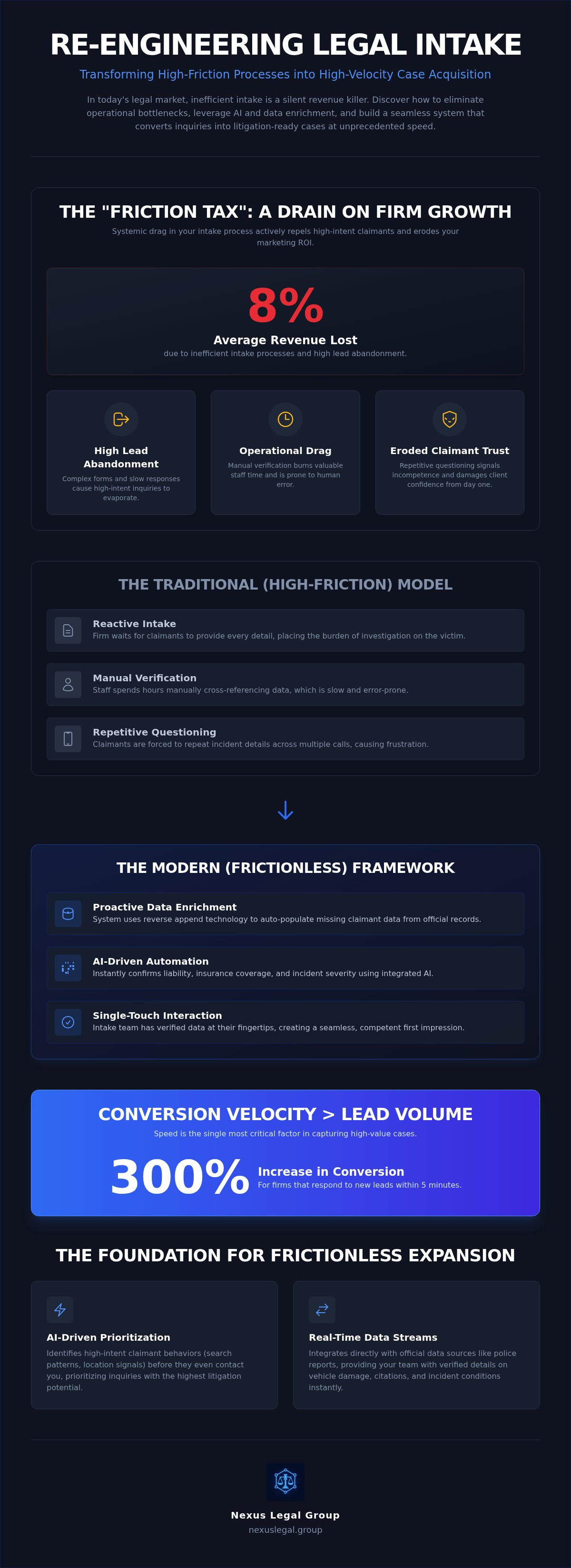
Every dollar you funnel into marketing is diluted when your intake process lacks precision. This "Friction Tax" manifests as a direct drain on your marketing ROI. Statistics show that the average law firm loses 8% of potential revenue due to inefficient intake processes. Speed is a massive factor here, as firms responding to leads within five minutes can see conversion rates jump by 300%. To thrive, you must view legal intake friction reduction as a core financial strategy rather than just an administrative task. Moving toward an institutional approach to intake ensures that your firm captures the highest-value cases before the competition even places a callback.
The Psychological Impact of Friction on Claimants
Victims of a serious accident carry a heavy cognitive load. They're often dealing with physical pain, financial stress, and emotional trauma all at once. Forcing these individuals to repeat accident details across multiple phone calls or forms isn't just tedious; it's damaging to the relationship. Repetitive questioning signals a lack of internal coordination and erodes trust before a retainer is even signed. A seamless, data-enriched process signals professional competence. It tells the claimant that you're already in control of the facts, which provides the sense of security they desperately need during a crisis.
Operational Costs of Manual Verification
Manual data entry and lead vetting represent a significant drain on firm resources. When your staff manually verifies accident details, they aren't just performing administrative work; they're burning the billable hour equivalent of your most valuable human capital. This manual approach is also prone to human error, leading to inconsistent data quality and wasted time on non-viable leads. Relying on "hiring more intake staff" to solve these delays is a linear solution to an exponential problem. True scalability requires a system that automates verification, allowing your team to focus on high-value strategy rather than basic data retrieval.
Engineering Seamless Intake: The Role of AI and Incident Data
Engineering a frictionless intake system requires moving beyond simple form capture. In 2026, the most successful firms use legal intake friction reduction to transition from a reactive posture to a proactive, data-driven verification model. Instead of waiting for a claimant to provide every detail, your infrastructure should already be working to validate the incident. High-performance AI-driven marketing now identifies high-intent behaviors, such as specific search patterns and location-based signals following an accident, before a user even clicks your ad. This allows your firm to prioritize inquiries that demonstrate immediate litigation potential.
Automating the Verification Workflow
Verification isn't just about confirming contact info; it's about confirming liability and insurance coverage in seconds. There's a massive difference between a 'verified lead' and a 'qualified inquiry.' A lead is a name; an inquiry is a case with documented damages and a viable defendant. Reverse append technology serves as a critical friction-reduction tool by automatically populating missing claimant data from official accident records. By integrating these tools, you remove the investigative burden from the claimant and place the power of verified information in your intake team's hands before the first phone call ends.
Integrating Real-Time Data Streams
Sourcing data directly from emergency services and police reports creates a foundation of systemic integrity. When your intake agents have real-time enrichment at their fingertips, their confidence increases because they aren't just guessing about the severity of a crash. They can see vehicle damage descriptions, citation details, and even the weather conditions at the time of the event. This automated cross-referencing ensures that every case you pursue is built on a bedrock of verified facts. Implementing a comprehensive case acquisition infrastructure can help your firm deploy these advanced data streams to ensure every inquiry is litigation-ready from the moment it enters your CRM.
Volume vs. Velocity: Accelerating Litigation Readiness
High lead volume often serves as a vanity metric that masks underlying operational inefficiencies. While a high number of inquiries might look impressive on a dashboard, it means very little if your team is bogged down in a "Discovery Lag." This lag occurs when days or weeks pass between the initial inquiry and the acquisition of the official accident report. By securing police reports and emergency services data at the point of intake, you eliminate this gap and move straight to litigation readiness. This acceleration is the primary objective of legal intake friction reduction, ensuring that high-intent claimants are signed while their motivation and the case's viability are at their peak.
The "Golden Hour" of case signing is a documented phenomenon in the 2026 legal landscape. Research shows that law firms responding to online leads within five minutes see conversion rates up to 300% higher than those who wait. Velocity isn't just about speed; it's about the completeness of the information you provide during that first contact. When you can present a claimant with the facts of their own accident, already verified by official records, you position your firm as the most efficient and competent option available. You aren't just another firm asking questions; you're the firm that already has the answers.
Strategic Acquisition vs. Lead Buying
Elite firms are moving away from the traditional model of buying generic lead lists, which often suffer from inconsistent data quality and high abandonment rates. Instead, they're investing in growth infrastructure that prioritizes automated intake for plaintiff firms. This shift allows you to engineer high-intent case growth by focusing on inquiries that are already pre-vetted against your specific litigation criteria. Having a litigation-ready file on day one provides a massive competitive advantage, allowing your legal team to focus on case strategy rather than administrative hunting.
Precision Vetting for Mass Torts
The principles of legal intake friction reduction are equally vital in the mass tort space, where the volume of claimants can easily overwhelm a manual intake team. Success in mass torts requires a mass tort case acquisition strategy that automates the verification of complex medical criteria. By utilizing AI-driven workflows to cross-reference claimant statements with available data points, you can filter out non-viable inquiries instantly. This precision vetting ensures that your firm's resources are dedicated only to the cases with the highest potential for recovery, maintaining high conversion velocity even at massive scale.
Implementing a Frictionless Intake Framework for 2026
Building a high-performance intake system requires a shift from passive lead collection to active case engineering. You should start by auditing your current funnel to identify specific 'Drop-Off Points' where potential claimants abandon the process. Often, these points coincide with high-friction requests, such as asking for insurance policy numbers or detailed crash descriptions during the initial outreach. By deploying automated verification, you replace these manual vetting tasks with background data retrieval. This ensures that every inquiry is enriched with incident data before it even reaches your intake desk, allowing your team to lead with facts rather than questions.
Operational success in 2026 is measured through clinical precision in your metrics. You must monitor your Time-to-Sign and Cost-per-Acquisition with the same rigor you apply to trial preparation. Reducing the time it takes to move from an inquiry to a signed retainer directly impacts your bottom line. When you implement legal intake friction reduction as a formal framework, you aren't just making things faster; you're lowering the cost of acquiring high-intent MVA cases by eliminating the waste inherent in manual, error-prone workflows.
The Data-First Architecture
Traditional intake models prioritize expanding form fields to capture more information, but this actually increases abandonment. Your architecture should prioritize data enrichment instead. By utilizing police report data for attorneys, you can validate MVA claims instantly without burdening the claimant. The 2026 standard for data-driven case acquisition relies on the preemptive enrichment of inquiries through reverse append technology to ensure litigation readiness. This approach allows your firm to verify liability and insurance coverage before the first outreach, turning a cold lead into a warm, verified opportunity.
Refining the Human-AI Interface
As you automate the mechanical aspects of intake, your staff's role must evolve. They should no longer function as data entry clerks but as 'Case Strategists' who guide claimants through the next steps of their litigation journey. You can use AI to guide intake scripts based on real-time data enrichment, ensuring the conversation remains professional and sophisticated. This balance of clinical precision and approachable instructional guidance helps build immediate trust. It ensures that the claimant feels they're speaking with a high-level expert who already understands the specifics of their accident, rather than a generic call center agent.
Nexus Growth Infrastructure: The Foundation for Frictionless Expansion
Nexus Legal Group functions as a strategic architect for elite plaintiff firms, providing the foundational growth infrastructure necessary for institutional scaling. Unlike peripheral toolsets that merely manage existing leads, this infrastructure serves as a high-performance engine that drives expansion from behind the scenes. By implementing legal intake friction reduction at the systemic level, Nexus allows firms to move beyond the limitations of manual processes. The mechanics of Nexus CaseFlow focus on the clinical precision of the acquisition funnel, ensuring that every inquiry is verified through automated incident data before it reaches your CRM.
Securing exclusive, litigation-ready MVA and mass tort inquiries requires a commitment to systemic integrity. In the 2026 landscape, raw lead volume has been replaced by the need for high-intent inquiries that are already backed by official documentation. Nexus utilizes AI-driven marketing precision to identify these opportunities, then deploys automated verification to confirm liability and damages. This process transforms a high-intent inquiry into a signed case with minimal human intervention, allowing your firm to maintain a high-velocity workflow while reducing operational overhead per case acquired.
The Nexus Advantage: Beyond Lead Generation
Scaling a modern law firm requires more than just a list of names; it demands a robust system of record for acquisition. This institutional approach ensures that every data point is captured, verified, and enriched without the 'admin drag' typical of traditional intake models. By leveraging reverse append technology, Nexus secures comprehensive accident reports and emergency services data to pre-populate case files. This level of technical mastery allows your team to lead with authority during the initial claimant contact, signaling professional competence from the outset.
Ethical and Compliant Scalability
Maintaining DPPA and TCPA compliance is a non-negotiable requirement for sustainable growth. All friction-reduction tactics must meet rigorous state bar standards to ensure the long-term viability of your firm's reputation. Nexus integrates compliance directly into the automated verification workflow, creating a self-correcting system that maintains ethical lead sourcing. This focus on data driven case acquisition ensures that your firm's expansion is built on a bedrock of systemic integrity and regulatory adherence. By automating the vetting process, you don't just sign more cases; you sign cases that are ethically sourced and litigation-ready on day one.
Dominating the 2026 Legal Landscape through Acquisition Excellence
Engineering a high-performance plaintiff firm in 2026 requires a clinical focus on the mechanics of your acquisition funnel. By prioritizing legal intake friction reduction, you move beyond the limitations of manual vetting and generic lead lists. You've learned that the path to elite growth involves replacing administrative drag with automated verification and incident-level data enrichment. This transition ensures your firm captures high-intent inquiries while their motivation is at its peak.
Success is found where AI-driven marketing precision meets the immediate acquisition of verified incident data. This combination allows your team to act as strategists rather than clerks, securing exclusive, litigation-ready inquiries during the critical "Golden Hour." When you provide comprehensive accident files from day one, you establish a standard of professional competence that claimants trust and competitors cannot match. It's time to build your firm on a foundation of technical mastery and systemic integrity.
Take the next step toward institutional excellence and secure your position at the forefront of the industry with a system built for the future of litigation.
Frequently Asked Questions
What is the primary cause of intake friction in plaintiff law firms?
The primary cause is the reliance on manual, repetitive data collection processes that burden the claimant. When a firm requires accident victims to provide complex details like insurance policy numbers or specific crash coordinates, abandonment rates rise. This structural inefficiency delays the conversion of high-intent inquiries into signed retainers. Implementing a system that pre-populates these details removes the cognitive load from the victim and accelerates the acquisition workflow.
How does automated verification improve MVA case conversion rates?
Automated verification improves conversion by confirming liability and insurance coverage instantly using real-time incident data. By validating a case's viability before the first call ends, you reduce the window for claimant abandonment. This speed is critical because firms that respond within five minutes see significantly higher conversion rates. Accurate, instant verification ensures your team spends time only on cases that meet your specific litigation criteria.
Can AI-driven intake maintain the professional tone required for elite firms?
Yes, AI-driven systems utilize sophisticated scripts guided by real-time data enrichment to maintain a high degree of professional confidence. This technology allows intake agents to speak as knowledgeable case strategists rather than data entry clerks. By having verified accident details at their fingertips, agents build immediate trust with the claimant. It's a clinical approach that signals competence and institutional authority from the very first interaction.
What role does police report data play in reducing intake friction?
Police report data provides a bedrock of verified facts, such as vehicle damage descriptions and official citations, without requiring the claimant to hunt for documents. This preemptive enrichment is a cornerstone of legal intake friction reduction because it allows your team to lead the conversation with the facts already in hand. It turns a standard intake call into a high-level strategic consultation that respects the claimant's time and emotional state.
How much time can a firm save by implementing reverse append technology?
Reverse append technology saves hours of manual investigative work per case by automatically populating accident reports and participant details. This eliminates the "Discovery Lag" and moves cases toward litigation readiness on day one. Your staff doesn't have to chase down reports or verify addresses manually, which allows them to focus on high-value strategy. The resulting efficiency gain allows your organization to scale case volume without a proportional increase in headcount.
Is automated intake friction reduction compliant with TCPA and DPPA regulations?
Yes, provided the system is built with automated systemic integrity. Nexus Legal Group ensures all data sourcing and outreach methods adhere to national regulatory standards for ethical lead generation. By automating the verification process, firms can maintain rigorous compliance with TCPA and DPPA requirements while scaling their acquisition efforts. This institutional approach protects your firm's reputation and ensures that every signed case is sourced through ethical, compliant channels.
What is the difference between a lead and a litigation-ready inquiry?
A lead is merely contact information that requires extensive vetting, while a litigation-ready inquiry includes verified incident data, liability confirmation, and documented damages. A lead is often a raw, unverified data point that may or may not result in a case. A litigation-ready inquiry is a foundational asset that's already been pre-vetted against your firm's criteria. This distinction is vital for maintaining a high-velocity, high-conversion acquisition funnel.
How does friction reduction impact the overall ROI of MVA marketing?
Reducing friction directly improves marketing ROI by minimizing the revenue loss associated with lead abandonment. When your intake process is streamlined, a higher percentage of high-intent inquiries convert into signed cases. Implementing legal intake friction reduction as a core strategy lowers your overall Cost-per-Acquisition. It ensures that your marketing budget isn't wasted on viable leads that slip through the cracks due to slow or inefficient manual vetting processes.