Law Firm Growth Strategies 2026: The Shift to High-Intent Growth Infrastructure
Explore law firm growth strategies 2026. Shift from costly marketing to a growth infrastructure that secures high-intent MVA & Mass Tort cases automatically.
The era of law firm marketing as a creative endeavor is effectively over, replaced by a rigorous requirement for mechanical growth infrastructure. As you evaluate law firm growth strategies 2026, you've likely felt the strain of rising cost-per-acquisition paired with intake processes that let qualified claimants slip through the cracks. It's frustrating to depend on lead sources that deliver inconsistency instead of cases. This dependency creates a bottleneck that prevents your firm from scaling at the pace your expertise deserves.
This article provides a blueprint for moving beyond traditional marketing to implement a data-driven growth system. You'll discover how elite plaintiff firms use automated verification to reduce staff workload while securing exclusive, litigation-ready MVA and Mass Tort cases. We'll examine the mechanics of reverse append technology and police report integration to ensure your pipeline remains predictable and profitable. This guide outlines the transition from a peripheral marketing approach to a foundational layer of technical mastery that drives sustainable expansion.
Key Takeaways
- Learn why shifting from traditional marketing to a mechanical growth infrastructure is essential for ensuring predictable case volume.
- Discover how to leverage police reports and reverse append technology to identify and secure exclusive, high-intent MVA inquiries.
- Understand how automated verification acts as a critical filter to eliminate friction and reduce administrative overhead during intake.
- Implement law firm growth strategies 2026 that successfully balance high-volume MVA acquisition with the scalability of Mass Tort cases.
- Follow a structured roadmap to evaluate the decision to either build or buy the technical systems driving your firm's expansion.
The Evolution of Law Firm Growth: Shifting from Marketing to Infrastructure in 2026
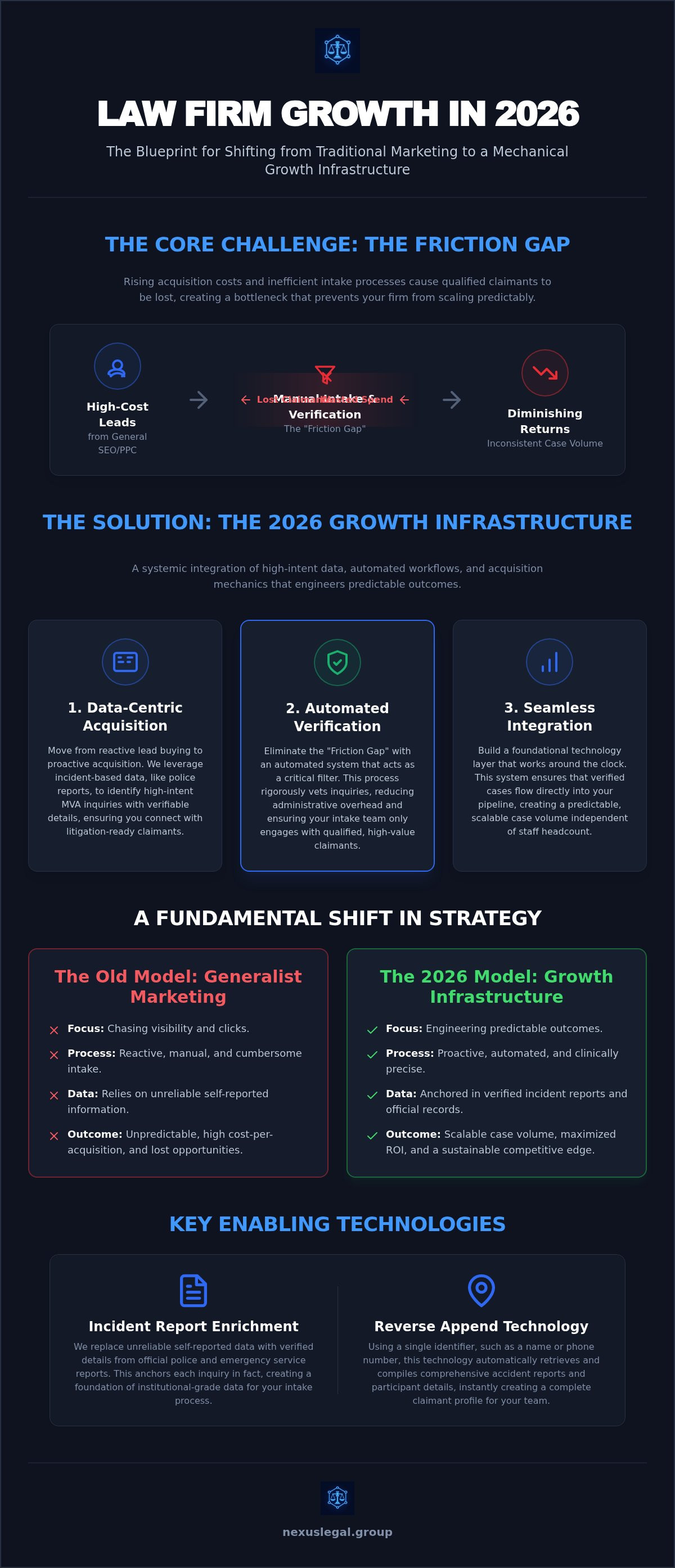
Law firm growth strategies 2026 require a fundamental shift in how partners view their expansion. The traditional model of treating marketing as a separate, creative department is failing. Instead, elite firms are adopting Growth Infrastructure. This is the systemic integration of high-intent data, automated workflows, and acquisition mechanics. This shift moves the focus from chasing visibility to engineering predictable outcomes. It's about building a machine that works regardless of who is in the office.
Traditional legal marketing, specifically standard SEO and PPC, is no longer enough. In a hyper-competitive market, these channels often produce high costs-per-acquisition with diminishing returns. Most firms suffer from a Friction Gap. This is where qualified claimants are lost during cumbersome, manual intake processes. To solve this, firms must embrace Mechanical Growth. This involves building systems that scale case volume independently of staff headcount, ensuring that every dollar spent on acquisition is maximized through efficiency.
The Decline of Generalist Marketing for Elite Firms
Broad-spectrum digital advertising is yielding lower quality inquiries as AI-driven market saturation makes generic lead generation nearly obsolete. When every firm bids on the same keywords, the winner isn't the one with the best ad. It's the one with the most efficient backend. Elite firms are moving away from volume-first strategies that flood intake teams with low-intent noise. They're pivoting toward intent-first models that prioritize the quality and readiness of the claimant from the first point of contact.
Defining the 2026 Growth Infrastructure Layer
This layer is the foundational architecture of a modern practice. It integrates three core pillars: precise data sourcing from emergency services, automated verification to filter noise, and seamless intake integration. This evolution in legal technology allows firms to operate with clinical precision. By utilizing ethical standards and compliant data, firms can maintain systemic integrity while scaling. Nexus Legal Group acts as the strategic architect of this shift, providing the tools necessary to remove operational friction. Effective law firm growth strategies 2026 rely on this level of integration to maintain a competitive edge. Growth Infrastructure is the foundational technology that converts market intent into signed cases.
Data-Centric Acquisition: Leveraging Incident Reports and Reverse Append Technology
Law firm growth strategies 2026 hinge on the transition from reactive lead purchasing to proactive, data-centric acquisition. In the past, firms waited for claimants to find them through generic search queries or social media ads. This reactive posture often results in high costs and low-quality inquiries that require extensive manual filtering. By contrast, a data-driven infrastructure leverages real-world incident data to identify high-intent inquiries with clinical precision. This shift ensures that your firm isn't just buying leads; it's acquiring litigation-ready cases based on verified events. This proactive approach eliminates the uncertainty of traditional marketing, replacing it with a steady stream of inquiries verified by objective data points.
The Power of Incident-Based Data Enrichment
Self-reported data from web forms is notoriously unreliable. Claimants often misremember dates, locations, or the severity of their accidents under the stress of an event. Utilizing police report generated MVA leads provides a higher degree of accuracy by anchoring the inquiry in official records. Emergency services data allows for real-time verification of incident details, ensuring that every inquiry entering your system is backed by a documented event. This level of enrichment transforms a simple inquiry into a high-intent case, allowing your team to focus their energy on claimants who have a verifiable path to litigation. It's about removing the guesswork from the intake process and replacing it with institutional-grade data.
Reverse Append Technology: Completing the Claimant Profile
Reverse append technology is a critical component of a sophisticated growth infrastructure. It's the process of using limited identifiers, such as a phone number or name, to automatically retrieve comprehensive accident reports and participant details. In the context of personal injury litigation, this technology provides immediate access to accident severity, insurance information, and additional parties involved. This automated matching significantly reduces the discovery burden during the early intake stages. Instead of spending hours tracking down reports or interviewing claimants for basic facts, your staff receives a completed profile. This allows for faster decision-making, immediate qualification, and significantly higher conversion rates. Implementing these high-intent acquisition systems ensures your firm maintains a competitive advantage through technical mastery and operational efficiency.
Engineering Efficiency: The Role of Automated Intake and Rigorous Verification
Law firm growth strategies 2026 demand a shift from high-touch manual processes to high-efficiency automated filters. For many elite plaintiff firms, the primary barrier to scaling isn't a lack of inquiries; it's the administrative burden of sorting through them. Without a rigorous verification layer, your firm spends valuable resources on non-qualified leads that never reach litigation. Implementing an automated verification system ensures that your intake team only engages with cases that meet specific, data-backed criteria. This clinical precision reduces overhead and allows your firm to focus on high-value MVA and Mass Tort acquisition without increasing staff headcount.
Eliminating the Intake Bottleneck
Traditional intake models rely on human availability, which often leads to missed opportunities during off-hours. Transitioning to automated intake for plaintiff firms allows for 24/7 engagement with high-intent claimants. These systems don't just collect information; they interact with potential clients using a sophisticated and respectful tone. This ensures that the professional decorum expected of a law firm is maintained while the system captures critical data in real-time. By engaging claimants immediately, you prevent them from contacting competitors, securing the case before the friction of manual follow-up can occur.
The Mechanics of Automated Verification
The goal of automated verification is to establish "Litigation-Ready" status before a human ever picks up the phone. This requires verifying three essential pillars: clear liability, adequate insurance coverage, and documented injury severity. Automated systems cross-reference incoming inquiries against emergency services data and police reports to ensure accuracy and exclusivity. This process also serves as a critical risk mitigation tool. By adhering to compliant legal lead generation standards, your firm avoids the ethical pitfalls of unverified or low-quality data. The result is a streamlined pipeline where every inquiry has been vetted for its litigation potential, ensuring that law firm growth strategies 2026 are built on a foundation of operational excellence and technical mastery.
Strategic Diversification: Balancing MVA Volume with Mass Tort Scalability
Law firm growth strategies 2026 require more than just efficient intake; they demand a sophisticated portfolio approach to case acquisition. Elite firms don't choose between high-volume MVA and high-value Mass Tort litigation. Instead, they implement a Hybrid Acquisition Model. This strategy uses a unified infrastructure to manage both streams, ensuring that the firm's revenue remains stable while pursuing high-value settlements. Managing this balance requires precise operational metrics. You must track the cost-per-signed-case alongside the projected settlement timeline to maintain healthy cash flow. Sourcing ethical and compliant signed cases is the only way to protect your firm's reputation while scaling these complex litigations with clinical precision.
The transition to a hybrid model ensures that your firm isn't vulnerable to market shifts in a single practice area. By treating case acquisition as a mechanical process, you can allocate resources based on real-time data. This approach allows for a "strategic architect" mindset, where growth is engineered rather than guessed. It's about building a foundational layer that supports multiple litigation types simultaneously, reducing the friction typically associated with entering new markets.
Scaling Mass Tort Case Acquisition
Implementing a successful mass tort case acquisition strategy involves identifying specific digital intent signals that differ from MVA events. While MVA cases are often triggered by a single incident, mass tort claimants are identified through behavioral data and exposure patterns. This requires a growth infrastructure capable of managing a longer lifecycle. You aren't just looking for a lead; you're looking for a verified, signed case that is ready for the long haul of multi-district litigation. The mechanics of this process rely on sophisticated data sets that ensure every claimant meets rigorous criteria before they enter your pipeline.
The Synergy of Multi-Channel Case Acquisition
The synergy between these two acquisition streams is what creates a truly resilient firm. MVA case flow acts as your cash flow engine, providing the immediate liquidity needed to fund daily operations. Mass Torts provide the equity growth that builds long-term firm value and significant ROI. A single, tech-enabled infrastructure layer allows you to toggle between these acquisition streams based on market conditions or firm capacity. This level of control ensures firm-wide scalability without the need to rebuild your systems for every new practice area. By leveraging law firm growth strategies 2026, you maintain a competitive edge through technical mastery and diversified acquisition.
Building Your 2026 Growth Roadmap: Implementing High-Intent Systems
Transitioning to an infrastructure-led model requires a methodical roadmap. It's no longer enough to simply increase ad spend; you must rebuild the foundational layer that processes market intent. Law firm growth strategies 2026 center on this mechanical transition. The first decision you face is the "Build vs. Buy" dilemma. While some large firms attempt to build internal data scrapers and verification logic, most find that the technical debt of maintaining police report integrations and reverse append APIs is prohibitive. Partnering with a specialized infrastructure provider allows you to deploy these systems immediately without the overhead of a dedicated engineering team.
Successful implementation integrates high-intent legal growth tools directly into your existing workflows. This ensures that data flows seamlessly from the initial accident report to your case management software. By positioning Nexus Legal Group as your strategic architect, you gain access to a foundational engine that drives growth from behind the scenes. This approach allows you to focus on litigation while the infrastructure handles the complexities of data acquisition and claimant verification.
Auditing Your Current Acquisition Funnel
Start by identifying common leakage points where qualified claimants are lost to competitors. This often happens during the manual intake phase or due to slow verification speeds. Evaluate the quality of your current MVA and mass tort attorney leads by measuring the "Litigation-Ready" conversion rate rather than just raw volume. If your intake team spends more than 30% of their time filtering non-qualified noise, your current system is failing. For a deeper technical audit of your existing processes, visit the Nexus Legal Group blog to understand the mechanics of data-driven growth.
The Implementation Phase: Systems Over Headcount
Deploying automated verification and data enrichment systems typically follows a phased timeline. Within the first 30 days, the focus should be on integrating data streams from emergency services and police reports into your intake workflow. This shift allows you to prioritize inquiries based on objective accident severity and liability data. Training your staff is the final, critical step. Instead of acting as cold-callers chasing unverified leads, your team becomes case specialists handling litigation-ready inquiries. This approach maximizes their expertise and ensures that the professional decorum of your firm remains intact during the final signing stage. By implementing these end-to-end systems, you ensure that your law firm growth strategies 2026 are grounded in technical mastery and operational efficiency.
Mastering the Mechanics of Scalable Growth
The shift toward high-intent growth infrastructure represents the next phase of operational excellence for elite plaintiff firms. By moving away from reactive marketing and embracing incident-based data sourcing, you ensure your pipeline is built on a foundation of exclusive, litigation-ready inquiries. We've explored how rigorous automated intake verification eliminates the friction of manual intake; this allows your staff to focus on high-value case management rather than lead filtering.
Implementing effective law firm growth strategies 2026 isn't just about adopting new tools; it's about installing a mechanical system that scales independently of your headcount. This technical mastery provides the AI-driven marketing precision required to maintain a competitive edge in a saturated market. By balancing high-volume MVA acquisition with the equity growth of Mass Tort litigation, you create a resilient practice capable of sustained expansion. You now have the roadmap to audit your current funnel and deploy a more precise, data-driven growth engine.
Your firm is ready to transition from traditional lead buying to a sophisticated, foundational layer of technical mastery that ensures long-term security and expansion.
Frequently Asked Questions
What are the most effective law firm growth strategies for 2026?
The most effective law firm growth strategies 2026 center on building a mechanical infrastructure that integrates high-intent data with automated verification. Elite firms are moving away from broad-spectrum marketing toward systems that identify litigation-ready inquiries using police reports and emergency services data. This approach ensures predictable revenue growth by focusing on cases with verified liability and injury severity, allowing the firm to scale without a proportional increase in administrative overhead or staff headcount.
How does automated intake verification improve law firm ROI?
Automated intake verification improves ROI by acting as a high-efficiency filter that eliminates non-qualified inquiries before they reach your staff. By establishing litigation-ready status through automated data cross-referencing, your firm reduces the administrative burden of manual sorting. This ensures that your intake team only spends time on cases with high settlement potential, significantly lowering your cost-per-signed-case and maximizing the productivity of your existing legal professionals during the expansion process.
Can high-intent MVA case acquisition be automated ethically?
High-intent MVA case acquisition can be automated ethically by adhering to rigorous compliance standards and utilizing official incident data. Systems that rely on police reports and emergency services records ensure that inquiries are grounded in documented events rather than intrusive solicitation. Maintaining transparency and following ethical lead generation guidelines allows firms to scale their acquisition efforts while protecting their reputation and ensuring all data handling meets the highest industry standards for privacy.
What is the difference between legal marketing and growth infrastructure?
Legal marketing typically focuses on top-of-funnel visibility through SEO or PPC, while growth infrastructure is the mechanical layer that converts that intent into signed cases. Infrastructure integrates data sourcing, automated verification, and seamless intake into a unified system. It's the foundational technology that allows a firm to operate with clinical precision, ensuring that the acquisition process is predictable, scalable, and independent of creative marketing fluctuations or manual bottlenecks found in legacy models.
How do police reports improve the quality of motor vehicle accident leads?
Police reports improve lead quality by providing objective, third-party verification of accident details, liability, and insurance information. Unlike self-reported web forms where claimants may misremember facts, police report data provides a clinical view of the incident severity and the parties involved. This level of data enrichment ensures that inquiries are litigation-ready, allowing your firm to identify high-value cases with a much higher degree of accuracy and confidence during the initial vetting process.
What should elite plaintiff firms look for in a mass tort case acquisition strategy?
Elite plaintiff firms should look for a mass tort case acquisition strategy that prioritizes verified exposure patterns and behavioral intent signals. A successful strategy requires an infrastructure capable of managing the longer lifecycle of mass tort litigation while ensuring all signed cases are ethically sourced and compliant. Look for systems that provide exclusive, litigation-ready inquiries and utilize automated verification to maintain high standards of claimant qualification throughout the entire acquisition process from start to finish.
How does reverse append technology work for legal case generation?
Reverse append technology works by using a single identifier, such as a phone number or name, to automatically retrieve comprehensive accident details from official records. In legal case generation, this allows firms to complete a claimant's profile with information on accident severity and insurance participants without manual research. This automated data matching reduces the discovery burden during intake, allowing your team to qualify cases faster and with greater technical precision than traditional manual methods.
Is it better to build or buy a case acquisition system in 2026?
For most firms, buying or partnering with a specialized infrastructure provider is more efficient than building a custom system in 2026. The technical debt involved in maintaining police report APIs and real-time verification logic is significant. Buying a proven system allows for immediate deployment and ensures your law firm growth strategies 2026 are supported by an expert-managed engine. This lets your firm focus on litigation while the infrastructure provider handles the complex mechanics of data acquisition.