How Top Plaintiff Firms Get Clients: The 2026 Growth Infrastructure Guide

Wondering how top plaintiff firms get clients? Learn to build a 2026 growth infrastructure with high-intent data, not just leads, for predictable case flow.
What if the primary obstacle to your firm's growth isn't a lack of leads, but an outdated reliance on unpredictable marketing tactics? Most partners understand the frustration of high costs per lead coupled with an intake department that's perpetually overwhelmed by unqualified inquiries. You've likely felt the strain of depending on attorney referrals that fluctuate month to month. Understanding how top plaintiff firms get clients in 2026 requires a shift in perspective from general advertising to a precision-engineered growth infrastructure.
We've designed this guide to show you the systematic frameworks and high-intent data strategies elite firms use to dominate the MVA and mass tort markets. You'll learn how to move beyond basic lead generation and implement a predictable flow of litigation-ready cases. We will explore the mechanics of reverse-append technology, automated verification, and the integration of emergency services data to build a resilient acquisition engine. By the end of this article, you'll have a clear blueprint for reducing intake overhead and securing exclusive access to high-intent claimants who are ready for representation.
Key Takeaways
- Shift your perspective from unpredictable referral networks to a foundational growth infrastructure. This system allows for predictable revenue through a focus on technical mastery and operational efficiency.
- Discover how top plaintiff firms get clients by leveraging high-intent incident data, including police reports and emergency services records, to identify claimants immediately following an accident.
- Understand the operational distinction between raw leads and litigation-ready inquiries. Automated verification systems eliminate friction by filtering out non-qualifying prospects before they reach your intake department.
- Compare the long-term scalability and cost-efficiency of automated acquisition models against traditional networking. This analysis helps maximize your firm's return on investment for MVA and mass tort cases.
- Identify the specific operational steps required to transition your organization from reactive marketing to a proactive, data-driven system for high-volume expansion.
The Evolution of Case Acquisition: From Referrals to Infrastructure
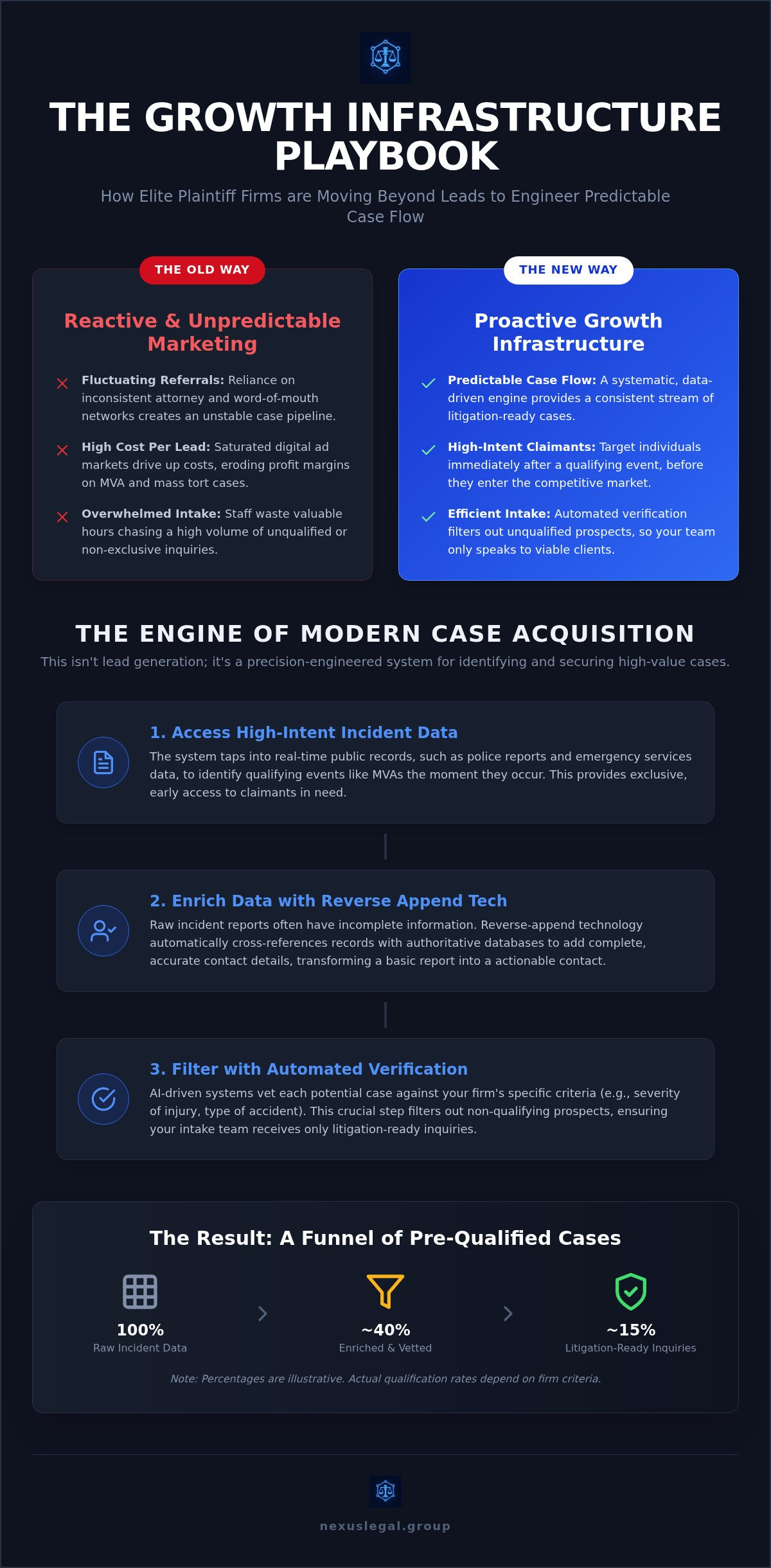
Modern legal practices often reach a ceiling where word-of-mouth and manual networking fail to support the overhead of a large-scale firm. Traditionally, partners relied on a "wait and see" approach, hoping the phone would ring with a high-value referral. However, The Evolution of Case Acquisition has transitioned from these passive methods toward a model of precision engineering. Growth infrastructure is the integration of data, AI, and automated intake for law firms. This shift is essential for understanding how top plaintiff firms get clients in a market where competition for MVA and mass tort cases is at an all-time high. By treating acquisition as a foundational system rather than a series of disconnected campaigns, elite firms secure predictable revenue and eliminate the friction inherent in manual processes.
The Limitations of Traditional Legal Marketing
Digital auction environments have become increasingly saturated, driving up the cost-per-click to levels that erode profit margins for many firms. Simply buying "more leads" frequently results in a bloated intake department that spends hours chasing unqualified inquiries. In 2026, the problem is compounded by non-exclusive lead providers who sell the same claimant data to multiple competitors; this creates a race to the bottom that rewards speed over case quality. This model is fundamentally reactive and lacks the systemic integrity required for sustainable scaling. When firms depend on unpredictable external sources, they lose control over their growth trajectory and operational efficiency.
The Competitive Advantage of Systematic Acquisition
Elite firms stabilize their case flow through technological mastery, moving from reactive marketing to proactive case engineering. This involves identifying high-intent claimants using specific incident-level data before they ever enter the general marketing funnel. By implementing a robust law firm growth infrastructure, organizations manage high-volume intake with clinical precision. This infrastructure ensures that only litigation-ready inquiries reach the desk of an attorney. It's the primary reason why how top plaintiff firms get clients has become a question of technical integration rather than just creative advertising. These systems provide a sense of security through technical mastery, allowing firms to focus on litigation rather than the logistics of finding new cases.
Leveraging Incident-Level Data for MVA Case Precision
Elite firms have abandoned the shotgun approach of general social media advertising. Instead, they focus on incident-level precision. This involves utilizing police reports and emergency services data to identify accidents in real-time. This is a core component of how top plaintiff firms get clients without wasting capital on broad-based awareness. By understanding the mechanics of police report generated MVA leads, firms can reach high-intent claimants who have just experienced a qualifying event. This method is not just about speed; it's about the ethical and compliant use of public records to provide immediate support to those in need. It transforms the acquisition process from a guessing game into a clinical operation.
Reverse Append Technology: Enriching Accident Reports
Raw incident data is often incomplete or lacks the necessary contact details for immediate follow-up. Reverse append technology serves as the bridge between a basic accident record and a litigation-ready inquiry. This process involves taking a police report number or partial participant information and cross-referencing it with authoritative databases to obtain comprehensive contact details and vehicle history. This enrichment process eliminates the need for manual skip-tracing or investigative phone calls, which often result in friction and lost time. Data accuracy is paramount here; in high-stakes motor vehicle litigation, even a minor error in contact information or accident details can derail the intake process. Using these systems ensures your firm operates with a high degree of technical mastery and operational efficiency.
AI-Driven Identification of High-Value Accidents
Not every accident warrants the resources of a premier firm. AI-driven systems now vet incident severity by analyzing data points like airbag deployment, vehicle tow status, and emergency room transport indicators. These algorithms prioritize inquiries based on liability and insurance coverage indicators, allowing your team to focus on the most viable cases first. Sourcing verified MVA leads for law firms significantly reduces investigative costs by filtering out low-impact or no-fault scenarios before they reach your intake desk. Understanding how top plaintiff firms get clients through these data-driven filters is the key to maintaining a competitive edge in 2026. Integrating these automated acquisition systems into your practice creates a seamless transition from incident to signed case, ensuring your growth is built on a foundation of verified, high-value opportunities.
Automated Verification: Filtering for Litigation-Ready Inquiries
Distinguishing between a contact name and a viable case is where most firms struggle. A "lead" represents potential, but a "litigation-ready inquiry" represents a verified opportunity with confirmed insurance, liability, and injury status. This filtering process is a core pillar of how top plaintiff firms get clients while maintaining high profit margins. By implementing automated vetting, firms eliminate non-qualifying prospects before they ever reach an intake specialist. This technical layer ensures your staff only engages with high-value claimants, transforming the intake department from a call center into a high-conversion signing engine.
AI-driven verification utilizes logic-based workflows to cross-reference incident data against specific litigation criteria. These systems document every step of the verification process; this is essential for ensuring ethical compliance and maintaining a rigorous audit trail. This systematic approach reduces the cognitive load on your team, allowing them to focus on building rapport with qualified claimants rather than performing manual data entry or basic screening. It creates a foundational layer of reliability that manual processes simply can't match.
Operational Efficiency in Modern Intake
Scaling a practice requires removing the friction between initial contact and a signed retainer. Traditional manual intake is limited by human hours and prone to fatigue-related errors. By utilizing automated intake for plaintiff firms, you can capture and verify high-intent inquiries 24/7. This ensures that no high-value MVA or mass tort case is lost to a competitor due to a delayed response time. The speed of the system mirrors the urgency of the claimant, providing a seamless experience that increases the likelihood of a signed case. It's a powerful, high-performance engine that drives growth from behind the scenes.
Verification Metrics That Matter
To measure the health of your growth infrastructure, you must track "Qualified-to-Signed" ratios rather than just total lead volume. This metric reveals the actual efficiency of your verification layer. Identifying patterns in "unqualified" inquiries allows you to refine your upstream data sourcing, ensuring that your acquisition budget is allocated toward the highest-performing channels. Maintaining compliant legal lead generation standards is non-negotiable for elite firms. These metrics provide the transparency needed to optimize your acquisition strategy, confirming that how top plaintiff firms get clients remains a data-driven science rather than a marketing experiment.
Acquisition Model Comparison: Networking vs. Infrastructure
Choosing between organic networking and a technological infrastructure is the fundamental decision that dictates a firm's growth ceiling. While traditional methods rely on the slow accumulation of goodwill, modern systems prioritize the immediate capture of high-intent data. Analyzing how top plaintiff firms get clients reveals a clear divide: elite organizations treat acquisition as a precision engineering problem rather than a social exercise. This transition is driven by the need for predictability in a market where speed-to-lead determines the winner of high-value MVA and mass tort cases.
The cost-per-signed-case in a networking model is often deceptive. Partners may view referrals as "free," yet the time cost of maintaining these relationships is immense. Conversely, a growth infrastructure model requires an investment in technology and data sourcing, but it delivers a lower cost-per-signed-case at scale by eliminating manual inefficiencies. Infrastructure-based models provide better long-term predictability because they aren't subject to the whims of a referral partner's schedule or shifting loyalties. This systemic integrity ensures that the firm's growth is not dependent on unpredictable external factors.
Organic Networking and Referrals
Traditional networking remains a staple for many practitioners due to the high levels of trust inherent in personal recommendations. These cases often come with a pre-established rapport, leading to high conversion rates and low immediate cash outlay. However, the weaknesses of this model are significant for firms aiming to scale. Referrals are inherently non-scalable and unpredictable, often resulting in "feast or famine" cycles that disrupt operational planning. The high "time" cost for partners to attend events and manage relationships often distracts from high-level litigation strategy. This approach is best suited for solo practitioners and boutique firms that prioritize a low volume of high-touch cases.
Growth Infrastructure and High-Intent Data
Growth infrastructure offers a sophisticated alternative designed for elite firms aiming for national or high-volume regional dominance. The primary strength of this model is its capacity for predictable scale; by utilizing high-intent data, firms can generate a steady stream of litigation-ready inquiries regardless of social factors. This system captures claimants within the critical window immediately following an accident, where conversion rates are highest. While the model requires sophisticated technological integration and a focus on data integrity, it provides a sense of security through technical mastery. Understanding how top plaintiff firms get clients through these automated engines is the first step toward building a resilient, high-performance practice.
Implementing Growth Infrastructure for Elite Scale
Implementing growth infrastructure requires a deliberate shift from managing individual marketing campaigns to managing integrated systems. Understanding how top plaintiff firms get clients at scale involves more than just increasing an ad budget; it demands technical alignment between data sourcing and intake. Transitioning to this model starts with a comprehensive audit of your current acquisition funnel to identify where high-intent claimants are being lost to friction or slow response times. Elite firms recognize that building this technology in-house is often a distraction from their core competency of litigation. Partnering with a specialized technology provider ensures your firm remains at the cutting edge of data acquisition without the overhead of a proprietary software development team.
A successful mass tort case acquisition strategy allows firms to diversify their revenue streams without increasing the manual burden on their staff. By utilizing the same high-intent data and automated verification frameworks used for MVA cases, firms can scale into complex litigation with minimal operational friction. This finalizing of the framework ensures a seamless flow from initial incident data to signed, litigation-ready cases. It's a powerful, high-performance engine that drives growth from behind the scenes, allowing partners to focus on high-level legal strategy rather than lead logistics.
Bridging the Gap Between Technology and Litigation
Your acquisition systems must align with your firm's specific litigation goals to be effective. Generic leads lack the depth of information required for immediate filing, which is why exclusive access to high-intent inquiries is critical. Nexus Legal Group provides the growth engine for elite practices by handling the heavy lifting of data enrichment and automated vetting. Exclusive access prevents the race to the bottom seen with non-exclusive lead providers. When your firm is the only one contacting a high-intent claimant, the conversion rate increases dramatically. This exclusivity is a hallmark of how top plaintiff firms get clients in highly competitive national markets, providing a sense of security through technical mastery.
Next Steps for Partners and Growth Managers
Begin by auditing your current intake and acquisition bottlenecks. If your qualified-to-signed ratio is low, the issue likely resides in the verification layer or the quality of your upstream data. Evaluate the ROI of automated verification systems by calculating the hours saved in manual screening and the reduction in intake overhead. This data-driven approach moves the firm away from unpredictable results toward a model of clinical precision. When you're ready to transition to a high-performance model, Contact Nexus Legal Group for a strategic acquisition consultation. This isn't just about getting more clients; it's about engineering a foundational layer for national dominance and long-term practice stability.
Securing Your Practice's Scalable Future
Transitioning your firm from a reactive marketing model to a precision-engineered growth infrastructure is the most significant step you can take toward long-term stability. You've seen how top plaintiff firms get clients by moving beyond unpredictable referrals and embracing incident-level data sourced from police reports and emergency services. This technical mastery, combined with rigorous automated intake verification, ensures that your team only handles litigation-ready inquiries. By eliminating the friction of manual screening, you reduce overhead while securing exclusive access to high-intent claimants.
Implementing these systems allows you to focus on high-level litigation while a sophisticated acquisition engine drives your expansion from behind the scenes. It's time to replace unpredictability with a foundation of technical excellence and clinical precision. Build a practice that doesn't just survive the evolving legal market but dominates it through systemic integrity and reliable results.
Frequently Asked Questions
How do top plaintiff firms maintain case quality at high volumes?
Top firms maintain quality by implementing AI-driven vetting and automated verification layers that filter inquiries based on specific litigation criteria. It's this technical mastery that allows them to process thousands of data points while ensuring only high-value, litigation-ready inquiries reach their intake specialists. By removing the human error associated with manual screening, firms stabilize their case flow and maintain a high qualified-to-signed ratio even during periods of rapid national expansion.
Can automated intake systems ensure ethical compliance for law firms?
Automated intake systems ensure ethical compliance by utilizing documented, logic-based workflows that create a rigorous audit trail for every claimant interaction. These systems are programmed to follow specific regulatory requirements, ensuring that all signed cases are both ethical and compliant. This systematic approach provides a level of security and reliability that manual processes can't match, protecting the firm's reputation while allowing for high-volume growth without compromising professional standards.
What is the most effective way to acquire MVA cases without high PPC costs?
Utilizing incident-level data from police reports and emergency services is the most effective alternative to saturated digital auction environments. This proactive strategy allows you to identify high-intent claimants immediately following an accident, bypassing the high costs of broad-based PPC advertising. Understanding how top plaintiff firms get clients through these precision-engineered data channels is essential for maintaining healthy profit margins in 2026. It's a method that prioritizes technical accuracy over creative marketing spend.
How does police report data improve the quality of motor vehicle accident leads?
Police report data provides objective, verified details such as airbag deployment, vehicle tow status, and initial liability assessments. When you're using reverse append technology to enrich this raw information, you're working with the most accurate claimant profile possible. This improves lead quality by ensuring that every inquiry is based on a real, qualifying event with documented damages. It's a clinical approach that eliminates the guesswork often found in social media generated inquiries.
What is the difference between a lead provider and a growth infrastructure partner?
A lead provider typically sells raw, often non-exclusive contact data, whereas a growth infrastructure partner provides a foundational system for end-to-end acquisition. This includes the technology for data enrichment, automated verification, and seamless intake integration. It's the difference between buying a one-off product and installing a high-performance engine that drives your firm's revenue. Partners focus on systemic integrity and long-term predictability rather than just short-term lead volume.
How quickly can a firm implement an automated acquisition system?
Most firms can begin integrating these systems within a few weeks, depending on their existing technical stack and operational goals. The process is designed to be methodical and efficient, focusing on removing friction from your current intake workflows without disrupting ongoing litigation. Rapid implementation allows partners to see a reduction in overhead and an improvement in case quality quickly. It's about building a foundational layer that scales with your firm's national ambitions.
Can these strategies be applied to mass tort case acquisition?
These strategies are highly effective for mass tort case acquisition because the core logic of data-driven vetting remains the same. By applying automated verification and high-intent data sourcing to mass torts, firms can diversify their revenue streams with minimal additional overhead. This framework allows you to identify and sign claimants with the same clinical precision used in MVA cases. It's a scalable model that supports high-volume growth across multiple practice areas simultaneously.