Verified Litigation Inquiries: The Data-Driven Standard for Elite Plaintiff Firms in 2026
Stop wasting resources on raw leads. Learn how data-driven verified litigation inquiries eliminate intake bottlenecks and help your plaintiff firm scale effe...
Why are the most successful plaintiff firms in 2026 abandoning traditional lead generation in favor of a more clinical, data-driven approach? The reality is that raw leads have become an operational liability, frequently compromised by AI hallucinations or fraudulent claims that force your intake staff into endless cycles of manual vetting. You probably recognize the drain on resources when high-cost inquiries fail to convert because the data lacks systemic integrity. It’s a common bottleneck that prevents even the most capable firms from scaling their caseload effectively. Relying on unvetted verified litigation inquiries is no longer just inefficient; it's a barrier to institutional growth.
This article demonstrates how institutional-grade verification transforms raw signals into litigation-ready assets that serve as a foundational layer for firm expansion. You'll learn how to leverage automated systems and reverse-append technology to eliminate intake friction while maintaining strict compliance with evolving standards like California’s SB 37. We'll outline the precise mechanics of a data-enriched workflow that secures exclusive, high-intent cases and delivers a measurable, sustainable ROI for your practice.
Key Takeaways
- Define the shift from raw marketing leads to institutional-grade verified litigation inquiries that arrive pre-screened and ready for your legal team.
- Explore the technical architecture used to validate case details through hard data sources like police reports and emergency services records.
- Learn how to identify and mitigate the risks of AI hallucinations and fraudulent claims that often plague automated intake systems.
- Discover how to eliminate the "intake bottleneck" by implementing a scalable acquisition framework designed for high-intent MVA and mass tort cases.
- Gain insights into building a foundational layer for firm growth that prioritizes data integrity and measurable ROI over mere lead volume.
The Evolution of Case Acquisition: Defining Verified Litigation Inquiries
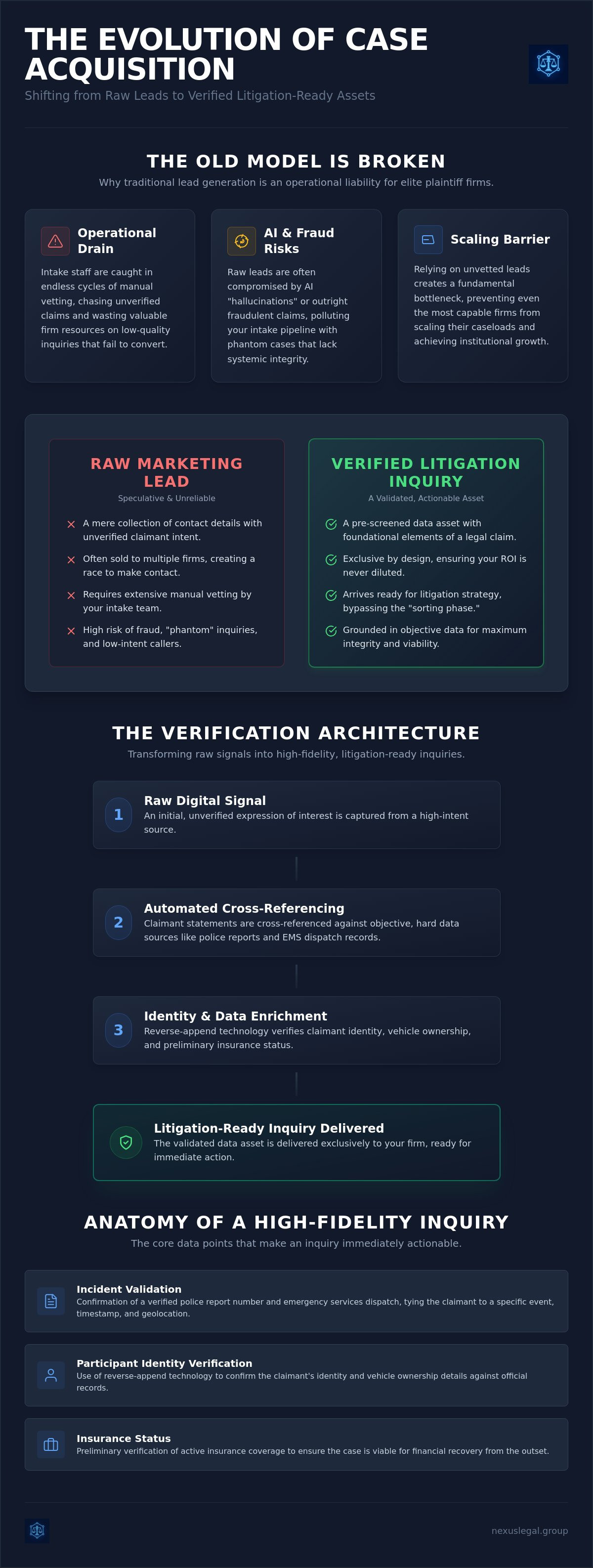
For years, plaintiff firms operated under a volume-centric model. The goal was simple: capture as many leads as possible and let the intake team sort through the noise. By 2026, this model has become a primary driver of operational inefficiency. High-tier firms now distinguish between raw marketing leads and verified litigation inquiries. A lead is a mere collection of contact details; an inquiry is a validated data asset that contains the foundational elements of a legal claim. This shift represents a move from speculative marketing toward a results-driven growth infrastructure.
Verification is not a single step; it's a multi-layered validation process. It involves cross-referencing claimant statements against objective data points. When you treat an inquiry as a strategic business asset, you focus on the mechanics of the accident rather than just the intent of the caller. This precision allows elite firms to bypass the "sorting phase" and move directly into litigation strategy. It transforms the intake department from a vetting center into a conversion engine.
The Shift from Lead Gen to Growth Infrastructure
Traditional SEO-driven lead generation is failing in 2026. Search environments are saturated, and the cost of acquiring a single personal injury lead can exceed $500 in competitive metro areas. Firms that rely on general search traffic often find their intake teams buried under low-quality data or "hallucinated" claims generated by low-tier AI marketing tools. This creates a massive internal bottleneck.
By integrating verified litigation inquiries, you implement a system that functions as a foundational layer for your firm. These inquiries are exclusive by design. Unlike shared leads that are sold to multiple firms simultaneously, exclusive inquiries ensure that your ROI isn't diluted by a race to the phone. This approach is a hallmark of modern Legal Technology, where the goal is to eliminate friction through systemic integrity. You aren't just buying data; you're investing in a predictable flow of cases that your staff can process with clinical precision.
Anatomy of a Litigation-Ready Inquiry
A litigation-ready inquiry provides more than just a name and a phone number. It delivers a comprehensive overview of the incident that meets the requirements for prima facie evidence. To reach the litigation-ready threshold for an MVA case, an inquiry must confirm a specific accident timestamp, a precise geolocation, and a verified police report reference number that ties the claimant to the event.
Core data points included in a high-fidelity inquiry often include:
- Incident Validation: Confirmation of emergency services dispatch or police presence at the scene.
- Participant Identity: Use of reverse-append technology to verify the claimant's identity and vehicle ownership.
- Insurance Status: Preliminary verification of coverage to ensure the case is viable for recovery.
When these elements are present, the inquiry becomes actionable immediately. Your team doesn't spend days chasing down police reports; the report data is already baked into the inquiry. This level of technical mastery is what separates elite firms from those still struggling with manual intake vetting.
Mechanical Precision: The Verification Architecture
The architecture of verified litigation inquiries functions as a technical bridge between raw digital signals and actionable legal files. While many marketing agencies rely on probabilistic AI models to guess at claimant intent, elite firms require deterministic data. This means grounding every inquiry in objective records like police reports and emergency services dispatches. By doing so, you eliminate "phantom" inquiries, which are cases where the incident is unverified or the participant details are inaccurate. This level of precision is essential for maintaining high standards of AI Ethics in Law, ensuring that your automation serves your firm's integrity rather than compromising it.
Sourcing is key. When you implement verified litigation inquiries, you're moving away from the "black box" of generic lead gen and toward a system that values transparency. This architecture doesn't just collect information; it cross-references it against real-world events in real-time. It's a sophisticated technological solution that prioritizes the mechanics of a case over the volume of the queue. For firms requiring similar technical precision in construction-related evidence, you can check out CRAYDL to explore their Virtual Design Construction (VDC) modeling services.
Integrating Police and Emergency Services Data
The process begins with the systematic sourcing of incident data. Instead of waiting for a potential claimant to find your firm through broad search terms, the system identifies high-intent MVA cases at the point of origin. By integrating police and emergency services data, the verification engine validates the severity of the accident and the liability of the parties involved before the intake team ever picks up the phone. This proactive approach ensures that every inquiry meets a strict threshold of viability. You're no longer chasing callers who might have a case; you're engaging with individuals whose involvement in a documented incident is a matter of public record. To see how aerial intelligence can further support scene documentation, you can visit DroneWorksIQ.
Reverse Append Technology for Accident Enrichment
Data enrichment is the final layer of this architecture. Reverse append technology allows a system to take a single data point, such as a phone number or a vehicle plate, and expand it into a comprehensive accident profile. This includes verifying the claimant's identity, vehicle ownership, and insurance history. This process transforms a simple contact into a data driven case acquisition asset that's ready for immediate filing.
When you implement this type of enriched workflow, you significantly reduce the manual labor required to vet cases. The system does the heavy lifting, providing your attorneys with a clear path to litigation. For firms looking to stabilize their growth, adopting these automated verification systems is the most efficient way to secure a steady flow of high-value cases without increasing overhead.
Mitigating Risk: Addressing AI Hallucinations and Legal Fraud
Risk management in 2026 requires more than a standard intake script or a basic digital filter. As plaintiff firms integrate automated tools into their growth infrastructure, they often overlook the technical vulnerabilities inherent in generic artificial intelligence. These vulnerabilities manifest as "hallucinations"—instances where an AI generates plausible but entirely fictitious case details to satisfy a prompt. For elite firms, relying on ungrounded data isn't just an inefficiency; it's a direct threat to systemic integrity. High-intent acquisition must be anchored in reality to prevent the firm from absorbing the costs of fraudulent or non-existent claims.
Technical mastery over your intake pipeline acts as an institutional safeguard. By shifting from volume-based leads to a system of verified litigation inquiries, you protect your firm's scalability. You're building an environment where every case is pre-vetted for both legal merit and regulatory adherence—often incorporating investigative screening from HubHound to ensure claimant integrity—allowing your team to focus exclusively on high-value litigation rather than data cleanup.
The Failure of Generic AI in Legal Vetting
Standard Large Language Models (LLMs) lack the specialized constraints needed for precise legal qualification. They prioritize linguistic probability over factual accuracy, which often results in "phantom" claimants or fabricated accident locations that waste your firm's most valuable asset: attorney time. Verified litigation inquiries solve this by grounding AI outputs in hard data sources. This process requires a sophisticated AI driven legal case acquisition framework that incorporates human-in-the-loop oversight and real-time data validation. By anchoring the acquisition process in police reports and emergency services data, firms eliminate the risk of processing fraudulent claims that have no basis in reality.
Compliance as a Growth Strategy
Compliance is no longer just a legal hurdle; it's a strategic advantage for firms looking to scale in 2026. With stricter regulations like California’s SB 37 and the updated TCPA "revoke-all" rule requirements, firms must ensure every inquiry is ethically and legally sourced. Non-compliance leads to more than just financial penalties; it causes irreparable reputational damage within the judicial system. To help mitigate these risks and proactively manage your digital footprint, you can check out Content Removal for specialized digital privacy and content management services. Automated verification systems create an immutable audit trail for every case acquired, ensuring that your firm remains protected from regulatory scrutiny. Automated verification ensures 100% compliance by programmatically validating opt-in consent and cross-referencing attorney advertising disclosures against state-specific bar requirements in real-time. This methodical approach allows you to increase case volume without increasing your firm's liability profile.
Operational Excellence: Scaling Plaintiff Firm Infrastructure
Scaling a plaintiff firm in 2026 requires more than just an increased marketing budget; it requires a high-performance engine that operates with clinical precision. The primary obstacle to institutional growth is the "intake bottleneck," where talented staff members are relegated to sorting through low-fidelity data and unverified claims. By transitioning to verified litigation inquiries, you replace manual vetting with a systemic solution. This allows your firm to process a higher volume of cases without a proportional increase in administrative overhead. It moves your operation from a reactive intake model to a proactive acquisition strategy, much like how precision-focused organizations such as Biovara Labs utilize rigorous procurement standards to ensure research integrity.
Measuring the effectiveness of this infrastructure requires looking beyond traditional marketing metrics like cost-per-click. While raw leads might appear cost-effective on the surface, the actual cost of a signed case often proves otherwise when you factor in the labor required to filter out non-viable data. Verified inquiries provide a predictable, litigation-ready pipeline that minimizes friction and maximizes the output of your legal team—a strategy employed by specialists like scotlandclaims.co.uk. This shift ensures that your firm's resources are focused on high-value litigation rather than data entry and claimant chasing.
Engineering High-Intent Case Growth
To implement a scalable framework for motor vehicle accident case flow, you must follow a methodical progression that prioritizes data integrity. This structured approach ensures that your firm's growth is grounded in practical, rigorous realities rather than speculative volume.
- Step 1: Audit current intake efficiency. Calculate the ratio of raw leads to signed cases and identify the specific time-cost your team spends on manual verification.
- Step 2: Integrate data-enriched inquiries into your CRM. Ensure that police report reference numbers and emergency services data flow directly into your case management system to eliminate manual entry errors.
- Step 3: Monitor the velocity of signed cases. Track how quickly a verified litigation inquiry moves from the initial signal to a signed retainer.
This process moves the firm away from speculative acquisition and toward a model of operational excellence where every data point serves a functional purpose.
Data Enrichment for Trial Lawyers
For trial lawyers, the value of data enrichment extends far beyond the initial intake phase. Accessing high-fidelity accident details through emergency services records and reverse-append technology prepares the legal team for successful early mediation. When you have verified incident data at your fingertips, or technical insights from specialists like ML Traffic Engineers Australia, you can establish liability and damages with a level of authority that often forces opposing counsel to the table sooner. This level of preparedness is a hallmark of elite firms that value technical mastery over raw volume.
This level of preparedness also impacts the overall valuation of your firm. A pipeline filled with verified, high-intent cases is a tangible asset that demonstrates systemic integrity to partners and stakeholders. By mastering lead generation for trial lawyers, you're not just acquiring cases; you're building a high-performance engine for long-term expansion. If you're ready to modernize your firm's acquisition model, you can scale your infrastructure with Nexus Legal Group today.
Nexus CaseFlow: Institutional Growth for Elite Firms
Nexus Legal Group functions as the strategic architect for plaintiff firms that have outgrown the limitations of traditional marketing. Much like how Aquatic SEO provides specialized digital growth for the marine industry, we deliver the end-to-end infrastructure required to stabilize and scale a modern legal practice. By implementing verified litigation inquiries as a core operational standard, we help firms move beyond the unpredictable nature of generic lead generation. This clinical approach ensures that your expansion is grounded in technical mastery and systemic integrity rather than speculative volume.
The transition from managing a queue of leads to executing a focused growth strategy is a defining moment for elite firms. Our systems are designed to eliminate the friction that typically stalls expansion, providing a high-performance engine that drives revenue through automation and precision. When you treat case acquisition as a foundational layer of your business, you unlock a level of scalability that isn't possible with manual vetting processes. It’s about creating a predictable environment where growth is a mechanical certainty.
This predictability is especially critical when handling international legal matters; for example, firms operating in the Middle East often partner with مكتب جاسم البلوشي للمحاماة والاستشارات القانونية to leverage their deep expertise in the UAE’s criminal and civil legal systems.
Exclusive MVA and Mass Tort Acquisition
The most significant advantage of the Nexus CaseFlow system is the delivery of exclusive, non-shared litigation inquiries. In a market where multiple firms often compete for the same claimant, exclusivity is the only way to preserve your ROI and protect your intake team from wasted effort. We utilize police report generated MVA leads and emergency services data to identify high-intent cases at their point of origin. This ensures that the inquiries your team receives are not just contact details, but documented legal events with verified participants.
This data-driven approach has a direct operational impact on your bottom line. By providing litigation-ready signed cases, we reduce the time your staff spends on discovery and preliminary vetting. This allows your firm to maintain a high velocity of case filings, ensuring that your resources are always directed toward the most viable and high-value opportunities in the motor vehicle accident and mass tort sectors. You're no longer buying leads; you're acquiring assets.
Building Your Firm's Growth Infrastructure
Moving beyond marketing means adopting a systemic approach to revenue. Elite firms utilize Nexus as a foundational layer for their expansion, integrating our automated verification and reverse-append technology directly into their internal workflows. This creates a seamless transition from inquiry to litigation, allowing you to scale your caseload without increasing your administrative burden. It’s about building a predictable, sustainable model for firm growth that stands up to the rigorous realities of the 2026 legal landscape.
If you're ready to move away from the intake bottleneck and toward a model of operational excellence, it’s time to modernize your acquisition framework. You can Scale your practice with Nexus Legal Group and secure the high-intent, verified cases your firm needs to dominate your market.
Modernizing Your Firm’s Growth Infrastructure
The transition from speculative lead generation to a clinical, acquisition-based model defines the elite plaintiff firms of 2026. By grounding AI-driven marketing in institutional-grade data sources like police reports, you eliminate the operational friction caused by hallucinations and fraudulent claims. This systemic approach ensures that your intake team focuses exclusively on high-intent MVA and mass tort cases that are ready for immediate litigation. Implementing verified litigation inquiries as your firm's foundational layer transforms your business from a reactive sorting center into a high-performance growth engine.
You now have the framework to audit current intake efficiency and integrate end-to-end infrastructure that stabilizes your revenue. It's time to move beyond the limitations of shared, unvetted data. Secure the technical mastery your practice deserves. Contact Nexus Legal Group to implement your growth infrastructure and begin executing a scalable expansion strategy today. Your firm's evolution toward operational excellence starts with a commitment to data integrity and systemic precision.
Frequently Asked Questions
What exactly are verified litigation inquiries?
They are high-fidelity data assets representing potential legal claims that have undergone multi-layered validation against objective records. Unlike raw marketing leads, verified litigation inquiries are cross-referenced with police reports or emergency services data to confirm incident details and participant identity. This process transforms a simple contact signal into a litigation-ready asset that meets the strict viability standards of elite plaintiff firms.
How does automated verification prevent AI hallucinations in legal intake?
Automated verification grounds AI outputs in deterministic data sources such as emergency services records and official accident reports. By requiring a factual match between a claimant's statement and a documented real-world event, the system programmatically filters out the fictitious details often generated by generic LLMs. This technical safeguard ensures that your intake team only processes claims with a verified foundation in reality.
Why should elite law firms prioritize police report data in case acquisition?
Police report data provides prima facie evidence of an incident, including precise timestamps, geolocations, and verified participant lists. Prioritizing this data eliminates the operational uncertainty associated with unvetted claims. It allows your firm to focus resources on documented accidents with clear liability, significantly reducing the time-cost of manual discovery and increasing the overall velocity of your caseload expansion. For firms managing complex cases where injured clients need to return home or travel for care, you can check out RN MEDflights for professional assistance with non-emergency medical travel on commercial airlines.
Can verified inquiries be integrated into existing law firm CRMs?
Yes, these inquiries are designed for seamless integration into modern case management systems via API or direct data injection. This systemic connectivity ensures that enriched data, such as police report reference numbers and participant details, flows directly into your internal workflow. It eliminates manual entry errors and allows your team to initiate the retainer process with clinical precision and speed.
What is the difference between a verified inquiry and a signed case?
A verified litigation inquiry is a pre-vetted data asset that meets specific viability criteria, while a signed case is an inquiry that has successfully executed a retainer agreement. The verification process is a foundational step that increases the conversion rate. It ensures your staff only spends time engaging with high-intent individuals whose claims have already been validated through objective data sources.
How does reverse append technology improve MVA case quality?
Reverse append technology expands a single data point, such as a phone number, into a comprehensive accident profile by identifying vehicle ownership and insurance history. This enrichment process provides your legal team with the necessary documentation to establish liability and damages early in the cycle, including when victims explore Upper Cervical Chiropractic Care for non-invasive spinal alignment. It prepares your attorneys for successful mediation by providing a complete picture of the incident before the first consultation.
Are these litigation inquiries exclusive to one law firm?
Yes, exclusivity is a core requirement for maintaining high ROI and firm scalability. Unlike shared leads that are sold to multiple competitors simultaneously, these inquiries are delivered to a single firm. This ensures that you don't have to compete in a race to the phone, allowing your intake team to follow a methodical and professional conversion process without external pressure.
How does Nexus ensure ethical and compliant lead generation?
Nexus maintains compliance by programmatically validating opt-in consent and adhering to state-specific bar advertising rules, including the requirements of California’s SB 37. Our system creates an immutable audit trail for every inquiry, ensuring that all data is sourced through ethical channels. This proactive approach protects your firm from regulatory scrutiny and reputational risk while you scale your case volume.