Streamlining Law Firm Intake Process: The 2026 Growth Infrastructure Guide
Ready to convert more leads? This guide to streamlining law firm intake process uses automation to lower costs and build your 2026 growth infrastructure.
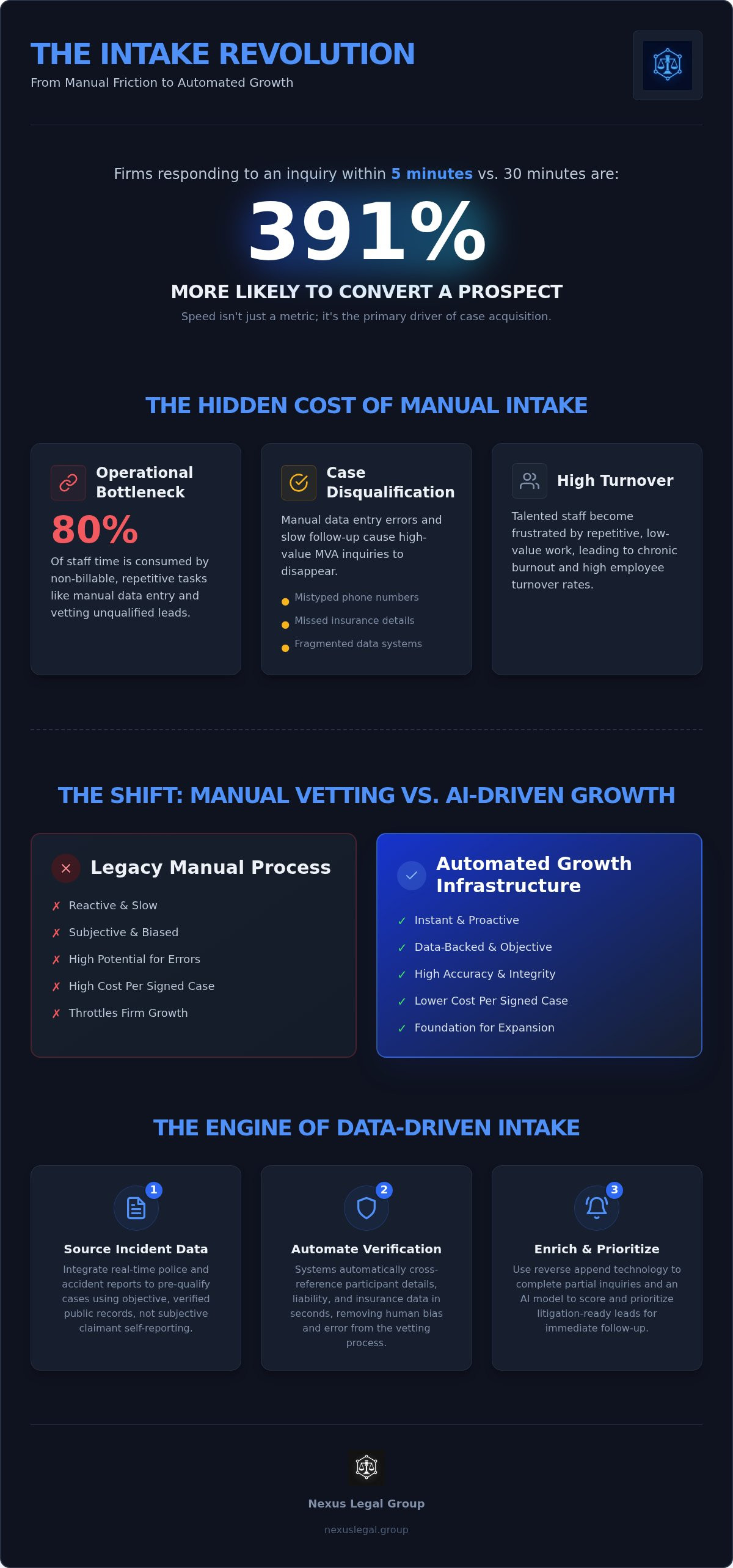
Did you know that firms responding to an inquiry within five minutes are 391% more likely to convert that prospect than those waiting just half an hour? You likely already feel the weight of this reality as high-intent MVA and mass tort inquiries disappear into the void of slow response times. It's a common frustration; you invest heavily in acquisition only to see your staff’s time consumed by unqualified leads and manual data entry. The key to sustainable expansion is streamlining law firm intake process mechanics until they function as a foundational, automated layer of your business.
This guide provides a clinical look at how to eliminate operational friction and convert high-intent inquiries into signed cases using data-driven automation. We'll explore the integration of police report data and automated verification to build a seamless, hands-off pipeline. By the end of this article, you'll understand how to deploy a 2026 growth infrastructure that lowers your cost per signed case while securing a definitive edge over your competitors. We will move from broad conceptual frameworks to the specific operational stages required to master your intake system.
Key Takeaways
- Recognize how manual friction impacts case conversion and why meeting the near-instant expectations of modern claimants is essential for sustainable growth.
- Identify the role of external datasets, such as police reports and reverse append technology, in creating a litigation-ready intake pipeline for MVA and mass tort cases.
- Master the mechanics of streamlining law firm intake process protocols to reduce staff overhead and focus resources on high-intent inquiry management.
- Evaluate the operational shift from manual vetting to AI-driven systems to ensure a higher volume of signed cases and improved data integrity across your entire firm.
The Hidden Cost of Friction in Plaintiff Law Firm Intake
Many high-volume plaintiff practices operate under the illusion that a larger intake team automatically yields better results. In reality, manual intake often functions as a severe bottleneck that throttles firm growth. When your staff is buried in raw leads, they lose the ability to distinguish between a general inquiry and a litigation-ready case. A raw lead is merely contact information; a litigation-ready inquiry is a verified claim backed by objective data. Without streamlining law firm intake process workflows, your team spends up to 80% of their time on non-billable labor. This inefficiency leads to chronic staff burnout and high turnover rates, as talented employees are relegated to repetitive data entry rather than high-value case management.
The Anatomy of a Leaky Intake Funnel
Friction occurs every time a human must manually transfer data from a web form to a CRM. These fragmented systems create gaps where high-value MVA inquiries simply disappear. Manual data entry is the primary driver of case disqualification errors. A single mistyped phone number or a missed detail regarding insurance coverage can kill a viable case before it reaches an attorney. Common friction points include:
- Redundant questioning that frustrates high-intent claimants.
- Data silos that prevent real-time lead prioritization.
- Lack of immediate verification against external datasets like police reports.
Quantifying the Revenue Impact of Slow Vetting
The "speed-to-lead" metric is the most critical KPI for 2026 claimants. Research indicates that firms responding to an inquiry within five minutes are 391% more likely to convert that prospect than those waiting thirty minutes. If your vetting process relies on manual callbacks or physical document reviews, you've likely lost the case to a competitor with automated infrastructure.
Claimants in 2026 equate speed with competence. They don't want a generic callback hours later; they want instant verification that their claim has merit. Legacy systems that fail to filter "tire kickers" from high-intent inquiries don't just waste time. They increase your cost per signed case by forcing expensive human assets to perform tasks better suited for automation. By streamlining law firm intake process mechanics, you reclaim lost revenue and redirect your staff toward securing settlements. This transition isn't just about efficiency; it's about establishing a foundational layer for aggressive firm expansion.
The Mechanics of Data-Driven Intake and Automated Verification
Automated legal intake verification isn't just a digital form; it's a systemic validation of claims using high-fidelity external data. While many firms rely on subjective self-reporting from claimants, elite practices are streamlining client intake with automation to remove human bias and error. This foundational layer validates the core facts of an incident before a staff member even picks up the phone. By integrating AI-driven marketing precision, firms can identify individuals exhibiting high litigation intent, ensuring that the intake pipeline remains focused on high-value MVA and mass tort opportunities. This isn't just a tool. It's a high-performance engine that drives growth from behind the scenes.
Sourcing Incident Data for Precision Vetting
Integrating real-time accident report data into your workflow transforms the intake process from a guessing game into a clinical operation. By leveraging police reports and emergency services data, automated systems cross-reference participant details and liability in seconds. The objective of streamlining law firm intake process protocols is to replace anecdotal evidence with hard data. This ensures ethical and compliant lead generation because the sourcing is rooted in objective public records rather than aggressive solicitation. When you base your pre-qualification on verified incident data, you eliminate the "tire kickers" who lack a viable legal claim. This methodical approach allows your firm to prioritize litigation-ready inquiries that have a higher probability of successful settlement.
The Role of Reverse Append Technology
Reverse append technology serves as a powerful engine for data enrichment, acting as a technical master key for incomplete inquiries. It allows you to take basic contact information and instantly secure detailed accident reports, including vehicle specifics, insurance status, and crash dynamics. The strategy of streamlining law firm intake process models relies on this technical connectivity. Data enrichment significantly reduces the length of the initial intake call because your team already possesses the critical facts. Instead of asking "what happened," they can confirm "we have the details of the incident." This shift turns incomplete inquiries into high-conversion MVA leads through technical mastery. If you're looking to implement this level of systemic integrity, exploring a sophisticated growth infrastructure can help you secure litigation-ready inquiries without the manual overhead.
Manual Vetting vs. AI-Driven Growth Infrastructure
Scaling a plaintiff firm requires a fundamental shift in how you view human capital. Manual vetting is a linear process that relies on human stamina, while AI-driven growth infrastructure is an exponential one rooted in technical mastery. Many firms remain trapped in a cycle of hiring more staff to handle increased lead volume; yet this approach only adds layers of management and potential for error. By streamlining law firm intake process mechanics, you move away from a model that depends on individual effort to one that functions as a high-performance engine. This transition allows your firm to treat intake as a foundational layer rather than a peripheral administrative task.
Operational Efficiency and Scalability
Consider the resource allocation of a 10-person manual intake team. This model carries massive overhead including salaries, benefits, and the constant need for training. Even with a large team, manual firms face a critical scalability problem. When a sudden mass tort influx occurs, a human-centric system breaks under the pressure, leading to missed opportunities and slow response times. In contrast, an automated system maintains clinical precision regardless of volume. It doesn't get fatigued, and it doesn't require additional headcount to process a thousand inquiries instead of ten. This stability ensures that your firm remains agile and capable of handling rapid case acquisition without the traditional growing pains of legacy operations.
Precision and Accuracy in Case Vetting
Human bias is an unavoidable element of manual case evaluation. Staff members may unintentionally prioritize inquiries based on subjective factors or overlook critical details during high-stress periods. Tech-enabled acquisition eliminates these variables by using algorithmic scoring to prioritize high-value MVA inquiries. This system evaluates every lead against objective data points, such as liability and insurance limits, with a level of accuracy that manual review cannot match. Transitioning to this model means moving from reactive lead management to proactive case acquisition. For more on the mechanics of Automated Intake for Plaintiff Firms, it's essential to understand how engineering growth relies on these technical systems. Streamlining law firm intake process protocols through automation ensures that only litigation-ready inquiries reach your attorneys, maximizing the efficiency of your highest-paid assets.
Strategic Steps for Optimizing the Intake-to-Retainer Pipeline
Optimization is the bridge between lead acquisition and revenue realization. Streamlining law firm intake process mechanics requires a clinical audit of every touchpoint to identify where technical friction prevents a claimant from signing a retainer. It's not enough to simply capture contact information; you must build a system that validates the claim and secures the client in a single, fluid motion. This transition requires moving away from staff-heavy workflows toward a data-centric infrastructure that prioritizes litigation-ready inquiries.
Auditing and Mapping the Intake Journey
The first step in engineering a frictionless pipeline is identifying exactly where claimants drop off in your current process. If your initial questionnaire exceeds five essential fields before verification, you're likely creating unnecessary resistance. Your team should focus exclusively on litigation-essential data, such as the date of the incident, insurance coverage, and injury severity. By establishing clear KPIs for intake speed and conversion rates, you can pinpoint bottlenecks where manual data entry slows down the "speed-to-lead" response. A streamlined journey ensures that high-intent inquiries move from the web form to a qualified status without human intervention.
Integrating High-Intent Data Sources
Precision vetting depends on the quality of your incoming data. Rather than waiting for a claimant to provide details, elite firms are sourcing police report generated MVA leads to pre-qualify cases with objective facts. This integration allows your lead management system to cross-reference liability and participant details automatically. The same logic applies to mass torts, where automated verification protocols can immediately screen for claimant eligibility based on specific criteria. Once a case is verified, utilize integrated e-signature tools to send a retainer the moment the inquiry is qualified. This ensures a seamless handoff from the intake system to the legal team, preventing competitors from intercepting your high-value cases.
Nexus Legal Group: Engineering Frictionless Case Acquisition
Nexus Legal Group provides the end-to-end growth infrastructure that elite plaintiff firms require to dominate their markets. We specialize in high-intent MVA and mass tort case acquisition through a clinical application of AI and automated verification. By streamlining law firm intake process mechanics, we remove the burden of manual vetting from your staff, allowing your firm to operate with technical mastery. Our system isn't a peripheral tool; it's a foundational layer designed to deliver exclusive, litigation-ready inquiries that convert into signed cases. We focus on the mechanics of business expansion, ensuring that your firm's growth is supported by a robust, data-driven engine.
Exclusive MVA and Mass Tort Infrastructure
Our model relies on objective datasets rather than subjective claimant statements. We utilize police reports and emergency services data to pre-qualify every inquiry before it reaches your desk. By employing reverse append technology, we secure detailed accident reports and participant information instantly. This automated verification reduces firm overhead by eliminating the need for a massive manual intake team. The result is a higher conversion rate for MVA and mass tort inquiries, as every case we deliver is backed by verifiable incident history. Elite firms use our platform to maintain the highest ethical and compliant standards while scaling their operations nationally. This precision ensures that your intake-to-retainer pipeline is not just fast, but fundamentally sound and legally defensible.
Partnering for Scalable Growth
Choosing Nexus means partnering with a strategic architect who understands the rigorous realities of workflow management. We provide the "no-nonsense" technical mastery required to transform your intake pipeline into a high-performance engine. Our infrastructure allows you to focus on the legal merits of a case while we handle the complexities of data-driven acquisition. We act as the foundational layer for your organization, ensuring that every inquiry is vetted with clinical precision. If you're ready to move beyond legacy systems and embrace a sophisticated technological solution that delivers litigation-ready cases, it's time to Scale your practice with Nexus Legal Group today. Streamlining law firm intake process protocols is the first step toward achieving sustainable, high-volume growth in 2026 and beyond. This partnership ensures your firm remains innovative and forward-thinking in an increasingly competitive landscape.
Mastering the 2026 Growth Infrastructure
The transition from legacy manual vetting to a sophisticated growth infrastructure is a requirement for elite plaintiff firms aiming for market dominance. By streamlining law firm intake process mechanics, you successfully replace human error and chronic staff burnout with technical mastery. We've analyzed how integrating police reports and reverse append technology creates a litigation-ready pipeline that functions as a foundational layer for your firm's national expansion. This systematic approach ensures your team focuses on settling high-value cases rather than auditing raw, unqualified leads.
Deploying these automated protocols allows you to maintain national ethical compliance standards while leveraging AI-driven marketing precision to secure exclusive inquiries. The result is a high-performance engine that eliminates operational friction and drives consistent revenue growth. Your firm's capacity for expansion is limited only by the integrity of your intake systems.
By embracing these advanced protocols, you're positioning your practice to lead the industry with clinical precision and unmatched operational excellence. It's time to build a firm that grows as fast as the data allows.
Frequently Asked Questions
How does streamlining the intake process affect law firm revenue?
Streamlining the intake process directly increases revenue by capturing high-intent claimants before they contact a competitor. Research shows firms responding within five minutes are 391% more likely to convert prospects. Automated systems eliminate the non-billable labor costs associated with manual vetting. By streamlining law firm intake process mechanics, firms reduce their cost per signed case while maximizing the efficiency of their high-paid legal staff. This transition turns your intake from a cost center into a growth engine.
What is the difference between an MVA lead and a litigation-ready inquiry?
A standard MVA lead is often just raw contact data that requires extensive manual vetting to determine its value. In contrast, a litigation-ready inquiry is a verified claim backed by objective evidence like police reports and insurance details. These inquiries arrive at your firm already pre-qualified for liability and injury severity. This distinction is critical for elite firms that want to avoid wasting time on unqualified inquiries and focus exclusively on cases with high settlement potential.
Can intake automation be used for mass tort case acquisition?
Automation is a foundational requirement for successful mass tort case acquisition. These litigations often involve sudden, massive influxes of inquiries that would overwhelm a manual intake team. Automated systems utilize specific algorithmic scoring to verify claimant eligibility against complex litigation criteria in real time. This ensures your firm can scale rapidly to capture a significant market share without the need for proportional increases in administrative headcount or operational overhead during high-volume periods.
How do police reports help in the automated intake process?
Police reports serve as the clinical baseline for automated verification. By integrating this data directly into your workflow, you can cross-reference participant details and liability without waiting for physical documents. This objective validation removes the risk of human bias or claimant exaggeration during the initial evaluation. Using police report data ensures your acquisition model is rooted in verified incident history, which significantly improves the integrity and accuracy of your entire case portfolio from the first contact.
Is automated legal intake ethical and compliant with bar standards?
Automated intake is fully ethical and compliant when it adheres to national standards for data privacy and transparent sourcing. Using public records like emergency services data ensures that your lead generation remains objective and non-solicitous. This systematic approach provides a defensible audit trail for every case acquired. By relying on technical mastery rather than aggressive manual outreach, your firm can maintain high professional standards while aggressively pursuing high-intent MVA and mass tort opportunities across the country.
What technologies are essential for streamlining law firm intake in 2026?
The 2026 standard for streamlining law firm intake process protocols includes AI-driven marketing precision and reverse append technology. These tools allow for instant data enrichment and verification. Additionally, integrated e-signature platforms and automated lead management systems are essential for securing retainers immediately after qualification. These technologies function as a cohesive infrastructure that eliminates operational friction, ensuring that high-value inquiries move through your pipeline with clinical efficiency and minimal human intervention at every stage.
How does reverse append technology improve case conversion rates?
Reverse append technology improves conversion rates by instantly enriching basic contact information with comprehensive accident history. When your intake system can secure detailed accident reports immediately, the length of the initial intake call is drastically reduced. This technical capability allows your team to lead with facts rather than questions. Claimants perceive this speed and data accuracy as a sign of professional competence, which increases their sense of security and the likelihood of an immediate retainer signature.
Can streamlining intake reduce the need for a large in-house intake team?
Streamlining your intake process significantly reduces the need for a large in-house administrative staff. Automated systems handle the repetitive tasks of data entry and initial vetting that typically consume 80% of a manual team's time. This allows you to replace a large intake department with a high-performance technological engine. Your remaining staff can then pivot toward high-value case management and client relations, effectively lowering your operational overhead while increasing your firm's total case capacity and scalability.