Police Report Case Acquisition: Engineering High-Intent MVA Growth in 2026
Tired of phantom leads? Learn our 2026 police report case acquisition strategy to get verified, high-intent MVA cases and engineer sustainable growth.
With roughly 6 million police-reported motor vehicle crashes occurring annually in the U.S., the raw material for firm expansion is abundant, yet most intake departments are still starving for quality. You've likely felt the operational friction of high-volume digital leads that fail to convert because the data is unverified or the claimant is unreachable. It's a systemic drain on resources that often forces elite firms to choose between scaling their volume and maintaining clinical precision.
I'm going to show you how to eliminate that compromise by engineering a sophisticated police report case acquisition strategy that leverages reverse-append technology. You'll learn how to use automated verification to filter out "phantom" leads and secure a consistent flow of litigation-ready MVA inquiries. We'll break down the technical framework required for success in 2026, from navigating complex state privacy mandates to implementing the high-intent data models that drive sustainable, predictable growth.
Key Takeaways
- Identify why traditional digital lead generation is failing in 2026 and how objective police data provides the necessary foundation for high-stakes MVA litigation.
- Learn how reverse-append technology and EMS data enrichment turn fragmented incident details into comprehensive, high-intent claimant profiles.
- Optimize your police report case acquisition by transitioning from manual retrieval to automated, direct-from-source data streams that support nationwide scalability.
- Navigate the 2026 ethical landscape by implementing joint advertising compliance and adhering to state-specific bar rules for data-driven outreach.
- Discover how integrating automated verification into your intake workflow eliminates "phantom" claimants and secures a predictable flow of litigation-ready cases.
The Shift from Digital Lead Gen to Police Report Case Acquisition
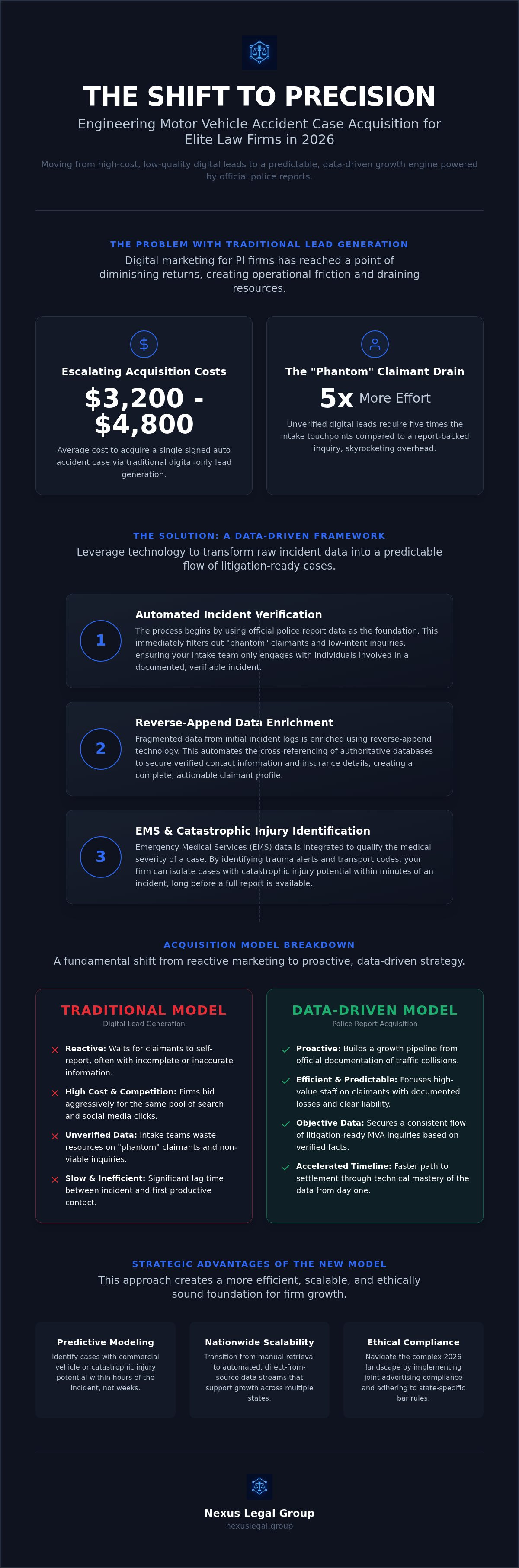
Digital marketing for personal injury firms has reached a point of diminishing returns. In 2026, the average cost to acquire a signed standard auto accident case has climbed to between $3,200 and $4,800. These escalating costs are largely driven by a reliance on "digital-only" lead generation, where firms aggressively bid against one another for the same social media clicks and search engine real estate. This model is inherently reactive and relies entirely on a claimant's self-reporting, which is frequently inaccurate or incomplete. Transitioning to a model built on police report case acquisition shifts the strategic advantage back to the firm. Instead of waiting for a lead to fill out a vague web form, you're building a growth pipeline based on official documentation of a traffic collision. This "direct-from-source" data provides an objective backbone for litigation that social media inquiries simply cannot match.
The Problem with "Phantom" Claimants
Low-intent digital leads, often referred to as "phantom" claimants, are the primary drain on law firm intake resources. These individuals may engage with an advertisement but lack a viable case, often providing unverified contact information or reporting incidents that don't meet litigation thresholds. When your intake team spends a significant portion of their day chasing these dead-end leads, your operational overhead sky-rockets without a corresponding increase in signed cases. A rigorous cost-per-case analysis reveals that unverified leads often require five times the touchpoints of a report-backed inquiry. By verifying the incident via a police report before the first call, you filter out the noise and focus your high-value staff on claimants with documented losses and clear liability.
Police Reports as Strategic Data Assets
Elite firms treat police reports as more than just evidence; they are strategic data assets. When integrated into a robust law firm growth infrastructure, this data allows for predictive modeling. You can identify cases with commercial vehicle involvement or catastrophic injury potential within hours of the incident. Official documentation also accelerates the filing timeline by providing the names of the parties, insurance carriers, and witness statements immediately. This eliminates the weeks-long delay often caused by waiting for a client to locate their own paperwork. You're no longer just retrieving a document; you're engineering a faster, more efficient path to settlement through technical mastery of the data.
The Mechanics of Data-Driven Acquisition: EMS and Reverse Append
If section one established why digital lead generation is failing, this section focuses on the technical architecture required to replace it. Traditional firms treat police records as static documents to be ordered and filed. This passive approach creates a significant lag between the incident and the first contact. An elite police report case acquisition engine treats these records as raw data streams. By applying AI-driven algorithms to incident logs, firms can prioritize inquiries based on specific liability markers, such as commercial vehicle involvement or multi-vehicle complexity, long before a physical report is even processed. This systematic approach bridges the gap between a 911 dispatch and a signed retainer with clinical precision.
Leveraging Reverse Append for Enrichment
The technical process of reverse append is what transforms a public record into a litigation-ready file. Often, initial police logs contain only fragmented data, such as a name, a date, and a general location. Our systems utilize multi-point validation to match these snippets against authoritative databases, securing verified contact information and insurance details. This automated cross-referencing ensures that your intake team isn't wasting time on disconnected numbers or outdated addresses. Reverse append is the process of enriching minimal incident data with verified claimant details to ensure litigation readiness. This foundational layer of automation removes the friction of manual data entry and allows your staff to focus on high-level case evaluation.
Emergency Services Data Integration
The most significant advantage in 2026 is the integration of Emergency Medical Services (EMS) data. While police reports establish liability, EMS dispatch logs qualify the medical severity of a case. By identifying transport codes and trauma alerts, firms can isolate catastrophic injury potential within minutes of an accident. This timing advantage is critical; it allows your firm to reach claimants during their "moment of need," providing professional guidance before they are overwhelmed by insurance adjusters. You can see how police report generated MVA leads utilize this data to create a more responsive intake experience. Implementing this type of high-performance engine ensures that your firm is the first to offer a structured path forward for those with the most significant losses.
Comparing Acquisition Models: Mohr Model vs. Traditional Retrieval
Traditional police report retrieval is a reactive, manual process that forces firms to wait for physical documents before they can begin their intake evaluation. This creates a significant time lag that often allows insurance adjusters to reach claimants first. The Mohr Model, by contrast, utilizes automated data streams to feed litigation-ready inquiries directly into a firm's growth ecosystem. This shift from manual retrieval to a direct-from-source partnership model is essential for police report case acquisition in a competitive 2026 market. It's the difference between chasing a lead and architecting a case from a position of verified authority.
Operational Efficiency in Case Flow
Reducing fact-finding hours is the primary goal of this model. When your intake team receives a lead, they shouldn't have to verify the basics like the date of incident or the insurance carrier. Pre-verified documentation ensures that the liability and insurance data are already in place before the first call is made. This level of data integrity directly impacts conversion rates because you aren't guessing about the viability of a claim. Firms that analyze high conversion MVA leads often find that the presence of an official report at the start of the intake process significantly increases the eventual settlement value. It provides a position of strength from the first interaction, allowing attorneys to focus on the legal merits rather than administrative data collection.
Scalability Across National Markets
Local retrieval processes are notoriously fragmented and difficult to manage. Every municipality has its own fees, request portals, and processing timelines, making it nearly impossible to scale a nationwide practice through manual efforts. A standardized acquisition framework overcomes these limitations by centralizing the data flow into a single, high-performance engine. By implementing AI-driven legal case acquisition, firms can expand into new jurisdictions without the need to increase their administrative headcount proportionally. The system handles the jurisdictional nuances and data formatting, providing a consistent stream of verified inquiries regardless of the accident location. This technical mastery allows elite firms to maintain rigorous quality standards while pursuing aggressive volume growth in untapped markets.
Compliance and Ethics in Automated Case Acquisition
As firms transition from reactive retrieval to proactive police report case acquisition, the regulatory stakes have never been higher. The legal landscape in 2026 is defined by a tightening grip on data privacy and consumer protection. Federal laws like the Driver's Privacy Protection Act (DPPA) remain the bedrock of this framework, strictly prohibiting the use of DMV data for marketing without express consent. Violations are financially devastating, with penalties reaching $2,500 per infraction plus attorney's fees. To maintain clinical precision in growth, elite firms must ensure their automated verification systems are designed with these safeguards at their core, positioning themselves as strategic architects rather than aggressive solicitors.
The 2026 Regulatory Framework
State-level mandates are becoming increasingly granular and difficult to navigate without sophisticated systems. For instance, new state-specific privacy legislation, with enforcement beginning in 2026, is setting a new standard for data processing and consumer opt-out rights. Structuring compliant third-party data partnerships now requires more than a standard contract; it demands a technical audit of how data is sourced and scrubbed. Firms must verify that every inquiry is generated through ethical channels that respect the "permissible use" clauses of the DPPA. For a deeper dive into these requirements, see our guide on compliant legal lead generation to understand how to protect your practice while scaling volume across multiple jurisdictions.
Risk Mitigation in Data Handling
Securing sensitive incident data requires rigorous encryption and access protocols that meet institutional standards. Automated verification doesn't just improve intake efficiency; it acts as a critical compliance filter. By cross-referencing incident logs against TCPA-compliant databases, firms can prevent the ethical lapses that often occur during high-pressure intake cycles. A litigation-ready inquiry must meet a strict checklist: verified incident occurrence, documented liability, and confirmed consent for contact. This methodical approach ensures that your police report case acquisition strategy remains a brand differentiator. By adhering to these standards, you eliminate the threat of "phantom" claimants while building a foundation of systemic integrity that insurance carriers and courts respect.
Nexus Legal Group: The Infrastructure for Elite MVA Growth
Nexus Legal Group provides the foundational layer for firms looking to move beyond the volatility of traditional lead generation. Our approach to police report case acquisition is built on the Nexus CaseFlow system, which serves as a high-performance engine for litigation-ready inquiries. By integrating real-time incident data with proprietary AI marketing precision, we eliminate the friction that typically plagues high-volume intake departments. This isn't just about document retrieval; it's about building a seamless growth infrastructure that operates with clinical precision and systemic integrity.
The Nexus CaseFlow System
Automated verification is the core of our technical architecture. When a fragmented police log enters our system, our reverse append technology immediately enriches that data with verified participant profiles and insurance indicators. For example, if a log indicates a multi-vehicle collision with commercial truck involvement, the system prioritizes that inquiry for immediate intake. This ensures that your team is engaging with high-intent claimants who have documented losses. You can explore our full growth infrastructure to see how these automated workflows drive ROI by replacing "phantom" leads with verifiable documentation.
One of the most critical differentiators in our model is the commitment to exclusivity. In 2026, the average cost to acquire a signed case from shared leads can be prohibitively high due to low conversion rates and intense competition. Nexus delivers exclusive inquiries, ensuring that your firm is the only entity engaging with the claimant. This exclusivity is the foundation of a high-return acquisition strategy, as it preserves the integrity of the attorney-client relationship and allows for a more focused, professional intake process.
Next Steps for Strategic Partners
Scaling a plaintiff practice requires a methodical assessment of your current acquisition efficiency and long-term volume goals. We don't act as a "friendly guide," but as a strategic architect for your firm's expansion. If you're ready to implement a more sophisticated police report case acquisition framework, the next step is a formal consultation to audit your existing intake workflows. You can also view our latest strategic videos for deeper operational insights into how we bridge the gap between incident data and signed retainers. Success in 2026 demands this level of technical mastery and commitment to operational excellence.
Engineering Your Firm’s Future Case Flow
The transition toward a sophisticated police report case acquisition model represents a shift from reactive marketing to proactive engineering. We've explored how reverse-append technology and EMS data integration provide the objective evidence needed to qualify catastrophic injury potential within hours of an incident. By prioritizing data integrity and strict adherence to 2026 regulatory standards, your firm can achieve national scalability without sacrificing the clinical precision required for high-stakes litigation.
Implementing this high-performance engine allows your intake team to bypass the noise of unverified digital leads and focus exclusively on inquiries with documented liability. Nexus Legal Group stands ready to serve as the foundational layer of your growth, providing the AI-driven verification and exclusive inquiries necessary to dominate your market. It's time to replace operational friction with a predictable, high-intent case flow.
Your firm is now equipped with the technical blueprint to secure a consistent, litigation-ready pipeline with absolute confidence.
Frequently Asked Questions
How does police report case acquisition differ from traditional SEO for lawyers?
SEO relies on organic search visibility to capture traffic, whereas police report case acquisition utilizes official accident records to identify high-intent claimants before they even begin a search. While SEO is a passive, long-term strategy, data-driven acquisition is an active engine that targets specific incidents with documented liability. This shift allows elite firms to bypass the volatility of search algorithms and build a more predictable case pipeline based on objective facts.
Is it ethical to use police reports for law firm marketing in 2026?
Ethical compliance in 2026 depends on adhering to the Driver’s Privacy Protection Act (DPPA) and state-level mandates like the Maryland Online Data Privacy Act. Marketing requires express consent from the individual. Firms must navigate these regulations with technical mastery, ensuring that every outreach is rooted in a "permissible use" framework. Violations can result in penalties of $2,500 per infraction, making a compliant growth infrastructure a critical brand differentiator for modern practices.
What is the role of reverse append technology in MVA lead generation?
Reverse append technology serves as the enrichment layer that turns fragmented police logs into comprehensive participant profiles. It matches minimal data, like a name or location, against authoritative databases to secure verified contact information and insurance details. This process ensures your intake team isn't wasting resources on disconnected numbers. By automating this validation, you move from raw data to a litigation-ready inquiry that is ready for immediate evaluation.
Can I scale police report acquisition across multiple states simultaneously?
Scaling across multiple jurisdictions is achievable when you move away from manual, localized retrieval. A centralized police report case acquisition stream standardizes the framework, handling the varied fees and processing timelines of different municipalities automatically. This systemic approach allows your firm to expand into new national markets without a proportional increase in administrative headcount. Technical automation handles the jurisdictional nuances, providing a consistent flow of verified inquiries regardless of the accident's location.
How does EMS data help in qualifying catastrophic injury cases?
EMS dispatch logs provide an immediate timing advantage by identifying trauma alerts and medical transport codes. While a police report establishes liability, EMS data qualifies the medical severity of the event. This allows your firm to isolate cases with catastrophic injury potential within minutes of the incident. Reaching these claimants during their critical "moment of need" ensures you can offer professional guidance before they are engaged by aggressive insurance adjusters.
What is the typical conversion rate for report-backed litigation-ready inquiries?
Conversion rates for report-backed inquiries are significantly higher than traditional digital leads because the data is pre-qualified. Since the incident occurrence and insurance coverage are verified against official records, your team isn't chasing "phantom" claimants. This clinical precision reduces intake friction and ensures a higher percentage of inquiries result in signed retainers. Firms using this model report a more efficient workflow where every lead has a documented foundation for litigation.
How does Nexus Legal Group ensure the exclusivity of MVA cases?
Nexus Legal Group maintains exclusivity by delivering inquiries through a dedicated case flow system that assigns each lead to a single partner firm. Unlike shared lead models that trigger a frantic race to the phone, our infrastructure ensures you are the only entity engaging with the claimant. This exclusivity is the foundation of a high ROI, as it preserves the integrity of the attorney-client relationship and allows for a more sophisticated, professional intake experience.
What infrastructure is required to handle high-volume data-driven intake?
High-volume acquisition requires an integrated infrastructure featuring AI-driven verification and seamless CRM connectivity. Your system must be capable of processing real-time data streams and applying reverse-append technology without manual intervention. This foundational layer eliminates operational friction and allows your intake staff to focus on high-level case strategy. Without this technical architecture, firms often struggle to maintain quality while attempting to scale their MVA case volume in a competitive market.