Law Firm Intake Efficiency Tools: Engineering Litigation-Ready Growth in 2026
Transform your law firm client intake services from a bottleneck to a growth engine. Learn to use AI and automation to secure high-value, litigation-ready ca...
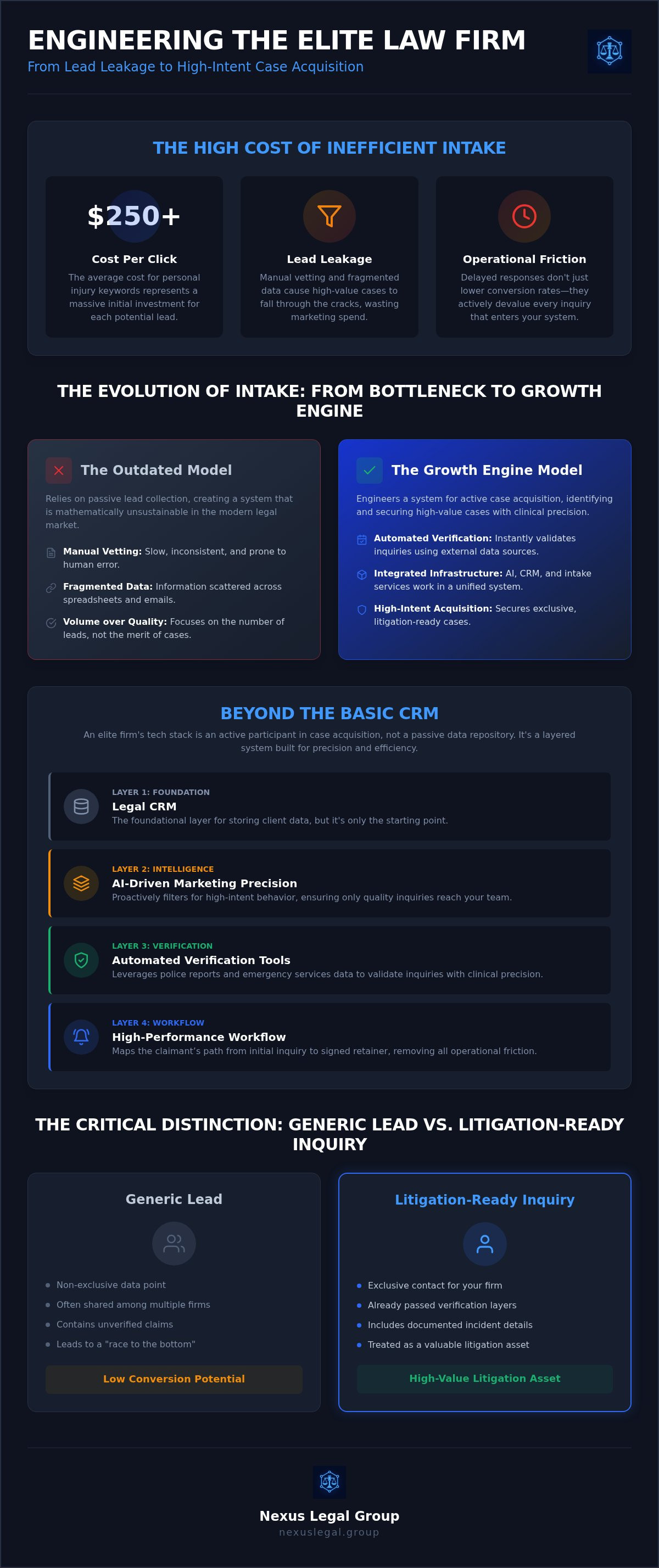
With the average cost per click for personal injury keywords reaching over $250 in 2026, every minute your team spends vetting a non-viable lead represents a significant drain on your firm's capital. It's a frustrating reality that many partners accept as an unavoidable cost of doing business, yet manual processes and fragmented data continue to cause massive lead leakage. When you rely on outdated law firm client intake services, you aren't just losing time; you're losing the high-value, litigation-ready cases that drive your firm's expansion.
You likely already feel that your intake department should function as a high-performance growth engine rather than a bottleneck. This article shows you exactly how to engineer that shift by using advanced automation and data enrichment tools to eliminate operational friction. We'll explore the mechanics of building a seamless, automated pipeline that identifies high-intent cases with clinical precision. By the end of this guide, you'll understand how to reduce overhead while securing the quality cases your practice needs to thrive in an increasingly competitive legal market.
Key Takeaways
- Learn to transition from passive lead collection to active case acquisition by replacing manual vetting with automated, high-intent systems that eliminate lead leakage.
- Discover how to upgrade your law firm client intake services by integrating AI-driven marketing precision with your CRM to capture high-value litigation opportunities.
- Understand the role of automated verification tools that leverage police reports and emergency services data to validate MVA inquiries with clinical precision.
- Implement a high-performance workflow designed to map the claimant’s path from initial inquiry to signed retainer while removing all points of operational friction.
- Explore how end-to-end growth infrastructure provides the systemic integrity required to scale an elite plaintiff firm through exclusive, litigation-ready inquiries.
The Evolution of Law Firm Intake: From Manual Forms to High-Intent Systems
The traditional model of legal intake centered on passive collection. Firms would post a digital form, wait for a submission, and hope a staff member followed up within a reasonable window. In 2026, this approach is mathematically unsustainable. As the global Legal technology market expands toward a projected $36 billion, the industry has moved toward active case acquisition. This means moving away from simply gathering names and toward engineering systems that identify, verify, and secure high-value cases before a competitor can intervene.
Clinical precision is now the baseline for elite plaintiff firms. You can't rely on a marketing mindset that prioritizes lead volume over case quality. Instead, you need a growth infrastructure model where every operational stage is measured by its ability to produce a signed, litigation-ready file. Modern law firm client intake services must function as a filter rather than just a funnel. This ensures your resources are dedicated only to cases with high merit and documented intent. Friction kills conversion. If your intake process isn't immediate, it's obsolete.
The High Cost of Inefficient Intake
Manual intake is the primary driver of lead leakage. When a potential MVA claimant reaches out, the window for conversion is measured in minutes. If your data is fragmented across spreadsheets or basic email notifications, you lose the ability to identify high-value cases quickly. This fragmentation undermines mass tort litigation strategies where timing and data integrity are everything. You have to treat every inquiry as a potential litigation asset from the very first second it enters your ecosystem. Delayed response times don't just lower conversion rates; they actively devalue your marketing spend.
Defining High-Intent Case Acquisition
There is a fundamental difference between a generic lead and a litigation-ready inquiry. A generic lead is often shared among multiple firms, leading to a race to the bottom and a struggle for the claimant's attention. Elite firms avoid this by demanding exclusive inquiries that have already passed through automated verification layers. This shift requires a new vocabulary for growth.
- Generic Leads: Non-exclusive data points with unverified claims.
- Litigation-Ready Inquiries: Exclusive, verified contacts with documented incident details.
- High-Intent Acquisition: The systematic process of identifying and securing exclusive claimants who meet specific litigation criteria through a robust law firm growth infrastructure.
By focusing on exclusivity and immediate verification, you eliminate the friction that typically derails the onboarding experience. Your law firm client intake services should be judged by the quality of the signed case, not the number of calls answered. It's about building a system that works while you sleep, ensuring that every lead is vetted with the same clinical rigor your senior partners would apply.
Essential Tech Stack for Intake Efficiency: Beyond the Basic CRM
While many firms consider a standard Legal CRM the finish line for their digital transformation, it's actually just the foundational layer. A CRM stores data, but it doesn't generate high-intent inquiries or verify them with clinical precision. To scale effectively in 2026, you need a tech stack that proactively manages the top of your funnel. This requires moving beyond basic record-keeping and toward a system that integrates law firm client intake services with advanced automation. Your infrastructure must be an active participant in case acquisition rather than a passive repository for contact information.
AI-Driven Marketing and Top-Funnel Precision
Effective intake begins before the first phone call. By implementing AI driven legal case acquisition, your firm can filter for high-intent behavior in real-time. Predictive analytics allow you to identify viable mass tort claimants by analyzing patterns that manual vetting would miss. This machine learning feedback loop constantly refines your targeting, which directly reduces your cost-per-acquisition. It ensures that the inquiries reaching your team are already predisposed to be litigation-ready assets. You aren't just buying leads; you're engineering a predictable stream of qualified opportunities.
Automated Legal Intake Verification
Manual vetting is the primary bottleneck in modern plaintiff practices. Replacing basic contact forms with algorithmic case vetting allows you to validate claims instantly. This instant verification does more than just save time; it builds immediate trust with the claimant. When a potential client knows their incident has been verified through official data sources, they are far more likely to remain engaged through the signing process. Automating the rejection of unqualified inquiries also significantly reduces your administrative overhead. This allows your team to focus exclusively on high-value cases that meet your specific criteria without wasting hours on non-viable leads.
A seamless multi-channel experience is no longer optional. Your tech stack must unify SMS, email, and voice communications into a single, cohesive workflow. This connectivity ensures that no inquiry falls through the cracks due to fragmented data. If you're looking to build this kind of high-performance growth infrastructure, you must prioritize tools that offer systemic integrity over simple data storage. Every component of your stack should serve the ultimate goal of delivering signed, compliant cases with minimal manual intervention. The result is a clinical, efficient pipeline that scales without a proportional increase in headcount.
Data Enrichment and Automated Verification: The New Standard for Quality
Quality in law firm client intake services is no longer a matter of subjective staff assessment; it's a function of objective data integrity. Most firms struggle with the inherent unreliability of claimant-provided information, which is often incomplete or colored by the stress of the incident. To solve this, elite practices are shifting toward data enrichment. This process involves cross-referencing an initial inquiry against third-party databases to create a comprehensive, litigation-ready file before your team even initiates the first contact. By the time you speak to a potential client, you should already have a clear picture of the incident's viability.
Leveraging Police and Emergency Data
The core of a high-performance intake system is the integration of incident-level data. Relying on police report generated MVA leads provides a level of certainty that behavioral search data simply cannot match. While search data tells you someone is looking for a lawyer, incident data confirms that a specific event occurred, identifying the location, time, and severity of the accident. This distinction is critical for maintaining ethical and compliant case acquisition standards. You aren't chasing clicks; you're responding to documented events. Using emergency services data for immediate verification allows your firm to act with clinical precision, ensuring you only dedicate resources to inquiries with a high probability of conversion.
Reverse Append and Accident Report Enrichment
Reverse append technology is a powerful tool in the modern legal tech stack. It allows you to take a single data point, such as a phone number or email address, and automatically populate the missing details of the claimant's profile. In a legal context, this means identifying all involved parties, vehicle information, and even preliminary insurance details without requiring the claimant to hunt for paperwork.
- Instant Documentation: Automatically obtain accident reports to bypass the weeks of waiting typically associated with manual requests.
- Party Identification: Pinpoint the exact identity of the adverse party and their carrier status immediately.
- Asset Validation: Verify the claimant’s contact history to ensure you're dealing with an exclusive, high-intent inquiry.
This level of enrichment accelerates the path to a signed retainer and a filed case. When your law firm client intake services are backed by reverse append technology, you eliminate the back-and-forth that often leads to claimant drop-off. You provide a smoother onboarding experience because you already have the facts. This systemic approach reduces the administrative burden on your staff and ensures that every case you accept is backed by a robust, verified data set. It's about moving from a reactive posture to a proactive, data-driven growth strategy.
Operationalizing Efficiency: Implementing High-Performance Intake Workflows
Building a high-performance intake department requires more than just purchasing software; it demands a total operational shift. You must map the claimant's journey from the first touchpoint to the signed retainer with clinical precision. This mapping identifies every friction point where a lead might drop off or where data integrity might be compromised. By standardizing law firm client intake services into a repeatable, automated workflow, you ensure that your firm scales without the chaos of manual oversight. Success isn't measured by how many calls your team answers, but by how many litigation-ready files they secure.
Friction points in the onboarding experience are often the result of redundant questioning or slow response times. When your system automatically populates incident details, you eliminate the need for the claimant to repeat their story multiple times. This respect for the claimant's time builds immediate rapport and increases the likelihood of a signed retainer. Your intake staff must be trained to act as case navigators rather than simple data entry clerks. They should use the automated insights provided by the system to guide the conversation with authority, focusing on empathy and clarity while the machine handles the technical verification.
The 5-Step Automated Intake Framework
A structured framework removes the guesswork from case acquisition. By automating the early stages of the funnel, you allow your staff to focus on the high-value interactions that require human expertise. This five-step process creates a straight-through processing model for your intake department.
- Step 1: High-Intent Inquiry Capture. Utilize AI-driven channels to attract claimants who exhibit specific, high-intent behaviors related to their incident.
- Step 2: Instant Data Enrichment. Cross-reference inquiries against verified MVA leads for law firms to confirm incident details and insurance status immediately.
- Step 3: Automated Verification. Run the enriched data against your specific litigation criteria to filter out non-viable inquiries without manual review.
- Step 4: Immediate Digital Retainer Delivery. Send signing documents the moment a case is qualified to capitalize on the claimant's peak intent.
- Step 5: Clinical Onboarding. Transfer the signed file into your management system with all supporting documentation already attached and verified.
Measuring What Matters: KPIs for Intake Growth
Traditional metrics like call volume or total lead count are often misleading. To drive real growth, you need to analyze the "Time to Sign" metric. This measures the velocity at which an inquiry moves through your pipeline. A faster time to sign correlates directly with higher retention and lower acquisition costs. You should also analyze lead-to-case ratios by acquisition source to identify which channels provide the most stable litigation assets. Litigation readiness is the ultimate quality metric. It ensures that every signed case has the necessary documentation, such as police reports and verified insurance details, to move into the litigation phase without administrative delay. This data-driven approach to law firm client intake services ensures your growth is both predictable and sustainable.
Nexus Legal Group: The Infrastructure for Elite Plaintiff Firm Expansion
Relying on a fragmented collection of lead vendors and basic software creates a structural ceiling for your firm's scalability. In the competitive landscape of 2026, the most effective law firm client intake services are those that operate as a unified growth infrastructure rather than a series of disconnected tools. Nexus Legal Group provides this foundational layer, offering an end-to-end system that identifies, verifies, and delivers high-intent cases with clinical precision. We don't just provide data points; we engineer the mechanics of business expansion for elite plaintiff practices.
Partnering with a strategic architect allows you to move away from the volatility of the traditional lead market. While generic vendors sell shared, unverified inquiries, Nexus focuses on exclusivity and litigation readiness. Our systems are built specifically for the rigorous demands of MVA and Mass Tort acquisition, ensuring that every inquiry meets strict ethical and compliant standards. This systemic integrity reinforces your firm’s reputation while providing the steady case flow required to sustain long-term growth. You aren't just buying a service; you're installing a high-performance engine that drives your practice from behind the scenes.
Engineering Your Firm’s Future
Elite firms trust Nexus because we prioritize the technical mastery of case acquisition. Our infrastructure utilizes AI-driven marketing and automated verification to filter out noise and focus on high-value litigation assets. By leveraging police reports and emergency services data, we provide a level of incident-level certainty that manual intake teams cannot replicate. This precision ensures that your resources are always directed toward cases with the highest probability of success. To see how this sophisticated automation functions in a real-world environment, you can view our videos detailing the mechanics of our growth infrastructure.
Next Steps for Growth-Minded Partners
Integrating Nexus into your current model requires a shift in perspective. You must transition from managing a volume of leads to managing a predictable litigation pipeline. This evolution allows your senior partners to focus on trial strategy and case resolution rather than administrative bottlenecks. Our onboarding process is designed to be seamless, connecting our automated verification engines directly to your existing workflows. This ensures that your law firm client intake services remain uninterrupted while simultaneously becoming more efficient. The result is a reduced overhead and a significantly higher quality of signed cases.
The path to engineering a litigation-ready firm begins with a commitment to operational excellence. By adopting a growth infrastructure model, you eliminate the friction that causes lead leakage and devalues your marketing spend. You gain the security of a reliable, data-driven system that scales alongside your ambitions. It's time to stop chasing leads and start engineering a predictable future for your practice.
Engineering a Scalable Future for Your Practice
Modernizing your law firm client intake services is about more than just software; it's about building a robust growth infrastructure that operates with clinical precision. We've explored how transitioning from manual vetting to high-intent systems eliminates lead leakage and dramatically reduces administrative overhead. By integrating incident-level data from police reports and emergency services, your firm can verify inquiries instantly. This ensures that your team spends their valuable time only on exclusive, litigation-ready cases that meet your specific criteria.
Shifting your focus toward data enrichment and automated workflows turns your intake department into a high-performance engine. When you prioritize systemic integrity over simple lead volume, you create a predictable path for expansion. This structural evolution allows your practice to scale without the friction of fragmented data or inefficient vetting processes. You now have the blueprint to transform your intake pipeline into a powerful driver of growth.
The transition to a data-driven model is the most effective way to secure your firm's position in a competitive market. It's time to stop managing leads and start engineering a predictable future for your practice.
Frequently Asked Questions
What are the most essential law firm intake efficiency tools for 2026?
The most essential tools include AI-driven verification engines, reverse append technology, and automated data enrichment platforms that integrate directly with your CRM. These systems move beyond simple data storage to provide active case acquisition capabilities. By using these tools, your firm can identify high-intent inquiries and validate incident details with clinical precision, ensuring that your intake pipeline functions as a high-performance growth engine rather than a manual bottleneck.
How does AI-driven intake automation improve case conversion rates?
AI-driven automation improves conversion rates by eliminating response lag and identifying high-intent behavior in real time. When a potential claimant exhibits specific patterns, the system can trigger immediate digital retainer delivery. This captures the claimant at their peak moment of intent, preventing them from seeking representation elsewhere. Speed and data integrity are the primary drivers of conversion in a competitive legal market where minutes matter.
Is automated legal intake verification ethical and compliant?
Automated verification is highly ethical and compliant because it relies on objective, third-party data sources like police reports to validate claims. This process ensures that marketing efforts remain truthful and that only cases with documented merit are accepted into the firm's pipeline. By using standardized, attorney-approved vetting logic, firms also mitigate the risk of the unauthorized practice of law during the initial screening phase.
Can intake efficiency tools integrate with my existing practice management software?
Modern intake efficiency tools are designed for seamless connectivity through advanced API integrations. These systems can push verified, litigation-ready data directly into industry-standard practice management platforms without manual intervention. This systemic integrity ensures that your law firm client intake services operate as a foundational layer of your practice, allowing for a smooth transition from the initial inquiry to active case management.
What is the difference between a lead and a litigation-ready inquiry?
A lead is typically just unverified contact information that may be shared among multiple firms, whereas a litigation-ready inquiry is an exclusive, verified asset. Litigation-ready inquiries come with documented incident details, insurance status, and verified contact history already attached. This distinction is critical for elite firms that value case quality over raw volume. You aren't just managing names; you're managing a pipeline of viable legal actions.
How do police reports and emergency data improve intake efficiency?
Police reports and emergency services data provide incident-level certainty that behavioral search data cannot provide. By cross-referencing an inquiry against these objective sources, law firm client intake services can confirm that an accident actually occurred and identify the parties involved immediately. This allows your team to bypass the weeks of waiting typically associated with manual report requests, accelerating the entire case filing process from day one.
Will automating my intake process alienate potential clients?
Automation actually improves the claimant experience by reducing operational friction and providing immediate feedback. In 2026, claimants prioritize digital convenience and fast response times over traditional, slow-moving manual processes. When you use automation to handle the technical vetting, your staff can focus on high-value, empathetic interactions. This balance of technical mastery and human guidance builds greater trust and improves overall claimant retention throughout the onboarding process.
What metrics should I track to measure my intake department’s efficiency?
You should prioritize tracking Time to Sign, lead-to-case ratios by acquisition source, and the litigation readiness of signed files. These metrics provide a more accurate picture of departmental health than simple call volume or raw lead counts. Measuring how quickly a case moves from inquiry to signed retainer allows you to identify and eliminate bottlenecks. High-performance firms use these KPIs to refine their growth infrastructure and ensure sustainable expansion.