Law Firm Client Acquisition Strategy: The 2026 Growth Infrastructure Template
Tired of low-quality leads? Our 2026 law firm client acquisition strategy builds a data-driven growth infrastructure to automate intake and boost your ROI.
In 2026, the most successful plaintiff firms have stopped viewing growth as a marketing exercise and started treating it as a systems engineering challenge. This shift represents a fundamental evolution in law firm client acquisition strategy, moving away from the volatility of third-party lead aggregators toward a proprietary, data-driven infrastructure. You likely recognize the persistent frustration of high-volume spend that yields non-exclusive, low-quality leads or the operational friction of manual intake processes that allow high-value claimants to slip through the cracks. It's impossible to scale effectively when your revenue depends on fluctuating case flow and fragmented tools that fail to integrate.
This guide provides the blueprint to transform your business development from a reactive expense into a predictable revenue engine. We'll show you how to implement a framework that leverages AI-driven precision and police report data to secure litigation-ready inquiries while lowering your cost-per-signed-case through automation. We'll examine the technical layers of elite MVA and mass tort acquisition, focusing on automated verification and the systemic elimination of intake friction to ensure your firm maintains a dominant competitive advantage in a crowded marketplace.
Key Takeaways
- Learn why transitioning from traditional marketing to a "growth infrastructure" model is essential for stabilizing revenue and eliminating the volatility of non-exclusive leads.
- Discover how to leverage real-time police report and emergency services data to secure a first-mover advantage in high-intent MVA case acquisition.
- Master a data-driven law firm client acquisition strategy that replaces the diminishing returns of 2026 SEO and PPC with a predictable, automated pipeline.
- Evaluate the ROI differences between qualified inquiry and signed case models to determine which framework best supports your firm's specific scalability goals.
- Identify the operational pillars required to remove human intake bottlenecks and ensure every inquiry is litigation-ready before it reaches your legal team.
Beyond Traditional Marketing: Why Your Law Firm Business Development Plan Needs Infrastructure
In 2026, the distinction between a law firm that survives and one that dominates lies in its foundational systems. Traditional marketing tactics like SEO and PPC have transitioned into pure cost centers for elite plaintiff firms. These channels often produce diminishing returns because they prioritize top-of-funnel clicks over bottom-line case conversions. A modern law firm client acquisition strategy requires a shift toward "Growth Infrastructure," which is the integrated application of incident data, AI-driven verification, and automated intake systems. This framework doesn't just attract attention; it engineers a predictable flow of cases through technical precision.
The marketing model is fundamentally reactive, as it chases clicks and hopes for the best. In contrast, the infrastructure model is a proactive, engineered process designed to facilitate a steady pipeline. By applying services marketing principles to a high-stakes legal environment, you can move from speculative spending to systematic scaling. This transition rests on three specific pillars: high-intent data sourcing that identifies claimants at the point of incident, automated multi-layer verification to ensure case quality, and a scalable intake engine that operates without human-induced friction. This setup ensures your firm isn't just buying leads, but building an asset.
The Limitations of the Referral-Only Model
Relying solely on referrals is a precarious strategy for elite plaintiff firms seeking national growth. While these cases are often high-quality, they lack the predictability required for aggressive expansion. You can't forecast revenue or staff your firm based on the hope that another attorney will call you next month. This dependency severely limits your ability to enter emerging mass tort or MVA markets where speed and volume are critical. Implementing a robust law firm growth infrastructure allows you to step out of this reactive cycle and take direct control of your market share. It provides the technical foundation needed to scale across jurisdictions without waiting for a referral network to catch up.
Shifting from Cost-Per-Click to Cost-Per-Signed-Case
Success in 2026 is measured by the total cost required to secure a signed retainer, not just the price of a website visit. Traditional marketing often ignores the hidden costs of manual lead vetting, where your staff spends hours filtering through non-exclusive or low-value inquiries. Infrastructure-led firms focus on reducing these operational drains through automated verification protocols that qualify prospects before they reach a human intake specialist. In this environment, litigation-ready inquiries, defined as verified, high-intent prospects who meet specific case criteria and are prepared for immediate engagement, represent the gold standard for 2026. By focusing on the end-to-end cost of acquisition, you ensure that every dollar spent contributes directly to a signed case rather than a bloated administrative budget.
Engineering High-Intent Case Flow: The Role of Real-Time Incident Data
Behavioral data captures what people search for, which is often a lagging indicator of legal need. Incident data captures what actually happened, providing a leading indicator of a viable case. Elite firms use this distinction to engineer a more resilient law firm client acquisition strategy. By focusing on police report generated MVA leads, you eliminate the guesswork inherent in general search marketing. This strategy utilizes real-time emergency services data to secure a first-mover advantage, identifying high-value claimants before they enter the broader advertising ecosystem.
This process moves beyond simply identifying a crash. It involves a systematic "Reverse Append" workflow where basic incident records are enriched with specific participant details. While a search for "car accident lawyer" might indicate a casual inquiry, a police-verified incident report confirms a legally actionable event. This data-driven approach ensures your pipeline isn't filled with informational seekers, but with individuals who have an immediate, documented need for litigation support.
Leveraging Police and Emergency Services Data
Police reports provide a verified foundation for any claim. They contain objective details like location, time, and responding officers, making the resulting inquiries legally actionable from the start. Ethically, using this data ensures you're reaching out to individuals who have a documented need for representation. In the fast-paced motor vehicle accident space, real-time access is a requirement for maintaining a consistent case flow. It allows your firm to provide assistance when the claimant is most receptive to professional guidance.
Enriching Leads with Reverse Append Technology
Reverse append technology is the process of taking limited incident data and enriching it with comprehensive participant details. This technology allows trial lawyers to obtain full accident reports and contact information for everyone involved in a collision. This level of detail is what produces high conversion MVA leads, as your intake team has the specific facts needed to file a case immediately. If you're looking to upgrade your firm's technical capabilities, exploring end-to-end growth infrastructure is the logical next step for a modern law firm client acquisition strategy.
Evaluating Case Acquisition Models: Qualified Inquiries vs. Signed Cases
Choosing between the "Qualified Inquiry" and "Signed Case" models is a pivotal decision in any law firm client acquisition strategy. The inquiry model provides high-volume, verified data for firms with established internal intake departments, allowing for greater control over the claimant relationship from the first touchpoint. In contrast, the signed case model utilizes outsourced intake to deliver fully executed retainers, effectively shifting the administrative burden to the infrastructure provider. For elite plaintiff firms, the ROI of ethical mass tort lead generation hinges on this choice. While MVA cases often favor the inquiry model due to the speed of local filing, mass torts frequently benefit from the signed case approach to manage national scale without inflating internal overhead.
The Anatomy of a Litigation-Ready Inquiry
A "litigation-ready" inquiry must meet rigorous technical criteria before it enters your workflow. Automated verification ensures that every inquiry isn't just a name and a number, but a viable legal asset ready for immediate processing. The essential criteria include:
- Verified Liability: Documented evidence of fault, incident data, or exposure.
- Documented Injury: Specific incident-related trauma or medical confirmation.
- Defendant Viability: Confirmation of insurance coverage or corporate assets.
AI-driven marketing precision plays a critical role here, as it autonomously filters out non-compensable claims before they consume your staff's time. In 2026, exclusivity is a non-negotiable standard for elite firms. Non-exclusive leads represent a fundamental failure in growth infrastructure, as they force firms into a race that erodes profit margins. By prioritizing litigation-ready inquiries, you ensure your intake team focuses only on cases with a high probability of settlement or verdict.
Scalable Mass Tort Acquisition Strategies
Sourcing high-quality mass tort claimants presents unique challenges, particularly regarding long-term compliance and ethical standards. You must evaluate your mass tort case acquisition strategy based on its ability to withstand judicial scrutiny while maintaining high conversion rates. Effective signed case acquisition relies on transparent data sourcing and rigorous ethical protocols to ensure every retainer is valid. This systemic approach allows firms to build massive inventories in emerging litigations without compromising the integrity of their practice. It's about engineering a pipeline that is both scalable and defensible in a court of law.
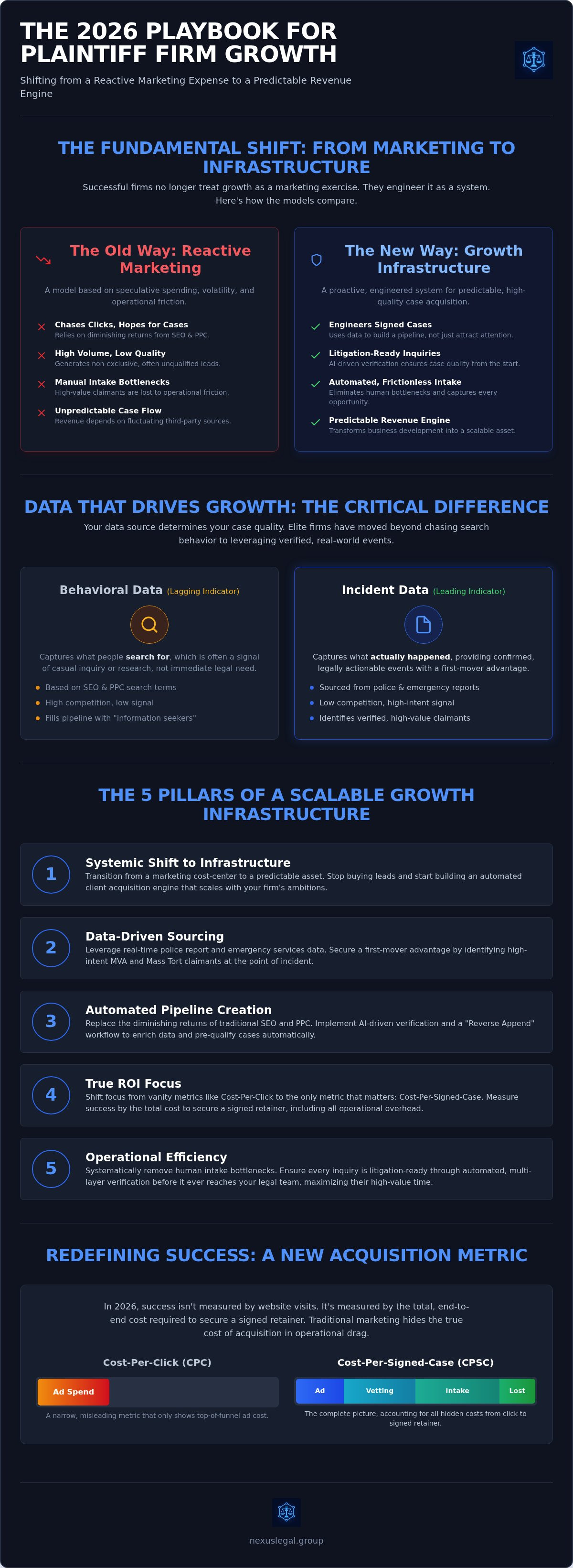
The 2026 Law Firm Business Development Template: 5 Pillars of Scalability
A scalable law firm client acquisition strategy requires more than just capital; it demands a modular framework that adapts to shifting market conditions. In 2026, firms that rely on fragmented marketing efforts face unsustainable overhead and unpredictable case flow. To achieve systemic growth, you must implement an institutional template that treats business development as a technical process rather than a creative one. This template is built upon five specific pillars designed to eliminate operational friction and maximize the value of every inquiry.
- Pillar 1: High-Intent Sourcing. Prioritize real-time incident data over general search queries to identify claimants at the point of need.
- Pillar 2: Automated Verification. Deploy algorithmic filters to remove non-compensable inquiries instantly, ensuring your staff only handles viable cases.
- Pillar 3: Data Enrichment. Utilize reverse append technology to secure accident reports and participant details before the first call is made.
- Pillar 4: Ethical Compliance. Maintain rigorous sourcing protocols to protect your firm's reputation and ensure every case is defensible.
- Pillar 5: Conversion Tracking. Connect litigation outcomes back to the original data source to identify and scale your highest-ROI channels.
Implementing Automated Intake Verification
Implementing automated intake for plaintiff firms is the most effective way to reduce administrative overhead in 2026. AI-driven vetting protocols determine case viability in seconds, identifying key factors like liability and insurance coverage without human intervention. This speed is critical for reducing claimant friction. When you respond to a verified inquiry immediately, you significantly increase sign-up rates by capturing the prospect before they engage with a competitor. It transforms your intake from a bottleneck into a high-speed conversion engine.
Designing the Feedback Loop
A robust growth infrastructure requires a continuous feedback loop between your acquisition data and your Case Management System (CMS). You should integrate litigation outcomes directly with upstream data sourcing filters to refine your targeting parameters over time. This ensures your law firm client acquisition strategy stays focused on high-value settlements rather than raw volume. Exclusivity remains a critical component of this loop. Shared leads degrade the quality of your data and introduce unnecessary competition, making it impossible to maintain a predictable revenue engine. Exclusive status ensures that your ROI calculations are based on a controlled, proprietary pipeline.
Implementing Nexus Legal Group’s End-to-End Growth Infrastructure
Nexus Legal Group serves as the strategic architect for firms ready to transition from reactive lead buying to institutional infrastructure building. While traditional vendors offer raw, shared data, we provide a proprietary law firm client acquisition strategy built on the technical frameworks discussed throughout this guide. By positioning our systems as a foundational layer within your practice, we eliminate the volatility of third-party platforms. Our approach focuses on the systematic sourcing of exclusive MVA inquiries through direct police and emergency services data, ensuring your pipeline remains insulated from the inefficiencies of general search marketing.
We provide a "litigation-ready" guarantee that redefines industry expectations for inquiry quality. Every prospect delivered through our infrastructure has been subjected to multi-layer AI verification and reverse append enrichment to meet the rigorous standards of elite plaintiff firms. This isn't a surface-level marketing service; it's a high-performance engine designed to drive predictable revenue. We invite partners to stop chasing clicks and start engineering a scalable business development environment where every inquiry is a verified legal asset.
The Nexus Advantage: MVA and Mass Tort Precision
Our expertise lies in the clinical precision of high-intent MVA acquisition and large-scale mass tort case generation. We utilize AI-driven verification protocols to filter out non-compensable claims, delivering either qualified inquiries or fully signed cases based on your firm’s operational requirements. This technical mastery ensures that your internal team spends zero time on manual vetting, focusing instead on high-value litigation. Learn more about Nexus Legal Group’s growth infrastructure to see how these systems integrate with your current practice area goals.
Next Steps for Elite Plaintiff Firms
Scaling your practice starts with a clinical audit of your current acquisition overhead and intake friction. Most firms find that their existing law firm client acquisition strategy is hampered by fragmented tools and non-exclusive data sources. Integrating Nexus CaseFlow into your operations involves a methodical transition where our incident data and automated verification layers replace your legacy marketing spend. This shift reduces your cost-per-signed-case while providing the transparency needed for long-term ROI tracking. To begin the integration process and secure your market share for the 2026 cycle, take the next step in your firm's evolution.
Transitioning to a Data-Driven Growth Infrastructure
The legal landscape of 2026 requires elite plaintiff firms to move beyond speculative marketing spend and adopt a technical approach to business development. You've seen how a sophisticated law firm client acquisition strategy relies on the integration of real-time incident data and automated verification to eliminate manual intake overhead. By prioritizing litigation-ready MVA inquiries and exclusive cases, your firm can replace the volatility of raw leads with a predictable revenue engine that scales without increasing administrative friction.
Implementing this framework allows you to maintain a dominant competitive advantage by securing high-intent claimants at the point of incident. This systematic shift from lead buying to infrastructure building ensures every dollar contributes directly to a signed, defensible case. It's the most effective way to protect your market share and ensure your practice remains a high-performance organization in an increasingly crowded marketplace.
Building this foundation is the key to achieving long-term scalability and operational excellence. It's time to stop reacting to market fluctuations and start engineering the future of your firm.
Frequently Asked Questions
What is the difference between a legal lead and a litigation-ready inquiry?
A litigation-ready inquiry is a verified, high-intent prospect that has met specific technical criteria like liability and insurance confirmation, whereas a standard legal lead is often just unvetted contact information. This distinction is critical for a high-performance law firm client acquisition strategy. By using automated filters, you ensure your intake team only engages with individuals who have a documented, actionable claim. This shift reduces the time wasted on non-compensable clicks and general informational seekers.
How does police report data improve MVA case acquisition?
Police report data improves acquisition by providing objective, third-party verification of an incident immediately after it occurs. This data includes specific accident details, participant identities, and responding officer notes, which allows your firm to act with a first-mover advantage. Instead of waiting for a claimant to search for a lawyer, you utilize real-time incident data to identify high-intent prospects who have a documented legal need. This creates a more predictable and high-quality case flow.
Is automated legal intake ethical and compliant with ABA standards?
Yes, automated intake is ethical and compliant when it's designed to facilitate the initial screening process without providing direct legal advice. These systems use algorithmic logic to verify case criteria like injury severity and liability based on the firm's established standards. By automating the data collection and verification phases, you ensure consistency and accuracy in the intake process. It's a technical layer that supports, rather than replaces, the professional judgment required for legal representation.
Why is exclusivity important in a law firm business development plan?
Exclusivity is vital because it eliminates the profit-eroding race to the phone that occurs with shared leads. When you own the inquiry, you control the claimant experience and maintain higher conversion rates without competing against multiple firms for the same retainer. In a modern law firm client acquisition strategy, non-exclusive data is considered a liability. Exclusive inquiries preserve your margin and allow for accurate ROI tracking by ensuring your data remains proprietary and uncontested.
How much can a firm reduce overhead by using automated verification?
Firms often see a significant reduction in administrative overhead by automating the initial vetting of inquiries. While exact numbers vary based on firm size and current manual processes, removing the human bottleneck from the qualification stage allows your intake specialists to focus exclusively on signing verified cases. Automation handles the high-volume filtering of non-compensable claims in seconds. This systemic efficiency reduces the cost-per-signed-case by maximizing the productivity of your existing legal staff.
Can high-intent acquisition strategies be scaled for mass torts?
High-intent strategies are highly scalable for mass torts when you apply a data-driven infrastructure model. By utilizing AI-driven marketing precision to identify specific exposure or injury criteria, you can build large inventories of verified claimants across multiple jurisdictions. This approach ensures that your mass tort pipeline is filled with litigation-ready inquiries rather than raw, unvetted leads. It provides the technical foundation needed to manage national campaigns without overwhelming your firm's internal administrative capacity.
What data points are included in a reverse append accident report?
A reverse append accident report enriches basic incident data with comprehensive participant and vehicle details. Key data points often include:
- Full names and contact information for all involved parties.
- Insurance carrier details and policy information when available.
- Specific vehicle descriptions and damage assessments.
- A complete narrative of the incident from the responding officer.
This level of detail allows your team to evaluate case viability before the initial contact.
How do I integrate a case acquisition system with my existing CMS?
Integration typically occurs through secure API connections that facilitate a seamless data transfer between the acquisition infrastructure and your Case Management System. This connectivity ensures that verified inquiries appear in your workflow in real time, complete with all enriched data points and documentation. By bridging these systems, you create a closed feedback loop that allows you to track a case from the initial incident data to the final settlement or verdict.