Improving Legal Lead Conversion: Engineering Growth Infrastructure for Plaintiff Firms
Stop wasting marketing spend on bad leads. Learn our framework for improving legal lead conversion by using data and automation to get litigation-ready cases.
Why are your MVA and mass tort leads failing to convert into signed cases despite a massive marketing spend? In a competitive landscape where personal injury cost-per-click can exceed $300 in top metro areas, the traditional volume-first approach is no longer sustainable. You've likely felt the frustration of high lead waste from unqualified inquiries and the heavy administrative overhead required to vet low-intent prospects. Improving legal lead conversion isn't about buying more traffic. It's about engineering a sophisticated infrastructure that prioritizes data integrity over raw numbers.
We agree that your intake team's time is too valuable to waste on manual vetting of unverified contacts. This guide will show you how to eliminate lead waste and maximize your ROI by transitioning from generic marketing to a data-driven, high-intent case acquisition framework. We'll examine the technical shift from raw lead volume to a system powered by police report data and automated verification, ensuring your inquiries are litigation-ready before they ever reach your desk.
Key Takeaways
- Define conversion as mechanical efficiency to identify exactly where your firm is losing case momentum and inquiry value.
- Transition from broad behavioral marketing to incident-based sourcing; utilize police reports and emergency services data to secure high-intent inquiries.
- Implement an automated intake system that meets the critical five-minute "speed-to-lead" threshold to prevent terminal lead decay.
- Establish a scalable growth infrastructure focused on improving legal lead conversion by integrating AI-driven marketing with verified accident enrichment.
- Move beyond raw lead volume to a predictable acquisition model that delivers litigation-ready signed cases directly to your practice.
The Conversion Crisis: Why Plaintiff Firms Lose Case Momentum
In the high-stakes environment of plaintiff litigation, legal lead conversion is often misidentified as a sales skill. It isn't. It's the mechanical efficiency of your firm's growth infrastructure, specifically the speed and precision with which an inquiry becomes a signed retainer. Many firms focus exclusively on the top-of-funnel lead generation phase, assuming that a higher volume of inquiries will naturally yield more cases. This is a fallacy. For elite practices, "more leads" often creates a bottleneck that triggers a phenomenon known as Lead Decay.
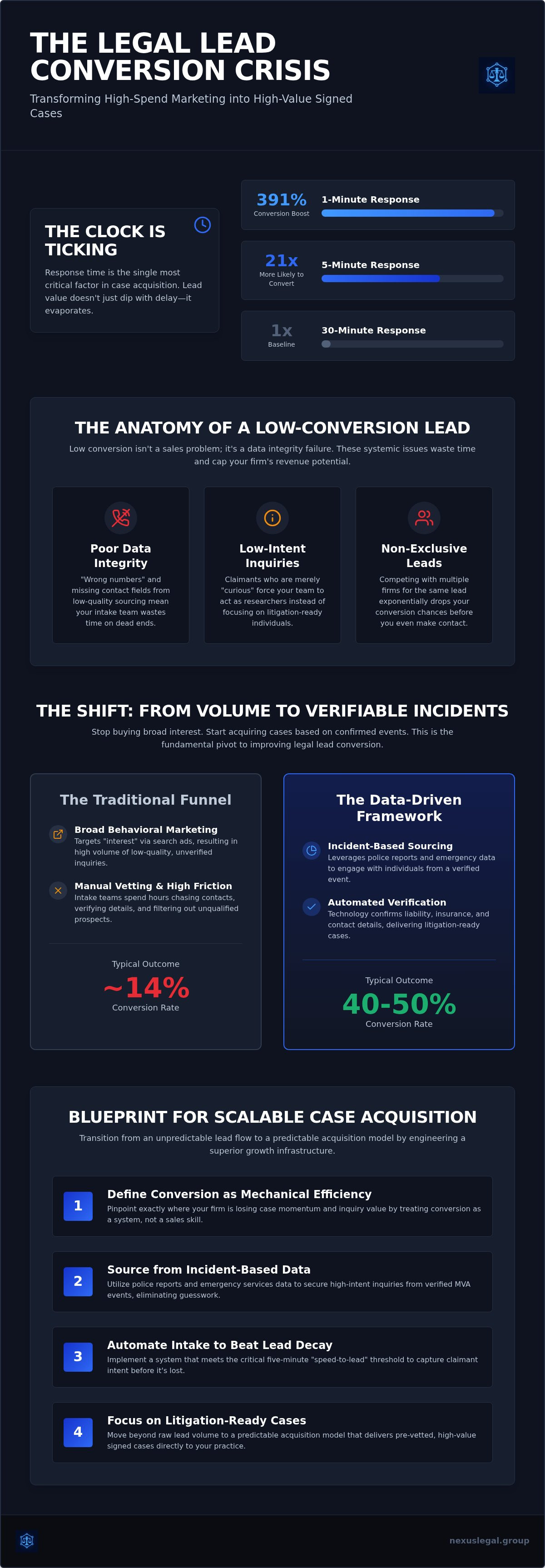
Data shows that response time is the single most critical factor in case acquisition. Responding to a lead within five minutes makes you 21 times more likely to convert than waiting just thirty minutes. A one-minute response can boost conversion by as much as 391%. When your intake process is slow, the case value doesn't just dip; it evaporates. You're no longer just competing on legal merit. You're racing against the clock to capture a claimant's intent before they move to a more responsive competitor.
The Anatomy of a Low-Conversion Lead
Low conversion rates are frequently the result of poor data integrity. The "wrong number" epidemic and missing contact fields are symptoms of low-quality sourcing that plague traditional legal marketing. These aren't just minor inconveniences. They're systemic failures. Low-intent inquiries, where a claimant is merely curious rather than "litigation-ready," force your team to act as researchers instead of legal professionals. Additionally, non-exclusive lead sharing is devastating. If you're competing with multiple firms for the same MVA lead, your chances of improving legal lead conversion drop exponentially. You aren't just fighting for a case; you're fighting a losing battle against an industry-wide decay of intent.
Quantifying the Cost of Intake Friction
Manual vetting carries a massive, often invisible, price tag. Every hour an attorney or high-level staffer spends chasing unqualified inquiries is an hour stolen from high-value litigation. This administrative friction leads to burnout and operational stagnation. When firms rely on manual verification for motor vehicle accident leads, they incur an opportunity cost that prevents them from scaling. Without a frictionless system, moving into national mass torts becomes impossible. These infrastructure gaps aren't just slowing you down. They're capping your firm's revenue potential. Improving legal lead conversion requires replacing these manual hurdles with automated, data-rich processes that prioritize high-intent inquiries over raw volume.
High-Intent Data: Sourcing Litigation-Ready MVA Inquiries
Transitioning from behavioral interest to incident-based data is the most significant pivot a firm can make. Most traditional marketing relies on "interest," which is often just a claimant clicking a search ad or filling out a generic form. Incident-based data is different. It relies on the objective reality of a motor vehicle accident. By sourcing police report generated MVA leads, you're starting with a verified event rather than a vague intention. This shift is fundamental to improving legal lead conversion because it filters out the noise before the intake call even begins.
The results of this data-driven approach are quantifiable. Industry data suggests that litigation-ready inquiries, backed by verified accident data, can out-convert generic web-form leads by as much as three times. While the average firm struggles with a 14% conversion rate, those leveraging incident-specific data often see their rates climb toward the 40% to 50% range. This isn't magic. It's the result of removing the guesswork from the qualification process and focusing on claimants with a documented need for representation.
Leveraging Incident Data for Precision
Police report data allows attorneys to confirm liability and insurance coverage with clinical precision. Instead of relying on a claimant's memory, which is often clouded by trauma or lack of legal knowledge, you have access to the officer's initial assessment and the involved parties' insurance carriers. Emergency services data further identifies high-impact cases by highlighting the severity of the incident. This level of detail enables your firm to prioritize cases with the highest potential value, ensuring your intake team focuses their energy where it matters most.
The Power of Reverse Append Technology
Reverse append technology serves as the final layer of data integrity. It automatically fills the gaps in claimant-provided information by cross-referencing partial data points against verified databases. This process verifies incident dates, locations, and participant details without requiring the claimant to provide an exhaustive list of facts during their first interaction. By reducing this administrative burden on the claimant, you create a smoother experience that builds trust. Integrating these technological layers is an essential strategy for improving legal lead conversion by ensuring every contact is pre-qualified against hard data. This creates a foundation for a scalable case acquisition system that values efficiency over volume.
Automating Intake: Engineering a Frictionless Conversion Path
A manual intake process is a structural liability for firms aiming to scale. Relying on human staff to manually screen every inbound inquiry creates a bottleneck that inevitably leads to the decay of case value. The shift from human-first to AI-augmented legal intake verification is not merely a technological upgrade; it's an operational necessity. By implementing an automated framework, you ensure that every inquiry is processed with clinical precision, regardless of the time of day or staff availability. This transition is a foundational step in improving legal lead conversion by removing the friction that traditionally stalls case momentum.
The "Speed-to-Lead" imperative remains the most critical metric in plaintiff litigation. Because responding within five minutes is the industry-recognized threshold for successful conversion, automation is the only reliable way to meet this demand consistently. Automated systems don't just respond; they vet. They filter out non-litigable inquiries using pre-defined criteria, allowing your legal team to focus exclusively on high-intent, litigation-ready cases. This ensures that your firm's resources are allocated to the inquiries with the highest probability of becoming signed retainers.
Steps to Optimize Your Intake Framework
- Step 1: Implement real-time automated intake for plaintiff firms to capture data the moment an incident occurs.
- Step 2: Deploy automated verification protocols to confirm claimant eligibility instantly, cross-referencing incident data against jurisdictional requirements.
- Step 3: Integrate this high-intent data directly into your firm's CRM or Case Management System to eliminate manual data entry and ensure a seamless transition to the legal team.
Balancing Automation with Professional Precision
While automation drives speed, professional precision maintains the integrity of your practice. Advanced AI systems can prioritize high-value mass tort inquiries for immediate partner review, ensuring that complex cases receive the expert attention they require without delay. It's essential that every automated touchpoint reflects your firm's authoritative brand voice. This consistency builds trust with the claimant from the first interaction. Furthermore, automation significantly reduces human error in the data entry and verification phase, which is vital for maintaining ethical and compliant lead generation standards.
Compliance is especially critical under current regulations, such as California's SB 37, which holds attorneys directly responsible for their marketing vendors' compliance as of January 1, 2026. Automated systems provide a transparent, audit-ready trail of every interaction, ensuring your firm remains compliant while improving legal lead conversion. By engineering a frictionless path from inquiry to retainer, you position your firm as a high-performance engine capable of sustained, scalable growth.
Growth Infrastructure: The Blueprint for Scaling Case Flow
Scaling a plaintiff practice requires more than just an increased advertising budget. It demands a robust law firm growth infrastructure that operates as a holistic acquisition system. Unlike traditional marketing campaigns that rely on sporadic bursts of activity, a mechanical case acquisition model treats every inquiry as a unit of production. This systematic approach is essential for improving legal lead conversion because it replaces human variability with technical consistency. Elite firms recognize that profitability is maintained by securing exclusive, litigation-ready inquiries that don't require extensive manual vetting.
Moving toward this model means shifting your perspective from "buying leads" to "engineering outcomes." When your firm operates on a foundational layer of high-intent data, the entire funnel becomes predictable. AI-driven marketing plays a pivotal role here, specifically in identifying high-intent mass tort claimants who meet strict eligibility criteria. This precision ensures that your growth isn't just fast; it's sustainable. By focusing on the mechanics of the system, you eliminate the friction that typically erodes margins during rapid expansion.
Scaling MVA Case Flow Mechanically
A predictable pipeline for motor vehicle accident cases is built on the integration of incident data and high-intent search. By utilizing verified MVA leads for law firms, you stabilize your monthly revenue by ensuring a steady flow of qualified prospects. This mechanical scaling allows you to diversify acquisition channels without losing control over lead quality. It transforms the intake department from a cost center into a high-performance engine that drives the firm's expansion through data-backed certainty.
Mass Tort Expansion via Data-Driven Frameworks
National scaling often breaks traditional intake models due to the sheer volume and complexity of mass tort inquiries. Implementing a sophisticated mass tort case acquisition strategy is the only way to manage this load effectively. Many top-tier firms are now transitioning to "signed cases as a service" models. This eliminates internal intake bottlenecks by delivering retainers that are already vetted and compliant. This strategy is a primary driver in improving legal lead conversion at scale, as it allows partners to focus on litigation rather than administrative screening.
The Nexus Advantage: End-to-End Case Acquisition
Nexus Legal Group operates as the strategic architect of your firm's expansion, providing the foundational layer necessary for sustainable growth. We don't just deliver data; we engineer a complete acquisition pipeline that moves seamlessly from the moment of an incident to a litigation-ready signed case. By integrating AI-driven marketing precision with police report and emergency services data, we eliminate the friction that causes lead decay. This end-to-end framework is the most effective method for improving legal lead conversion because it replaces the uncertainty of traditional marketing with a high-performance growth engine.
Our platform is built on clinical precision and rigorous ethical standards. We understand that for elite plaintiff firms, the ultimate unit of growth is the signed retainer, not the raw inquiry. Every stage of our process is designed to ensure that the inquiries reaching your desk have been verified against objective incident data and enriched through reverse append technology. This results-driven approach ensures that your intake team focuses only on cases with confirmed liability and insurance coverage, maximizing your firm's operational efficiency and ROI.
Why Elite Firms Choose Nexus Legal Group
- Exclusive High-Intent Inquiries: Gain access to litigation-ready prospects sourced from verified incident data that competitors simply cannot replicate.
- AI and Manual Rigor: We combine the speed of AI-driven marketing with the accuracy of manual verification to ensure every signed case meets your firm's specific standards.
- Litigation-Ready Results: Our focus remains on the final outcome. We deliver ethical and compliant signed cases, allowing your partners to focus on what they do best: litigating.
Next Steps for Firm Partners
The first step toward improving legal lead conversion is a cold evaluation of your current infrastructure. Identify where your inquiries are stalling and calculate the true cost of your manual intake bottlenecks. Once you've pinpointed these gaps, it's time to transition to a more scalable model. We invite you to schedule a discovery session with our team to analyze your specific MVA or Mass Tort growth goals and see how our growth infrastructure can stabilize your case flow.
For those seeking a deeper dive into the mechanics of data-driven acquisition, we encourage you to explore our blog for more technical insights and strategic blueprints. Transitioning from lead waste to a high-performance engine isn't just about changing your marketing; it's about re-engineering your firm's foundational growth layer for the modern legal landscape.
Engineering a High-Performance Case Acquisition Model
Transitioning your firm from a volume-based marketing approach to a data-driven infrastructure is the only way to remain competitive in a landscape of rising costs and regulatory scrutiny. You've learned that incident-based data provides a layer of verification that generic web forms simply can't match. By automating your intake and vetting processes, you remove the human friction that traditionally leads to case decay. Improving legal lead conversion is ultimately a function of system integrity and technical mastery.
Success in modern plaintiff litigation requires a foundational layer that prioritizes litigation-ready signed cases over raw lead numbers. Utilizing AI-driven marketing precision and police report and emergency services data integration ensures that your growth is both ethical and scalable. This shift allows your legal team to focus on high-value litigation while the growth engine manages the complexities of acquisition and compliance with clinical precision.
Take control of your firm's trajectory by implementing a system built for precision and scalability. Your practice deserves a predictable pipeline that turns high-intent data into professional results.
Frequently Asked Questions
How can I improve my law firm's lead conversion rate immediately?
Immediate improvement is achieved by reducing your response time to under five minutes and prioritizing data integrity over raw inquiry volume. Implementing a system that filters for intent ensures your team spends time only on qualified prospects. Improving legal lead conversion starts with eliminating the manual vetting of unverified contacts and replacing it with automated, incident-based verification.
What is the difference between a legal lead and a litigation-ready inquiry?
A legal lead is a raw contact that often lacks verified incident details, while a litigation-ready inquiry is an enriched data set backed by objective facts. Litigation-ready inquiries include confirmed accident data, liability assessments, and insurance coverage details. These inquiries typically out-convert generic web-form leads by 3x because they remove the need for extensive preliminary investigation.
Is automated legal intake ethically compliant for plaintiff firms?
Automated intake is fully compliant when it adheres to specific state regulations, such as California's SB 37, which became effective January 1, 2026. This law holds attorneys directly responsible for their marketing vendors' compliance. Systems that provide transparent audit trails, clear disclosures, and accurate data enrichment ensure your firm remains ethical while accelerating its acquisition pipeline.
How does police report data improve MVA case acquisition?
Police report data confirms liability and insurance coverage using objective third-party assessments from the scene of the accident. By integrating this incident data, your firm bypasses the inaccuracies and gaps often found in a claimant's memory. This precision allows your intake team to prioritize high-impact cases based on verified mechanical facts rather than subjective behavioral interest.
Can AI-driven systems actually identify high-intent mass tort claimants?
Yes, AI-driven systems identify high-intent claimants by cross-referencing behavioral data with specific litigation eligibility criteria. These systems are engineered to filter for litigation-readiness by analyzing complex data sets to find individuals who meet the rigorous standards required for national mass tort scaling. This ensures that every inquiry has a high probability of becoming a signed retainer.
What are the common mistakes in law firm intake that hurt conversion?
The most common mistakes include slow response times and relying on manual vetting for unqualified inquiries. Data shows that 27% of law firms don't respond to online leads at all, which leads to terminal lead decay. Additionally, chasing non-exclusive leads or failing to verify insurance coverage early in the process significantly erodes firm profitability.
How long does it take to implement a legal growth infrastructure?
A standard transition from pilot to full production typically occurs within a 90-day timeline. This period allows for the seamless integration of AI-driven marketing precision and incident data sources into your firm's existing case management system. This methodical rollout ensures that the foundational layer of your acquisition engine is stable before you begin scaling case flow.
Why is speed-to-lead so critical for motor vehicle accident cases?
Speed-to-lead is critical because claimant intent and the availability of a case decay rapidly in the hours following an incident. A 1-minute response time can boost conversion by as much as 391%. In the highly competitive MVA landscape, being the first firm to provide an authoritative, professional touchpoint is often the deciding factor in securing a signed retainer.