Commercial Truck Accident Marketing Playbook
Explore commercial truck accident marketing costs, lead sources, ad formats, targeting, and verification—and learn to measure campaign performance by cost pe...
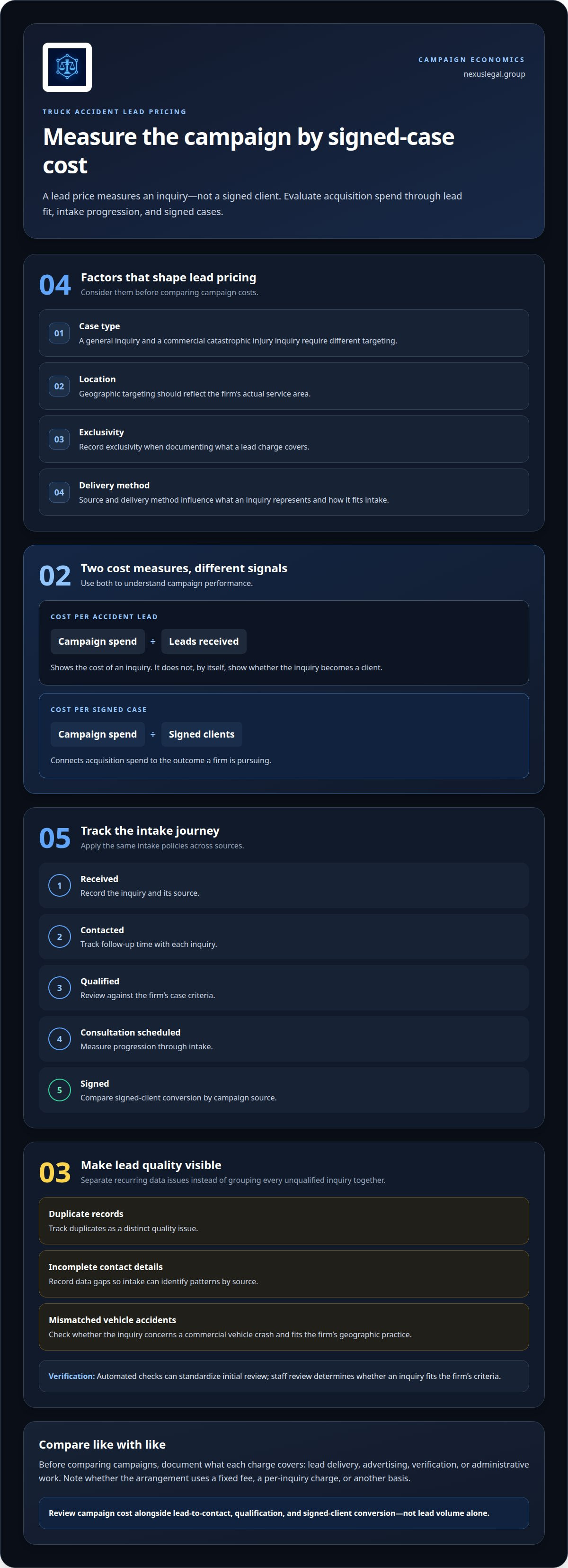
Lead costs depend on case type, location, exclusivity, and delivery method, so no single price describes every campaign. In commercial truck accident marketing, cost per signed case is often more useful than cost per lead because it connects acquisition spend to the outcome a firm is pursuing.
It’s reasonable to focus on the price of each inquiry, especially when comparing trucking cases with general personal injury campaigns. But the lead source and ad format also shape what an inquiry represents, how well it fits a firm’s intake process, and how to evaluate campaign performance.
This playbook explains the factors that affect lead pricing, compares common acquisition sources, and shows how trucking campaigns differ from broader personal injury marketing. It also examines ad formats, targeting, and verification, so you can evaluate a campaign as a connected system rather than by its price tag alone.
Key Takeaways
- Assess lead costs in context: case type, location, exclusivity, and delivery method all influence pricing.
- Measure acquisition performance by cost per signed case, not lead price alone.
- Separate truck accident search campaigns from general personal injury keywords to align targeting with case intent.
- Compare ad formats by how clearly they communicate the case focus and guide prospective clients to take the next step.
- Build advertising workflows around applicable state bar rules, transparent disclosures, and appropriate intake processes.
How Much Do Trucking Accident Leads Cost?
Trucking accident lead costs vary with case type, location, exclusivity, and delivery method. A general inquiry and a commercial catastrophic injury inquiry require different targeting, so compare them by fit and potential case relevance, not just the number of leads delivered. For a commercial truck accident marketing strategy, define the vehicle types and injury matters you want to reach before selecting channels.
Commercial targeting can include tractor-trailers, delivery vans, box trucks, buses, and fleet vehicles. This distinction matters because a campaign built only around “truck crash” may miss people searching for a company vehicle or delivery van. Specify the incident type, location, and potential liability issues in the campaign brief. For example, content about a delivery vehicle collision can explain company responsibility without promising a particular legal outcome.
Targeted content should answer the questions potential clients may have at different stages of intent. Build separate pages for truck collisions, commercial vehicle injuries, and catastrophic injury claims. Explain what information can help describe an incident, such as vehicle type, crash location, and the parties involved. Focused pages clarify the subject for visitors and help search engines understand each page’s topic.
Geographic targeting should reflect the firm’s actual service area. Map relevant freight corridors and nearby communities, then organize campaigns around locations the firm serves instead of targeting the entire country. A corridor-based strategy can align ad delivery with local search intent while limiting impressions outside the firm’s operating area. For example, a campaign can distinguish searches tied to a city from those tied to a regional highway corridor.
For search campaigns, separate truck accident terms from broad personal injury keywords. “Truck accident lawyer” signals different intent from a general injury information search. Google Ads ad groups can use distinct themes and landing pages so the message matches the search. Search content can also address trucking regulations, insurance coverage, and possible responsibility without making unsupported claims about liability.
Facebook and Instagram support audience-focused creative, but keep the message specific to the case type. A carousel can present distinct information across panels, such as commercial vehicle examples, common questions, and a clear next step. Use direct language and avoid implying that every viewer qualifies for legal representation. Track each campaign’s source and response so you can assess lead volume alongside relevance.
A truck accident law firm website should make the next step clear, with a focused landing page, contact options, and a concise explanation of the firm’s process. Use distinct pages for commercial vehicle cases and broader injury matters, with relevant information and a straightforward inquiry form. This structure helps visitors find the right path without confusing a truck-related matter with a general vehicle claim.
Truck accident lead pricing and cost per signed case
Measure campaign return by connecting spend to qualified inquiries and signed cases. For each source, calculate cost per accident lead by dividing campaign spend by the leads received. Then calculate cost per signed case by dividing spend by signed clients. Track both alongside conversion rates, which show how many leads move through intake.
A lead price measures an inquiry, not a signed client or a defined case outcome. Before comparing campaigns, record what each charge covers: lead delivery, advertising, verification, or administrative work. Document whether the arrangement uses a fixed fee, a per-inquiry charge, or another basis. These distinctions make comparisons meaningful without treating unlike services as equivalent.
Truck accident leads can cost more than general personal injury inquiries because this case type often calls for narrower targeting and more detailed qualification. Assess an accident lead by whether it concerns a commercial vehicle crash, fits the firm’s geographic practice, and includes enough information for intake review. A low unit cost can still produce weak results if inquiries don’t meet the firm’s case criteria.
Build a campaign scorecard with separate stages: received, contacted, qualified, consultation scheduled, and signed. Apply the same intake policies across sources, then compare conversion at each stage. For example, a campaign with fewer inquiries may generate more signed cases when its leads better match the firm’s practice. Record follow-up time and lead source with each inquiry.
Automated verification can standardize initial checks, while staff review determines whether an inquiry fits the firm’s criteria. Track duplicate records, incomplete contact details, and mismatched vehicle accidents as distinct quality issues. This makes lead quality actionable: if one source repeatedly produces data gaps, intake can identify the pattern instead of treating every unqualified inquiry alike.
Educational content helps measure campaigns by answering questions that come before a direct inquiry. A page explaining commercial liability, for example, can reach readers researching responsibility before contacting a firm. Case stories can illustrate a process, but use accurate, properly authorized details and don’t imply that another person’s result predicts a reader’s outcome. Connect each content asset to its source and resulting intake activity.
Review ROI at the campaign level, not by lead volume alone. Compare total campaign cost with signed-case production and, where available, the firm’s case economics. Track lead-to-contact, qualification, and signed-client conversion separately. This distinguishes acquisition performance from later case developments. A consistent dashboard helps decision-makers adjust targeting, creative, and intake workflows.
For a more structured approach to verified accident lead workflows, connect lead data with verification and intake review rather than relying on inquiry volume alone.
Truck accident marketing compared with general personal injury marketing
General personal injury campaigns address a broad range of injury inquiries; trucking campaigns focus on commercial vehicle crashes and related questions. Separate targeting helps attorneys match each message to search intent and the firm’s intake criteria.
Exclusive Trucking Accident Leads
An exclusive trucking accident lead goes to one law firm rather than being shared among multiple firms. Exclusivity can reduce competition for the same inquiry, but it doesn’t establish case fit. Review whether each lead concerns a commercial vehicle accident, falls within the firm’s geographic focus, and includes enough information for intake review.
Compare lead sources using consistent criteria. Record vehicle type, crash location, contact details, and whether each inquiry matches the firm’s practice. Shared and exclusive leads may have different delivery terms, so assess those alongside qualification and conversion results.
Search-Focused Trucking Injury Leads
Search-focused lead generation separates trucking injury searches from broader personal injury campaigns. Someone searching for a truck accident lawyer has a different need from someone researching an unrelated injury. Use dedicated ad groups and landing pages for trucking queries, then align page content with the questions behind those searches.
Useful topics include commercial liability, insurance coverage, and trucking regulations. A focused page can explain these subjects without implying that every accident has the same cause or legal outcome. Search terms and inquiry records can show which topics lead to relevant conversations with attorneys.
Ethical and Legal Marketing Risks
Truck accident attorney advertising must comply with state bar rules, including requirements for referral fees and disclosures when developing referral networks. Claims about results, representation, or case value should be accurate and must not imply that one person’s experience predicts another’s outcome.
Firms remain responsible for their advertising, professional obligations, intake, legal analysis, and decisions about engaging clients. Keep campaign messages, disclosures, and referral arrangements aligned with applicable state bar rules, and route each inquiry through the firm’s established review process.
Local SEO connects location-specific searches with accurate business information. Keep the firm’s hours, phone number, and office address current on its Google Business Profile. Build distinct location pages that reflect actual service areas, and make the contact path clear for people looking for a nearby accident lawyer.
General personal injury lead generation can cover varied matters in one campaign, but that breadth can blur the message for truck-related inquiries. Organize campaigns by practice area, then compare inquiry relevance and signed-case conversion across segments. This gives firms a clearer view of how a specialized trucking strategy performs alongside broader personal injury campaigns.
Ad formats used in truck accident marketing
Ad format determines how a law firm presents its message, not whether an inquiry becomes a case. In a review of 72 truck accident ad creatives, Sprites found that carousel ads accounted for 26 percent. That makes carousels a visible format in this sample, but the percentage alone doesn’t establish which format performs best. Compare formats by the audience, message, and resulting inquiries.
A carousel can sequence related information across multiple panels. For example, a law firm could introduce commercial vehicle cases, explain a common question, and direct viewers to a relevant page. Each panel should contribute a distinct point rather than repeat the same claim. A single-image ad offers less space, so it needs one clear case focus and a direct next step.
Search advertising differs from social advertising. Someone searching for a truck accident lawyer has expressed a specific need, so the ad can match that phrase and lead to a focused landing page. Facebook and Instagram ads can introduce a firm’s services to people who aren’t actively searching. Keep the creative and destination aligned so a truck accident ad doesn’t send visitors to a generic page.
Sponsors and law firms can also assess how active campaigns communicate. On October 23, 2026, Sprites read 366 ads from 12 truck accident lawyers in Meta Ad Library, and 334 were running. In that review, “Learn more” appeared as the call to action in 51 percent of ads. These figures describe that review’s snapshot, not a universal benchmark. They can still help teams identify common creative patterns.
That same review found a median creative run of 16 days, while the longest-running creative had run for 951 days. Duration doesn’t prove effectiveness, but it gives teams context for assessing creative rotation. Track each ad’s launch date, format, audience, destination page, and intake outcomes. Then distinguish a long-running ad from one that generates relevant accident leads.
Use a controlled testing plan. Keep the audience and destination consistent while changing one creative element, such as a carousel versus a static image. Record impressions, clicks, inquiries, and qualified intake outcomes separately. This helps identify where performance changes instead of attributing differences to the format when targeting or page content may be responsible.
For commercial truck accident advertising, match the format to the message: use search ads for explicit intent, social formats for clear educational sequences, and landing pages built for the advertised case type. Evaluate each format by the inquiries and intake results it produces, not its appearance or time in market alone.
What rules govern attorney advertising for truck accident cases in the United States?
State bar rules are a central reference for attorney advertising in truck accident cases. They apply to campaign copy, referral arrangements, landing pages, and intake communications. Because a campaign may reach people across state lines, map the jurisdictions it targets and review the applicable rules before launch. Don’t assume one standard applies in every state.
Referral networks need particular attention. Follow state bar rules on referral fees and disclosures when developing those networks. Before activating a referral relationship, document how inquiries move between parties, what each party does, and what information the audience receives. Keep the arrangement and its disclosures consistent across campaign materials, referral communications, and intake procedures.
Advertising claims should be precise and supportable. Describe the firm’s commercial vehicle practice without promising a recovery, a specific case value, or a result for every person who contacts the firm. A case story should distinguish the individual result from what another person might experience. Don’t turn one client’s outcome into a prediction.
Build a review workflow with clear responsibilities. Assign an attorney or designated reviewer to approve ad copy, landing-page text, and referral materials before publication. Keep each approved version with its campaign placement so the firm can identify which message generated an inquiry. Route creative revisions through the same review process rather than relying on an earlier approval.
Lead-generation arrangements also need clear operational boundaries. Participating law firms remain responsible for their advertising, professional obligations, intake, legal analysis, and decisions about engaging clients. A lead source can transmit an inquiry, but the firm decides whether the matter fits its practice and how to respond. Define these roles in written procedures for each campaign partner.
Pay attention to privacy and contact practices when campaigns collect or transmit personal information. Specify what information a form requests, how it is routed, and which team members can access it. For example, a truck-crash inquiry form should collect only information relevant to initial intake. Keep campaign claims and contact workflows aligned with the firm’s review process.
Use a final pre-launch review: identify targeted states, assess referral terms and disclosures, verify each claim, and confirm responsibility for intake decisions. This gives attorneys a practical control point before ads go live and creates a clear record for later updates to commercial truck accident advertising.
Nexus Legal Group: Reverse Append MVA Leads To Obtain Accident Reports and Details of those involved
Nexus Legal Group helps firms obtain more context about motor vehicle accident inquiries. Its Reverse Append MVA Leads offering obtains accident reports and details of those involved, helping firms assess incoming information within their own intake process.
For firms seeking a broader acquisition workflow, High-Intent MVA Case Acquisition works alongside Police Report Generated MVA Leads and Automated Verification. These offerings can connect accident-related information with structured lead review, rather than focusing on inquiry volume alone.
If this approach aligns with your firm’s needs, contact Nexus Legal Group to discuss the next step.
Build a Campaign That Fits Your Firm
Turn campaign objectives into a consistent operating plan. Define which inquiries fit your practice, how intake will assess them, and which outcomes will guide future decisions. A disciplined approach to commercial truck accident marketing connects acquisition activity with the firm’s actual capacity and priorities.
Nexus Legal Group offers High-Intent MVA Case Acquisition, Police Report Generated MVA Leads, and Automated Verification to support firms building this process. These offerings can help structure accident-related acquisition and inquiry review while leaving legal analysis and client-engagement decisions with the firm.
With a clear process and aligned acquisition strategy, your firm can make its next campaign decision with greater focus.
Frequently Asked Questions
Can you focus ads on truck routes and freight corridors?
Yes, campaigns can focus on geographic areas associated with freight corridors, provided those areas align with the firm’s practice coverage. Targeting is based on location and audience intent, not tracking individual trucks along a route. For example, a firm can organize location-based campaigns around searches connected to commercial vehicle crashes within its service area, then direct visitors to relevant case information.
Do delivery van and company vehicle crashes count as truck cases?
They may belong in commercial vehicle campaigns. Delivery vans, box trucks, and company vehicles are commonly included because they may be covered by commercial insurance policies. However, the vehicle label alone doesn’t determine whether a matter fits a firm’s practice. Intake can consider the vehicle’s use, the circumstances of the crash, the parties involved, and the firm’s case criteria.
Does this program guarantee signed clients or case outcomes?
No. A lead generation program doesn’t guarantee inquiries, signed clients, recoveries, liability outcomes, or case value. A campaign can provide information for a firm’s intake process, but attorneys make their own decisions about qualification, legal analysis, and client engagement. A documented inquiry still requires review against the firm’s practice focus and the facts provided by the person contacting the firm.
What is commercial truck accident marketing for law firms?
Commercial truck accident marketing is the coordinated effort to reach people seeking information or legal help after crashes involving commercial vehicles. It can combine search campaigns, educational content, social advertising, and intake processes designed for trucking-related inquiries. For example, a firm might create a resource about commercial vehicle insurance questions, then connect that page to a campaign and a relevant intake pathway.
How much do truck accident lawyer leads and PPC clicks cost?
Truck accident lead pricing varies with case type, geography, exclusivity, and delivery method. These market figures aren’t quotes for a particular lead program or a guarantee of conversion.
Which marketing channels work best for truck accident attorneys?
No single channel fits every firm’s audience and intake capacity. Paid search can reach people actively looking for a truck accident lawyer, while educational pages can answer earlier questions about insurance or commercial vehicle responsibility. Social ads can introduce a firm’s resources to broader audiences. Compare channels by the relevance of resulting inquiries and how they progress through intake.
How do law firms target commercial truck accident cases locally?
Start with the firm’s actual service area, then align location-specific pages and campaigns with the jurisdictions it serves. Create distinct content for commercial vehicle matters instead of relying only on broad personal injury terms. Keep location details consistent across public profiles and landing pages. This helps people distinguish a nearby practice from a general information resource before submitting an inquiry.
How do SEO and paid search compare for truck accident lawyer marketing?
SEO develops relevant pages that can appear in organic search results, including resources on trucking regulations, insurance, and liability questions. SEO and paid search serve different roles, so firms can assess organic visibility and paid inquiries separately.