Building a 7-Figure Personal Injury Practice: The Growth Infrastructure Blueprint
Master building a 7-figure personal injury practice. Discover the proven infrastructure blueprint to automate case intake, secure MVA leads, and scale fast.
A 7-figure practice isn't built on better marketing; it's engineered through high-intent growth infrastructure and automated verification. For many managing partners, the reality of building a 7-figure personal injury practice involves a constant battle against inconsistent case volume and the high overhead associated with manual intake. You shouldn't have to waste valuable attorney time on low-quality MVA inquiries that lack the necessary documentation to move forward. It's frustrating when your growth feels tethered to manual processes that don't scale.
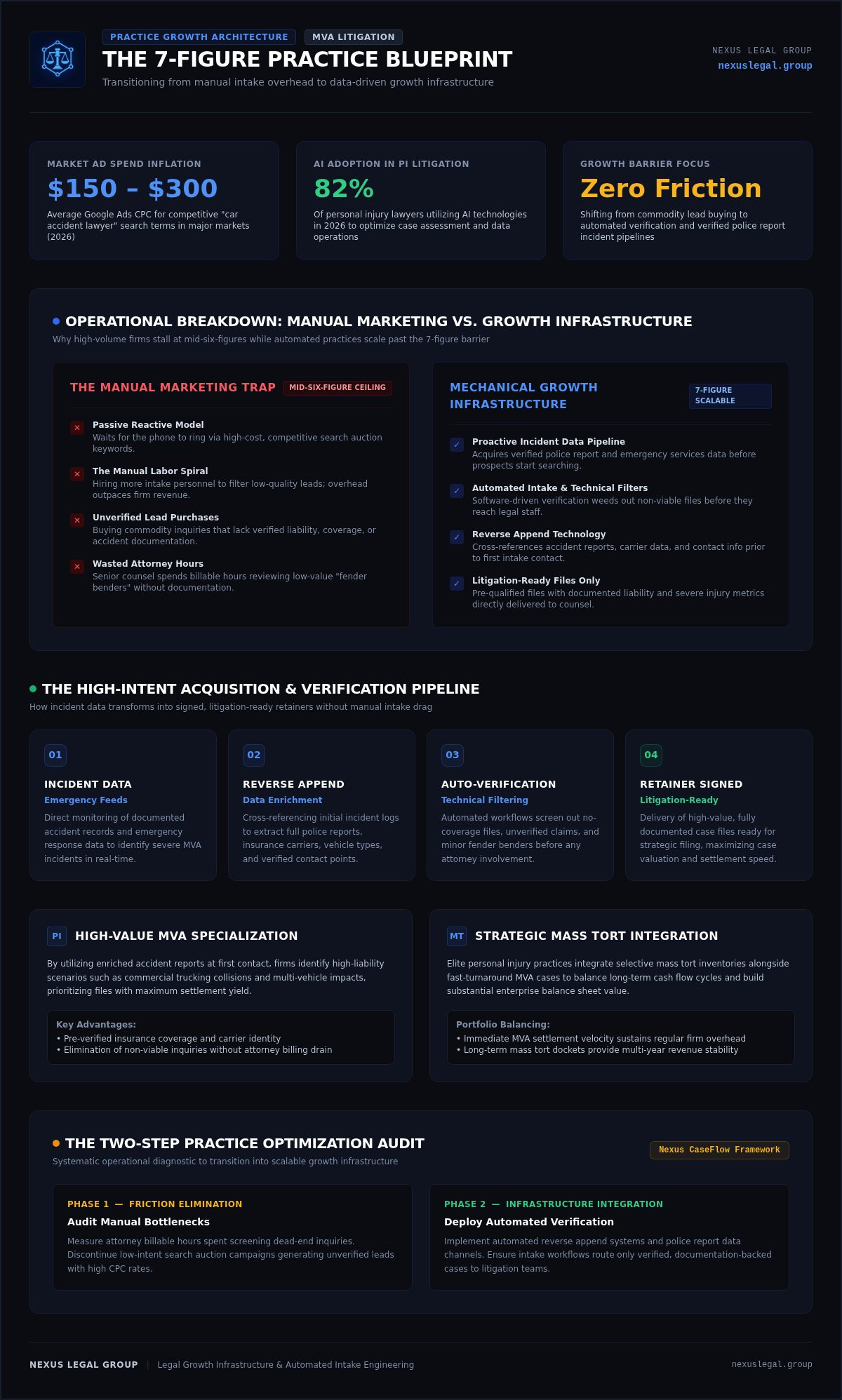
We're going to change that. You'll learn how to transition from manual marketing to a mechanical, data-driven growth infrastructure that scales your practice to predictable 7-figure revenue. By implementing automated verification and leveraging police report data, you can replace friction with a high-performance engine designed for efficiency. This blueprint outlines the exact systems needed to secure exclusive, litigation-ready MVA cases while automating your intake workflows to ensure every lead is verified before it ever reaches your desk.
Key Takeaways
- Identify the structural differences between a high-volume firm and a scalable, data-driven organization to overcome common growth plateaus.
- Learn to leverage police reports and emergency services data to proactively acquire high-intent MVA cases before competitors can react.
- Remove manual intake bottlenecks by deploying automated verification systems that deliver only litigation-ready inquiries to your legal team.
- Understand how strategic mass tort integration supports the process of building a 7-figure personal injury practice by balancing long-term revenue cycles.
- Follow a systematic two-step audit to eliminate operational friction and integrate foundational growth infrastructure like Nexus CaseFlow.
Defining the 7-Figure Barrier in Personal Injury Litigation
Many attorneys confuse a high volume of phone calls with a scalable business model. A busy firm is not necessarily a profitable or sustainable one. While a boutique practice might generate respectable revenue through referrals and local networking, building a 7-figure personal injury practice requires a departure from these manual, unpredictable methods in favor of a mechanical growth engine. The barrier to elite growth isn't usually a lack of effort; it's the absence of systems that can handle increased volume without breaking. Growth infrastructure is the foundational system for law firm scalability that integrates high-intent data acquisition, automated verification, and frictionless intake workflows.
Traditional marketing agencies often fail because they focus on vanity metrics like clicks and impressions rather than signed retainers. They don't understand the unit economics of a modern plaintiff firm. When you rely on broad search campaigns, you often fall into the manual labor trap. This happens when a firm hires more intake staff to process a growing pile of low-quality leads. It's a death spiral where overhead increases faster than revenue. Instead of adding more human filters, elite firms deploy technical ones that eliminate friction before it reaches the legal team.
The Revenue Ceiling: Why Most Firms Stall
Firms often stall at the mid-six-figure mark because they're buried under the cost of low-intent inquiries. In 2026, Google Ads CPC for competitive terms like "car accident lawyer" averages between $150 and $300 in major markets. Paying these rates for inquiries that lack insurance coverage or clear liability is a waste of attorney billable hours. A 7-figure practice requires a shift toward high-intent MVA specialization. Without a predictable case flow, you can't make strategic hires. You're stuck in a reactive cycle, unable to invest in the senior associates or sophisticated law practice management principles needed to manage a larger docket.
Transitioning from Marketing to Infrastructure
Buying leads is a tactical error; it's a commodity purchase that leaves you vulnerable to market fluctuations. Building a system is an investment in a firm asset. With 82% of personal injury lawyers utilizing AI in 2026, the competitive advantage has shifted to those who own their data pipeline. AI-driven precision allows you to identify litigation-ready cases via police report data before a prospect even starts a Google search. This transition is the core of a modern law firm growth infrastructure. By moving away from manual intake and toward automated verification, you ensure that every case on your desk has the highest possible settlement potential.
Engineering High-Intent MVA Case Acquisition Systems
Most firms wait for the phone to ring. This passive approach is a strategic vulnerability. To succeed in building a 7-figure personal injury practice, you must shift toward proactive acquisition. This involves engineering a system that identifies high-value opportunities before a prospect even begins a Google search. By utilizing police reports and emergency services data, firms can bypass the expensive "cost-per-click" auction and focus on individuals with documented, verifiable accidents. This isn't just about finding leads; it's about building a data pipeline that prioritizes litigation-ready inquiries over raw, unverified contact information.
The mechanics of this system rely heavily on reverse append technology. This process allows a firm to take initial incident data and cross-reference it to obtain comprehensive accident reports and contact details of those involved. It eliminates the guesswork that plagues traditional marketing. When you have the police report in hand before the first intake call, you already know the liability, the vehicle types, and the potential insurance carriers involved. Scaling this volume requires a commitment to ethical and compliant lead generation standards, ensuring that every inquiry is obtained through transparent, data-driven methods that protect the firm's reputation.
The Role of Data Enrichment in Case Value
Detailed accident reports dramatically increase the initial valuation of a case. By using incident data to identify high-liability scenarios, such as commercial trucking accidents or multi-vehicle collisions, your team can prioritize files with the highest settlement potential. This level of technical depth is why elite firms transition to police report generated MVA leads. You're no longer wasting time on "fender benders" with no insurance; you're focusing on cases where the data confirms a high probability of recovery. If you want to see how this technical precision can be applied to your intake, exploring high-intent acquisition tools is a logical next step.
Mechanical Scalability: Moving Beyond Referrals
Referral-based growth is a byproduct of quality work, but it isn't a scalable engine. It's inconsistent and depends entirely on the partner's personal network. A 7-figure practice requires a "case flow engine" that operates independently of any single individual. By implementing high conversion MVA leads through behavioral analysis and data enrichment, you create a predictable, recurring revenue stream. This disciplined approach to acquisition mirrors the rigorous procedural structures found in the Legal Information Institute's overview of mass torts, where systemic efficiency is the only way to manage high-volume litigation effectively.
Eliminating Friction with Automated Intake and Verification
Manual intake is the primary bottleneck preventing firms from scaling beyond mid-six-figure revenue. When your staff spends hours every day answering calls, only to find that the majority of inquiries lack insurance coverage or clear liability, you're hemorrhaging billable time. Building a 7-figure personal injury practice requires a transition from human-dependent screening to a technical verification engine. This system works by cross-referencing incoming data against police reports and insurance databases in real time, ensuring that only litigation-ready inquiries ever reach your legal team.
By filtering out non-compensable claims automatically, you reduce your administrative overhead and allow your senior associates to focus exclusively on high-value negotiations. This isn't just about efficiency; it's about speed. Research shows that 67% of prospective personal injury clients state that speed of initial response is the decisive factor in selecting representation. An automated system provides that instant touchpoint, capturing the claimant's interest while their intent is at its peak. This level of organizational precision is essential as you scale, mirroring the structural rigor required by the Judicial Panel on Multidistrict Litigation for managing high-volume federal dockets.
Verification as a Profit Center
Automated vetting transforms your intake department from a cost center into a profit center. AI-driven verification systems can issue e-retainers via SMS within seconds of a qualified inquiry, significantly compressing the time-to-sign. This "controlled urgency" prevents claimants from shopping their case to competitors. Implementing automated intake for plaintiff firms is no longer an optional upgrade; it's a core requirement for any organization that intends to process 100 or more signed MVA cases annually. It ensures that every dollar spent on acquisition is protected by a high-performance conversion filter.
Engineering the Frictionless Claimant Journey
Trust isn't built through marketing slogans; it's built through technical mastery. A claimant who has just experienced a traumatic accident wants a clear, frictionless path to representation. When your intake process is digital, intuitive, and immediate, it instills a sense of security and professional competence. This seamless journey from high-intent inquiry to signed retainer is the hallmark of an elite practice. By partnering with Nexus Legal Group, you can deploy the foundational infrastructure needed to automate these workflows, allowing your firm to scale without the friction of traditional manual intake.
Strategic Diversification: Integrating Mass Torts into Your Practice
Diversification is a hallmark of institutional stability. While MVA cases provide the steady cash flow necessary for daily operations, building a 7-figure personal injury practice often requires the high-reward potential of mass tort litigation to achieve exponential growth. Mass torts act as a hedge against the fluctuations of local MVA markets. They allow a firm to leverage national data pipelines to acquire claimants at scale without the geographic constraints of traditional practice. However, the operational metrics differ significantly. While MVA success depends on rapid intake and medical record velocity, mass tort success is measured by the quality of signed retainers and the firm's ability to manage long-term litigation cycles without exhausting internal resources.
Managing this volume requires a specific type of internal infrastructure. You can't simply dump 500 mass tort claimants into a system designed for 50 MVA cases. It's about building a secondary engine that handles document retrieval and claimant communication through automation. This prevents associate burnout and ensures that your firm remains focused on the strategic posture of the litigation rather than administrative minutiae. By treating mass torts as a separate business unit, you protect your firm's core MVA revenue while building long-term equity. Building a 7-figure personal injury practice requires this level of strategic foresight and operational discipline.
The Mass Tort Growth Engine
Identifying litigation-ready inquiries is the first step in this process. You need a system that qualifies claimants based on specific criteria, such as product usage and documented injury, before they reach your desk. Balancing high-reward mass torts with steady MVA flow creates a resilient revenue model. This dual-track approach ensures your firm isn't vulnerable to cash-flow starvation during long settlement waits. For a deeper look at the mechanics of this process, review our mass tort case acquisition strategy for partners.
Ethical Standards in Mass Tort Acquisition
Compliance is non-negotiable when scaling national claimant generation. As regulations evolve, signed cases have become the gold standard for growth, as they represent a fully vetted and committed claimant. Relying on unverified leads is a liability that can stall your progress and damage your reputation with co-counsel. Firms that prioritize ethical mass tort lead generation ensure every case in their inventory meets the rigorous standards required by national MDL leadership. This disciplined approach to acquisition is what separates elite practices from those simply chasing volume.
Implementing Scalable Growth Infrastructure for 2026
The transition from a boutique firm to a high-performance organization requires a shift from human-centric processes to technical systems. Building a 7-figure personal injury practice isn't an achievement of effort; it's an achievement of engineering. To begin this transformation, you must follow a methodical implementation roadmap designed to eliminate operational friction and maximize case value. The first step involves a comprehensive audit of your current intake and acquisition pipeline. You need to identify exactly where high-intent prospects are lost, whether through delayed response times or a lack of immediate data verification.
Once you've identified these bottlenecks, the next step is to deploy data-driven acquisition tools like Nexus CaseFlow. This system moves your firm beyond passive marketing and into proactive acquisition by utilizing police reports and emergency services data. By the time a prospect considers their legal options, your infrastructure should already have the data necessary to verify liability. This leads to the third step: automating the verification layer. With 82% of personal injury lawyers utilizing AI in 2026, firms that continue to rely on manual screening will find their margins eroded by overhead. Finally, scale your volume by diversifying into mass torts, using the same automated infrastructure to manage high-volume claimant inventories without increasing your headcount.
The 2026 Strategic Roadmap
Firms that ignore AI-driven data will be left behind in a market where speed and precision are the only sustainable competitive advantages. Transitioning from a "firm" to a "high-performance growth engine" requires a commitment to technical mastery. During the first 90 days of infrastructure deployment, your focus should be on systemic integration. In the first 30 days, audit your tech stack and integrate real-time data feeds. By day 60, your automated verification filters should be live, issuing e-retainers to qualified MVA prospects within seconds. By day 90, you should be scaling acquisition volume across both MVA and mass tort channels, ensuring a predictable revenue cycle.
Next Steps for Elite Plaintiff Firms
Evaluating growth infrastructure partners requires a focus on technical mastery rather than marketing fluff. You need a partner that understands the mechanics of "litigation-ready" inquiries, as these are the only leads that provide a true return on investment. Research indicates that AI-assisted intake systems can increase initial-inquiry-to-signed-retainer conversion rates by 40% to 45%. This level of efficiency is the foundational layer for building a 7-figure personal injury practice. It allows you to focus on the practice of law while the infrastructure handles the mechanics of growth.
Engineering Your Firm's Future
The transition from a busy practice to a scalable organization depends on your willingness to replace manual bottlenecks with technical mastery. By integrating police report data and automated verification, you ensure that your intake team focuses only on high-value, litigation-ready inquiries. This shift doesn't just reduce overhead; it provides the consistent case flow necessary for long-term strategic expansion. Building a 7-figure personal injury practice is a matter of deploying the right growth infrastructure to handle the complexities of 2026 and beyond.
Strategic diversification into mass torts further stabilizes your revenue cycle, allowing you to leverage AI-driven marketing precision across multiple litigation channels. Nexus Legal Group provides the end-to-end systems required for elite firms to scale with confidence and ethical compliance. It's time to move beyond the limitations of traditional marketing and embrace a foundational layer built for high-performance growth.
Your firm's next level of success is within reach when you have the right engine driving your acquisition. We look forward to helping you architect a more profitable and efficient future.
Frequently Asked Questions
How long does it take to scale a personal injury practice to 7-figures?
Scaling to 7-figures typically requires 12 to 24 months of consistent high-intent case acquisition and operational refinement. The timeline depends on your firm's ability to reinvest 10% to 20% of gross revenue into growth infrastructure. Building a 7-figure personal injury practice is faster when you move away from manual referrals toward automated systems that deliver litigation-ready cases. This shift ensures your revenue cycle isn't stalled by the 9 to 18 month settlement delay common in MVA matters.
Is automated intake verification ethical for plaintiff law firms?
Automated intake verification is entirely ethical when it adheres to professional responsibility standards and data privacy regulations. These systems act as a technical filter to ensure your firm only engages with claimants who have verifiable injuries and insurance coverage. By utilizing automated verification, you maintain compliance while protecting your team from the ethical risks associated with non-compliant lead aggregators. This technical mastery ensures a higher standard of care for every litigation-ready inquiry your firm accepts.
What is the difference between high-intent inquiries and standard legal leads?
High-intent inquiries are prospects with documented accidents and a clear desire for legal representation; standard leads are often passive clicks from general search terms. High-intent data is enriched with police reports or emergency services details, providing immediate proof of liability and injury. Standard leads frequently lack insurance verification, leading to high rejection rates. Elite firms prioritize high-intent inquiries because they convert at 20% to 35%, significantly outperforming the 2% to 5% conversion seen with shared aggregator leads.
How does police report data improve MVA case acquisition?
Police report data provides a factual foundation for case acquisition by identifying liability, insurance carriers, and participant details before the initial intake call. This data-driven approach allows your firm to target high-value incidents, such as commercial trucking accidents, with clinical precision. By leveraging police reports, you eliminate the guesswork inherent in broad marketing campaigns. This infrastructure ensures your acquisition strategy is built on verifiable incident data rather than unpredictable search engine algorithms or vanity metrics.
Can small firms compete with "big law" using growth infrastructure?
Growth infrastructure allows boutique firms to compete with large-scale organizations by automating the intake and verification processes that typically require massive administrative teams. Smaller practices can achieve high-volume results without the overhead of "big law" by deploying AI-driven precision and data enrichment. Building a 7-figure personal injury practice is no longer restricted to firms with massive budgets. Technical mastery allows you to outmaneuver larger competitors by securing high-intent MVA cases through faster, more efficient digital pipelines.
What are the most profitable mass torts to integrate in 2026?
In 2026, the most profitable mass tort targets include GLP-1 receptor agonists like Ozempic, firefighting foam (AFFF), and chemical hair relaxers. The Judicial Panel on Multidistrict Litigation currently tracks over 205,000 pending civil actions, with GLP-1 cases emerging as a high-volume opportunity for firms with the infrastructure to handle gastroparesis and vision loss claims. Integrating these litigation-ready mass tort inquiries allows your firm to diversify revenue cycles and build long-term settlement equity alongside your steady MVA practice.
How does reverse append technology help in obtaining accident reports?
Reverse append technology allows your firm to take limited incident data, such as a license plate or partial name, and cross-reference it against public and private databases to obtain a full accident report. This process provides the necessary details of all involved parties and insurance carriers automatically. It turns a simple inquiry into a litigation-ready file before an attorney ever reviews it. This technical capability is a foundational component of a high-performance growth infrastructure designed for elite firms.
What infrastructure is needed to handle high-volume mass tort cases?
Handling high-volume mass torts requires a specialized infrastructure that includes automated intake verification, AI-driven document retrieval, and systematic claimant communication tools. You need a platform that can process hundreds of signed cases without increasing your administrative headcount. This infrastructure must also ensure ethical compliance and data integrity throughout the litigation lifecycle. By deploying these mechanical systems, your firm can manage large claimant inventories efficiently, allowing your legal team to focus on the strategic posture of the multidistrict litigation.