Why Is My Law Firm Not Growing? Breaking the Growth Ceiling in 2026
Asking 'why is my law firm not growing' despite high marketing spend? Discover the intake bottlenecks holding you back & build a scalable, data-driven growth...
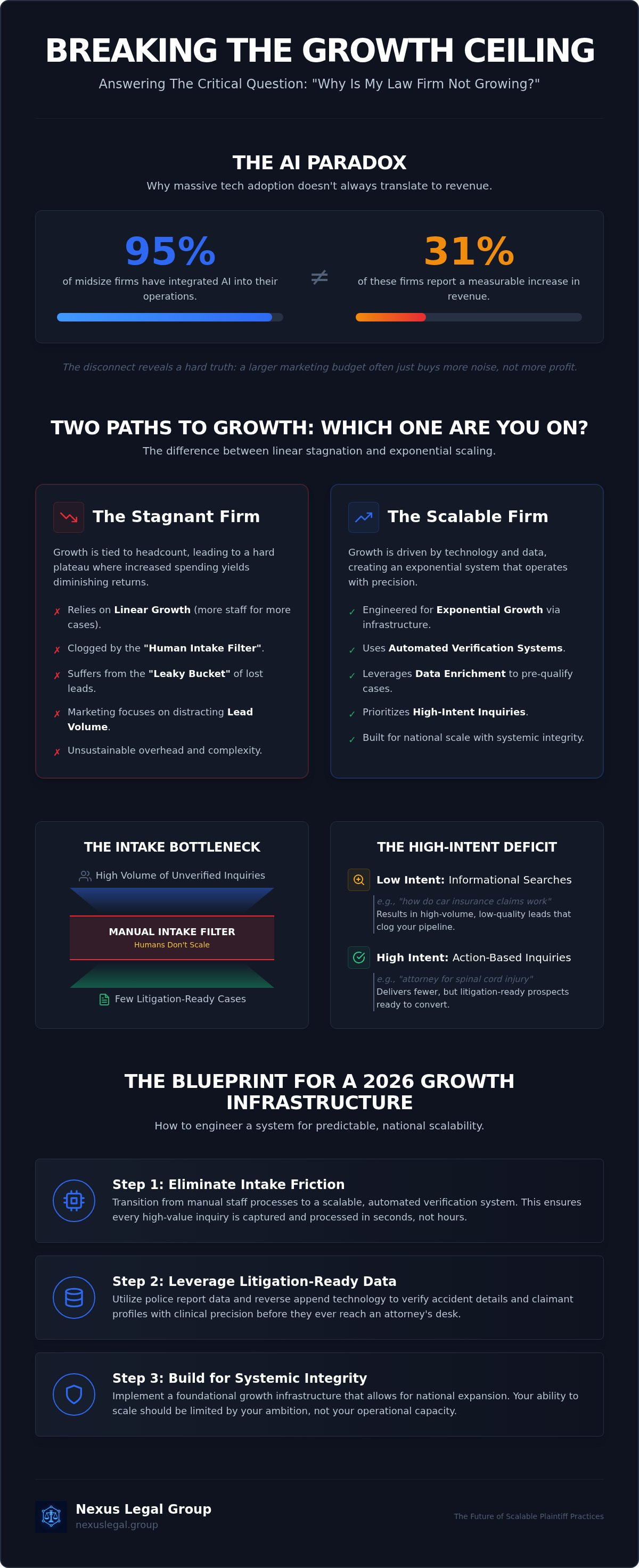
While 95% of midsize law firms have integrated AI into their operations in 2026, only about 31% report a measurable increase in revenue. This disconnect reveals a hard truth for elite plaintiff firms: a larger marketing budget often just buys more noise rather than more profit. If you've hit a ceiling, you're likely asking, "why is my law firm not growing" despite investing heavily in digital marketing and lead generation. The issue isn't your legal expertise; it's a structural gap where manual intake processes leak potential cases and traditional marketing fails to deliver the precision required for national scalability.
You recognize that a sustainable firm requires a predictable, litigation-ready case flow, yet the friction of verifying high-volume inquiries often halts expansion. This guide explores the specific technological and data-driven reasons why elite firms stagnate and how to engineer a growth infrastructure that eliminates intake bottlenecks. We'll examine how automated verification and police-report-driven data enrichment can transform your practice into a high-performance engine. You'll learn to move beyond generic lead acquisition to a model that prioritizes systemic integrity, allowing you to scale nationally without losing operational precision.
Key Takeaways
- Identify the structural dysfunction and manual bottlenecks that answer the persistent question of why is my law firm not growing despite increased marketing spend.
- Distinguish between informational searches and high-intent inquiries to ensure your firm prioritizes litigation-ready prospects.
- Leverage police report data and reverse append technology to verify accident details and claimant profiles with clinical precision.
- Eliminate intake friction by transitioning from manual staff processes to scalable, automated verification systems.
- Implement a foundational growth infrastructure that allows for national expansion without sacrificing systemic integrity.
Beyond the Plateau: Identifying the Structural Barriers to Law Firm Growth
The growth ceiling is not a marketing failure; it's an operational breaking point. It occurs when the friction of manual processes and the influx of low-intent leads exceed your firm's internal capacity. While revenue growth can often mask systemic dysfunction during early scaling phases, these inefficiencies inevitably lead to a hard plateau. If you're currently asking why is my law firm not growing, the answer is likely found in your reliance on linear expansion. Linear growth suggests that to double your case files, you must double your staff. This approach is unsustainable because it increases overhead and complexity at the same rate as revenue. True scaling requires exponential growth driven by a foundational law firm growth infrastructure.
The primary bottleneck for most stagnant firms is the "Human Intake Filter." This is the point where a high volume of unverified inquiries hits a manual staff process. Humans don't scale. They get tired, they miss calls, and they fail to follow up with the clinical precision required to secure elite MVA cases. Identifying these structural barriers to law firm growth is the first step toward engineering a system that operates independently of individual effort. When your growth is tied to headcount, you aren't building a scalable firm; you're building a management nightmare.
The Hidden Cost of Inefficient Case Acquisition
Inefficient intake creates a "leaky bucket" syndrome. You spend thousands on marketing, only to lose high-value MVA cases because your response time lags behind the competition. In 2026, the window to capture a high-intent claimant is measured in seconds, not hours. Chasing unverified inquiries that never sign creates massive operational drag. Every hour your team spends vetting a low-value or non-existent case is an hour stolen from high-stakes litigation. Without data enrichment, your attorneys waste billable hours on administrative vetting that should be handled by a system before the file ever reaches their desk.
Why Traditional Marketing Agencies Fail Elite Firms
Most agencies focus on "lead volume" as their primary success metric. For an elite plaintiff firm, this is a distraction. A thousand clicks don't matter if they don't convert into signed retainers. Traditional SEO and PPC often cast a net that's too wide, capturing people looking for general information rather than those ready to litigate. If you're wondering why is my law firm not growing, it's often because your marketing partner doesn't understand the difference between a lead and a high-intent inquiry. You need a system that prioritizes case acquisition through data-driven precision rather than just visibility.
The High-Intent Inquiry Deficit: Why Traditional Marketing Fails Elite Firms
Traditional digital channels have reached a point of saturation that makes raw lead volume a liability rather than an asset. Law firms are projected to spend approximately $2.9 billion on advertising in 2026, yet many find their conversion rates stagnant. If you're currently asking why is my law firm not growing, you're likely facing the "Intent Gap." This is the fundamental disconnect between a user seeking general information and a claimant ready to litigate. The 2026 Report on the State of the US Legal Market confirms that while demand for legal services is rising, the cost of acquisition is climbing because firms continue to bid on broad, low-intent keywords. Elite firms must pivot from chasing clicks to securing litigation-ready inquiries that have already cleared a high threshold of intent.
The Mechanics of Intent in MVA and Mass Tort
High-intent isn't a vague concept; it's a measurable behavioral state. Curiosity-based searches, such as "how do car insurance claims work," often result in high-volume, low-quality leads that clog your intake pipeline. In contrast, action-based inquiries occur when a claimant exhibits specific behaviors, like searching for "personal injury attorney for spinal cord injury." By utilizing behavioral data analysis, you can identify individuals who are ready to sign a retainer immediately. Prioritizing high conversion MVA leads ensures that your marketing spend is directed toward prospects with the highest probability of settlement. This data-driven approach stabilizes your firm's revenue by eliminating the unpredictability of general SEO and PPC campaigns.
Identifying Qualified MVA Inquiries with Precision
Precision in 2026 requires a clinical assessment of every inquiry before it reaches your staff. A truly qualified inquiry meets three specific criteria: clear liability, verifiable insurance coverage, and documented injury severity. Elite firms must stop treating intake as a sales role and start treating it as a rigorous verification process. This shift prevents your legal team from wasting billable hours on vetting cases that lack the necessary components for successful litigation.
AI now plays a critical role in this process by pre-qualifying leads through automated logic. Instead of a human spending twenty minutes on a screening call, a system can verify incident details and insurance data in seconds. This allows your staff to focus only on the most promising files. If you're still stuck wondering why is my law firm not growing, it's time to integrate high-intent case acquisition into your core operations. Transitioning to a verification-first model ensures that your intake engine is built for precision, not just volume.
Leveraging Litigation-Ready Data: The Role of Accident Reports and Reverse Append Technology
Police reports and emergency services data represent the gold standard of verification in personal injury litigation. Unlike self-reported digital leads, these records provide an objective, third-party account of liability, participant details, and incident severity. If you're struggling to understand why is my law firm not growing, the answer often lies in the lack of this foundational data. Without verified incident reports, your intake team is essentially flying blind, relying on claimant memory which can be unreliable or incomplete. Integrating litigation-ready data allows your firm to transition from a reactive posture to a proactive, data-enriched acquisition model.
The "Reverse Append" process is the technical engine behind this shift. It takes basic incident data, such as a date and location from a police report, and enriches it with comprehensive claimant profiles. This technology provides attorneys with the necessary context to evaluate a case's merit in minutes rather than days. By sourcing ethical and compliant inquiries through these channels, you ensure that every file entering your system has already cleared a rigorous verification threshold. This isn't just about getting more leads; it's about engineering a system where every inquiry is backed by verifiable facts. Data doesn't lie.
Sourcing Police Report Generated MVA Leads
Obtaining accident reports is the first step in moving from "shotgun" marketing to "surgical" case acquisition. By verifying participants and liability at the source, you eliminate the friction of vetting unqualified claimants. This data-driven approach ensures your resources are focused exclusively on high-value MVA cases where liability is clearly established. For a deeper technical analysis of this process, see our guide on police report generated MVA leads.
Data-Driven Case Acquisition for Mass Tort
The same principles of data enrichment apply to mass tort litigation. Verifying usage or exposure through third-party data sources is essential for maintaining high-stakes litigation standards. Automated verification ensures that your firm remains compliant with ethical standards while scaling case volume. If your mass tort volume is flat and you're questioning why is my law firm not growing, the culprit is likely a lack of verifiable exposure data. Implementing data driven case acquisition allows you to identify qualified claimants with clinical precision, reducing the burden on your legal staff and ensuring a high-intent case flow.
Engineering Scalability: Transitioning from Manual Intake to Automated Verification
Manual intake is the structural friction point that halts law firm scalability. When your growth is tied to the number of people answering phones, you've built a linear business model in an exponential market. If you're asking why is my law firm not growing, it's likely because your manual intake process cannot keep pace with the speed of 2026 digital demand. Research indicates that firms on average only respond to 33% of prospective client emails. This delay allows high-value MVA and mass tort cases to decay while staff struggle with unverified, low-intent inquiries.
The Mechanics of Automated Verification
Transitioning to automated intake for plaintiff firms removes the human bottleneck by applying AI-driven logic to every incoming inquiry. These systems filter leads based on specific litigation criteria in real-time, such as liability and insurance limits. For verified, high-intent prospects, the system triggers an "Instant Sign" workflow. This delivers a retainer before a competitor even checks their voicemail. This infrastructure ensures no inquiry goes unanswered, effectively eliminating lead decay.
Reducing Firm Overhead through Systems, Not Staff
Scaling by increasing headcount is an antiquated strategy that drives up operational drag. In 2026, midsize firms are facing intense expense growth, with lawyer salaries up 8.2% and technology spending increasing by 9.7%. Investing in automated verification allows elite practices to stay lean while maintaining clinical precision. The ROI of a scalable system far exceeds the cost of a bloated intake department. If you find yourself still questioning why is my law firm not growing, it's time to shift your investment from staff to systems. By automating the verification layer, your legal team can focus on high-stakes litigation rather than administrative vetting.
Implementing a 2026 Growth Infrastructure: The Blueprint for Scaling Plaintiff Practices
If you're still asking why is my law firm not growing, it's time to stop auditing your marketing agency and start auditing your infrastructure. In 2026, the firms that dominate the market aren't necessarily those with the largest advertising budgets, but those with the most resilient, data-driven systems. Transitioning to a system-driven firm means moving away from the unpredictable "lead-buying" cycle and toward a proprietary growth engine that operates with clinical precision. Nexus Legal Group acts as the strategic architect for this transition, providing the foundational layer required for national scalability and the elimination of operational friction.
The Components of a Modern Case Acquisition Engine
The "Holy Trinity" of modern growth consists of High-Intent Sourcing, Data Enrichment, and Automated Verification. High-intent sourcing ensures you're targeting action-based inquiries rather than curiosity-based searches that waste your staff's time. Data enrichment, specifically through police reports and reverse append technology, provides the objective verification needed to evaluate case merit instantly. Finally, automated verification removes the human bottleneck, ensuring that exclusive inquiries are captured and signed before they decay. This model creates a unified infrastructure that supports both high-volume MVA acquisition and specialized Mass Tort growth simultaneously, allowing your firm to pivot between practice areas without rebuilding its core intake engine.
Next Steps for Elite Plaintiff Firms
To break through your current growth ceiling, you must perform a rigorous audit of your acquisition pipeline. Partners who continue to ask why is my law firm not growing must recognize that the bottleneck is usually an infrastructure that lacks technical integration. Follow this checklist to identify where your current model fails the 2026 standard:
- Audit your response times; any inquiry not contacted within 60 seconds in the current digital landscape is a lost opportunity.
- Identify the percentage of unverified or low-intent leads currently hitting your manual intake staff.
- Evaluate whether your current lead sources provide exclusive, litigation-ready data or shared, recycled inquiries.
- Transition your marketing spend toward compliant legal lead generation that prioritizes data enrichment.
Your firm's ability to scale depends entirely on the integrity of your underlying systems. If your current acquisition model relies on manual vetting and inconsistent lead quality, you'll remain stuck in a cycle of diminishing returns. Evaluate your infrastructure against these standards to determine if you're built for expansion or merely surviving the status quo. We invite you to explore Nexus Legal Group's specialized acquisition services to begin engineering a scalable, litigation-ready case flow that defines the elite practice of 2026.
Engineering Your Firm's Future: Scaling Beyond the 2026 Growth Ceiling
The transition from a marketing-dependent firm to a system-driven powerhouse is the only viable path to national scalability in 2026. By replacing manual intake bottlenecks with automated verification and prioritizing high-intent inquiries over raw lead volume, you eliminate the operational friction that answers the persistent question of why is my law firm not growing. Leveraging data-enriched sources like police reports ensures your team focuses exclusively on litigation-ready cases with clear liability and verified insurance coverage.
Implementing this end-to-end growth infrastructure allows you to maintain a lean, high-performance organization while expanding your reach into MVA and Mass Tort litigation. You've been provided the blueprint to move beyond the plateau and establish a predictable case flow that drives long-term revenue. Success in this landscape requires technical mastery and a commitment to systemic integrity.
Your firm is positioned for the next tier of professional excellence. With these foundational systems in place, your potential for expansion is limitless.
Frequently Asked Questions
Why is my law firm marketing not resulting in signed cases?
Marketing often fails when it prioritizes visibility over high-intent acquisition. If you're asking why is my law firm not growing, the culprit is usually the "Intent Gap." Many campaigns capture curiosity-based searches rather than action-oriented inquiries. Without a system to filter these leads, your team spends time vetting people who aren't ready to litigate. Success requires a shift toward litigation-ready data enrichment to ensure every lead has a high probability of conversion.
What is the difference between a lead and a litigation-ready inquiry?
A lead is merely raw contact information from someone who expressed interest. In contrast, a litigation-ready inquiry is a verified prospect backed by objective data, such as a police report or emergency services record. These inquiries have already cleared critical thresholds like liability and insurance coverage. By focusing on litigation-ready prospects, firms eliminate the friction of manual vetting and ensure their intake engine targets cases with high settlement potential.
How can I scale my MVA practice without hiring more intake staff?
Scaling without increasing headcount requires transitioning from manual intake to an automated verification infrastructure. AI-driven systems can screen inquiries in real-time based on your specific litigation criteria. This removes the "Human Intake Filter" bottleneck. Instead of hiring more staff to handle volume, you implement a system that triggers "Instant Sign" workflows for qualified cases. This allows your firm to remain lean while managing a national case flow with clinical precision.
Is automated case verification ethical and compliant?
Yes, automated verification is ethical and compliant when it utilizes legitimate data sources and adheres to state-level privacy regulations. By using police reports and reverse append technology, firms ensure they are contacting individuals involved in documented incidents. This data-driven approach is often more compliant than broad-spectrum digital marketing because it relies on objective records. It's essential to partner with a provider that prioritizes ethical sourcing and maintains rigorous data standards.
What role does police report data play in modern case acquisition?
Police report data serves as the foundational layer for high-intent MVA case acquisition. It provides an objective account of liability, participant details, and injury severity that self-reported leads cannot match. By integrating this data, firms can verify the merits of a case before the first phone call is made. This surgical approach reduces lead decay and ensures your marketing spend is directed toward claimants who are statistically more likely to result in a signed retainer.
How do I identify the specific bottleneck in my firm's growth?
Identifying the bottleneck starts with auditing your conversion rates from inquiry to signed case. If your volume is high but retainers are low, the issue is likely lead quality or manual intake friction. If you're wondering why is my law firm not growing, track your response times and the percentage of unverified leads hitting your staff. A bottleneck exists wherever human effort is required to perform tasks that can be handled by automated data enrichment.
Why is the Cost Per Acquisition (CPA) rising for personal injury firms?
CPA is rising because traditional digital channels like SEO and PPC are saturated with firms bidding on the same broad keywords. In 2026, law firm advertising spend is projected to reach $2.9 billion, driving up click costs for everyone. To lower your CPA, you must move away from "shotgun" marketing. Transitioning to a model based on police report generated leads allows for higher precision, reducing the waste associated with broad, low-intent digital campaigns.
What is 'growth infrastructure' for law firms?
Growth infrastructure is an end-to-end system that integrates high-intent sourcing, data enrichment, and automated verification into a single engine. It isn't just a website or a CRM; it's the foundational layer that allows a firm to scale nationally without sacrificing operational precision. This infrastructure eliminates the unpredictability of traditional marketing by creating a predictable, litigation-ready case flow. It's the technical framework that enables elite firms to drive revenue growth through systems rather than headcount.