Verified Intake for Trial Lawyers: Engineering High-Intent Growth Infrastructure
Stop losing high-value cases. Learn how verified intake for trial lawyers transforms your firm's growth with a data-driven, automated client acquisition engine.
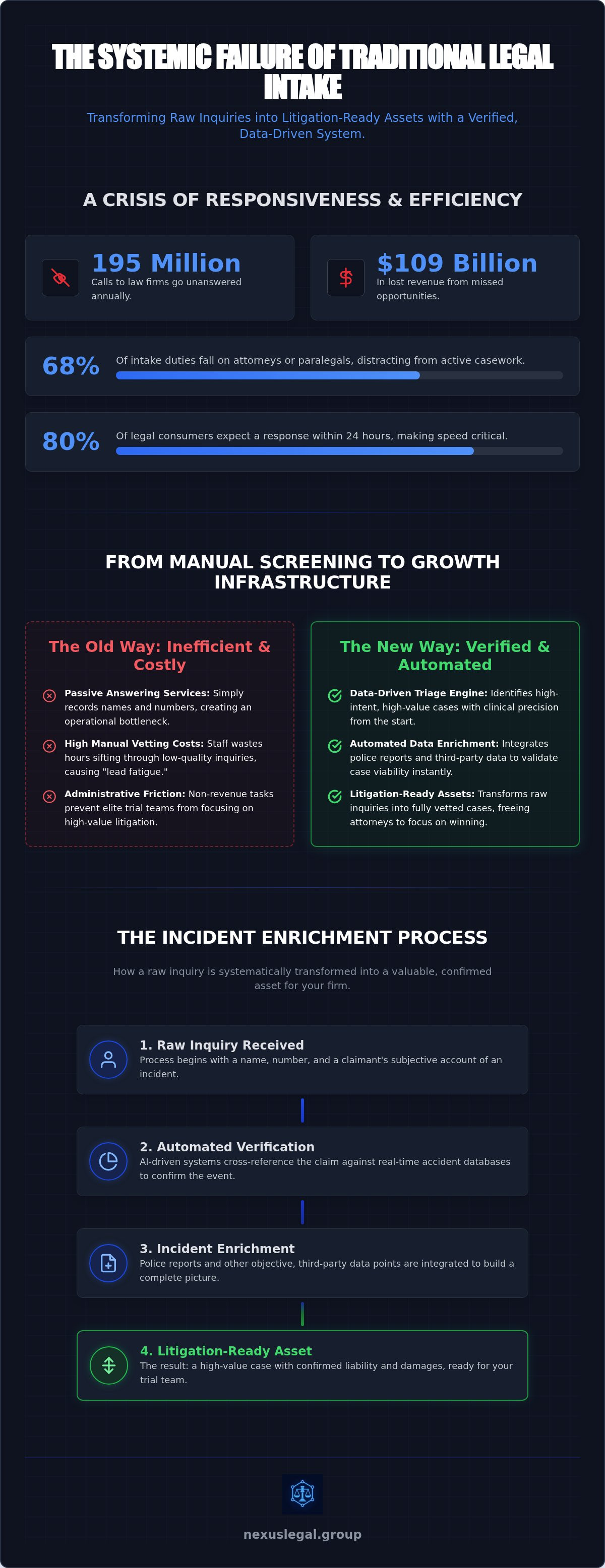
Did you know that an estimated 195 million calls to law firms go unanswered every year, resulting in a staggering $109 billion in lost revenue? It's a sobering reality for many firms where 68% of intake duties still fall on attorneys or paralegals who are already managing heavy active casework. You likely feel the strain of high manual vetting costs and the sting of losing high-value motor vehicle accident cases to faster competitors. Since nearly 80% of legal consumers expect a response within 24 hours, an inefficient intake process is a structural liability that your firm can't afford.
This article provides the blueprint to solve these inefficiencies by implementing verified intake for trial lawyers. You'll learn how to transform raw inquiries into litigation-ready assets by building a data-driven growth infrastructure that eliminates administrative friction. We'll examine the specific mechanics of automating case acquisition to lower your overhead and significantly increase your conversion rates from initial inquiry to signed retainer. We're moving beyond simple lead generation to show you how to treat your intake as a high-performance engine for firm scalability.
Key Takeaways
- Shift from passive answering services to a sophisticated data-driven triage engine that identifies high-intent cases with clinical precision.
- Implement verified intake for trial lawyers to integrate police reports and reverse append technology, securing critical accident details at the point of first contact.
- Eliminate administrative friction and human bias by replacing manual screening processes with a scalable, automated growth infrastructure.
- Transform raw inquiries into litigation-ready assets, allowing elite trial teams to focus on high-value casework rather than administrative vetting.
- Audit existing intake funnels to identify data gaps and deploy technical solutions that ensure a high-performance, end-to-end acquisition engine.
The Systemic Failure of Traditional Legal Intake
Traditional legal intake is fundamentally broken. Most firms treat the initial point of contact as a peripheral administrative task, often outsourcing it to basic answering services that do little more than record names and phone numbers. This approach creates a massive operational gap that stalls firm expansion. Verified intake for trial lawyers is not a passive recording tool; it's a high-performance, data-driven triage engine designed to identify high-intent litigation assets before they ever reach your desk. By treating intake as a foundational layer of your growth infrastructure, you move away from the chaos of raw lead volume and toward a system of clinical precision.
The industry is currently facing a crisis of responsiveness. Statistics show an industry benchmark where 57% of prospective clients never receive a return call from the firms they contact. This failure isn't usually due to a lack of effort, but a lack of systems. When your high-value trial teams are bogged down by manual vetting and administrative tasks, they can't respond with the speed required in a competitive market. Transitioning to a sophisticated Legal technology (Legal Tech) framework allows you to automate the initial qualification process, ensuring that only the most viable cases move forward while eliminating the noise that distracts your staff.
The High Cost of Unverified Lead Volume
High-volume firms often fall into the trap of chasing lead quantity over lead quality. This creates an immense overhead burden as intake staff spend hours manual screening inquiries that lack the necessary criteria for a signed retainer. Over time, this results in "lead fatigue," a condition where staff members become desensitized to new inquiries because they expect them to be low-value or unqualified. This fatigue leads to slower response times and missed opportunities for high-value motor vehicle accident (MVA) cases. Administrative friction is the cumulative operational resistance caused by manual, non-revenue-generating tasks that prevent high-value trial teams from focusing on case litigation.
Regulatory Shifts and Attorney Responsibility
The landscape of case acquisition is shifting toward greater transparency and accountability. In 2026, attorneys are held to a higher standard regarding the methods used to acquire clients. You can't simply outsource your growth to third parties without oversight. Ethical and compliant legal lead generation has become a non-negotiable standard for elite firms. By implementing an automated, verified system, you ensure that every case entering your funnel meets rigorous compliance standards. This technical mastery doesn't just drive growth; it provides a layer of institutional security that protects your firm's reputation while you scale operations.
The Mechanics of Automated Verification and Data Enrichment
Effective verified intake for trial lawyers requires a fundamental shift from simple data collection to what we define as "Incident Enrichment." This process involves the clinical addition of objective, third-party data points to a raw inquiry, transforming a basic name and number into a litigation-ready asset. Instead of relying solely on a claimant's subjective account, a sophisticated growth infrastructure validates the core facts of an incident through technical integration with external databases. This ensures that your firm spends its resources only on cases with confirmed liability and damages.
AI-driven marketing precision plays a critical role in this ecosystem. By analyzing high-intent signals and behavioral patterns, these systems identify potential claimants before they even reach out to a firm. This proactive approach allows for a more controlled acquisition funnel where the quality of the inquiry is pre-qualified by the system's logic. When an inquiry does arrive, the infrastructure immediately begins the verification process, cross-referencing the submission against real-time accident data to confirm the event's occurrence and severity.
Leveraging Real-Time Incident Data
The integration of emergency services data provides a technical baseline of accuracy that traditional lead generation cannot match. By utilizing police report generated MVA leads, firms gain access to verified details such as the exact time of the collision, the responding agency, and initial fault assessments. This level of detail is essential for rapid response. Speed-to-lead is a critical metric, but it only delivers value when paired with data accuracy. A firm that calls a lead back in seconds with the police report already in hand possesses a significant psychological and strategic advantage over competitors who are still asking basic screening questions.
Reverse Append and Participant Detail Sourcing
Reverse append technology is the mechanical engine that fills the "data gaps" common in initial inquiries. If a potential client provides only a phone number or a partial vehicle description, the system uses reverse append protocols to match that fragment against comprehensive accident records. This process secures participant details, insurance carrier information, and official accident reports without requiring the claimant to provide them manually. This level of technical mastery eliminates the administrative friction often found in the "last mile" of case acquisition. By automating this vetting, you can examine how sophisticated infrastructure scales your firm without increasing your internal headcount. Securing these details early allows your trial team to perform a rigorous pre-litigation analysis before the initial consultation even begins.
Manual Screening vs. AI-Driven Growth Infrastructure
The transition from manual screening to an AI-driven model isn't just a technical upgrade; it's a structural necessity for firms aiming for clinical precision. Traditional human-led call centers are inherently limited by cognitive bias and operational fatigue. When an intake specialist manually qualifies a lead, they're susceptible to subjective interpretation, which often leads to inconsistent data and missed opportunities for high-value Motor Vehicle Accident (MVA) cases. Standardized logic wins. By contrast, verified intake for trial lawyers applies a rigorous, algorithmic framework to every inquiry, ensuring that case qualification is based on objective data points rather than human intuition or varying levels of staff experience.
This shift represents a move from simply "qualifying leads" to "acquiring litigation-ready inquiries." In a litigation-ready model, the infrastructure doesn't just ask questions; it verifies the answers against external datasets in real time. This eliminates the "wait-and-see" period that often plagues manual vetting processes. You aren't just looking for someone who says they were in an accident; you're securing inquiries where the incident, liability, and potential damages are already technically confirmed through incident enrichment. This level of technical mastery allows your firm to move from inquiry to signed retainer with unprecedented speed and certainty.
Operational Efficiency and Overhead Reduction
Scaling a firm traditionally required a linear increase in staff, which directly erodes profit margins and increases administrative overhead. Automated legal intake verification breaks this dependency by handling the high-volume vetting process so you don't need large, unskilled intake departments. This reduction in administrative friction allows your senior trial attorneys to focus on high-value litigation tasks rather than manual data entry or lead chasing. AI-driven systems provide a foundational layer for firm growth by decoupling case volume from headcount expansion, ensuring that your operational costs remain stable even as your case acquisition scales.
Precision in High-Intent Case Acquisition
"High-Intent" is defined through a combination of behavioral data and automated triage at the point of first contact. By analyzing how a user interacts with digital touchpoints, the system identifies claimants who are actively seeking legal resolution rather than just browsing information. This data-driven approach ensures that verified intake for trial lawyers remains the gold standard for ethical and compliant growth. Integrating high conversion MVA leads into this infrastructure allows you to capitalize on these behavioral trends with surgical accuracy. This level of technical mastery ensures that your funnel is filled with inquiries that have a high probability of converting into high-value signed retainers, so you're always focusing on the most viable cases.
Implementing a High-Intent Intake Framework
Implementing a verified intake for trial lawyers requires a methodical approach to technical integration. You can't just bolt on a tool; you must engineer a system that replaces manual guesswork with data-backed certainty. This framework moves your firm away from the unpredictability of raw lead volume and establishes a foundational layer for scalable growth. By following a structured implementation path, you ensure that every inquiry is treated with clinical precision from the moment of first contact.
The process begins with a rigorous audit of your existing friction points. You need to identify where data gaps occur and why inquiries fail to convert. Once these gaps are identified, the following steps establish a high-performance acquisition engine:
- Integrate automated verification: Deploy validation tools at the point of first contact to screen out noise immediately.
- Implement data enrichment: Connect your funnel to real-time incident and police report feeds to validate case facts.
- Establish a triage engine: Use automated logic to vet cases against your firm's specific litigation criteria.
- Transition to a signed-case model: Move your focus from lead volume to acquiring litigation-ready inquiries that are ready for a retainer.
This systematic transition eliminates the administrative friction that prevents trial teams from focusing on their primary casework. By automating the vetting process, you create a seamless flow from initial inquiry to signed case.
Engineering the Pre-Litigation Triage Engine
Setting specific qualification parameters is the key to a successful triage engine. For MVA cases, these parameters should include vehicle damage severity and insurance carrier identification. For Mass Tort, focus on specific exposure markers and medical history data points. Once an inquiry meets these technical thresholds, the system should trigger an automated hand-off to your litigation team. This ensures that high-value cases are prioritized without the delays inherent in manual reviews. You can explore the technical requirements for this in our guide on automated intake for plaintiff firms.
Compliance and Ethical Standards Integration
Technical mastery also provides a robust framework for ethical compliance. In a regulatory environment that demands attorney accountability, automated systems maintain an immutable audit trail for every case acquisition. This transparency ensures your firm meets national ethical standards for marketing and data privacy. A critical instructional tip: always verify the primary data source for every signed case to ensure the integrity of your acquisition funnel. This level of systemic integrity is what separates elite firms from those reliant on traditional, unverified lead generation.
Nexus Legal Group: Growth Infrastructure for Elite Firms
Nexus Legal Group functions as a strategic architect for law firm expansion, providing the foundational layer necessary for national scalability. While many firms settle for fragmented marketing efforts, elite plaintiff practices require a cohesive system that drives growth with clinical precision. Our approach to verified intake for trial lawyers involves an end-to-end CaseFlow model that manages the entire lifecycle of an inquiry, from initial digital engagement to technical verification. This is the difference between simply generating leads and engineering a high-performance acquisition engine that delivers consistent, high-intent results.
We position ourselves as a partner for firms that have outgrown traditional lead generation models. By integrating automated verification into your core workflow, we eliminate the administrative friction that prevents trial lawyers from doing what they do best: litigating cases. This institutional model ensures that every case entering your firm is backed by verified data, providing a sense of security through technical mastery. Our infrastructure isn't a peripheral tool; it's the engine that powers your firm's expansion.
Beyond Lead Generation: Litigation-Ready Assets
The inquiries delivered through our infrastructure are pre-litigated with a level of clinical precision that manual systems can't replicate. We don't just provide contact information; we deliver litigation-ready assets that include verified accident data and preliminary liability assessments. One of the primary advantages of this model is the inclusion of detailed accident reports alongside signed cases, allowing your team to skip the time-consuming process of manual sourcing. This level of technical mastery ensures that your firm is always working with the highest quality data from the outset. You can explore our high-intent MVA case acquisition services to see how this data-driven approach transforms your bottom line.
Engineering Your Firm’s Future Growth
Investing in growth infrastructure yields long-term benefits that far outweigh the temporary spikes of one-off marketing campaigns. An institutional model of case acquisition provides a stable, predictable path for firm expansion by decoupling your growth from administrative overhead. When you move away from manual vetting, you're not just saving time; you're building a scalable engine that supports your firm's long-term vision. Getting started requires a shift in perspective from viewing intake as a task to viewing it as a strategic asset. Contact Nexus Legal Group to scale your practice and implement a high-intent framework that drives elite results.
Scaling Your Firm Through Technical Mastery
Transitioning to an institutional model of case acquisition is a fundamental requirement for firms that want to remain competitive in a high-speed market. You've seen how verified intake for trial lawyers removes the administrative friction that leads to missed opportunities and wasted overhead. By integrating AI-driven marketing precision with ethical and compliant lead generation, you secure exclusive, litigation-ready MVA and Mass Tort inquiries that are ready for immediate action.
This systemic shift allows your trial team to focus on high-value litigation while the infrastructure handles the complexities of data enrichment and incident verification. It's about building a foundational layer that supports national scalability without the need for bloated intake departments. You now have the blueprint to transform raw inquiries into confirmed assets through clinical precision and technical mastery. It's time to move beyond the unpredictability of traditional lead generation.
The future of your firm depends on the systems you build today. Start engineering your growth engine now to secure your position at the top of the market and drive sustainable expansion.
Frequently Asked Questions
What is verified intake for trial lawyers?
Verified intake for trial lawyers is a sophisticated, data-driven triage engine that transforms raw inquiries into litigation-ready assets through technical verification. Instead of a simple answering service, it functions as a foundational layer of your growth infrastructure. The system automatically validates incident details against third-party datasets like police reports and emergency services logs. This process ensures that your firm only allocates resources to cases with confirmed liability and significant damage potential.
How does automated verification reduce law firm overhead?
Automated verification reduces overhead by eliminating the administrative friction associated with manual lead vetting. You don't need large, unskilled intake departments when an algorithmic framework handles the initial screening. This shift allows your senior trial team to focus on high-value casework rather than chasing unqualified leads. By decoupling firm growth from headcount expansion, you maintain stable operational costs while significantly increasing your conversion rates from initial inquiry to signed retainer.
Can AI-driven intake handle complex mass tort cases?
AI-driven intake is specifically engineered to manage the complexities of mass tort litigation. The growth infrastructure applies precise logic to screen inquiries based on specific exposure markers and injury criteria. This automated triage ensures that every inquiry meets the rigorous standards required for your mass tort docket. By using technical mastery to qualify high-intent claimants, the system provides a scalable solution for firms seeking to expand their national mass tort practice without increasing administrative burden.
Is automated case acquisition ethical and compliant?
Automated case acquisition is both ethical and compliant when built on a transparent growth infrastructure. The system maintains an immutable audit trail for every inquiry, ensuring that your firm meets national ethical standards for attorney marketing. By utilizing objective data sources like police reports, you eliminate the risks associated with unverified lead generation. This technical mastery provides a layer of institutional security, protecting your firm's reputation while driving consistent, high-intent case growth.
What data points are used in incident enrichment for MVA cases?
Incident enrichment for motor vehicle accident cases utilizes several clinical data points to validate a claim. These include real-time emergency services data, responding agency identifiers, and initial fault assessments found in police reports. The system also captures participant details and insurance carrier information through technical integration. By securing these facts at the point of first contact, the infrastructure provides your trial team with a comprehensive pre-litigation analysis before the initial consultation even begins.
How does reverse append technology help in case acquisition?
Reverse append technology functions as the mechanical engine that fills data gaps in raw inquiries. It allows the system to match a fragment of information, such as a phone number or vehicle description, against comprehensive accident records. This process secures the full accident report and participant details without requiring manual input from the claimant. It's a critical component of verified intake for trial lawyers that ensures your inquiries are enriched with objective, third-party data.
What is the difference between a lead and a litigation-ready inquiry?
The primary difference lies in the level of technical verification and data enrichment. A lead is often just a raw name and number with a subjective account of an incident. A litigation-ready inquiry is a verified asset where liability, damages, and insurance coverage have been technically confirmed. Our growth infrastructure transforms leads into these high-value inquiries by applying incident enrichment protocols, ensuring that your firm only spends time on cases that are ready for a signed retainer.
How do police reports improve the quality of law firm intake?
Police reports improve intake quality by providing an objective, third-party account of the incident. They offer verified details such as the exact collision time and responding agency, which are essential for rapid response and accurate vetting. By integrating police report data into your intake funnel, you reduce reliance on subjective claimant statements. This data-driven approach ensures that liability is technically confirmed early in the process, allowing your firm to prioritize high-value MVA cases with certainty.