Strategic Law Firm Intake Efficiency Tools: Engineering High-Intent Case Flow
Discover law firm intake efficiency tools that automate case verification. Stop losing leads and reduce costs with our guide to engineering high-intent case ...
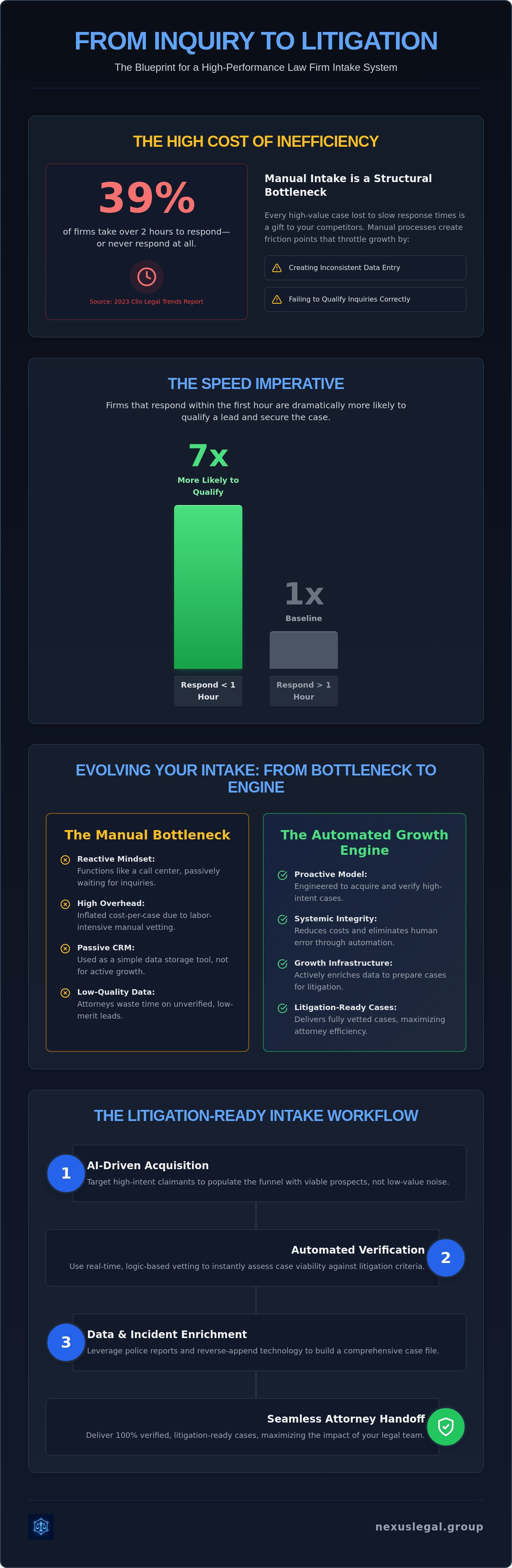
Did you know that 39% of law firms take more than two hours to respond to online inquiries, or simply never respond at all? This operational lag isn't just an administrative oversight; it's a structural failure that allows high-value cases to evaporate before they ever reach an attorney. You likely recognize that manual vetting processes and inconsistent data from lead providers are driving up your overhead and diluting your firm's growth potential. To compete at an elite level, you need more than a receptionist. You need advanced law firm intake efficiency tools that function as a precision-engineered growth engine for your practice.
By utilizing AI-driven business automation from Memphis Web Solutions, firms can deploy AI receptionists and lead desks to manage these interactions 24/7, ensuring no high-value inquiry is lost to slow response times.
In this guide, you'll discover how top-tier plaintiff firms utilize automated verification and data enrichment to secure high-intent MVA and mass tort cases with clinical accuracy. We'll show you how to implement a system that delivers 100% automated verification of incident data, effectively reducing your cost-per-signed-case while ensuring a seamless transition from initial inquiry to active litigation. From leveraging police report data to deploying reverse-append technology, we're outlining the exact infrastructure required to eliminate friction and transform your intake department into a high-performance asset.
Key Takeaways
- Shift your focus from manual vetting to a data-driven model that prioritizes the conversion ratio of inquiries to litigation-ready cases.
- Discover how to implement advanced law firm intake efficiency tools that replace manual vetting with automated, high-intent verification systems.
- Understand why a standard CRM often acts as a passive storage tool and how to transition toward a proactive growth infrastructure.
- Learn to leverage police reports and emergency services data to verify MVA incidents with 100% accuracy before an attorney gets involved.
- Deploy a multi-phase workflow that uses reverse-append technology to enrich lead data, ensuring every inquiry is fully prepared for immediate litigation.
The Economics of Inefficiency: Why Manual Intake Stalls Firm Growth
Intake efficiency is best defined as the surgical ratio of raw inquiries to verified, litigation-ready cases. Many firms operate under the delusion that a high volume of phone activity equates to growth. In reality, manual vetting processes often act as a structural bottleneck that throttles firm-wide ROI. Every hour a staff member spends manually cross-referencing basic incident details is an hour stolen from high-value legal strategy. This labor-intensive approach creates a high overhead that directly inflates your cost-per-signed-case. To understand how these systems fit into the broader industry shift toward digital-first frameworks, this Legal technology overview provides essential context on the evolution of firm operations.
Traditional plaintiff firm models frequently suffer from lead leakage at multiple friction points. These include slow response times, inconsistent data entry, and the failure to qualify inquiries against strict litigation criteria. Transitioning from a reactive, call-center mindset to a proactive data-acquisition model is the only way to secure a competitive advantage. By deploying advanced law firm intake efficiency tools, you replace human error with systemic integrity. This ensures that your firm isn't just "taking calls" but is instead engineering a consistent flow of high-intent cases.
Transitioning to these digital-first models also necessitates a high level of staff proficiency; for example, a digital confidence coach NZ can provide the training needed to help your team communicate effectively and navigate new technology with ease.
Quantifying the Opportunity Cost of Slow Intake
Speed to lead is the primary determinant of acquisition success in the modern legal market. Data shows that firms responding to an inquiry within one hour are seven times more likely to qualify that lead than those that wait. In the competitive landscape of 2026, manual friction is effectively a gift to your competitors. When your intake team is bogged down by manual data entry, high-value claimants move to the next firm in their search results. True scale becomes impossible when your growth is tethered to administrative headcount rather than automated law firm intake efficiency tools.
The Quality Gap: Inquiries vs. Litigation-Ready Cases
The true drain on a firm's resources isn't just the leads you lose; it's the low-quality inquiries you keep. Senior partners often find their schedules cluttered with unverified leads that lack the necessary incident data to move forward. Establishing a baseline for litigation-readiness requires moving beyond basic contact information. You need verified incident data, such as Police Report Generated MVA Leads, to ensure your attorneys only touch cases with high merit. Without automated verification, your intake process remains a passive filter instead of a precision-engineered growth engine.
Core Law Firm Intake Efficiency Tools for 2026
The transition from a manual intake desk to a precision-engineered growth engine requires a shift in the underlying technology stack. While many firms rely on basic software, elite organizations implement a comprehensive suite of law firm intake efficiency tools designed to prioritize litigation-readiness over simple contact volume. This infrastructure begins with AI-driven marketing precision, which targets high-intent claimants before they reach a general search engine. By focusing on intent-based acquisition, firms ensure that the intake funnel is populated with viable prospects rather than low-value noise. To better understand how these advanced systems fit into a wider strategy of enterprise transformation, you can visit IntellifyAi and explore the latest in agentic AI and intelligent automation.
A secure, cloud-based infrastructure serves as the foundational layer for this process. It facilitates seamless data mobility, allowing incident data to flow from the moment of impact to the attorney's desk without manual intervention. This connectivity is essential for maintaining a competitive response time while ensuring data integrity remains uncompromised across the entire case lifecycle. For firms looking to overhaul their current systems, exploring a dedicated growth infrastructure is often the first step toward achieving operational excellence.
Automated Verification: The Filter for Elite Firms
Traditional screening methods rely on staff members to ask a scripted series of questions. This is inefficient and prone to human error. Automated verification systems replace this manual friction with real-time vetting. These tools use pre-defined logic to assess whether a claimant meets specific litigation criteria the moment they engage. By automating the initial assessment of case viability, you drastically reduce administrative overhead. This allows your team to focus exclusively on high-intent claimants who have already passed a rigorous, system-level validation process.
Data Enrichment via Reverse Append Technology
Speed is irrelevant if the data is incomplete. Competitors often rush to call a lead with only a name and phone number, leading to wasted time and unproductive inquiries. Advanced law firm intake efficiency tools utilize reverse append technology to solve this. This process takes a single data point and automatically cross-references it against police report data and emergency services records. The result is a comprehensive accident profile that includes participant details, vehicle information, and incident specifics. When an inquiry reaches your desk, it's a litigation-ready package that provides everything needed to move forward immediately.
CRM vs. Growth Infrastructure: Selecting the Right Framework
A standard Customer Relationship Management (CRM) platform is essentially a passive repository. It excels at recording historical interactions and organizing contact lists, but it lacks the active mechanics required to drive firm expansion. In contrast, a growth infrastructure model functions as an operational engine that proactively sources and verifies inquiries. When you're comparing law firm intake efficiency tools, it's vital to look beyond storage capabilities. You need a framework that actively engineers the transition from a raw lead to a litigation-ready case.
Evaluating these systems based on their ability to deliver high-intent inquiries is the only way to ensure a positive ROI. If a tool doesn't integrate automated verification or police report data directly into the intake workflow, it's likely contributing to administrative bloat. Elite plaintiff firms avoid point solution fatigue by opting for integrated systems that handle end-to-end acquisition. This systemic integration prevents the friction that occurs when staff must manually transfer data between disconnected platforms. By centralizing the acquisition and vetting stages, you create a foundational layer that supports consistent, scalable growth.
The Limitations of Point Solutions in High-Volume Intake
Standalone tools, such as generic chat widgets or isolated transcription software, often lead to fragmented data silos. In the context of Mass Tort and MVA litigation, where incident details are paramount, these silos represent a significant risk. If your intake team has to piece together a case profile from three different tools, lead leakage is inevitable. You don't just need more software; you need a unified system that maintains data integrity. Prioritizing a holistic system ensures that every inquiry arrives as a complete, verified data package, allowing your attorneys to move straight into litigation without delay.
Defining Growth Infrastructure for Plaintiff Practices
Growth infrastructure represents the foundational layer of a modern, tech-enabled law firm. It's the architecture that allows a practice to scale its MVA and Mass Tort acquisition strategies without a corresponding increase in overhead. By utilizing advanced law firm intake efficiency tools, this model automates the vetting process and enriches inquiries with real-time incident data. For a deeper look at this model, see our guide on law firm growth infrastructure. This approach transforms intake from an administrative burden into a precision-engineered growth engine that delivers high-intent cases with clinical precision.
Implementing a Litigation-Ready Intake Workflow
Implementing a litigation-ready workflow requires a departure from traditional first-call metrics toward a focus on total data depth. This four-phase progression ensures that your team isn't just qualifying leads but is instead preparing cases for immediate action. By integrating advanced law firm intake efficiency tools into each stage, you eliminate the administrative gaps that typically lead to case attrition. This structured approach transforms intake from a simple reception desk into a sophisticated gateway for high-value litigation.
Sourcing Incident Data with Precision
Phase one centers on deploying high-intent acquisition channels that provide a factual baseline for every inquiry. Rather than relying on self-reported data from claimants, elite firms prioritize police report generated MVA leads to ensure absolute accuracy. Phase two involves the immediate application of real-time automated verification to enrich this incident data. Reverse append technology is the specialized process of using limited initial data points to pull comprehensive accident records and participant details from authoritative databases. Utilizing emergency services data allows firms to identify active accident scenes, providing a level of precision that general marketing cannot match.
The second half of the workflow focuses on the transition from intake to litigation. Phase three establishes a seamless data hand-off, where the enriched case file is delivered directly to the legal team for immediate filing. This eliminates the waiting room period where high-value cases often go cold. Finally, phase four involves a continuous audit of intake metrics. By analyzing the conversion ROI of various acquisition channels, you can optimize your law firm intake efficiency tools to favor the highest-intent sources. This ensures your growth infrastructure remains a high-performance engine rather than a static expense.
Ethics and Compliance in Automated Intake
Technical mastery must be balanced with rigorous ethical standards to protect the firm's reputation and legal standing. Ensuring TCPA compliance and adhering to state-specific ethical rules is a non-negotiable component of automated inquiry acquisition. Maintaining data integrity isn't just an operational goal; it's a requirement for delivering litigation-ready inquiries that can withstand scrutiny. You should regularly review compliant legal lead generation standards to ensure your acquisition model stays ahead of regulatory shifts.
While maintaining professional data integrity is paramount, firm leaders should also consider the long-term security of their personal digital legacies. To see how to organize and safeguard your family's most critical documents, you can explore The Vault from IronClad Family for a secure and comprehensive preparedness solution.
If you're ready to transition your firm to a data-driven acquisition model, you can explore our high-intent MVA case acquisition systems today.
Nexus Legal Group: Engineering Growth for Plaintiff Firms
Nexus Legal Group serves as the strategic architect for firms ready to move beyond the limitations of manual vetting. We provide the foundational growth infrastructure that turns high-intent MVA and Mass Tort inquiries into a precision-engineered revenue stream. By integrating advanced law firm intake efficiency tools directly into our acquisition model, we remove the administrative burden that typically stalls firm expansion. Our approach is not about increasing the volume of noise. It is about delivering clinical precision to the case acquisition process, ensuring that every inquiry arriving at your firm is already prepared for litigation.
The traditional model of legal marketing often forces firms to act as their own vetting agencies. This creates a massive hidden cost in labor hours and lost opportunities. We eliminate this friction by functioning as an external, high-performance intake engine. Our systems handle the heavy lifting of automated verification and data enrichment before the data ever touches your CRM. This results in a significant reduction in your cost-per-signed-case and a radical acceleration of your revenue cycles. When your team receives a file from us, they aren't starting a discovery process; they are initiating a legal action.
Just as firms with multiple offices often rely on Nationwide Janitorial Connect to manage their commercial cleaning and janitorial needs through a single project management partner, our infrastructure provides a unified, high-performance solution for case acquisition nationwide.
Exclusive Case Acquisition Models
We deliver inquiries that are already verified and enriched through our proprietary data streams. This exclusivity provides a distinct competitive advantage in the crowded MVA and Mass Tort landscapes. Unlike general lead providers that sell the same unverified contact info to multiple firms, our model focuses on litigation-ready inquiries that belong solely to your practice. We support elite firms through high-intent MVA case acquisition systems that prioritize incident accuracy and claimant intent. This ensures your attorneys spend their time on high-merit litigation rather than chasing unverified leads.
Bridging the Gap Between Marketing and Litigation
The Nexus commitment to ethical, compliant, and data-dense inquiry acquisition bridges the gap between raw marketing and active litigation. We understand that scalability is impossible if your administrative headcount must grow at the same rate as your case file. Our infrastructure allows you to scale your firm with total confidence, knowing that the quality of your intake remains consistent regardless of volume. We maintain 100% automated verification of incident data, ensuring that your firm operates with a level of technical mastery that competitors cannot match. If you're ready to transform your intake into a precision-engineered growth engine, explore our end-to-end growth infrastructure today.
Engineering the Future of Your Firm's Acquisition Strategy
The transition from manual administrative intake to a precision-engineered growth engine isn't just an upgrade; it's a strategic necessity for firms aiming to lead in 2026. You've seen how the economics of inefficiency drain your ROI through lead leakage and labor-intensive vetting. By implementing sophisticated law firm intake efficiency tools, you replace reactive processes with a proactive data-acquisition model. This shift ensures that your attorneys focus exclusively on litigation-ready cases that have already been enriched with police report and emergency services data.
Scaling your practice requires a foundational layer that bridges the gap between raw marketing and high-intent litigation. Nexus Legal Group provides this infrastructure, delivering exclusive, AI-verified MVA inquiries that accelerate your revenue cycles without increasing your administrative headcount. For law firm partners looking to strategically manage this capital, MRA Advisory Group offers comprehensive financial planning and investment management tailored to both individual and business needs. It's time to move beyond the limitations of passive storage tools and adopt a system designed for clinical precision and ethical expansion. Our AI-driven marketing precision and integrated data streams provide the technical mastery your firm needs to thrive.
Architect Your Firm’s Growth Infrastructure with Nexus Legal Group and secure your competitive advantage today. Your firm's next phase of growth is ready to be engineered.
Frequently Asked Questions
What are the most essential law firm intake efficiency tools for 2026?
Essential tools include AI-driven acquisition channels, real-time automated verification, and reverse-append data enrichment systems. These law firm intake efficiency tools allow firms to bypass the noise of general search traffic and focus on high-intent claimants. Integrated police report data streams are also critical for validating MVA incidents without manual staff intervention.
How does automated intake verification reduce law firm overhead?
Automated verification reduces overhead by replacing manual staff screening with algorithmic logic that assesses case viability instantly. This shift allows your team to stop wasting labor hours on non-meritorious inquiries. By filtering out low-intent noise before it reaches your desk, you significantly lower the firm's total cost-per-signed-case.
Can intake automation tools integrate with my existing legal CRM?
Most advanced intake systems are designed to integrate seamlessly with existing legal CRMs through secure cloud-based infrastructure. This connectivity ensures that verified incident data flows directly into your case management software without manual data entry. It creates a unified growth infrastructure where acquisition and record-keeping function as a single, frictionless engine. To ensure your firm's digital foundation remains secure and optimized, you can visit Trinity Networx, LLC for specialized managed IT and cybersecurity support.
What is the difference between general leads and litigation-ready inquiries?
General leads typically provide only basic contact information, whereas litigation-ready inquiries arrive with a complete, verified accident profile. Litigation-ready inquiries include police report data and emergency services records that confirm the merit of a case. This depth of information allows your legal team to initiate filings immediately rather than starting a discovery process from scratch.
How does reverse append technology work in MVA case acquisition?
Reverse append technology takes a single data point, such as a phone number, and automatically cross-references it against authoritative databases to pull comprehensive accident records. This process enriches the inquiry with vehicle information, participant details, and incident specifics. It's a critical component of law firm intake efficiency tools because it provides the data depth required for immediate case assessment.
Is automated legal intake compliant with ethical advertising standards?
Automated intake is fully compliant when systems are built to adhere to TCPA regulations and state-specific ethical advertising rules. Ethical acquisition models prioritize transparency and data integrity throughout the vetting process. Using compliant legal lead generation standards ensures that your firm's growth is both sustainable and protected from regulatory risks.
How can I measure the ROI of my intake efficiency tools?
You measure ROI by analyzing the conversion ratio of raw inquiries to signed cases and the corresponding reduction in administrative labor costs. A successful system should show a marked decrease in the time attorneys spend on unverified inquiries. Comparing your previous manual vetting costs against the efficiency of an automated acquisition engine provides a clear financial picture of your growth.
What role does AI play in pre-screening high-intent legal inquiries?
AI acts as a precision filter that identifies high-intent claimants by analyzing engagement patterns and verifying incident details in real-time. It uses pre-defined logic to determine if an inquiry meets specific litigation criteria before any human interaction occurs. This ensures that your intake pipeline is populated only with claimants who have a verified, actionable case.