Scalable Case Acquisition Systems: The 2026 Growth Infrastructure Guide for Elite Plaintiff Firms
Build scalable case acquisition systems for 2026. This guide shows elite firms how to use AI and data to get litigation-ready inquiries, not just leads.
If your firm is still treating case acquisition as a marketing exercise rather than a technical infrastructure requirement, you're likely overpaying for leads that will never convert. It's a common frustration for elite plaintiff firms; the unpredictability of raw lead volume and the rising cost of manual vetting can stall even the most ambitious growth plans. You've likely felt the pressure of 2026 regulatory changes, such as California's SB 37, which demand higher transparency and stricter compliance in every advertisement.
For firms looking to align their digital advertising with these new standards while maintaining a competitive edge, you can visit Exclusive Business Marketing to explore specialized growth strategies for the legal sector.
This guide provides the strategic blueprint to master scalable case acquisition systems by integrating AI-driven verification and data-enriched infrastructure. You'll learn how to transform your firm's intake from a manual bottleneck into a high-performance engine that delivers exclusive, litigation-ready inquiries. We'll examine the mechanics of using police report data and reverse-append technology to eliminate friction, reduce lead decay, and scale your revenue with clinical precision.
Key Takeaways
- Identify the shift from traditional marketing to technical growth infrastructure to ensure your firm remains competitive and compliant under 2026 regulatory standards.
- Learn how to utilize police reports and emergency services data alongside reverse append technology to secure detailed, high-intent accident reports.
- Master the mechanics of scalable case acquisition systems that leverage AI-driven verification to deliver litigation-ready inquiries without increasing internal headcount.
- Compare the risk mitigation and ROI of growth infrastructure against traditional pay-per-lead models to protect your firm from TCPA and state bar violations.
- Implement a strategic roadmap for auditing intake friction and integrating automated acquisition tools with your existing case management software.
The Evolution of Case Acquisition: From Raw Leads to Scalable Systems
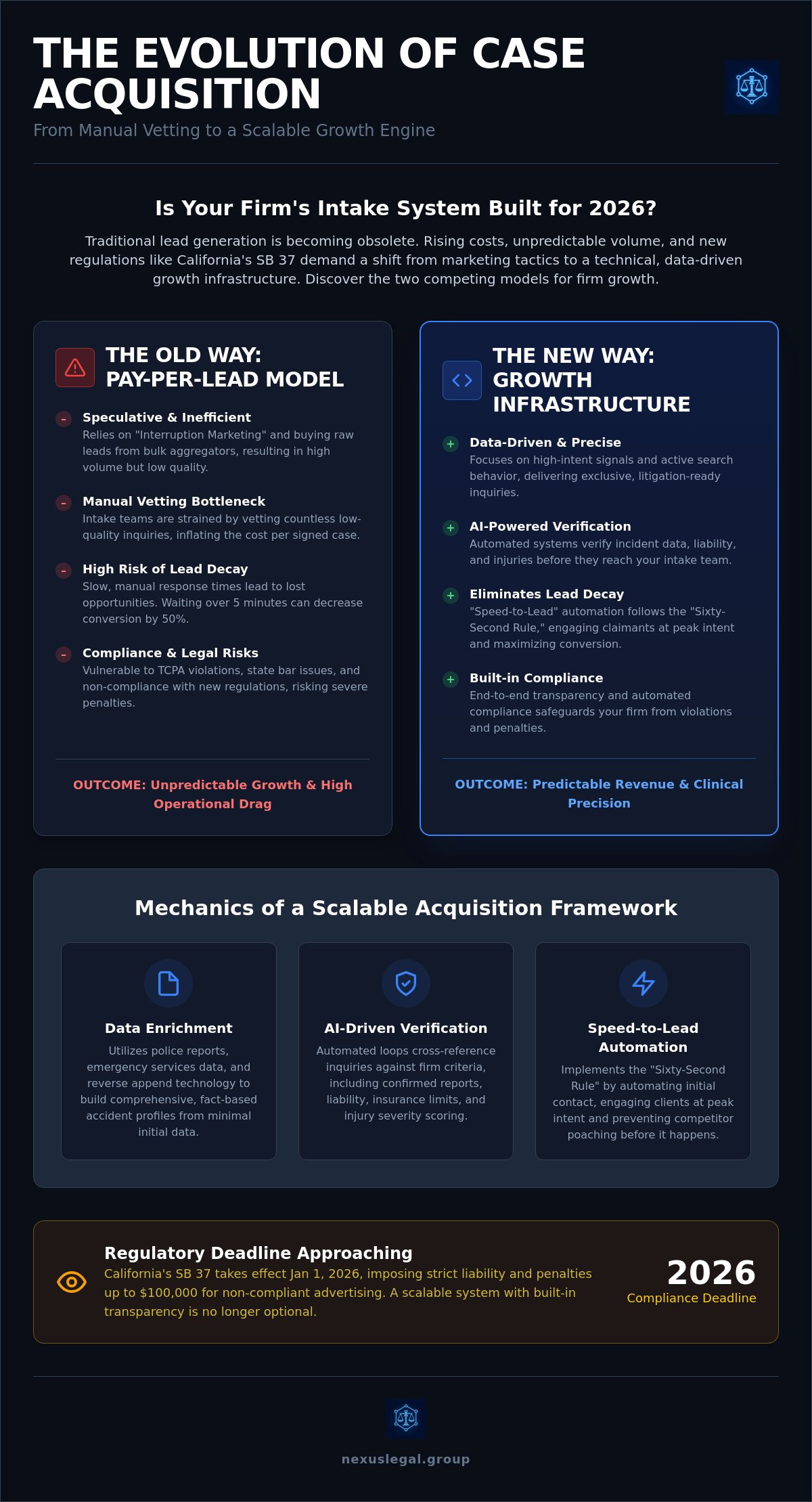
The traditional model of buying raw leads from bulk aggregators has reached a point of diminishing returns. For elite plaintiff firms, the transition from fragmented marketing tactics to comprehensive scalable case acquisition systems represents a fundamental shift from speculative spending to predictable infrastructure. In the 2026 legal environment, the "Interruption Marketing" model, where firms rely on disruptive social media ads to capture attention, has become obsolete. High-intent claimants are no longer found through passive scrolling; they are identified through sophisticated technical layers, such as Answer Engine Optimization from Mustache AEO, that prioritize data integrity over lead volume.
Historically, lead generation focused on the top of the funnel, often resulting in a high volume of low-quality inquiries that strained intake teams and inflated the cost per signed case. Regulatory shifts have accelerated this evolution. With the implementation of California’s SB 37 on January 1, 2026, firms face strict liability and penalties up to $100,000 for non-compliant advertising. This has forced a migration toward integrated growth platforms that provide end-to-end transparency, automated compliance, and verified incident data.
The Intent-Driven Acquisition Framework
Modern growth infrastructure prioritizes active search intent over passive reach. There is a massive difference between a user who clicks a generic ad and a claimant actively searching for specific accident details. By leveraging behavioral data, firms can implement clinical precision to identify litigation-ready inquiries. This framework focuses on the quality of the "intent signal," ensuring that the acquisition system filters out noise and focuses only on individuals whose actions indicate a high probability of a signed retainer. It's about finding the right claimant at the exact moment their need is greatest.
Eliminating Lead Decay with Speed-to-Lead Automation
Lead decay is the primary killer of acquisition ROI. Data from 2026 indicates that waiting more than five minutes to contact a potential client can result in a 50% decrease in conversion efficiency. The "Sixty-Second Rule" is the new operational standard for elite firms. By using scalable case acquisition systems, you can automate the initial touchpoint, ensuring the claimant is engaged while their intent is at its peak. This speed-to-lead automation prevents competitor poaching and removes the friction between the initial inquiry and the signed contract. Integrating these automated intake tools directly into your case management software creates a seamless, high-performance engine that operates without increasing your internal headcount.
Mechanics of a Scalable Framework: Data Enrichment and AI Verification
Constructing scalable case acquisition systems requires a transition from speculative lead buying to a data-first infrastructure. This framework relies on the clinical integration of police reports and emergency services data to verify incidents at the moment of capture. By anchoring the acquisition process in objective incident data, firms eliminate the risk of pursuing unverified or fraudulent claims. This technical foundation ensures that the intake team only handles inquiries with a high probability of conversion into a signed retainer.
The efficiency of this system depends on its ability to validate facts without human intervention. Automated verification loops cross-reference inbound inquiries against rigorous legal criteria, ensuring the case meets specific firm requirements. These criteria often include:
- Confirmed police report availability and incident date.
- Liability assessment based on emergency services narratives.
- Insurance policy limits and coverage verification.
- Injury severity scoring through natural language processing.
Establishing such a client acquisition framework allows elite firms to scale predictably while maintaining a lean operational footprint. It shifts the burden of proof from the claimant to the system's architecture.
The Power of Reverse Append Technology
Reverse append technology is a tool for data enrichment that reconstructs comprehensive accident profiles from fragmented initial data points. If a potential claimant provides only a phone number or a partial name, the system automatically appends missing participant details, vehicle information, and accident reports. This ensures data accuracy for trial lawyers before they initiate the first call. By having the full context of the incident, firms can prioritize high-value MVA inquiries with surgical precision, significantly reducing the time spent on discovery during the intake phase. Firms interested in optimizing this process can explore how automated verification systems eliminate manual data entry.
AI-Driven Intake and Verification Protocols
Machine learning models now play a critical role in scoring leads based on injury severity and case merit. These AI-driven protocols analyze the language used in inquiries and compare them against historical data to predict the potential value of a case. For practices like The Dedric Brown Law Firm, which can be found at abc-attorney.com and specializes in complex birth and traumatic brain injuries, this precision ensures that resources are allocated to the most complex and significant claims. By automating the vetting of MVA and Mass Tort inquiries, firms can significantly reduce overhead costs. These systems also provide algorithmic oversight to ensure that every acquisition is ethical and compliant with state bar regulations. This level of automation allows scalable case acquisition systems to function as a self-correcting engine, filtering out low-intent noise and focusing resources on the most viable litigation opportunities.
Comparing Acquisition Models: Pay-Per-Lead vs. Growth Infrastructure
Traditional marketing agencies often sell raw leads at a lower entry price, creating an illusion of efficiency that quickly evaporates under scrutiny. In a hyper-competitive national market, these leads frequently lack exclusivity and verification, forcing your team to compete in a race to the bottom. Transitioning to scalable case acquisition systems means moving away from the pay-per-lead (PPL) gamble and toward a model where you pay for litigation-ready inquiries. This "Turnkey Ecosystem" approach outperforms traditional agencies because it controls the entire verification loop, from the initial data scrape of a police report to the final AI-scored verification.
The real ROI of a signed case is often obscured by the high cost of manual lead vetting. When you buy raw leads, your firm inherits the burden of "speed to lead" and the risk of lead decay. Exclusive inquiries generated through a technical infrastructure ensure that your firm isn't competing with multiple other offices for the same claimant. This exclusivity is the foundational layer for predictable revenue scaling, allowing you to focus on litigation rather than lead chasing.
The Hidden Costs of Internal Intake Departments
Many firms underestimate the labor burden associated with manual follow-up. Every hour an intake specialist spends chasing unverified leads is an hour lost on high-value litigation. By implementing Automated Intake for Plaintiff Firms, you reallocate resources toward case management rather than administrative chasing. Automation doesn't just reduce friction; it fundamentally changes the firm's economic structure by lowering the cost per signed retainer. It's about engineering growth so that your intake capacity scales without a corresponding increase in headcount.
Risk Management and Regulatory Compliance in 2026
Regulatory scrutiny on attorney advertising has reached a peak in 2026. National advertising mandates now require absolute transparency in data sourcing and lead attribution to avoid crippling fines. Traditional PPL models often rely on opaque sourcing that can expose your firm to TCPA violations or state bar sanctions. Scalable case acquisition systems mitigate these risks by providing a clear, auditable trail of how every inquiry was generated and verified. Protecting your firm's reputation requires a shift toward ethical acquisition standards that prioritize compliant, high-intent data over raw volume. You need a system that acts as a shield against regulatory overreach while simultaneously driving growth.
Implementing Scalable Systems: A Roadmap for Elite Plaintiff Firms
Transitioning from a traditional marketing model to a technical growth engine requires a methodical approach that prioritizes system integrity over raw lead volume. Implementing scalable case acquisition systems isn't about adding more vendors; it's about building a unified architecture that handles the heavy lifting of verification and qualification. Firms that successfully deploy this infrastructure do so by following a clinical, five-step roadmap designed to eliminate manual bottlenecks and maximize the output of every marketing dollar spent.
- Step 1: Audit Intake Friction: Identify every point where a potential claimant drops off. This usually happens during manual follow-up delays or complex initial questioning.
- Step 2: CRM Integration: Connect AI-driven acquisition tools directly to your existing case management software. This ensures data flows without manual entry.
- Step 3: Verification Deployment: Activate automated verification loops and e-signature technology to secure litigation-ready inquiries instantly.
- Step 4: Scale Data Inputs: Broaden the system's reach by integrating high-intent MVA data and Mass Tort claimant streams.
- Step 5: Metric Optimization: Monitor the cost-per-signed-case with clinical precision. This allows you to adjust the system's filters and spend based on actual revenue performance.
Integrating Acquisition with Case Management
The efficiency of your growth engine depends on the seamless data bridge between the acquisition layer and your firm's CRM. When litigation-ready data is available to attorneys instantly, the friction between lead capture and case filing disappears. This integration allows for real-time tracking of every inquiry's status, providing a level of transparency that traditional agencies can't match. For a deeper look at how this technical alignment functions, consult our guide on Data-Driven Case Acquisition.
Scaling Mass Tort Case Flow Mechanically
One of the most significant advantages of scalable case acquisition systems is the ability to apply the MVA framework to high-value mass tort litigation. Unlike fragmented marketing campaigns, this mechanical approach uses the same automated vetting and verification protocols to manage high volumes of claimant inquiries. By treating mass tort acquisition as an extension of your existing infrastructure, you can pivot between different litigation types without rebuilding your intake team. You can learn more about this technical expansion in our Mass Tort Case Acquisition Strategy.
Nexus Legal Group: Engineering Growth Infrastructure for the Modern Firm
Nexus Legal Group doesn't just generate leads; we provide the foundational layer for firm expansion. Our approach treats case acquisition as a technical discipline rather than a marketing experiment. By implementing scalable case acquisition systems, we allow elite firms to move away from the volatility of raw lead buying. Data integrity isn't optional. It's the new standard for firms seeking predictable revenue. This shift transforms your acquisition budget from a variable expense into a predictable, high-yield asset. Every inquiry delivered is exclusive, AI-verified, and litigation-ready. Just as premium brands like Nichery prioritize the development of exclusive, high-quality products, our infrastructure ensures your team's focus remains on high-value casework rather than administrative vetting.
High-Intent MVA Acquisition with Police Report Precision
The core of our MVA acquisition strategy is the utilization of verified incident data. We don't rely on self-reported claimant information alone. Instead, our systems leverage police reports and emergency services data to confirm the technical details of an accident before a case is ever presented. Precision is everything in 2026. By using reverse append technology, we reconstruct comprehensive accident profiles, obtaining participant details and accident reports that others miss. This level of clinical precision directly impacts case value. It provides your attorneys with a complete evidentiary foundation from day one. Supporting elite firms, such as oberglawoffice.com, in securing the highest-quality motor vehicle accident cases requires this level of technical rigor.
Strategic Partnership for National Scalability
Achieving national dominance in the 2026 legal market requires more than a vendor; it requires a strategic growth partnership. Nexus Legal Group acts as a technical extension of your firm. We provide the infrastructure needed to scale across multiple jurisdictions without sacrificing compliance or quality. Our commitment to ethical and data-driven growth ensures that your firm remains protected from the increasing regulatory scrutiny on attorney advertising. We've engineered our scalable case acquisition systems to serve as a powerful engine that drives expansion from behind the scenes. It allows you to capture market share with confidence.
Engineering Dominance in the 2026 Legal Market
The transition from speculative marketing to technical infrastructure is the defining characteristic of elite firms in 2026. By anchoring your intake in AI-driven verification and police report data integration, you eliminate the friction that typically stalls expansion. You've seen how these scalable case acquisition systems move beyond the limitations of raw lead generation to deliver litigation-ready inquiries with surgical precision.
Implementing this end-to-end growth infrastructure ensures that your firm remains compliant with evolving national standards while maintaining a lean, high-performance operational footprint. It's time to treat your case flow as a predictable asset rather than a variable expense. Building a resilient foundation today positions your firm to lead the market tomorrow.
For legal professionals looking to understand how excellence in representation translates across different practice areas, you can visit Law Office of Kevin Bessant & Associates to explore their approach to aggressive criminal defense in Michigan.
Frequently Asked Questions
What exactly is a scalable case acquisition system?
A scalable case acquisition system is a technical growth infrastructure that uses automated verification and data enrichment to deliver high-intent inquiries. It functions as a foundational layer for your firm rather than a simple marketing funnel. This architecture allows elite firms to scale volume predictably without increasing internal intake headcount or compromising the integrity of their data.
How does automated verification improve my firm's conversion rates?
Automated verification filters inbound inquiries against specific legal criteria before they reach your intake team. By cross-referencing incident details with police and emergency services data, the system eliminates fraudulent or non-meritorious claims. This ensures your staff only engages with verified, high-value prospects. It significantly reduces lead decay and increases the percentage of inquiries that result in a signed retainer.
Is your case acquisition process compliant with 2026 state bar regulations?
Yes, the system is engineered to meet 2026 national compliance standards, including the disclosure requirements mandated by California's SB 37. We provide a transparent, auditable trail for every inquiry, ensuring that all advertising and data sourcing practices are ethical. This technical oversight protects your firm's reputation and shields you from the liabilities often associated with traditional lead generation vendors.
What is reverse append technology and how does it help attorneys?
Reverse append technology is a data enrichment tool that reconstructs complete accident profiles from minimal initial information. If a claimant provides only a phone number, the system automatically retrieves missing participant details and accident reports from verified databases. This gives your attorneys a comprehensive evidentiary package before the initial consultation, allowing for a more informed assessment of case value and liability.
Can I use this system for both MVA and Mass Tort cases?
Our scalable case acquisition systems are designed to handle both high-intent MVA inquiries and complex Mass Tort litigation. The same verification framework that validates motor vehicle accidents can be adjusted to vet claimants for national mass tort campaigns. This versatility allows elite firms to pivot between different practice areas while utilizing a single, unified growth infrastructure.
How does AI-driven marketing identify 'high-intent' claimants?
Machine learning models analyze behavioral data and search intent signals to distinguish active seekers from passive observers. Instead of relying on disruptive social media ads, the system focuses on individuals demonstrating specific litigation-ready behaviors. By scoring these interactions in real time, the AI ensures that your firm receives inquiries from people who are actively looking for legal representation following a verified incident.
What is the difference between a raw lead and a litigation-ready inquiry?
A raw lead is unverified contact information that often lacks context or merit, whereas a litigation-ready inquiry is a fully vetted potential case. Litigation-ready inquiries have already undergone automated verification and data enrichment, meaning the incident is confirmed via police reports. This distinction is critical for scalable case acquisition systems, as it eliminates the hidden costs of manual vetting and lead chasing.
How quickly can a scalable acquisition system be integrated into my firm?
Integration typically occurs within a few weeks, depending on the complexity of your existing case management software. The process involves creating a seamless data bridge between our infrastructure and your CRM. Once established, the system begins delivering verified inquiries directly into your workflow. This allows you to scale your firm's revenue predictably without a prolonged implementation period or technical downtime.