Scalable Case Acquisition: 2026 Law Firm Growth Guide
Learn scalable case acquisition for law firms. This 2026 guide reveals how to use AI-driven data to replace costly lead buying with a predictable growth engine.
Why are most plaintiff firms still gambling their marketing budgets on a "buy and hope" lead model when the technology exists to engineer a guaranteed outcome? You've likely felt the frustration of paying for high-volume lead lists that result in nothing but administrative friction and an unsustainable cost-per-signed-case. It's a common struggle to predict how marketing spend actually translates into revenue when your intake team is bogged down by manual verification and poor lead quality. Achieving true scalable case acquisition for law firms requires moving beyond these traditional bottlenecks.
This guide explores how elite firms are now utilizing AI-driven data and automated verification to build a predictable, high-intent case pipeline. We'll examine the mechanics of incident-based data sourcing, including the use of police reports and emergency services data, to secure a strategic advantage in high-value MVA and Mass Tort markets. By installing this sophisticated growth infrastructure, you can reduce overhead and transform your firm into a high-performance engine. We'll show you how to eliminate friction and replace it with a clinical, data-driven system for expansion.
Key Takeaways
- Transition from high-volume lead buying to a systematic framework for scalable case acquisition for law firms that prioritizes litigation-ready intent.
- Discover how to leverage real-time data from police reports and emergency services to identify high-value MVA cases as they occur.
- Reduce administrative friction and overhead by replacing manual vetting processes with AI-driven automated verification.
- Identify the specific data gaps in your current intake protocol to establish a more predictable and measurable revenue pipeline.
- Gain a strategic advantage in the Mass Tort and MVA markets by installing sophisticated, compliant growth infrastructure as a foundational layer.
Defining Scalable Case Acquisition for Modern Law Firms
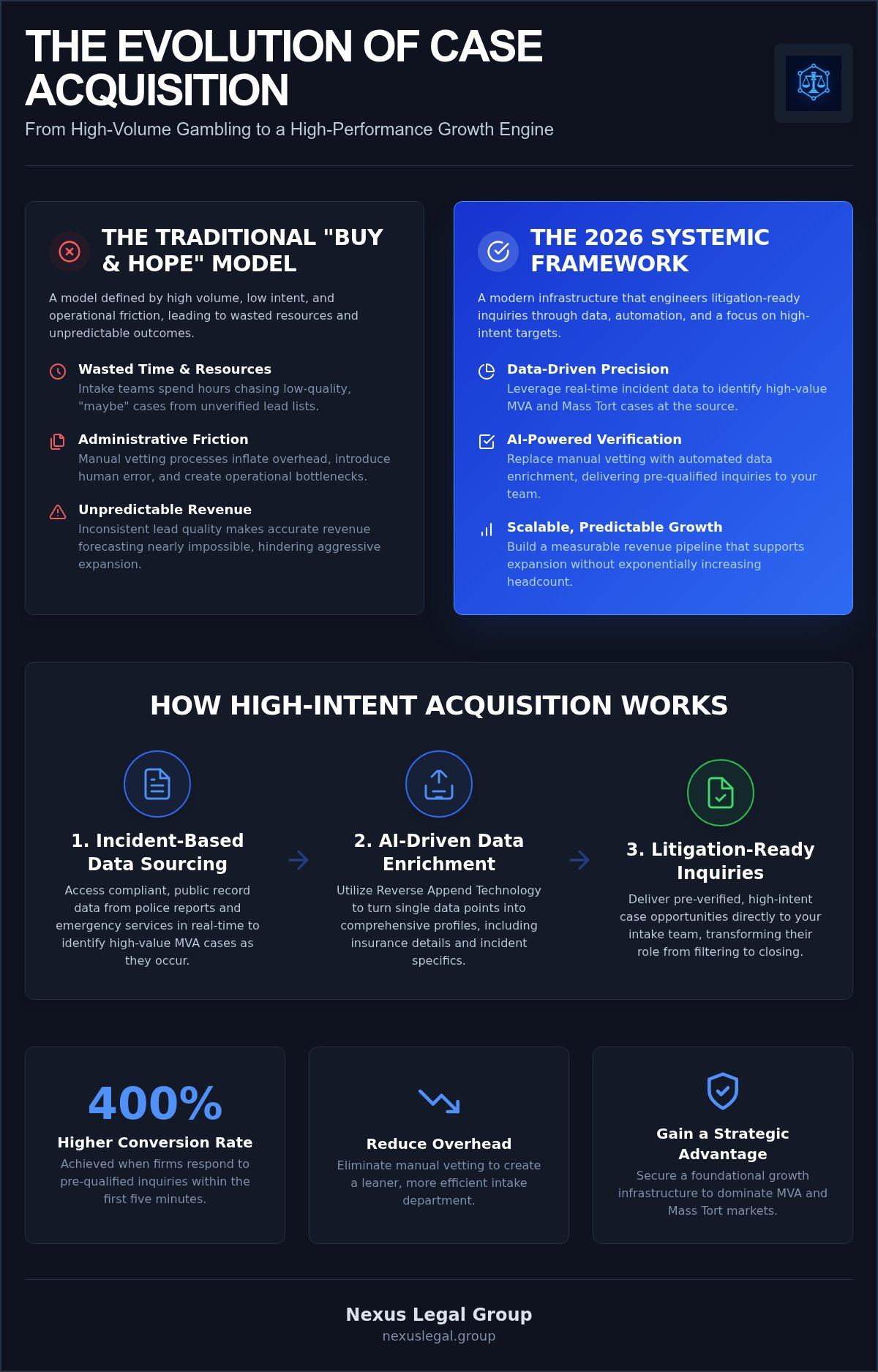
Scalable case acquisition for law firms isn't merely a marketing objective; it's the systematic engineering of litigation-ready inquiries through data-driven infrastructure. This marks a critical departure from legacy volume-based models. In the past, firms focused on the sheer number of leads, but modern expansion requires a transition to intent-based acquisition. This shift is essential for firms looking to optimize their Customer Acquisition Cost (CAC) while maintaining high margins.
Traditional "lead buying" creates significant operational friction. When a firm purchases raw, unverified data, it forces the intake team to act as a filter rather than a closer. This process inflates overhead and introduces human error into the earliest stages of the funnel. Elite firms now view growth infrastructure as the foundational layer that ensures every inquiry entering the system has a high probability of conversion. By treating acquisition as an engineering problem rather than a creative one, firms can achieve predictable revenue growth without exponentially increasing headcount.
The Limitations of Traditional Lead Generation
Low-intent leads do more than just waste time; they exhaust your intake staff and inflate operational overhead. When your team spends hours chasing "maybe" cases, your most valuable human resources are misallocated. The noise-to-signal ratio in mass-market digital advertising has reached a breaking point, making it nearly impossible to filter quality manually. Without consistent lead quality, accurate revenue forecasting becomes a guessing game rather than a strategic exercise. This inconsistency prevents firms from committing to aggressive expansion plans because they can't trust the data feeding their pipeline.
The 2026 Standard for Litigation-Ready Inquiries
The 2026 standard dictates that "litigation-ready" means an inquiry has been enriched with verified data points before it ever reaches your desk. For MVA and Mass Tort cases, this includes specific accident details, insurance information, and preliminary liability assessments. Growth infrastructure is the foundational firm layer that automates this verification to eliminate friction. Prioritizing pre-verified data ensures that your firm only allocates resources to high-intent opportunities. This precision allows for a leaner intake department and a more predictable revenue pipeline, giving you a distinct advantage over competitors who still rely on manual vetting.
The Mechanics of High-Intent MVA Data Sourcing
High-intent acquisition isn't about casting a wider net; it's about using a more precise spear. While competitors waste capital on broad digital keywords, elite firms focus on the mechanics of incident-based data. This approach identifies Motor Vehicle Accident (MVA) participants through verifiable public records at the moment of impact. By the time a claimant starts searching for representation, the firm already possesses the foundational data needed to evaluate the case's viability. This precision is the engine behind scalable case acquisition for law firms in 2026.
Leveraging Police and Emergency Services Data
Accessing real-time incident data provides a critical competitive window. When firms utilize police report generated MVA leads, they shift from reactive marketing to proactive acquisition. This isn't about intrusive tactics. It's about sourcing ethically compliant, public record information to identify high-intent individuals who require immediate legal assistance. Research indicates that law firms responding to inquiries within five minutes see a 400% higher conversion rate. Obtaining participant details and incident specifics early allows your intake team to hit these benchmarks consistently. You aren't just asking what happened; you're confirming facts you already know.
Reverse Append Technology and Data Enrichment
Raw data is often incomplete. Reverse append technology bridges this gap by turning a single data point, like a vehicle identifier or a partial name, into a comprehensive incident profile. This enrichment process allows for sophisticated case vetting before a human ever picks up the phone. When you know the insurance carrier, the severity of the vehicle damage, and the emergency services response details, your conversion rates naturally climb. This level of technical mastery is a prerequisite for any firm serious about scalable case acquisition for law firms.
Enriched data transforms the intake conversation from a cold discovery call into a professional verification session. This technical integration is a key component of Implementing a Scalable Growth Infrastructure within your organization. By the time an attorney reviews the file, it's already litigation-ready. If you're looking to upgrade your firm's technical capabilities, exploring advanced data sourcing models can provide the clarity needed to scale. AI-driven marketing then uses these enriched profiles to identify similar high-intent claimants across the national market, ensuring your pipeline never runs dry.
Manual vs. Automated Intake Verification Frameworks
Verification serves as the critical filter between raw incident data and a signed, litigation-ready case. While many firms still rely on human bandwidth to vet inquiries, this manual approach creates a bottleneck that prevents true expansion. The primary friction points in standard plaintiff firm intake involve inconsistent qualifying questions, slow response times, and the high cost of human error. To achieve scalable case acquisition for law firms, the verification process must move from a manual task to an automated, programmatic standard.
The True Cost of Manual Intake
Manual intake is the primary barrier to scaling case volume because it links growth directly to headcount. When your firm relies on staff to filter through low-intent inquiries, you're incurring a massive opportunity cost. With the average litigation attorney's hourly rate reaching between $200 and $550 in 2026, using legal professionals to vet unverified leads is a misallocation of capital. This labor-intensive model inflates your cost-per-signed-case and prevents accurate revenue forecasting. Transitioning to automated intake for plaintiff firms allows you to decouple lead volume from administrative overhead, ensuring that your team only focuses on cases with high settlement potential.
Engineering an Automated Vetting Engine
An automated vetting engine utilizes AI to verify claimant eligibility and incident validity against real-time data feeds. By integrating the reverse append technology discussed previously, these systems can cross-reference a claimant's statement with actual police report details instantly. This multi-step verification process ensures that only inquiries meeting specific litigation-ready criteria proceed to your intake closers. Automated systems ensure litigation readiness by validating insurance coverage and liability factors before any human contact occurs.
Maintaining ethical compliance is a non-negotiable standard in modern acquisition. Programmatic intake standards remove the risk of aggressive or non-compliant human tactics by following a strictly defined, logic-based sequence. This ensures every interaction is recorded, compliant, and focused on high-intent data points. By filtering out non-qualified inquiries through an algorithmic lens, your firm maintains a clean pipeline and a superior strategic advantage. This systematic approach allows for a predictable flow of cases while protecting the firm's professional reputation and operational margins.
Implementing a Scalable Growth Infrastructure
Building a sustainable model for scalable case acquisition for law firms requires more than just a higher marketing budget; it demands a structural overhaul of how data flows through your organization. Most firms fail to scale because they treat intake and acquisition as separate silos. True growth infrastructure integrates these functions into a single, automated ecosystem where data enrichment informs every subsequent step. This systematic approach ensures that your expansion is supported by technical mastery rather than just increased labor.
Auditing Your Case Acquisition Pipeline
Start by identifying the specific leaks in your current conversion funnel. If your lead-to-client conversion rate is below the 25% industry average, your process is likely suffering from administrative friction or poor data quality. In 2026, the cost-per-signed-case for standard MVA cases often ranges from $1,500 to $3,000, making it vital to compare your internal metrics against these benchmarks. Auditing your pipeline reveals exactly where high-intent inquiries are stalling due to manual vetting delays. You can find a detailed framework for this in our guide on law firm growth infrastructure.
Aligning Intake with Data-Driven Leads
Moving to a pre-vetted model requires a psychological shift for your intake team. They're no longer cold-calling prospects to discover if a case exists. Instead, they're acting as professional consultants verifying established facts. Train your staff to use the incident specifics provided by police reports and reverse append technology to build rapport instantly. Mentioning the exact insurance carrier or the specific details of the collision demonstrates authority and clinical precision. This approach reduces the friction of discovery and accelerates the path to a signed retainer.
Finalize your infrastructure by integrating your acquisition feeds directly into your existing case management platform. This ensures that litigation-ready metrics, not just lead volume, drive your decision-making. Monitor the speed of contact and the percentage of enriched inquiries that convert to active litigation. When your systems are synchronized, you can predict revenue growth with the accuracy of a strategic architect. This level of technical integration is the final step in establishing scalable case acquisition for law firms.
Nexus Legal Group: The Strategic Engine for Elite Firms
Nexus Legal Group positions itself as the strategic architect for firms ready to transcend the limitations of traditional marketing. We don't operate as a peripheral lead vendor; instead, we function as a foundational layer, providing the end-to-end growth infrastructure necessary for clinical expansion. This approach eliminates the historical friction between marketing spend and signed cases by ensuring that every inquiry entering your system has already passed through a rigorous, AI-driven verification process. It's about providing a high-performance engine that drives scalable case acquisition for law firms with absolute precision.
Our commitment to ethical, compliant, and data-driven case generation remains a non-negotiable standard. By integrating our specialized verification processes directly into your firm's pipeline, we remove the administrative bottlenecks that typically throttle expansion. This technical mastery allows your team to focus on high-level litigation while our systems manage the mechanics of the acquisition funnel from behind the scenes. We provide the security of technical mastery so you can focus on the security of your clients' outcomes.
Exclusive MVA and Mass Tort Acquisition
Elite plaintiff practices understand that lead volume is often a vanity metric; litigation-ready inquiries are the only data points that truly impact the bottom line. Nexus focuses exclusively on high-intent inquiries enriched with the incident specifics required for immediate action. Whether your firm is targeting high-value motor vehicle accidents or seeking signed mass tort cases, our methodology ensures every inquiry is prepared for your intake closers. This precision sourcing allows firms to maintain significantly higher margins by reducing the time spent on discovery and manual vetting.
The Future of Plaintiff Firm Scalability
The legal industry is currently undergoing a structural shift where elite firms are moving away from general digital agencies in favor of tech-enabled partners. Relying on a predictable, machine-driven case flow is no longer optional for those who wish to lead the market. This long-term focus on automation and systemic integrity ensures your firm can scale without an exponential increase in administrative burden. You're not just buying a service; you're installing a powerful engine designed for operational excellence. It's time to stop gambling on lead quality and start investing in a proven framework for growth. Scale your firm with Nexus Legal Group growth infrastructure and secure your strategic advantage in the 2026 market.
Engineering the Future of Your Practice
The path to market dominance requires a fundamental shift from reactive lead buying toward a proactive, data-driven architecture. You've seen how moving to incident-based sourcing and AI-driven automated verification systems can eliminate administrative friction while stabilizing your margins. By prioritizing litigation-ready inquiries, your firm ensures that every resource is allocated toward high-intent opportunities with the greatest settlement potential.
Establishing scalable case acquisition for law firms isn't just about increasing spend; it's about installing a resilient engine. Utilizing specialized expertise in high-intent Mass Tort acquisition and exclusive access to litigation-ready MVA inquiries allows you to focus on high-level strategy. It's time to stop managing bottlenecks and start architecting a predictable revenue pipeline through technical mastery.
Your firm's expansion is an engineering challenge with a definitive technical solution. We're ready to help you build a more efficient and profitable future.
Frequently Asked Questions
What makes a case inquiry "litigation-ready" in 2026?
A litigation-ready inquiry is one where the claimant's identity, incident details, and liability factors have been pre-verified through authoritative data sources. In 2026, this means the file includes confirmed insurance coverage and specific accident particulars from police reports before reaching your intake team. This level of preparation ensures that scalable case acquisition for law firms remains efficient. By removing the burden of discovery from your staff, the inquiry is prepared for immediate retainer signing.
How does reverse append technology improve MVA lead quality?
Reverse append technology improves quality by enriching a single data point into a comprehensive accident profile. This system utilizes vehicle identifiers or partial participant information to pull complete accident reports and insurance details. Instead of relying on a claimant's memory, your firm receives verified incident specifics. This high-intent data allows for a more clinical vetting process, ensuring that only cases with significant recovery potential enter your firm's growth pipeline and intake systems.
Can automated intake verification really replace manual vetting?
Automated intake verification replaces manual vetting by applying algorithmic logic to filter inquiries based on pre-defined litigation criteria. AI-driven systems cross-reference claimant statements against real-time emergency services data to validate the incident's severity and liability. This process eliminates the administrative friction and human error inherent in traditional intake models. By automating the filtering stage, your firm can scale volume without exponentially increasing headcount, significantly reducing your total operational overhead and staff burnout.
Is data-driven case acquisition ethical and compliant with ABA standards?
Data-driven acquisition is fully compliant when it utilizes public record incident information and follows programmatic intake standards. Ethical lead generation relies on transparency and strict adherence to national advertising regulations. By using logic-based automated systems, firms remove the risk of aggressive or non-compliant human tactics during the initial contact phase. This systematic approach ensures every interaction is recorded and adheres to the highest professional standards, protecting your firm's reputation while driving expansion.
What is the difference between a lead generation company and a growth infrastructure firm?
A lead generation company typically sells raw, unverified inquiries based on broad digital keywords. In contrast, a growth infrastructure firm like Nexus Legal Group provides an end-to-end system that integrates AI-driven marketing with automated verification. This framework acts as a foundational layer for your organization, focusing on high-intent data and litigation-ready inquiries. While lead generators provide volume, growth infrastructure provides a predictable revenue pipeline designed for long-term scalability and clinical precision.
How long does it typically take to integrate a scalable acquisition system?
Integration timelines depend on your firm's existing technical stack and the complexity of your current intake protocols. The process generally involves auditing your acquisition pipeline, standardizing intake scripts to align with high-intent data feeds, and connecting verification systems to your case management platform. While technical setup can be rapid, the psychological shift toward a pre-vetted model requires consistent staff training. Most elite firms establish a fully functional growth infrastructure within a few operational weeks.
Why is police report data superior to standard social media lead generation?
Police report data is superior because it identifies high-intent participants involved in verified incidents at the moment they occur. Social media lead generation relies on broad interest-based targeting, which often results in a high noise-to-signal ratio and low-intent inquiries. Incident-based sourcing provides specific accident details and participant information that cannot be fabricated. This technical precision allows for scalable case acquisition for law firms that is rooted in fact rather than digital browsing behavior.
How do high-intent inquiries impact the overall cost-per-signed-case?
High-intent inquiries lower the overall cost-per-signed-case (CPSC) by significantly increasing conversion rates and reducing intake labor. When inquiries are pre-verified and litigation-ready, your closers spend less time on discovery and more time on signing retainers. This efficiency decouples your growth from administrative overhead. While the initial cost per inquiry may be higher than raw leads, the reduction in friction and higher case quality results in a more profitable and predictable ROI for the firm.