Reducing Law Firm Intake Overhead: The 2026 Strategic Infrastructure Guide
Stop wasting money on unqualified leads. Learn the framework for reducing law firm intake overhead with automated verification and high-intent case acquisition.
Why does the expense of securing a single signed case continue to escalate even as legal AI adoption reaches 79% in 2026? For many firms, the traditional model of scaling payroll to chase a high volume of unqualified digital leads has become a structural liability rather than a growth asset. Achieving a sustainable result in reducing law firm intake overhead requires more than just incremental software updates. It demands a clinical re-engineering of your firm's front-end infrastructure to prioritize automated verification over manual labor.
You're likely aware that manual verification processes and the friction of chasing low-intent inquiries are the primary drivers of your rising operational costs. This guide provides the strategic blueprint to eliminate those bottlenecks by engineering high-intent case acquisition systems that filter for litigation readiness before your staff ever picks up the phone. We'll explore how to leverage incident enrichment and reverse append technology to transform your intake department into a lean, high-performance engine that delivers predictable results with technical mastery.
Key Takeaways
- Identify the "cost of noise" within your current operations to stop manual vetting from draining your firm's resources.
- Master the technical frameworks for reducing law firm intake overhead by transitioning from human-dependent tasks to automated verification protocols.
- Learn how to source high-intent, police report generated leads that arrive pre-verified and ready for immediate litigation.
- Implement reverse append technology to enrich incident data, ensuring your intake department focuses only on the most valuable inquiries.
- Establish a foundational growth infrastructure that provides predictable case acquisition costs and eliminates the friction of chasing unqualified leads.
The Hidden Mechanics of Law Firm Intake Overhead
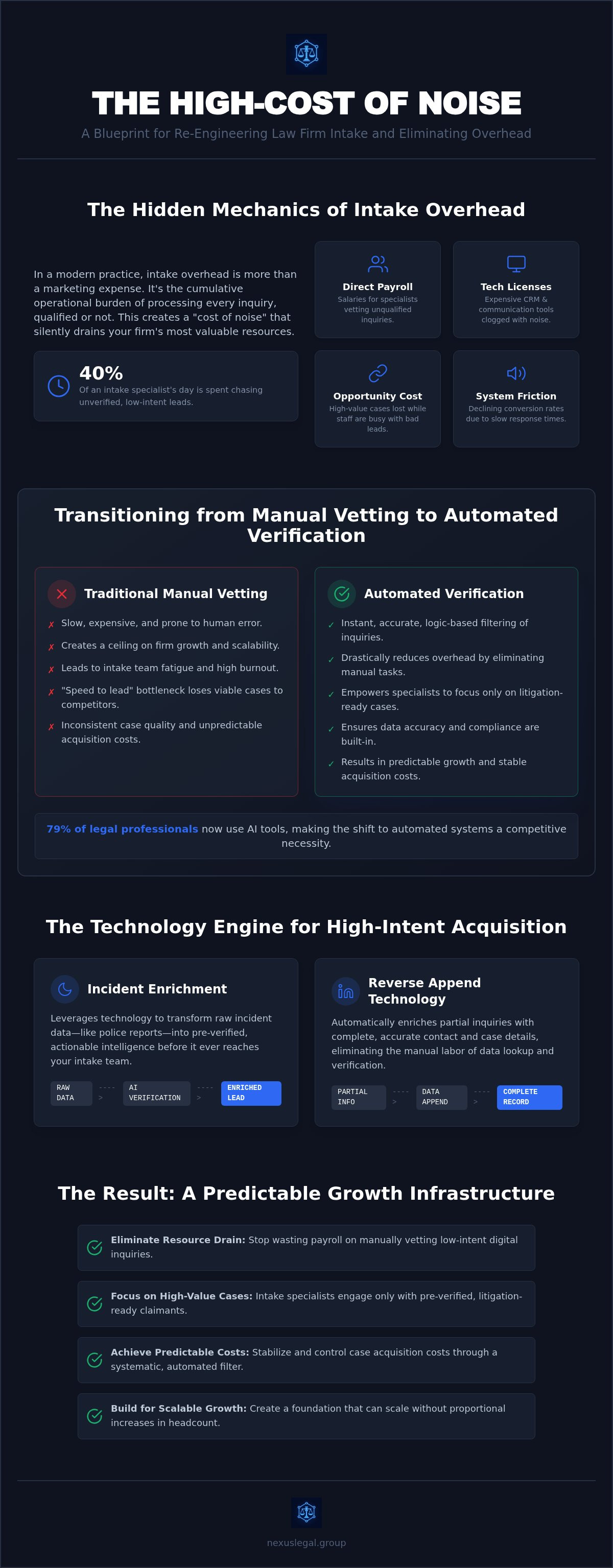
Intake overhead is frequently misidentified as a simple marketing expense. In a sophisticated 2026 practice, it represents the cumulative operational burden of processing inquiries. This includes a variety of hidden costs that often go unmeasured:
- Direct payroll for intake specialists and administrative staff.
- Technology licenses for CRM and communication platforms.
- The significant opportunity cost of misallocated human capital.
- The "cost of noise" generated by filtering low-intent digital inquiries.
True progress in reducing law firm intake overhead begins by acknowledging that every unqualified inquiry is a drain on your firm's foundational systems. Traditional lead generation models often fail because they don't account for intake department fatigue. When your team spends 40% of their day chasing ghosts from unverified digital campaigns, their ability to convert high-value, litigation-ready cases diminishes rapidly.
The "cost of noise" is the most pervasive, yet invisible, factor in this equation. Digital marketing often generates a high volume of leads with zero intent. These inquiries require manual filtering, which creates structural friction in your legal case management workflows. This friction is not a minor nuisance; it's a systemic failure that prevents scalable growth and inflates the cost per signed case.
The Economic Impact of Unqualified Inquiries
A "bad lead" costs far more than its initial purchase price. Its true cost includes the hourly rate of your specialists, the CRM processing power, and the delay it causes in responding to high-intent victims. High-volume, low-intent inquiries overwhelm elite intake teams. When your staff is buried in noise, response times for valuable cases slow down. This direct correlation between intake friction and declining conversion rates proves that volume without verification is an economic liability.
Shifting from Cost-Cutting to Operational Precision
Many firms attempt to lower expenses by reducing staff headcount. This is a secondary, often counterproductive, solution that leads to missed opportunities. The primary lever for reducing law firm intake overhead is increasing inquiry quality at the source. Implementing automated intake for plaintiff firms allows for a clinical filter that stabilizes overhead by removing the human element from initial vetting. By establishing a clinical baseline for intake efficiency, your firm moves from a reactive posture to one of operational precision. This ensures that every dollar spent on intake is focused on inquiries that are already verified and ready for litigation.
Transitioning from Manual Vetting to Automated Verification
Human-only intake departments are reaching a point of diminishing returns. In 2026, relying solely on staff to manually vet every inquiry creates a ceiling on your firm's growth. Manual vetting is slow; it's prone to human error; it's expensive. By the time a specialist reviews a web form, the claimant has often moved on to a competitor. Transitioning to automated verification isn't just about speed. It's about engineering a system where only litigation-ready inquiries reach your desk.
Integrating legal automation into your intake workflow allows your firm to maintain high ethical and compliant standards without constant manual oversight. AI-driven precision ensures that marketing campaigns target high-intent individuals, drastically reducing law firm intake overhead by filtering out the "noise" before it touches your payroll. With 79% of legal professionals now utilizing AI tools, the shift from manual labor to technical mastery is no longer optional for firms seeking to remain competitive.
The Mechanics of Automated Case Vetting
Automated vetting utilizes logic-based frameworks to identify high-intent claimants instantly. When an inquiry enters the system, digital verification tools cross-reference data points to confirm the validity of an accident or injury claim. This eliminates the "speed to lead" bottleneck. Your team doesn't waste hours on the phone with unqualified leads because the system has already performed the heavy lifting. This systemic integrity ensures data accuracy and compliance are baked into the process, not added as an afterthought.
Comparison: Manual vs. Automated Intake Systems
To understand the impact on your firm's bottom line, consider the operational differences between these two frameworks. Firms adopting AI-driven legal operations tools are predicted to see a 30% faster case turnaround time, according to recent industry projections.
| Operational Metric | Manual Intake System | Automated Verification |
|---|---|---|
| Staff Allocation | High (Multiple specialists) | Minimal (System-led) |
| Error Frequency | Common (Fatigue-driven) | Negligible (Logic-based) |
| Inquiry Processing | Minutes to Hours | Near-Instantaneous |
Scaling a practice requires a robust law firm growth infrastructure that doesn't break under increased volume. You can begin phasing out redundant manual processes by implementing automated filters on your highest-volume lead sources first. This transition allows your elite intake staff to focus on closing high-value cases rather than basic data entry. If you're ready to audit your current friction points, exploring high-performance growth systems can provide the clinical baseline you need to modernize your firm's front-end operations.
Sourcing High-Intent Data: The Role of Incident Enrichment
Traditional lead generation is a volume game that often results in high operational friction. To truly achieve success in reducing law firm intake overhead, elite firms are shifting toward data-driven case acquisition. This approach replaces the "broadcast" model of digital marketing with surgical precision. Instead of waiting for a victim to see an ad and self-report their details, you're identifying incidents that have already been documented by official sources. It's a move from speculative marketing to clinical data retrieval.
Utilizing police report generated MVA leads fundamentally changes your intake department's dynamic. Your team isn't calling a "lead" who might have clicked an ad by mistake; they're contacting a verified participant in a documented accident. This pre-enriched data ensures that your staff only interacts with litigation-ready participants. By removing the need to vet the basic facts of an accident, you're effectively eliminating the hours wasted on unverified inquiries that typically inflate your cost-per-signed-case.
Leveraging Police Reports and Emergency Data
Obtaining accident reports via AI-driven sourcing is a technical process that bypasses the ambiguity of social media inquiries. Incident-level data provides a factual baseline, including vehicle impact details and fault assessments, which digital leads simply can't provide. To integrate this into your workflow, you'll need to configure your CRM to accept real-time data feeds from emergency services databases. This connectivity allows for immediate outreach based on verified events. It's about being the first to reach a victim with the facts already in hand, which significantly increases your conversion rates while lowering the labor required for each inquiry.
Reverse Append Technology for Case Detail Accuracy
Reverse append technology is a foundational tool for modern personal injury practices. It allows you to take a single data point, such as a license plate number or a phone number from an emergency dispatch, and automatically append full participant details and accident severity metrics. This verification happens before your staff ever makes the first call.
By verifying these details at the source, you're reducing law firm intake overhead by eliminating manual data entry errors and the time-consuming process of fact-finding during the initial call. Your intake specialists don't have to spend twenty minutes extracting basic facts from a stressed claimant. They can focus immediately on the clinical assessment of the case and the emotional needs of the client. This systemic automation ensures that every inquiry your firm processes is backed by verifiable incident data, creating a leaner and more predictable growth engine.
Strategic Implementation: Building Your Growth Infrastructure
Building a high-performance practice in 2026 requires a shift from reactive management to proactive systems architecture. You aren't just looking for software; you're selecting a foundational layer that supports limitless expansion. This process starts with a clinical evaluation of your current acquisition funnel to identify where technical friction is inflating your costs. By architecting a system that prioritizes data integrity, you move away from the "hire-to-solve" mentality that plagues many plaintiff firms.
Integrating high conversion MVA leads into a streamlined workflow is the most direct path to reducing law firm intake overhead. When inquiries arrive pre-enriched with behavioral data and incident details, your staff no longer needs to act as "screeners." Instead, they can be trained as "closers" who focus on the final signature. This shift in personnel focus maximizes the value of your payroll while minimizing the time spent on administrative vetting. It transforms your intake department from a cost center into a high-efficiency growth engine.
Phase 1: Friction Audit and Baseline Metrics
You must identify the "leaky buckets" where potential cases drop off due to slow response times or manual data entry errors. Measure your current cost-to-acquire (CAC) against your total intake department spend, including payroll, technology licenses, and management time. Key performance indicators for this transition should include the percentage of inquiries that reach a specialist without human intervention and the average time from initial contact to a signed retainer. Establishing these clinical baselines allows you to track the ROI of your infrastructure upgrades with technical mastery.
Phase 2: Deploying Automated Growth Systems
Implementation involves deploying AI-driven verification tools that act as a persistent filter for your firm. By transitioning to litigation-ready inquiries, you drastically reduce the departmental load, allowing your team to handle significantly higher case volume without increasing headcount. Scaling case volume mechanically ensures that your growth is predictable and insulated from the labor market's volatility. This stage is about moving from manual labor to systemic integrity, where every workflow is optimized for speed and accuracy.
The Nexus CaseFlow Advantage: Engineering Litigation-Ready Outcomes
Nexus Legal Group provides the end-to-end growth infrastructure that elite plaintiff practices require to thrive in a competitive 2026 market. We don't just provide leads; we deliver a clinical, high-performance engine designed for reducing law firm intake overhead by removing the burden of initial vetting from your internal staff. Our approach utilizes AI-driven precision to deliver exclusive, verified inquiries for MVA and mass torts, ensuring that your firm's resources are never wasted on speculative inquiries. This level of technical mastery allows your organization to scale without the friction typically associated with manual intake departments.
We position signed cases and exclusive, verified inquiries as the ultimate method for eliminating operational waste. When your team receives a file that has already been cross-referenced against police reports and emergency services data, the "cost of noise" discussed in previous sections is effectively neutralized. Our commitment to ethical, compliant, and data-driven acquisition provides the security and systemic integrity needed for sustainable firm scalability. This clinical precision ensures that every inquiry is backed by verifiable incident data, treating growth as a structural engineering challenge rather than a marketing experiment.
End-to-End Case Acquisition for Elite Firms
Elite firms understand that moving beyond basic leads to a litigation-ready case flow is essential for institutional growth. In a national market where competition is fierce, the value of exclusive inquiries cannot be overstated. A strategic partnership with Nexus Legal Group acts as a catalyst for this expansion, providing the connectivity and automation that allow your practice to function with authoritative expert efficiency. By outsourcing the technical complexity of incident enrichment and automated verification, you free your elite specialists to focus on high-level legal strategy. This shift ensures that your firm's foundational layer is built for long-term reliability and high-level competence.
Next Steps: Optimizing Your Acquisition Engine
Optimizing your intake infrastructure begins with a clinical assessment of your current workflow. You can request a customized growth infrastructure audit to identify specific friction points and "leaky buckets" within your acquisition funnel. Through our platform, you'll gain access to exclusive accident report data and high-intent MVA inquiries that have been processed through our rigorous vetting protocols. This is the first step toward building a predictable, high-performance practice that prioritizes reducing law firm intake overhead while maintaining technical excellence.
Engineering a Frictionless Future for Plaintiff Practices
Transitioning from manual vetting to automated verification is no longer an optional upgrade; it's a foundational requirement for scalability in 2026. By shifting from speculative lead generation to data-driven case acquisition, your firm secures a clinical advantage that eliminates the cost of noise inherent in traditional marketing. This guide has outlined the mechanics of reducing law firm intake overhead through incident enrichment and systemic automation.
Success depends on your ability to deploy infrastructure that prioritizes litigation-ready inquiries over raw volume. Utilizing elite AI-driven marketing precision and exclusive, pre-verified MVA inquiries ensures that your intake staff remains focused on high-value closing. With rigorous automated verification systems in place, you can scale your practice with total confidence in your data integrity.
You now have the strategic blueprint to transform your intake department from a resource drain into a high-performance engine. It's time to build the foundational layer that drives predictable, institutional growth for your firm.
Frequently Asked Questions
How does automated verification specifically reduce law firm overhead?
Automated verification replaces manual labor with technical precision. It uses logic-based filters to vet claimants instantly, removing the payroll costs associated with initial screening. This contributes significantly to reducing law firm intake overhead by ensuring your elite specialists only focus on pre-qualified, litigation-ready cases. By eliminating the human element from initial vetting, you create a more predictable and scalable acquisition engine that functions with clinical accuracy.
Can I reduce intake staff if I implement data-driven case acquisition?
Data-driven acquisition allows you to optimize your headcount rather than simply reducing it. By sourcing inquiries that are already enriched with incident data, the departmental load decreases. This shift allows a smaller, more elite team to handle a higher volume of cases. You move from a model of "screeners" to "closers," which stabilizes operational costs and prevents the need for large, expensive intake departments.
What is the cost of noise in legal intake departments?
The cost of noise represents the total operational drain caused by processing unqualified inquiries. Every hour an intake specialist spends chasing a low-intent digital lead is an hour of lost opportunity and wasted payroll. This noise inflates the cost-per-signed-case and creates structural friction. Eliminating this noise is the most effective lever for reducing law firm intake overhead and improving overall conversion rates.
Is automated legal intake ethical and compliant with state bar standards?
Automated systems are designed to maintain high ethical and compliant standards through systemic integrity. These platforms ensure that data collection is transparent and that inquiries are sourced through documented, compliant channels. By removing human variability and fatigue-driven errors, automated systems provide a consistent process that adheres to professional literacy requirements. This clinical approach ensures every inquiry is handled with technical mastery, providing a secure foundational layer for your firm's expansion.
How do police reports improve the efficiency of an intake department?
Police reports provide a factual baseline that eliminates the ambiguity of self-reported claimant data. When an intake department utilizes police report generated MVA leads, they start the conversation with verified accident details and fault assessments already in hand. This reduces the time spent on initial fact-finding. It allows your team to move immediately toward case evaluation and signing, cutting down the time required for each inquiry.
What is the difference between a lead and a litigation-ready inquiry?
A lead is a raw inquiry that requires extensive manual vetting to determine its value. In contrast, a litigation-ready inquiry has already been enriched with incident data and passed through automated verification filters. Litigation-ready inquiries are sourced from documented events, such as emergency services data, ensuring the participant is qualified for legal action. This distinction is foundational for firms seeking to build a high-performance growth infrastructure.
How quickly can a firm see a reduction in overhead after implementing growth infrastructure?
Firms typically observe a reduction in operational friction immediately following the deployment of automated verification tools. As the volume of unqualified noise decreases, the intake department's efficiency increases. While total overhead reduction scales as manual processes are phased out, the shift toward higher-quality inquiries produces measurable improvements in case turnaround times and staff productivity within the first few billing cycles of implementation.
Does reverse append technology work for mass tort case acquisition?
Reverse append technology is highly effective for verifying participant details in both MVA and mass tort litigation. By taking initial contact data and automatically appending secondary verification points, firms can confirm a claimant's history and eligibility before manual intervention. This systemic automation ensures that your mass tort acquisition engine remains lean and focused on ethical, compliant inquiries that are ready for litigation. It's a critical component of a high-performance growth infrastructure.