Qualified Motor Vehicle Accident Leads: Engineering High-Intent Case Acquisition in 2026
Stop buying shared inquiries. Learn to engineer a proprietary pipeline of qualified motor vehicle accident leads using data-driven systems for your law firm.
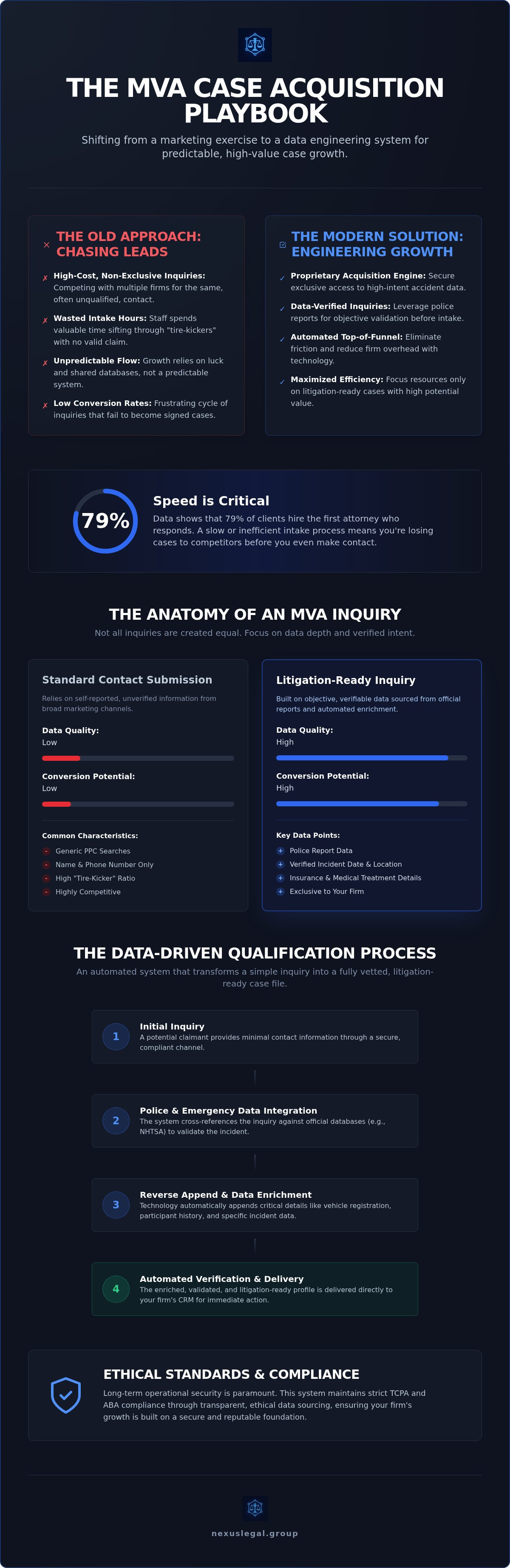
If your firm still treats lead generation as a marketing exercise rather than a data engineering problem, you're likely subsidizing your competitors' growth. Most elite plaintiff firms are exhausted by the cycle of high-cost, non-exclusive inquiries that fail to convert into signed cases. It's frustrating to watch your intake team waste hours on "tire-kickers" while the cost of acquiring qualified motor vehicle accident leads continues to climb. With data showing that 79% of clients hire the first attorney who responds, the margin for error in your intake process has effectively vanished.
You need a predictable flow of inquiries that doesn't rely on luck or shared databases. This article provides the data-driven frameworks and AI-integrated systems required to acquire litigation-ready MVA inquiries for high-growth firms. We'll explore how to engineer a proprietary acquisition engine using police report data and automated verification to eliminate friction and secure exclusive access to high-intent accident data.
Key Takeaways
- Define the critical distinction between a standard contact submission and a litigation-ready inquiry by focusing on data depth and objective intent.
- Leverage police reports and emergency services data to engineer a pipeline of qualified motor vehicle accident leads that are verified before intake.
- Transition from a tactical lead-buying mindset to a strategic growth infrastructure that automates top-of-funnel acquisition and reduces firm overhead.
- Ensure long-term operational security by maintaining strict TCPA and ABA compliance through transparent, ethical data sourcing.
- Maximize case acquisition efficiency by integrating high-intent data directly into your CRM to track conversion rates and cost per signed case.
Defining 'Qualified' MVA Leads in the 2026 Legal Landscape
In 2026, the legal industry has moved beyond the era of the lead as a simple commodity. For elite plaintiff firms, a name and a phone number are no longer sufficient to justify the overhead of a modern intake department. Genuine qualified motor vehicle accident leads are now defined by the depth of their metadata and the verified intent of the claimant. You shouldn't settle for raw inquiries that lack incident-level context. Instead, focus on litigation-ready data that allows your intake team to prioritize cases with the highest potential value immediately.
Traditional high-volume PPC strategies often prioritize quantity, which frequently leads to a flood of low-intent inquiries. This approach forces your staff to sift through "tire-kickers" who may not have a valid claim or active insurance coverage. High-intent acquisition, by contrast, filters for specific behavioral signals and incident-level verification. By securing exclusive access to these inquiries, you maintain a significantly higher conversion rate because you aren't competing with multiple firms for the same individual's attention.
High-Intent vs. Low-Intent Inquiry Profiles
Identifying the difference between a casual browser and a serious claimant requires looking at specific behavioral markers. High-intent signals include searches for specific legal remedies or the immediate request for a police report. Low-intent profiles often emerge from broad, generic searches that result in high "bounce" rates during intake. The operational cost of chasing unqualified leads is staggering. Every minute your team spends on a non-viable inquiry is a minute lost on a high-value case. You must transition your performance metrics from mere search volume to "case-ready" milestones to protect your firm's efficiency.
The Concept of Litigation-Ready Inquiries
A lead is only litigation-ready when it's backed by objective, verifiable data. This includes the date of the incident, the specific location, insurance status, and initial medical treatment details. Elite firms now prioritize inquiries that are enriched with incident-level data, such as Police Report Generated MVA Leads. This level of detail allows for an immediate assessment of liability and damages before the first phone call is even made.
Adhering to Ethical Standards in Legal Advertising is non-negotiable when sourcing this data. Transparency in how claimant information is gathered ensures that your firm remains compliant with ABA guidelines while acquiring high-value cases. When you integrate automated verification into this process, you create a system where only the most viable inquiries reach your desk, effectively engineering growth through technical precision.
The Data Mechanics of Precision MVA Lead Qualification
Most lead generation providers rely almost exclusively on self-reported data from claimants. This approach introduces significant human error and bias, often leading to a high volume of inquiries that fail to meet basic litigation standards. Engineering qualified motor vehicle accident leads requires moving away from subjective intake and toward objective data integration. By layering third-party validation over initial inquiries, you can reduce the "junk" lead ratio to near zero and focus your resources on cases with high recovery potential.
Integrating Police and Emergency Services Data
Objective incident data serves as the gold standard for real-time validation. When an inquiry enters your system, it should be cross-referenced against records from local and state emergency services. This process validates claimant statements regarding the time, location, and severity of the event. Accessing comprehensive datasets, such as NHTSA Crash Data, provides the statistical context needed to identify high-value liability patterns and insurance coverage profiles. Furthermore, as vehicles become more technologically advanced, data from onboard systems and auxiliary laser sensors, like those distributed by AL Priority USA, are providing new layers of evidence for law firms during the discovery phase. Matching inquiries to verified incident records ensures the accident is a documented legal event rather than a hypothetical scenario.
Reverse Append Technology and Data Enrichment
Reverse append technology is the technical mechanism that transforms minimal contact information into a comprehensive claimant profile. If a user provides only a name and a phone number, the system automatically retrieves vehicle registration details, participant history, and specific incident specifics from external databases. This enrichment provides your intake team with a complete picture of the case before the first outreach is even attempted. Automated data enrichment dramatically shortens the case-vetting cycle by providing the evidence needed to determine case viability instantly.
Automated Intake and Verification Systems
Implementing automated legal intake verification represents the final stage of this high-performance pipeline. AI models analyze the enriched data to identify disqualifying factors, such as the statute of limitations or clear at-fault status, in milliseconds. This clinical approach ensures your staff only handles inquiries that meet your firm's specific criteria for litigation. To build a truly scalable practice, you should consider a partner that provides exclusive, data-verified MVA inquiries to ensure your growth is driven by technical mastery rather than manual labor.
Lead Generation vs. Growth Infrastructure: A Strategic Shift
Relying on transactional lead purchases is a tactical fix that often masks deeper operational inefficiencies within a firm's growth strategy. When you buy qualified motor vehicle accident leads on a per-inquiry basis, you're participating in a volatile market where you have little control over source integrity or delivery consistency. Elite plaintiff firms have recognized that sustainable scaling requires a fundamental shift toward building a permanent Law Firm Growth Infrastructure. This systemic approach treats case acquisition as a foundational layer of the organization, prioritizing connectivity and systemic integrity over short-term, superficial gains.
By integrating technical mastery into your practice, you move away from the "pay-and-pray" model of traditional digital advertising. Infrastructure provides a clinical, results-driven framework that eliminates the friction inherent in fragmented, manual systems. This transformation positions your firm as a high-performance organization capable of processing high-intent inquiries with surgical precision and clinical reliability. The result is a significant increase in firm revenue growth, driven by a higher concentration of litigation-ready cases and a dramatic reduction in wasted administrative time. Every functional stage of your acquisition system should serve a specific purpose in driving case-ready inquiries to your intake team, who must be as expertly prepared as the elite insurance producers developed through IICS.
Eliminating Friction in the Acquisition Funnel
Manual intake processes are the primary bottleneck in highly competitive MVA markets. If your staff is bogged down by "tire-kickers" and unqualified inquiries, your response time for high-value cases will inevitably suffer. Implementing a "no-nonsense" automated acquisition engine removes these human-centric delays. This slashes the cost-per-signed-case and maximizes personnel output. Efficiency is the only way to maintain a competitive edge when ad costs are rising and attention spans are shrinking.
Scalability and Predictable Case Flow
Transitioning to data-driven case acquisition ends the "feast and famine" cycles that plague many personal injury practices. When your acquisition pipeline is mechanical and steady, you gain the ability to forecast firm expansion with high accuracy. Elite firms view this infrastructure as a strategic asset that increases firm valuation. It’s about building a system that provides a reliable engine for long-term, independent growth without the constant need for manual intervention, which includes optimizing corporate benefits through Novated Lease Quotes to support a high-performing team.
Ethical Standards and Compliance in MVA Lead Acquisition
In the current regulatory environment, ethical integrity is a foundational requirement for operational security rather than a peripheral concern. Acquiring qualified motor vehicle accident leads requires strict adherence to the Telephone Consumer Protection Act (TCPA) and American Bar Association (ABA) guidelines. While the Eleventh Circuit recently vacated the FCC's "one-to-one consent" rule in early 2025, the landscape remains complex and demanding. Statutory damages for TCPA violations remain between $500 and $1,500 per violation. This isn't just a financial burden; it's a direct threat to your firm's systemic integrity. Elite firms recognize that every inquiry must be obtained through transparent, permission-based protocols to ensure long-term viability.
ABA Model Rules govern how firms can legally and ethically pay for recommendations. It's vital to ensure that your lead generation partner isn't engaging in unethical "capping" or runner-and-slayer tactics that could jeopardize your license. You should demand full visibility into the consumer's journey from the initial advertisement click to the final intake submission. This level of transparency protects your professional reputation and ensures that your case acquisition engine operates within the boundaries of legal conduct. Success in 2026 is no longer just about marketing spend; it's about building efficient, responsive, and compliant systems for case acquisition.
Regulatory Compliance Frameworks
Risk mitigation requires a robust compliant legal lead generation framework that documents consent at every stage. Your acquisition system should automatically record the time, date, and specific marketing channel used for each inquiry. This digital paper trail is essential for defending against potential litigation and maintaining professional standing with state bars. By automating these checks, you remove the possibility of human oversight and ensure that every case entering your pipeline is ethically sourced. New rules regarding consent revocation, effective as of April 11, 2025, also require businesses to honor opt-out requests within 10 business days, making automated documentation even more critical.
Transparency and Data Integrity
You must maintain a clear chain of custody for all accident reports and claimant data. "Black box" lead providers that hide their sourcing methods represent a significant liability for modern law firms. Trust is built through clinical precision and verifiable acquisition methods. Verifying where data originates allows you to confirm the legitimacy of the accident and the claimant's intent without second-guessing your sources. This transparency ensures that your growth is built on a stable, ethical foundation rather than precarious, unverified data. Precise data sourcing eliminates the friction caused by non-compliant inquiries and protects your firm's professional reputation.
Implementing a Scalable Case Acquisition System
Integration is the final phase of building a high-performance engine. You don't want to manually transfer data between disparate systems; instead, you need high-intent inquiries to flow directly into your CRM or case management software through secure API connections. This connectivity ensures that your intake team can act on qualified motor vehicle accident leads the moment they are verified by the automated system. By removing manual data entry, you eliminate the risk of human error and ensure that your response time remains within the critical five-minute window. In a market where 79% of claimants hire the first firm to respond, this technical integration is the difference between a signed case and a lost opportunity—much like how the seamless booking process at Primatour ensures you never miss out on the perfect travel itinerary.
Transitioning from a lead-buying mindset to a case-processing mindset requires a rigorous focus on Key Performance Indicators (KPIs) that reflect true firm growth. You must move beyond surface-level metrics like cost-per-click and focus on the cost per signed case and the total return on investment. High-quality qualified motor vehicle accident leads are the raw material for this process, but the infrastructure is what turns them into revenue. When your acquisition system is properly engineered, the distinction between a raw inquiry and a signed retainer begins to blur because the quality of the incoming data is so high. This systemic approach allows you to treat case acquisition as a predictable, mechanical process that supports long-term financial planning.
Operational Metrics for Elite Firms
Using police report generated MVA leads often results in higher settlement values because liability and insurance coverage are established from the outset. This precision allows your trial lawyers to focus their energy on litigation rather than basic fact-finding, ultimately driving higher ROI through better case outcomes and reduced administrative friction. For cases requiring deeper technical analysis of the accident site, insights from ML Traffic Engineers Australia can provide the expert sight-line assessments necessary to confirm complex liability factors.
Next Steps for Growth-Focused Partners
Start by auditing your current acquisition methods to identify where data gaps and operational bottlenecks exist. If your intake team is still chasing unverified inquiries or dealing with shared lead databases, you're losing money on every outreach attempt. Evaluating specialized lead generation for trial lawyers can help you scale volume while maintaining the high standards your firm demands. Nexus Legal Group acts as the strategic architect for this transition, providing the technological foundation and data-driven systems necessary for sustainable expansion.
Your firm's future growth depends on the integrity of your acquisition systems. When you embrace these data-driven frameworks, you position your practice as a leader in the modern legal landscape.
Achieving this level of elite performance often grants firm leaders the freedom to recharge and gain new perspectives, perhaps by exploring the majestic trails of Arches or Canyonlands with Moab In A Day.
Frequently Asked Questions
What defines a 'qualified' motor vehicle accident lead in 2026?
A qualified lead is defined by incident-level verification and high intent rather than a simple contact form submission. In 2026, qualified motor vehicle accident leads must include confirmed accident details, insurance status, and a clear liability profile. Elite firms prioritize inquiries that are litigation-ready, meaning they've been cross-referenced against objective data sources to ensure the claimant is actively seeking legal representation for a valid incident.
How does police report data improve the quality of MVA inquiries?
Police report data provides an objective foundation that validates claimant statements in real-time. By integrating official incident records, you can confirm the date, location, and severity of the crash before your intake team makes the first call. This data-driven approach allows you to identify high-value cases with clear liability and active insurance coverage, effectively filtering out non-viable inquiries that would otherwise waste your firm's administrative resources.
What is the difference between exclusive and shared MVA leads?
Exclusive leads are sold to a single law firm, whereas shared leads are distributed to multiple competitors simultaneously. In 2026, the price of exclusive inquiries reflects their higher conversion potential, as you aren't racing other firms to contact the claimant. Shared leads often lead to a "race to the bottom" where response speed is the only metric that matters, frequently resulting in lower settlement values and higher intake friction.
Can automated verification systems handle complex multi-vehicle accident cases?
Yes, sophisticated AI-driven systems are designed to process multi-vehicle accident data by analyzing complex incident reports and participant histories. These systems use logic-based frameworks to map out liability among multiple parties and identify the most viable defendants. By automating this initial vetting, firms can quickly determine the potential recovery value of complex cases without requiring manual intervention from senior trial lawyers during the early intake stages.
How do high-intent leads reduce law firm overhead?
High-intent leads reduce overhead by eliminating the time your staff spends on "tire-kickers" and unqualified inquiries. When you source qualified motor vehicle accident leads that are already verified, your intake team can focus their energy on signing cases rather than performing basic fact-finding. This efficiency allows you to maintain a leaner administrative staff while increasing the volume of high-value retainers your firm processes each month.
What ethical standards should I look for in a lead generation partner?
You should prioritize partners that demonstrate strict adherence to TCPA and ABA compliance through permission-based marketing and transparent data sourcing. A reputable partner will provide a clear digital paper trail of consumer consent and maintain a verifiable chain of custody for all accident data. Avoid "black box" providers that hide their acquisition methods, as they represent a significant reputational and legal risk to your firm's systemic integrity.
How does reverse append technology help in qualifying MVA cases?
Reverse append technology enriches minimal contact information by automatically retrieving missing data points like vehicle registration, participant history, and insurance details from external databases. This process turns a simple name and phone number into a comprehensive claimant profile in milliseconds. By providing this contextual depth early in the funnel, the technology allows your firm to determine case viability and potential damages before the initial outreach attempt.
What are the key metrics for measuring the success of an MVA acquisition campaign?
Success should be measured by the cost per signed case and the total return on investment rather than simple lead volume or cost-per-click. Key metrics include the inquiry-to-retainer conversion rate and the average settlement value of cases sourced through specific channels. Tracking these figures within your CRM allows you to identify the most profitable data sources and refine your growth infrastructure for maximum long-term efficiency.