Marketing with Police Accident Reports: Compliance Guide
Explore smart strategies for using police accident reports for marketing. Learn how to verify MVA leads, maintain compliance, and improve legal intake results.
A police accident report is an acquisition signal, not permission to market or proof of a viable case. For law firms using police accident reports for marketing, that distinction is essential: access to a report alone doesn’t authorize outreach, and its details may be incomplete, outdated, or unverified.
Reports can help identify potential inquiries and give intake teams information to review. They don’t establish injury severity, liability, case merit, or a person’s intent to hire counsel. Treating a report as more than an initial data point can create avoidable compliance and screening risks.
This guide explains how reports fit into a broader acquisition process, which details need verification, and what controls to define before outreach. It also compares report-informed workflows with emergency-services data and reverse append, and explains how automated verification can support intake. With a clear process, law firms can assess police report generated MVA leads as one input to a more controlled case acquisition system.
Key Takeaways
- Separate incident identification from contact permission, consumer intent, and legal qualification before acting on report-derived information.
- Approach using police accident reports for marketing as a staged workflow, with documented controls for sourcing, data handling, matching, and verification.
- Compare police reports, emergency-services data, and consumer-submitted inquiries by their potential roles and information gaps before choosing an intake path.
- Set a review sequence for source, purpose, data minimization, validation, outreach, and monitoring. Have qualified counsel assess applicable requirements before launch.
- Consider how police reports, emergency-services data, reverse append, and automated verification can work together as inputs to MVA case acquisition.
Using Police Accident Reports for Marketing: What the Data Can, and Cannot, Tell a Law Firm
Report-informed marketing uses incident records as a potential acquisition signal. For a law firm, using police accident reports for marketing means treating report details as a starting point for review, not as a ready-made lead or proof of someone’s legal needs.
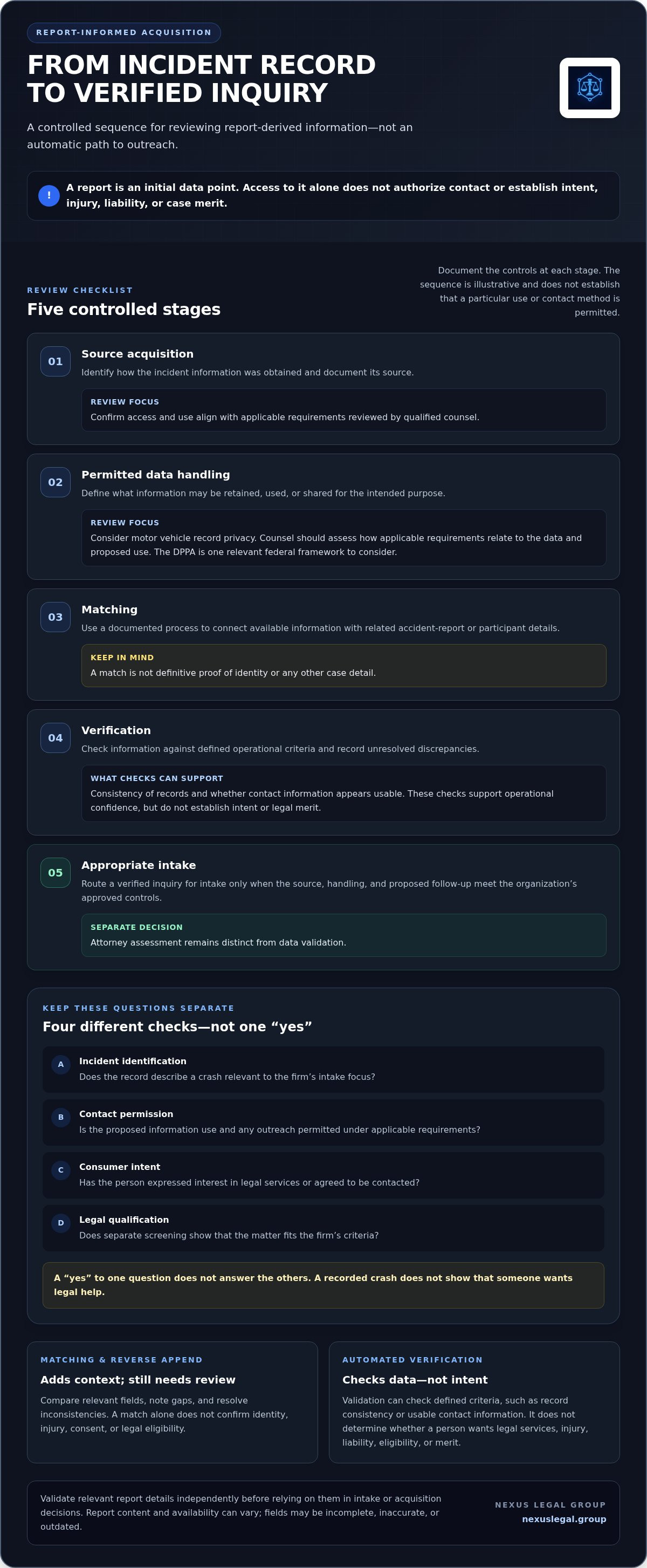
Keep four questions separate:
- Incident identification: Does the record describe a crash relevant to the firm’s intake focus?
- Contact permission: Is the proposed use of the information and any outreach permitted under applicable requirements?
- Consumer intent: Has the person expressed interest in legal services or agreed to be contacted?
- Legal qualification: Does separate screening show that the matter fits the firm’s criteria?
A “yes” to one question doesn’t answer the others. In particular, access to a report alone should never be treated as authorization to contact someone. Rules for report access and personal information can vary, so counsel should assess which requirements apply to the data and its intended use. The Driver's Privacy Protection Act (DPPA) is one relevant federal framework to consider when motor vehicle record information is involved. Its application depends on the information and circumstances.
What information may an accident report contribute to acquisition?
Depending on the jurisdiction and record, a report may include general incident details and information identifying people involved. These details can help a team identify a potential inquiry for further review, but report content and availability vary. Names, dates, and other fields may be incomplete, inaccurate, or outdated. Validate relevant details independently before relying on them in intake or acquisition decisions.
Why a report is not proof of intent or case viability
A recorded crash shows that an incident was documented, not that a person wants legal help. A report also doesn’t prove injury, liability, eligibility, case merit, or whether someone already has representation. Each point needs separate evaluation through an appropriate intake process. When assessing report-generated MVA leads, consider how the information was sourced alongside the safeguards that determine whether an inquiry is suitable for follow-up.
How Report-Informed Marketing Moves from Incident Data to a Verified Inquiry
A report-informed acquisition workflow is a sequence of controlled decisions, not an automatic path from incident record to outreach. Each stage should follow documented controls and applicable requirements reviewed by qualified counsel. The sequence below is illustrative. It doesn’t establish that a particular data use or contact method is permitted.
- Source acquisition: Identify how the incident information is obtained and document its source. Access and use should align with applicable, counsel-reviewed requirements.
- Permitted data handling: Define what information may be retained, used, or shared for the intended purpose. The privacy of motor vehicle records is a relevant consideration. Counsel should assess how the applicable framework relates to the data and proposed use.
- Matching: Use a documented process to connect available information with related accident-report or participant details. Don’t treat a match as definitive proof.
- Verification: Check the resulting information against defined operational criteria and record unresolved discrepancies.
- Appropriate intake: Route a verified inquiry for intake only when the source, handling, and any proposed follow-up meet the organization’s approved controls.
Where reverse append and data matching fit
Reverse append uses available information to obtain related accident details and information about people involved. It can add context to an initial record, but a match alone doesn’t confirm identity, injury, consent, or legal eligibility. Treat the result as a candidate for review: compare relevant fields, note gaps, and resolve inconsistencies before deciding on next steps. Using police accident reports for marketing should never make enrichment an automatic outreach trigger.
Data enrichment adds context; it doesn’t verify a person’s intent to engage with a law firm. Intent requires its own evidence and review, separate from the incident record.
What automated verification should establish
Automated verification can check inquiry details against criteria defined for the acquisition workflow, such as whether records are consistent or contact information appears usable. These checks support operational confidence, but they don’t establish that a person wants legal services. They also don’t determine injury, liability, eligibility, or legal merit. Attorney assessment remains distinct from data validation. A fuller verified MVA lead framework can help clarify how verification fits into responsible intake.
For plaintiff firms assessing how acquisition inputs and verification can work together, Nexus Legal Group’s MVA case acquisition infrastructure brings these considerations into a broader workflow.
Police Reports vs. Other Accident Data: Choosing the Right Marketing Input
Each acquisition input answers a different question. Police reports can help identify documented incidents and participants. Emergency-services data offers a distinct incident-related signal, while consumer-submitted inquiries indicate that someone has taken an action to express interest. These inputs aren’t interchangeable, and none is automatically ready for outreach without source-specific review.
| Input | Likely role | Possible information gaps | Verification and next step |
|---|---|---|---|
| Police reports | Identify a documented crash and potentially related participants. | Fields, completeness, availability, and release timing can vary by jurisdiction. | Validate relevant details, assess permitted use, and route for review before any outreach decision. |
| Emergency-services data | Provide a separate incident-related input for acquisition review. | The information available may not establish participant details, consumer interest, or legal qualification. | Assess its source and intended use, then verify relevant inquiry details through the intake process. |
| Consumer-submitted inquiries | Signal that a person has taken an action to express interest. | Submitted details may be incomplete, inaccurate, or insufficient to assess the matter. | Validate the information and evaluate the inquiry under defined intake criteria before proceeding. |
When police reports can support an acquisition workflow
Reports may help a firm identify an incident and people associated with it, creating a starting point for further review. Publication, access, included fields, and release timing vary across jurisdictions. Using police accident reports for marketing therefore takes more than locating a record. Firms need separate controls for data use and outreach, informed by applicable requirements and qualified counsel.
When emergency-services or consumer-requested data adds context
Emergency-services data is a distinct acquisition input, not a substitute for a police report. It may add context, but it doesn’t automatically establish a person’s interest in legal services. A consumer-submitted inquiry offers a different signal because the person has expressed interest, yet its details still need verification and appropriate intake review.
Choose a source based on the question it can responsibly help answer, the gaps your workflow can resolve, and the controls governing its use. For broader source-selection context, explore data-driven case acquisition resources. The same governance discipline applies to compliant legal lead generation: source information is one part of a controlled acquisition process.
A Practical Governance Workflow for Report-Based Law Firm Marketing
Using police accident reports for marketing calls for a review process that separates access, data quality, and outreach decisions. Before launch, qualified counsel should assess the applicable federal, state, and professional requirements for the jurisdictions, information sources, and contact methods involved. Assign an owner to each review stage so questions, exceptions, and corrections have a defined path.
- Source: Document where report information comes from, how it was obtained, and which jurisdictions or record types are in scope.
- Permitted purpose: Record the intended use and have counsel assess whether the source and proposed data use are appropriate.
- Data minimization: Limit collection and access to information needed for the approved workflow. Define who can view or handle it.
- Validation: Check relevant fields for completeness and consistency. Establish a process to flag discrepancies and handle corrections.
- Outreach: Review proposed channels, applicable consent records, and attorney-advertising considerations separately from report access. Set a clear escalation path for uncertain cases.
- Monitoring: Review exceptions, complaints, corrections, and suppression requests. Document how issues are resolved and how the workflow is updated.
Separate data access review from outreach review
Access to a report and the decision to contact a person are different questions. Counsel should assess source access and data-use conditions for each relevant jurisdiction, then separately review contemplated outreach channels and related records. A report’s availability, including public accessibility where applicable, shouldn’t be treated as blanket permission for marketing contact.
Measure workflow quality without overstating legal outcomes
Operational measures can show where a process needs attention. Track record completeness, verification outcomes, inquiry disposition, and exceptions such as mismatched details or corrected information. Assign an owner to investigate recurring issues, document resolution, and ensure suppression requests are reflected in the workflow. These indicators describe process performance; they don’t establish case merit, signed-case results, or legal outcomes. For consent-centered process considerations, see compliant MVA outreach guidance.
Define these controls before activation, then revisit them when sources, jurisdictions, or outreach methods change. This gives the firm a consistent basis for reviewing report-derived information without confusing data availability with outreach authorization.
How Nexus Legal Group Integrates Police Reports into MVA Case Acquisition
Nexus Legal Group provides legal technology and growth infrastructure for plaintiff firms, not direct legal representation. Its MVA case acquisition services combine police reports, emergency-services data, reverse append, and automated verification as distinct inputs and process steps. This approach supports inquiry identification and review without treating any single record as proof of a qualified case.
From report-derived information to litigation-ready inquiries
Police reports can contribute incident and participant details, while emergency-services data offers another incident-related input. Reverse append uses available information to obtain related accident details and information about people involved. Automated verification then supports review of inquiry details against defined operational criteria. Together, these steps can add context and help organize intake, but data enrichment doesn’t establish a person’s intent to engage or determine legal merit.
“Litigation-ready” should reflect the firm’s intake and legal-review decision, not a conclusion inferred from a report or data match. Assess whether information is suitable for follow-up under approved controls, and keep legal screening distinct from verification. Using police accident reports for marketing works best as part of a broader acquisition workflow, with each input reviewed according to its source and purpose.
Assess fit against your firm’s acquisition requirements
Evaluate an acquisition model against the requirements of your own process. Consider:
- Target matter profile: Does the input align with the types of MVA inquiries your firm is equipped to evaluate?
- Intake capacity: Can your team review and respond to inquiries through its established intake process?
- Verification needs: Which details require validation before an inquiry moves forward?
- Internal review: Are responsibilities and escalation steps clear when information is incomplete or inconsistent?
Then use the source-selection framework discussed earlier: identify what each source contributes, where gaps may remain, and what review is needed before the next step. Police reports may help surface an incident, while emergency-services data and consumer-submitted inquiries provide different signals. None replaces firm-specific intake or legal assessment.
Nexus Legal Group’s acquisition infrastructure combines these inputs with automated verification to support plaintiff firms’ MVA case acquisition workflows. Each component’s role depends on the firm’s requirements and its controls for review and outreach.
Build a More Controlled MVA Acquisition Workflow
An accident report can signal a documented incident, but it doesn’t establish permission to contact, consumer intent, or case viability. Using police accident reports for marketing responsibly means separating source review, permitted use, validation, and outreach decisions, with qualified counsel assessing applicable requirements before launch.
A disciplined acquisition process compares data inputs rather than treating them as interchangeable. Police reports and emergency-services data can inform inquiry identification. Reverse append can add related accident and participant details, while automated verification supports operational review. Firm intake and legal assessment remain separate from data enrichment.
Nexus Legal Group provides plaintiff firms with MVA case acquisition infrastructure that brings these inputs into a broader workflow. The focus is on supporting acquisition and review, not replacing a firm’s intake criteria or legal judgment. Clear controls help your team evaluate information consistently and build a process suited to its requirements.
To discuss how Nexus Legal Group’s MVA case acquisition infrastructure can support your firm’s workflow, get in touch with the team.
Frequently Asked Questions
Can law firms use police accident reports for marketing?
Potentially, but use depends on the report source, intended purpose, jurisdiction, and proposed outreach. Treat report information as an acquisition input, not automatic authorization to market. Before using police accident reports for marketing, have qualified counsel assess applicable federal, state, and professional requirements. Document permitted data handling and outreach controls for the workflow. A report can help identify an incident for further review, but it doesn’t establish that contacting anyone is appropriate.
Does a police accident report give a law firm permission to contact someone?
No. Access to a report, including its availability as a record, shouldn’t be treated as permission to contact a person. Report access and outreach are separate questions, and the rules may depend on the source, jurisdiction, data, and contact method. Have qualified counsel review those factors before outreach begins. Keep this review distinct from matching or verifying report details, since neither process establishes a person’s willingness to hear from a law firm.
What information can a police accident report provide for marketing?
A report may provide incident details and information about people involved, depending on the record and jurisdiction. These details can help identify a potential inquiry for additional review, but fields, completeness, and availability vary. A report doesn’t prove injury severity, fault, liability, legal eligibility, representation status, or consumer intent. Validate relevant information independently, and assess whether its use and any planned follow-up fit the controls established for the acquisition workflow.
Are police accident reports public records in every state?
No single answer applies across every state. Report access, public-record status, available fields, and release timing can vary by jurisdiction and by the circumstances of a request. Don’t assume a report is publicly accessible or that public access permits marketing use. Before building a workflow around these records, have qualified counsel assess applicable rules for the relevant jurisdictions and sources, including any limits on obtaining, handling, or using personal information.
How can law firms verify leads generated from accident reports?
Start by checking report-derived details for completeness and consistency, then validate inquiry information against criteria defined for your intake process. Automated verification can support these operational checks, such as flagging mismatched details or contact information that needs review. Keep contactability separate from consent or permission to reach out, and keep both separate from attorney assessment of legal merit. A report match alone doesn’t confirm identity, intent, injury, eligibility, or case viability.
Are police-report-based MVA leads better than emergency-services leads?
Not categorically. Police reports and emergency-services data are different acquisition inputs, and their usefulness depends on the firm’s target matters, information needs, and review process. A report may help identify a documented incident and participants; emergency-services data offers a distinct incident-related signal. Neither should be assumed to be more accurate, available, faster, or likely to convert without supporting evidence. Compare source fit, possible gaps, and verification needs before choosing a workflow.
What should a law firm review before using accident reports in marketing?
Review the data source and its permitted purpose first, then define what information is necessary, how details will be validated, and who owns each decision. Have qualified counsel assess applicable federal, state, and professional requirements before launch, including rules relevant to access, personal information, advertising, and outreach. Document escalation, correction, and suppression processes, and monitor exceptions. Keep operational quality measures separate from conclusions about consumer intent, legal merit, or case outcomes.