Motorcycle Accident Client Acquisition: 2026 Growth Guide
Master motorcycle accident client acquisition tactics with our 2026 guide. Learn how to qualify leads, streamline intake, and scale your law firm's growth.
A high volume of motorcycle accident inquiries can still produce weak growth if too many fall outside your firm’s case criteria or arrive faster than intake can assess them. Effective motorcycle accident client acquisition tactics connect targeting, verification, and follow-up instead of relying on lead count alone.
That distinction matters when choosing between channels or evaluating a provider. A source may generate relevant inquiries, but its value also depends on how those inquiries are verified, handed off, and handled by your team. Without consistent criteria, it’s difficult to see whether acquisition is efficient or where potential cases are dropping out.
This guide compares practical acquisition approaches and the questions to ask about sourcing, qualification, and workflow fit. You’ll learn how data-led options, including police-report and emergency-services approaches, may fit within a broader intake process, and how to assess them against your firm’s capacity. The goal is a measurable system that prioritizes case fit, verification, and timely follow-up.
Key Takeaways
- Compare awareness channels, inquiry-generation models, and intake operations as distinct parts of acquisition.
- Assess motorcycle accident client acquisition tactics against targeting, verification, handoff, reporting, and internal workload.
- Ask providers to define terms such as “exclusive,” “qualified,” and “verified” before comparing inquiry sources.
- Use a consistent testing sequence: set case criteria, choose an approach, configure intake, measure outcomes, and refine.
- Choose an internal, provider-led, or combined model based on your firm’s case criteria and capacity to handle inquiries.
Motorcycle Accident Client Acquisition Tactics: What Firms Should Compare
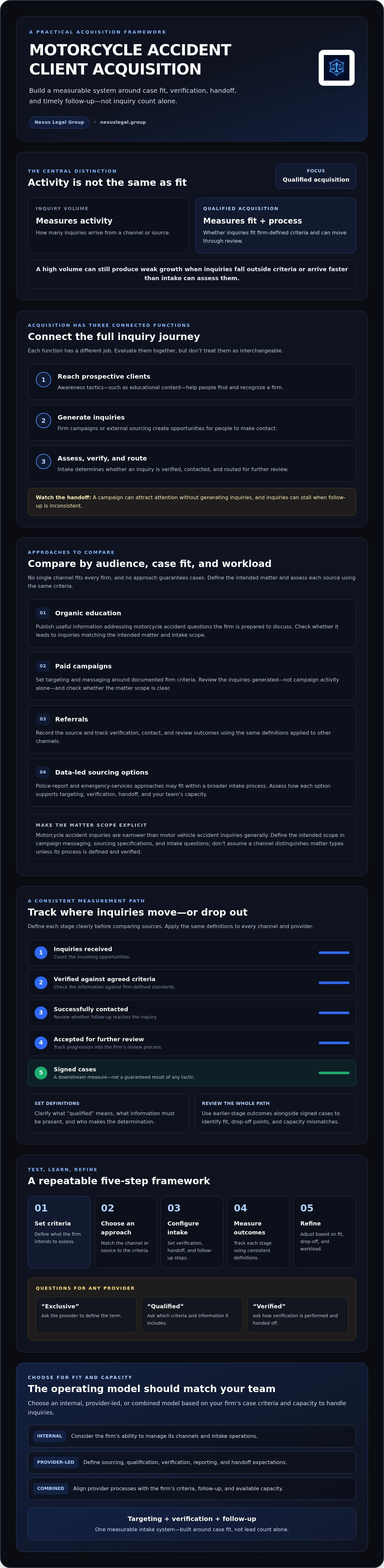
Motorcycle accident client acquisition tactics work best when a firm evaluates the full process, not just the channel that generates an inquiry. Client acquisition connects three tasks: reaching prospective clients, assessing whether an inquiry meets firm-defined criteria, and routing it through the appropriate intake process. Put simply: inquiry volume measures activity; qualified acquisition measures whether inquiries fit the firm’s criteria and can move through its review process.
Separate three functions before comparing approaches. Awareness tactics, such as educational content, help prospective clients find and recognize a firm. Inquiry-generation models create opportunities for people to make contact, through a firm’s own campaigns or external sourcing. Post-inquiry intake operations determine whether an inquiry is verified, contacted, and routed for further review. These functions connect, but they aren’t interchangeable. A campaign can attract attention without generating inquiries, and inquiries can stall if follow-up is inconsistent.
These distinctions sit within the broader field of legal marketing strategies, which includes how firms communicate with and reach prospective clients. For acquisition decisions, focus on how each approach fits your target matter, defined case criteria, and capacity to handle incoming inquiries.
How motorcycle accident acquisition differs from general audience marketing
A campaign’s relevance depends on the matters the firm intends to assess and the intake resources available. Motorcycle accident inquiries are narrower in scope than motor vehicle accident inquiries generally, since a broad MVA approach may include other types of incidents. Make the intended scope explicit in campaign messaging, sourcing specifications, and intake questions. Don’t assume a channel will distinguish between matter types unless its process is defined and verified.
Let firm criteria guide the review. Decide what information intake needs to determine whether an inquiry merits further assessment, then check that the acquisition approach can support that process. For example, specify whether intake needs incident details, participant information, or a clear record of how the inquiry was sourced.
Which outcomes should a law firm evaluate?
Track each stage separately: inquiries received, inquiries verified against agreed criteria, inquiries successfully contacted, and inquiries accepted for further review. Define “qualified” before comparing providers or channels, including what information must be present and who makes the determination. Otherwise, two sources may use the same label for different outcomes.
Signed cases may be a downstream measure, but they aren’t a guaranteed result of any tactic. Review them alongside earlier-stage measures to see where inquiries fit, where they drop out, and whether your intake capacity matches the volume and type of opportunities generated.
Five Acquisition Tactics for Reaching Motorcycle Accident Prospects
There’s no single channel that fits every firm. Compare each model by the audience it can reach, how well it aligns with your case criteria, and the work required from your team after an inquiry arrives. The motorcycle accident statistics published by the National Highway Traffic Safety Administration can provide context for educational planning, but they don’t establish whether a particular inquiry fits your practice.
These five approaches can be tested independently or combined. None guarantees cases. Each needs defined targeting and a consistent way to assess results.
Firm-managed channels: education, paid campaigns, and referrals
- Organic education: Publish clear, useful information addressing motorcycle accident questions your firm is prepared to discuss. Relevant content can build visibility, but measure whether it leads to inquiries that match the firm’s intended matter and intake scope.
- Paid campaigns: Set targeting and messaging around documented firm criteria. Review the inquiries generated, not just campaign activity, and check whether targeting attracts motorcycle accident matters or a broader mix of MVA inquiries.
- Referrals: Treat referrals as a relationship channel, not an exception to measurement. Record their source and track verification, contact, and review outcomes using the same definitions as other channels.
These firm-managed channels give the firm direct control over its content, campaign choices, or referral relationships, but they also require internal ownership. For more on how behavioral trends and data enrichment relate to MVA inquiries, see this high-conversion MVA leads analysis.
Data-led and provider-supported acquisition
Data-led sourcing uses information associated with incidents to support inquiry acquisition. Nexus Legal Group’s MVA acquisition approach includes police-report and emergency-services data, as well as reverse append technology to obtain accident-report information and details about people involved. These are sourcing models to assess, not proof that an inquiry meets a firm’s criteria. Learn more about the approach in this discussion of police-report-generated MVA leads.
Specialist acquisition providers can supply external infrastructure alongside a firm’s own marketing and intake operations. Before engaging a provider, ask how sourcing, verification, qualification, and handoff are defined. Confirm reporting and workflow details rather than assuming they’re included. Nexus Legal Group describes its work as MVA acquisition infrastructure, including automated verification. Firms evaluating that model can review Nexus Legal Group’s acquisition approach and assess whether it complements their internal capacity.
How to Compare Tactics by Fit, Verification, and Operational Load
Evaluate each acquisition approach against the same criteria. This makes differences in sourcing and workflow visible instead of letting an attractive inquiry count stand in for performance. Lead volume alone does not establish acquisition quality; quality depends on fit, verification, handoff, and the firm’s ability to act on an inquiry.
Use this framework to compare firm-managed channels and provider-supported acquisition. Ask for definitions in writing: “exclusive” should describe whether an inquiry is shared, “qualified” should identify the criteria applied, and “verified” should specify what was checked. Don’t assume these terms mean the same thing across providers.
| Comparison area | What to establish |
|---|---|
| Source | How is the inquiry generated or sourced, and what information supports that description? |
| Targeting | How does the approach align with the firm’s motorcycle accident matter criteria? |
| Verification | What details are checked, by what process, and how is verification recorded? |
| Handoff | What information reaches intake, through what channel, and at what point? |
| Reporting | Can the firm review source, contact status, verification status, and disposition? |
| Internal workload | Which steps remain with firm staff, including follow-up and further review? |
Questions to ask an acquisition provider
Request a clear account of inquiry sources and verification steps, including what is documented and shared with your team. Confirm what information intake receives and when. Ask directly about reporting, exclusivity terms, integration options, and service availability. Treat each as a point to verify, not an assumed feature. These questions help you understand how the process would work alongside your existing systems.
Match the tactic to intake capacity and case criteria
Before launch, map the route from receipt to review: who owns first contact, what information is collected, who assesses fit, and how unresolved inquiries are escalated. Then compare the expected inquiry flow with staff capacity. A sourcing model that fits your case criteria may still create friction if the team can’t manage its handoff consistently.
Separate process indicators, such as verified inquiries, completed follow-up, and review disposition, from downstream outcomes such as signed cases. Process indicators can help identify operational gaps; no acquisition tactic should be treated as guaranteeing signed cases. If you use a limited evaluation period, agree on its scope, definitions, reporting, and measurement in advance. These criteria make comparisons between motorcycle accident client acquisition tactics more actionable and consistent.
A Practical Framework for Testing and Improving Acquisition
A useful acquisition test starts with a defined question: can this approach generate motorcycle accident inquiries that fit the firm’s criteria and move through intake reliably? Use the same definitions and review window across sources so the comparison reflects differences in performance, not differences in tracking.
Apply a repeatable sequence:
- Define criteria: Document the motorcycle accident matters the firm intends to assess and the information intake needs to review an inquiry.
- Select a tactic: Choose the channel or provider model to evaluate, and record what it is intended to contribute.
- Configure intake: Assign ownership, confirm the handoff, and prepare a consistent method for recording outcomes.
- Measure: Review both inquiry fit and the operational steps required to process each inquiry.
- Refine: Identify gaps in targeting, verification, contact handling, or recordkeeping, then adjust the process before drawing conclusions.
Set up a controlled acquisition test
Before launch, write down the firm’s matter criteria and agree on what counts as an inquiry that merits further review. Define what “verified” means for the test. A verified MVA lead framework can help inform the questions your team asks about verification, but your firm should document the criteria it will apply.
Assign an intake owner and establish one logging method before inquiries arrive. For each record, capture the source, contact status, verification status, disposition, and follow-up completion. Test the tracking and handoff process before judging the tactic. If staff can’t reliably see an inquiry or log what happened next, comparisons between channels won’t be dependable.
Interpret results without relying on vanity metrics
Review the full sequence, not just the number of inquiries received. Compare how many appear relevant under your agreed criteria, how many have completed verification, whether contact handling is recorded, and how much staff effort each source requires. Keep definitions and the review window consistent across channels; otherwise, one source may appear stronger simply because it was measured differently.
Investigate missed contacts and incomplete records before attributing weak outcomes to a channel. A breakdown may point to a handoff or documentation gap rather than poor targeting. Avoid broad conclusions from a small or inconsistent sample, and state the limitation plainly. These steps make motorcycle accident client acquisition tactics easier to evaluate and improve without treating signed cases as a promised result.
Choosing an Acquisition Partner and Defining the Next Step
The right acquisition model depends on what your firm already manages well and where it needs additional capacity. Internal channels may suit firms with established marketing and intake workflows that can support ongoing testing. A specialist provider may be worth evaluating when the firm wants structured MVA inquiry sourcing and verification without building every sourcing component internally. A combined model can pair firm-managed education or referrals with external acquisition infrastructure.
Use the same decision criteria for each option: transparent sourcing, a clearly described verification workflow, a defined intake handoff, and reporting your team can use. The best fit isn’t simply the model that generates the most inquiries. It’s the approach that aligns with your documented matter criteria and the people and processes available to review incoming inquiries.
When a provider-supported model may fit
A provider-supported approach may be relevant if your firm is evaluating structured MVA inquiry acquisition, automated verification, or data-led sourcing. Nexus Legal Group describes national MVA acquisition infrastructure that includes police-report and emergency-services data approaches and reverse append technology. This is not a motorcycle-only service, so confirm whether its sourcing and qualification process can align with the motorcycle accident matters your firm intends to review.
Assess the workflow alongside your team’s capacity. Clarify which verification steps are handled externally, what information reaches intake, and what review and follow-up remain with firm staff. Don’t assume exclusivity, conversion rates, motorcycle-specific availability, or case outcomes. Confirm applicable details directly before proceeding.
Questions to resolve before moving forward
Before selecting a partner, document the target matter definition, sourcing methods, verification steps, and handoff expectations. Ask what operational and performance details can be put in writing, including how inquiries are described, what reporting is available, and which process responsibilities remain with your team. Confirm any terms or capabilities that affect implementation rather than relying on general labels.
A structured acquisition model should fit into the firm’s broader growth process, not operate as a disconnected source of inquiries. For additional context on motorcycle accident client acquisition tactics, consult the legal case acquisition overview and resources. Then compare the model against your criteria, intake capacity, and measurement plan before deciding whether it merits a test.
To consider whether Nexus Legal Group’s MVA acquisition infrastructure fits your firm’s workflow, review Nexus Legal Group acquisition infrastructure and discuss your requirements with the team.
Build an Acquisition Process Your Intake Team Can Sustain
Strong motorcycle accident client acquisition tactics aren’t defined by inquiry volume alone. They connect relevant targeting with firm-defined criteria, verification, a clear handoff, and the capacity to follow up. Compare channels using consistent definitions, track inquiries through contact and review, and refine the process when your records reveal friction.
Provider-supported acquisition may complement internal channels when its sourcing model and workflow fit your firm. Nexus Legal Group describes national MVA acquisition infrastructure that pairs AI-driven marketing precision with automated verification, using police-report and emergency-services data and reverse append approaches. These are MVA capabilities, not a motorcycle-only offering. Confirm sourcing, qualification, and handoff details directly, and assess signed cases as a possible downstream outcome, not a guaranteed result.
To assess whether Nexus Legal Group’s MVA acquisition infrastructure fits your firm’s criteria and intake workflow, review the acquisition capabilities and discuss your requirements with the team.
Frequently Asked Questions
What are the most effective motorcycle accident client acquisition tactics?
The most effective approach depends on your firm’s matter criteria, target audience, intake capacity, and measurement process. Compare education-led marketing, paid campaigns, referrals, data-led sourcing, and specialist acquisition providers based on inquiry relevance, verification, handoff quality, and staff workload. No channel is automatically right for every firm. Treat inquiry volume and provider labels as starting points for evaluation, not proof that an inquiry suits your practice.
How can a law firm evaluate motorcycle accident leads?
Start by defining the firm’s case criteria and the information intake staff need to assess each inquiry. Then track its source, verification status, contact attempts, disposition, and follow-up completion consistently. Ask providers to explain how inquiries are sourced and what their verification process covers. A “qualified” or “verified” label alone doesn’t establish suitability. Your firm’s review determines whether an inquiry meets its criteria and merits further consideration.
Are motorcycle accident leads different from general MVA leads?
Motorcycle accident inquiries fall within the broader motor vehicle accident category, but your firm may assess them using distinct matter criteria or intake questions. Define those distinctions before comparing channels or providers. Ask whether a campaign or acquisition workflow can support the scope you intend to review. Don’t assume a general MVA service includes a separately defined motorcycle-specific program; confirm the provider’s actual targeting and process directly.
What should a firm ask a motorcycle accident lead provider?
Ask how inquiries are sourced, what “verified” means, which details your intake team will receive, and how information is handed off. Clarify whether inquiries are exclusive, what reporting is available, and which service terms apply. Request clear definitions and operational details in writing, then confirm provider-specific capabilities directly. Finally, compare the proposed workflow with your case criteria, staffing, and follow-up process before deciding whether it fits.
Can police reports help with motorcycle accident client acquisition?
Police-report-based sourcing is one potential approach, but its usefulness depends on the information available, its relevance to your criteria, and your firm’s review process. Ask how reports are obtained, what details may be supplied, and how records are verified. Don’t assume every incident has an accessible report. A report can inform intake review, but it doesn’t establish that an inquiry is suitable or that the firm will provide representation.
How should firms measure motorcycle accident acquisition performance?
Track more than total inquiries. Use consistent definitions to record source, verification completion, successful contact, intake disposition, follow-up completion, and staff workload. Compare channels using the same measurement rules and review window so the results are meaningful. If records are incomplete or the volume is limited, state that limitation and interpret results cautiously. These process measures help identify operational gaps, but they don’t guarantee legal outcomes.
Is a motorcycle accident acquisition provider the same as an SEO agency?
Not necessarily. An acquisition provider may focus on sourcing and verifying inquiries or supporting a defined intake workflow, while an SEO agency generally provides services such as organic search strategy. Confirm the provider’s actual scope, deliverables, and responsibilities before engagement. Nexus Legal Group describes its offering as MVA case acquisition infrastructure, including automated verification, and does not offer general SEO agency services.
How can a firm check whether a lead generation approach is compliant?
Ask the provider to explain its sourcing, consent, verification, and data-handling processes, then have appropriate firm personnel review the arrangement against applicable requirements. Relevant considerations can depend on the activity and jurisdiction, so don’t rely on broad assurances or generic claims alone. Document responsibilities and seek qualified guidance if your review identifies uncertainty. Nexus Legal Group describes its lead generation as ethical and compliant, but firms should assess the specific workflow they may use.