Martindale-Nolo Alternatives: High-Intent Case Acquisition for Elite Firms in 2026
Tired of shared leads? Discover Martindale-Nolo alternatives that use data to deliver exclusive, high-intent cases directly to your elite firm. Stop filtering.
The traditional directory model has become a strategic bottleneck for high-performance firms. You've likely felt the friction of paying premium rates for shared, low-intent inquiries that force your intake team to act as high-priced filters rather than closers. It's frustrating to watch your ROI stagnate while you compete in the same crowded pools. Many elite practices are now actively seeking Martindale-Nolo alternatives that offer more than just a digital storefront; they're looking for systems that prioritize exclusivity and technical precision.
This article explores why the industry's top-tier firms are abandoning passive lead generation in favor of a specialized, data-driven case acquisition infrastructure. You'll discover how to replace unpredictable directory traffic with a predictable flow of litigation-ready inquiries. We'll examine the shift toward utilizing police report data and automated verification systems to eliminate wasted resources. By the end of this guide, you'll understand how to build a growth engine that delivers high-intent MVA and Mass Tort cases with clinical efficiency and total operational control.
Key Takeaways
- Shift your firm's focus from passive directory presence to a robust case acquisition infrastructure that actively identifies and secures high-intent claimants.
- Understand the strategic advantages of Martindale-Nolo alternatives that prioritize exclusive data streams over commodity, shared lead pools.
- Leverage the mechanics of police report data and reverse append technology to obtain comprehensive profiles of individuals involved in recent accidents.
- Reduce intake friction and wasted resources by implementing automated verification systems that deliver only litigation-ready inquiries to your firm.
- Transform your marketing spend into a predictable growth engine by moving away from broad search behavior toward specific, data-driven incident triggers.
The Shift from Directory Listings to Case Acquisition Infrastructure
The historical reliance on directory-based visibility is giving way to a more aggressive, systemic approach. For decades, firms viewed Martindale-Hubbell and similar platforms as the primary gateway to digital exposure. This legacy model is fundamentally passive. It relies on a consumer experiencing a legal crisis, initiating a search, and then selecting a profile from a crowded list. In 2026, elite plaintiff firms are recognizing that visibility is a vanity metric that often masks deep operational inefficiencies. They're moving toward Martindale-Nolo alternatives that treat case acquisition as a mechanical process rather than a marketing gamble.
Elite firms don't just want more leads; they want litigation-ready inquiries. This shift marks the transition from simple lead generation to a comprehensive case acquisition infrastructure. While the old model focuses on the top of the funnel, modern infrastructure bridges the gap between raw data and a signed retainer. It's about moving from a "pay-to-play" model to one defined by data ownership and exclusive access.
The Limitations of Passive Legal Marketing
Passive marketing creates an inherent friction. When you wait for a consumer to find your profile, you're competing with every other firm in a shared lead pool. This dilution of quality is a significant drain on resources. Most directory-generated inquiries aren't exclusive, meaning your intake team is racing against competitors to contact a single claimant. The overhead required to vet these unqualified inquiries often erodes the ROI of the initial spend. It's a high-friction environment that rewards speed over substance, forcing firms to waste valuable intake resources on low-intent data.
Defining Growth Infrastructure for Modern Firms
A law firm growth infrastructure replaces these fragmented tools with a unified, data-driven system. Instead of waiting for search triggers, this model uses AI and specific incident data to identify high-intent claimants immediately after an event occurs. This allows firms to engage with potential clients before they enter the general market or get lost in the directory noise.
The gold standard in 2026 is end-to-end connectivity. This means your acquisition system doesn't just deliver a name; it provides a verified, litigation-ready profile. By integrating automated verification and data-scraping technologies, firms can ensure that every inquiry meets strict qualifying criteria before it ever reaches a human intake specialist. This level of systemic integrity is what separates scaling firms from those stuck in the directory loop.
Evaluating Martindale-Nolo: Why Specialized Firms Seek Alternatives
Martindale-Nolo, part of the broader Martindale-Avvo "Authority Suite," remains a ubiquitous presence in the legal marketing sector. However, its broad-market focus often creates a mismatch for firms specializing in high-stakes MVA and Mass Tort litigation. While these platforms provide visibility, the inquiries generated are frequently commoditized. Elite firms are increasingly pivoting toward Martindale-Nolo alternatives because they require a higher degree of technical precision than a general directory can offer. The goal isn't just to be seen; it's to acquire cases that fit specific litigation profiles with minimal friction.
The fundamental issue lies in the quality-to-volume ratio. Broad directories prioritize traffic over intent. This leads to a high volume of inquiries that lack the specific criteria necessary for complex litigation. While legal advertising is regulated by state bar associations to ensure ethical standards, the commercial reality of directory models often results in a "numbers game" that drains firm resources. When you're managing high-stakes cases, you can't afford to sift through a hundred low-intent inquiries to find one viable client.
The Shared Lead Dilemma
A primary driver for seeking alternatives is the non-exclusive nature of many directory leads. When a platform sells the same inquiry to three or four different firms, it triggers an immediate race to the bottom. This isn't just about speed to lead; it's about the erosion of the consumer experience. A claimant who's just experienced a traumatic event doesn't want to be bombarded by multiple firms simultaneously. This practice can damage your firm's brand reputation before a conversation even begins. For elite practices, exclusivity isn't a luxury; it's a requirement for maintaining high conversion rates and professional decorum.
Intent Gaps in General Legal Directories
There's a significant difference between a "lawyer search" and behavioral incident data. A consumer browsing a directory might just be researching, whereas someone involved in a documented accident has a verified, high-intent need. General directories often fail to capture the granular details required for MVA or Mass Tort cases, such as specific injury types or liability factors. This lack of filtering forces your intake team to act as manual veters, which is an incredibly expensive way to use human capital. If you find your team is spending more time disqualifying leads than signing cases, it's likely time to evaluate your acquisition infrastructure for more specialized options.
The hidden cost of "cheap" directory leads is the massive overhead required to process them. Every minute your staff spends on a low-intent inquiry is a minute lost on a high-value case. Modern Martindale-Nolo alternatives eliminate this friction by delivering inquiries that are already verified against your firm's specific litigation criteria, ensuring your resources are focused strictly on high-ROI activities.
Data-Driven Alternatives: Moving Beyond Shared Lead Pools
The fundamental distinction between legacy platforms and modern Martindale-Nolo alternatives lies in the shift from a directory model to a data acquisition model. In the directory model, firms pay for visibility on a platform that relies on consumer search behavior and broad SEO profiles. This approach is inherently passive and often results in shared lead pools where multiple firms compete for the same claimant. Conversely, a data acquisition model focuses on incident-specific data and reverse append technology to identify high-intent individuals immediately after an event occurs. This transition allows elite firms to bypass the general market and secure exclusive inquiries before they become commoditized.
Risk mitigation is a critical component of this evolution. Implementing compliant legal lead generation ensures that your firm's growth isn't just fast, but also ethically sound. Shared lead pools often carry higher regulatory risks because the same consumer may be contacted by several organizations, leading to potential solicitation complaints. By owning the data and maintaining exclusivity, firms can control the entire claimant experience, reducing friction and protecting their professional standing.
Evaluating Exclusivity and Lead Ownership
True exclusivity requires a sophisticated technical infrastructure that goes beyond simple contact forms. It involves real-time data processing where an inquiry is matched to a single firm based on pre-defined litigation criteria. When your firm owns the data associated with an inquiry, you aren't just buying a name; you're acquiring a digital asset. This ownership allows for more nuanced follow-up strategies and long-term claimant management. Industry professionals often observe that exclusive inquiries result in significantly higher conversion rates compared to shared leads, primarily because the firm is not competing in a high-speed race to the phone. This stability fundamentally changes the economics of your practice, allowing for more predictable scaling and a higher return on marketing spend.
Precision Targeting for MVA and Mass Tort
Acquiring high-value cases in 2026 demands more than just a listing; it requires a proactive outreach strategy backed by hard data. For MVA practices, the window for engagement is narrow. Instead of waiting for a consumer to browse a directory, elite firms use automated systems to identify accident victims through police reports and emergency services data. This immediate, data-backed approach ensures that your firm is the first and only point of contact.
Complex litigation requires a similarly rigorous mass tort case acquisition strategy. AI-driven marketing plays a pivotal role here by filtering for high-value claims based on specific medical or liability triggers. This level of precision ensures that your acquisition pipeline is filled with litigation-ready inquiries rather than generic inquiries that require extensive manual vetting. By moving beyond the shared lead model, you're positioning your firm as a strategic architect of its own growth.
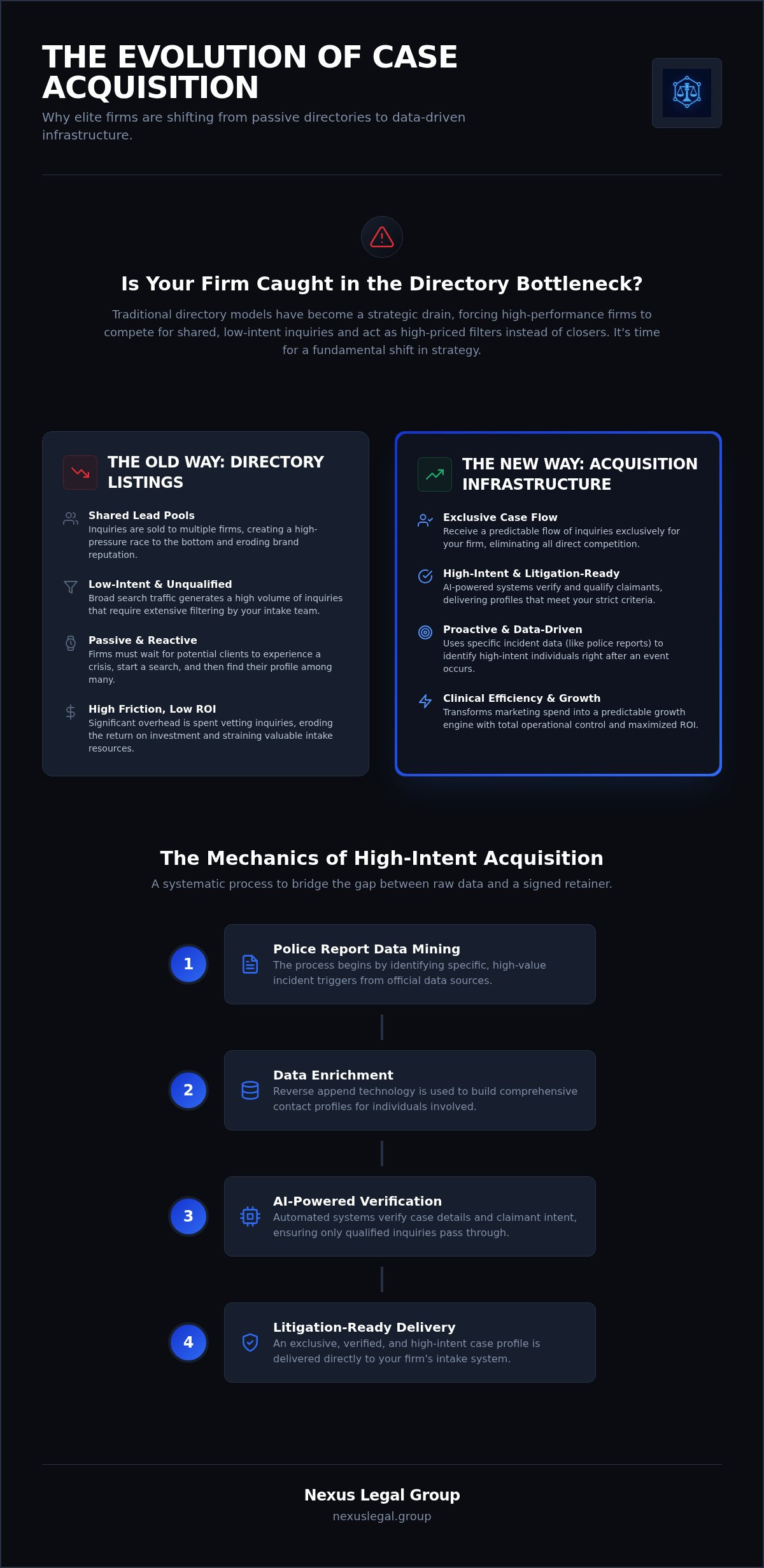
The Mechanics of High-Intent Acquisition: Police Reports and AI Verification
High-intent acquisition isn't about general visibility; it's about the mechanical precision of data integration. While traditional directories focus on broad search volume, modern Martindale-Nolo alternatives leverage specific incident triggers to identify potential claimants. This process begins with the systematic sourcing of real-time data from police reports and emergency services. By accessing these records, a firm can identify the exact date, location, and parties involved in a motor vehicle accident almost immediately after it occurs. This creates a foundational layer of verified data that bypasses the ambiguity of search engine behavior.
Harnessing Incident Data for MVA Cases
Sourcing police report generated MVA leads represents a fundamental shift in how firms approach growth. Rather than waiting for a claimant to initiate a search, the system identifies a verified incident. However, raw police data often lacks comprehensive contact information. This is where the reverse append process becomes essential. By cross-referencing incident data with proprietary databases, the system secures missing phone numbers and addresses, turning a simple report into a comprehensive claimant profile. This method ensures that your outreach is based on a documented event, which significantly increases the relevance and ethical standing of the communication. It's a proactive strategy that ensures your firm is engaging with individuals who have a confirmed, immediate need for legal representation.
Automated Verification and Intake Precision
Raw data is only the first stage of a sophisticated growth engine. To maintain a high-performance practice, firms must implement automated intake for plaintiff firms. This infrastructure uses AI to verify the litigation-ready status of each inquiry before it ever reaches your human intake specialists. The system filters for specific criteria such as insurance coverage availability, documented injury severity, and liability factors confirmed by official reports. This automated layer eliminates the friction of manual vetting and ensures that your high-priced legal staff only engages with inquiries that have already been qualified against your firm's specific litigation requirements.
By integrating emergency services data, this acquisition happens in real-time. This level of systemic integrity allows you to scale without a proportional increase in administrative overhead. Martindale-Nolo alternatives that utilize this technology provide a predictable flow of cases that are already vetted for high value, allowing your firm to focus its resources on litigation rather than lead qualification.
Nexus Legal Group: Engineering Exclusive, Litigation-Ready Case Flow
Elite firms don't want to merely participate in the legal marketplace; they want to dominate their specific practice areas. While many Martindale-Nolo alternatives focus on increasing visibility for smaller offices, Nexus Legal Group functions as a strategic architect for firms ready to scale through systemic infrastructure. We provide a foundational layer that replaces the unpredictability of directory-based leads with a high-performance engine designed for technical mastery. Our focus is strictly on high-intent MVA and Mass Tort acquisitions, ensuring that every operational resource you deploy is aimed at high-value outcomes.
The Nexus Advantage for Elite Plaintiff Firms
The core of our platform is an end-to-end AI driven legal case acquisition system that delivers litigation-ready inquiries with clinical precision. Unlike broad directories, we utilize police reports and emergency services data to identify incidents in real-time. Our automated verification engine then filters these data points against your firm's specific criteria, such as insurance coverage and injury severity. This level of systemic integrity ensures that your intake team isn't vetting leads, but rather closing signed cases. It's a scalable model that allows your firm to expand its footprint without the friction of traditional lead generation methods.
Operationalizing Your Firm's Growth
Transitioning from directories to infrastructure requires a shift in mindset. You're no longer managing a "marketing spend" that fluctuates with search volume. Instead, you're making a growth investment in a predictable, exclusive pipeline. Our onboarding process is designed to integrate seamlessly with your existing workflows, establishing a direct connection between incident data and your case management system. This eliminates the "commodity" nature of inquiries and places you in full control of your acquisition economics.
If you're ready to move beyond passive listings, we invite you to view our Nexus Legal Group videos for deeper operational insights. These resources demonstrate how our reverse append technology and automated intake systems function behind the scenes to drive institutional growth. By choosing a specialized infrastructure over a general directory, you're securing a future defined by operational excellence and a consistent flow of high-value litigation.
Transitioning to a Data-Driven Growth Infrastructure
The evolution of case acquisition in 2026 demands a departure from passive, shared lead pools. By prioritizing Martindale-Nolo alternatives that utilize direct incident data, your firm can eliminate the friction of manual vetting and the race to contact non-exclusive inquiries. You've seen how police reports and emergency services data provide a foundation for high-intent MVA and Mass Tort acquisition, ensuring your intake team only processes litigation-ready inquiries.
Implementing a sophisticated growth infrastructure means moving away from vanity metrics like visibility toward predictable, systemic results. AI-driven verification and automated intake represent the mechanics of modern firm expansion, allowing you to scale without increasing administrative overhead. The technical mastery of your acquisition pipeline is now the primary driver of ROI in a competitive legal landscape.
Your path to dominating the market starts with owning your data and automating your intake. It's time to build a more efficient, high-performance practice.
Frequently Asked Questions
How do Martindale-Nolo alternatives differ in lead exclusivity?
Most traditional directories sell the same lead to multiple firms, creating an immediate race to contact the claimant. Specialized Martindale-Nolo alternatives prioritize exclusivity by matching a single inquiry to a single firm. This infrastructure ensures your intake team doesn't compete with other offices for the same individual. Exclusive ownership allows for more methodical outreach and higher retention rates, as the consumer isn't overwhelmed by several firms simultaneously.
Why is incident data superior to directory-based legal leads?
Incident data is rooted in documented events like police reports and emergency services records, providing a verified signal of need. Directory-based leads rely on passive consumer search behavior, which often lacks specific intent or verified details. By using incident data, firms identify claimants immediately after a documented accident. This proactive approach bypasses the ambiguity of search engine traffic, delivering inquiries that are already anchored in a confirmed, litigation-ready event.
What is the average conversion rate for litigation-ready MVA inquiries?
Conversion rates for litigation-ready inquiries are significantly higher than general directory leads because the data has been pre-verified for intent and liability. While exact percentages vary based on a firm's internal intake efficiency, Martindale-Nolo alternatives that focus on litigation-ready data typically see much higher conversion rates than shared leads. This efficiency stems from the removal of unqualified traffic and the focus on claimants with documented, high-value accidents and available insurance coverage.
How does automated verification reduce law firm intake overhead?
With approximately 46% of firms with 100 or more attorneys now using AI, automated verification is becoming a standard operational layer. This technology filters inquiries against specific litigation criteria before they reach a human intake specialist. By automatically confirming insurance availability and assessing injury severity, firms significantly reduce their administrative overhead. Your team can focus exclusively on signing cases that have already been qualified, increasing overall operational efficiency.
Is data-driven case acquisition compliant with legal ethics standards?
Data-driven acquisition is designed to be ethical and compliant by utilizing public records and permission-based marketing protocols. Nexus Legal Group ensures all processes adhere to state bar regulations regarding lawyer advertising and claimant contact. By focusing on verified incident data rather than aggressive, unsolicited outreach, the system maintains high professional standards. This structured approach provides a transparent, compliant pathway for firms to acquire high-intent MVA and Mass Tort cases nationally.
Can high-intent MVA acquisition scale for national law firms?
High-intent acquisition is built for national scalability by leveraging a massive network of police reports and emergency services data across the country. This systemic approach allows elite firms to expand their footprint beyond regional boundaries without a proportional increase in marketing staff. The infrastructure handles the heavy lifting of data sourcing and automated verification, providing a consistent flow of litigation-ready inquiries regardless of the firm's target geographic volume.
What is reverse append technology in the context of legal marketing?
Reverse append technology is a data enrichment process that takes limited incident information, such as a name or vehicle plate, and matches it against proprietary databases to secure missing contact details. In legal marketing, this allows firms to turn a basic police report entry into a comprehensive claimant profile. This technology is essential for ensuring that outreach is accurate and that firms have the necessary information to initiate a professional, data-backed conversation.
How do specialized alternatives handle Mass Tort claimant acquisition?
Specialized Martindale-Nolo alternatives utilize AI-driven marketing precision to identify high-intent claimants for specific mass tort litigations. Instead of broad directory listings, these systems target individuals based on documented medical or liability triggers. This infrastructure delivers signed cases and qualified inquiries that are already vetted for specific case criteria. This methodical approach ensures that firms only acquire claimants who meet the rigorous standards required for complex, high-stakes mass tort litigation.