Litify Intake Alternatives: The 2026 Guide to High-Intent Growth Infrastructure
Find the best Litify intake alternatives for 2026. Stop scrubbing bad leads and build a growth infrastructure for high-intent, litigation-ready cases.
Your Salesforce-based CRM might be the very thing throttling your firm's scalability. While many elite plaintiff firms initially invest in complex platforms for their customization, they often find themselves buried under high overhead and a deluge of low-quality leads that require endless manual scrubbing. If you're searching for Litify intake alternatives, it's likely because you've realized that a general-purpose management tool isn't the same thing as a high-performance growth engine.
We understand the frustration of watching case conversion slow down because your intake team is stuck verifying basic accident details instead of signing cases. This guide promises to show you why the most successful firms are moving toward specialized growth infrastructure designed to deliver litigation-ready MVA inquiries directly into their pipeline. You'll discover how to replace manual bottlenecks with automated verification and data-driven sourcing. We'll explore the transition from passive lead management to a proactive system that utilizes police reports and emergency services data to ensure every inquiry has high-intent value and a clear path to ROI.
Key Takeaways
- Understand the fundamental shift from passive CRM lead management to active growth infrastructure designed to eliminate the operational friction of high-overhead, Salesforce-based systems.
- Identify the top Litify intake alternatives categorized by their ability to provide automated verification and high-intent sourcing rather than just basic administrative data storage.
- Learn how to leverage police reports and emergency services data to secure verified MVA cases that are litigation-ready from the moment of initial contact.
- Discover the technical requirements for transitioning your intake department from managing raw leads to processing qualified, high-intent inquiries that drive higher conversion rates.
- Evaluate the ROI advantages of an end-to-end acquisition infrastructure that provides consistent case volume through clinical precision and systemic automation.
Evaluating Litify Intake Alternatives: Why Elite Firms are Moving Toward Growth Infrastructure
The evolution of Legal technology has transitioned from simple record-keeping to complex system integration. Elite plaintiff firms have discovered that enterprise-scale CRM solutions often serve as high-maintenance digital filing cabinets rather than active growth drivers. When firms investigate Litify intake alternatives, they're typically seeking to resolve the disconnect between administrative management and high-intent acquisition. Software alone can't generate case volume; it can only manage the volume you successfully engineer. This realization is driving the 2026 shift toward growth infrastructure that prioritizes litigation-ready inquiries over raw lead counts.
The Limitations of Enterprise-Scale CRM for Plaintiff Practices
The primary friction point of Salesforce-based systems is the hidden cost of technical debt. While these platforms offer infinite customization, they require substantial technical expertise to maintain, often forcing firms to hire dedicated administrators just to keep the system operational. This high overhead creates a bottleneck where firm growth stalls due to system complexity rather than a lack of talent. Many practitioners find themselves facing the "Empty Pipeline" problem; they've built a sophisticated intake workflow, but it remains underutilized because it lacks a consistent feed of high-intent inquiries. Managing leads is a secondary function that provides zero value if the upstream sourcing is flawed. Clinical precision in intake requires moving beyond generic web form fills and focusing on the quality of the data entering your ecosystem.
Defining Growth Infrastructure vs. Lead Management
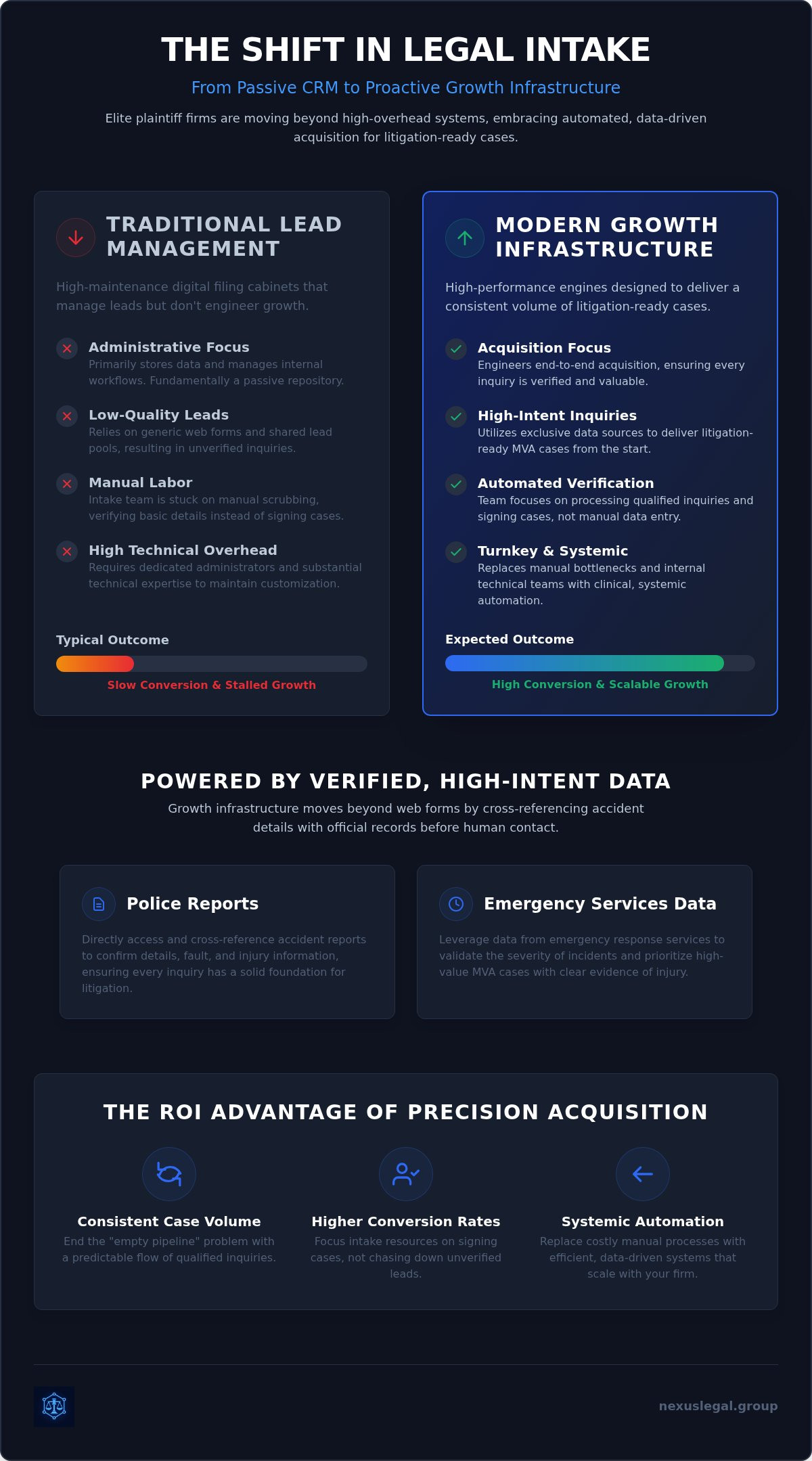
Growth infrastructure represents a fundamental departure from traditional lead management. While a CRM manages the pipeline, infrastructure engineers the acquisition of cases from the start. This model focuses on the mechanics of end-to-end acquisition, ensuring that every inquiry is verified through systemic automation. Through AI-driven legal case acquisition, firms can replace manual vetting with rigorous, data-backed verification processes. This approach utilizes police reports and emergency services data to cross-reference accident details before a human ever makes a call. By focusing on exclusive inquiry acquisition rather than shared lead pools, firms eliminate the race-to-the-bottom dynamics of generic marketing. When evaluating Litify intake alternatives, the objective shouldn't be to find a new place to store data, but to build a system that delivers litigation-ready inquiries that are ready for immediate signing.
The 2026 Legal Intake Landscape: Management Software vs. Case Acquisition Engines
The 2026 legal marketplace distinguishes clearly between tools that record data and systems that engineer growth. When firms audit Litify intake alternatives, they must evaluate platforms based on their primary utility: administrative management, marketing automation, or case acquisition. While the previous decade focused on the user interface, the current standard is defined by data enrichment and the ability to verify inquiries before they reach a human intake specialist. This shift necessitates a move away from generic data entry toward sophisticated systems that can cross-reference emergency services records in real time. Firms are increasingly choosing between high-maintenance, self-managed tools and turnkey infrastructure that eliminates the need for internal technical teams.
CRM-Centric Alternatives (Filevine, Lead Docket)
Firms prioritizing internal organization often gravitate toward CRM-centric platforms like Filevine or Lead Docket. These systems provide a robust framework for matter management and internal collaboration, making them suitable for practices with established, high-performing marketing channels. However, these tools remain fundamentally passive repositories. They lack the native ability to generate high-intent inquiries, requiring the firm to manage complex external vendor relationships to fill the pipeline. The operational gap between storing information and acquiring litigation-ready cases often leads to underutilized software and stagnant growth due to a lack of high-quality data inflow.
Marketing-Centric Alternatives (Lawmatics, Law Ruler)
Platforms such as Lawmatics and Law Ruler emphasize the post-inquiry lifecycle through automated follow-ups, SMS sequences, and drip campaigns. While these tools improve speed-to-lead metrics and initial engagement, they don't inherently solve the problem of lead quality at the source. Without integrating automated intake for plaintiff firms, these systems often accelerate the processing of low-intent inquiries, leading to significant staff burnout. The risk of lead fatigue is high when automation is applied to unverified data pools that haven't undergone rigorous qualification before entering the communication sequence.
Acquisition-Centric Infrastructure (Nexus Legal Group)
Nexus Legal Group provides a definitive alternative by offering an end-to-end law firm growth infrastructure. This model prioritizes the acquisition of police report generated MVA leads, ensuring that every inquiry is backed by verified incident data and high-intent signals. Unlike standard intake tools, this infrastructure combines acquisition with automated verification to deliver litigation-ready cases directly into the firm's pipeline. For firms seeking to scale without the friction of manual vetting or the overhead of managing fragmented software stacks, transitioning to an acquisition engine provides the systemic integrity required for predictable expansion.
Top Litify Alternatives for Plaintiff Firms: From CRMs to High-Intent Sourcing
Selecting from the available Litify intake alternatives requires a strategic assessment of your firm's operational maturity and specific growth objectives. In the 2026 legal market, the choice is no longer between different software interfaces; it's a decision between "all-in-one" legacy systems and "best-of-breed" modular stacks. Many firms fall into the "shelf-ware" trap. These are sophisticated features that look impressive in a demo but remain unoperationalized because the complexity exceeds the staff's technical capacity. To avoid this, you must prioritize tools that offer immediate integration with high-intent data streams rather than those that promise future customization through extensive coding.
Enterprise Alternatives for High-Volume Firms
For established practices processing hundreds of inquiries monthly, Filevine and Lead Docket offer robust, analytics-heavy environments. These platforms excel at providing a bird’s-eye view of firm performance and pipeline health. However, as firms scale, they often realize that sophisticated management is secondary to the quality of the data being managed. This realization is driving a shift toward data driven case acquisition, where the focus moves from tracking leads to engineering the acquisition of litigation-ready files. Enterprise firms must ensure that their intake layer is not just a digital filing cabinet but a verified gateway that maintains clinical precision in case selection. Without this verification, the high overhead of enterprise software becomes a liability rather than an asset.
Agile Alternatives for Rapidly Scaling Practices
Practices in a rapid growth phase require agility and low technical overhead, which often leads them to platforms like Lawmatics or PracticePanther. These tools serve as excellent entry points for automation, allowing smaller teams to punch above their weight by automating repetitive follow-up tasks. The challenge for these agile firms is the "garbage in, garbage out" dynamic. Automation only scales your problems if the inquiries are low-intent. To maintain a competitive edge, these firms must augment their CRM with high conversion MVA leads that have been pre-qualified through behavioral data. Scaling without increasing administrative headcount is only possible when your intake system is fed by inquiries that are statistically likely to result in a signed case.
Growth Infrastructure: The Nexus Advantage
Nexus Legal Group provides the definitive alternative for firms that have outgrown the software-only approach. While traditional CRMs focus on the post-acquisition lifecycle, Nexus provides the foundational infrastructure for the systemic acquisition of verified MVA leads for law firms. By integrating police report data and emergency services records into the acquisition phase, Nexus delivers litigation-ready inquiries that eliminate the need for manual vetting. This model allows firms to bypass the technical debt of legacy systems and focus entirely on the legal merits of their cases. It's the essential choice for elite firms that prioritize clinical precision and predictable growth over the maintenance of complex, unproven software stacks.
Operationalizing Your Intake: Transitioning from Lead Management to Litigation-Ready Inquiries
Upgrading your intake department requires more than just swapping software; it demands a fundamental shift in how your firm defines its incoming opportunities. Many firms searching for Litify intake alternatives are actually struggling with the distinction between a "lead" and a "qualified inquiry." A lead is merely raw contact information with unverified claims. In contrast, a qualified inquiry is a vetted, high-intent prospect backed by objective data. Transitioning to this model involves integrating lead generation for trial lawyers that focuses on litigation-readiness from the initial touchpoint. You must move away from manual data entry and toward a system that validates the legal merit of every call before it reaches your signing team.
The Mechanics of Automated Verification
Modern intake operations rely on systemic automation to filter for high-intent claimants before they reach a human staff member. This process uses AI-driven marketing to analyze behavioral signals, ensuring that the individual is actively seeking legal resolution rather than just browsing. By cross-referencing inquiries with emergency services data and police reports, firms can verify the existence of an incident in real time. This clinical approach reduces the friction typically found in the "signed case" transition, as the intake team isn't wasting time on fabrications or minor incidents that don't meet your firm's criteria. It's about ensuring that your staff only interacts with prospects who have a high statistical probability of becoming a successful case.
Enriching Accident Reports with Reverse Append Technology
One of the most significant advancements in growth infrastructure is the use of reverse append technology to obtain detailed accident reports. Instead of waiting for a claimant to provide documents, the system uses available data points to pull participant details and incident specifics automatically. This level of enrichment provides trial lawyers with immediate access to vehicle speeds, impact points, and witness statements. It transforms case acquisition from a game of "chasing" leads into a precise, data-driven operation. Detailed participant data allows your team to assess liability and coverage limits almost instantly, which is essential for scaling a plaintiff practice without ballooning your administrative costs. When you operationalize your intake with this level of technical mastery, you're no longer just managing a pipeline; you're engineering a consistent flow of high-value cases.
Nexus Legal Group: Engineering High-Intent Case Acquisition for Scalable Growth
Nexus Legal Group represents the evolution of the plaintiff firm ecosystem by providing a foundational growth layer that software-only solutions cannot replicate. While many Litify intake alternatives focus on refining the user interface or adding minor automation features, Nexus engineers a complete end-to-end infrastructure. This model doesn't just manage the data you already have; it actively acquires and verifies high-intent inquiries to ensure your pipeline remains full of litigation-ready cases. By shifting the focus from administrative record-keeping to proactive case engineering, firms can eliminate the technical debt and high overhead associated with managing enterprise-scale CRMs.
Exclusive MVA Case Acquisition Infrastructure
The core of the Nexus model is a commitment to exclusivity and data-driven verification. Unlike generic marketing agencies that sell shared leads to multiple firms, Nexus focuses on high-intent inquiries sourced through sophisticated data integration. By utilizing police report and emergency services data, the system identifies and vets potential claimants with clinical precision. This level of technical advantage ensures that every inquiry is backed by objective incident details, providing a level of compliant legal lead generation that meets the highest ethical standards. This isn't just about volume; it's about the systemic integrity of the data entering your firm's workflow. We provide the reverse append technology necessary to obtain accident reports and participant details, removing the burden of manual discovery from your staff.
Scaling Mass Tort and MVA with Precision
Scaling a modern practice requires a predictable flow of signed cases and qualified inquiries. Nexus provides the infrastructure necessary to execute a high-performance mass tort case acquisition strategy alongside consistent MVA growth. The delivery of litigation-ready files allows your attorneys to focus on their primary function: litigating and settling cases. You don't need a larger intake team when you have a more precise acquisition engine that filters out low-value noise before it reaches your desk. Partnering with Nexus allows elite firms to build a scalable foundation for 2026 and beyond, replacing the friction of manual vetting with automated, data-rich processes. If your firm has outgrown the limitations of standard management tools and requires a more powerful engine for expansion, it's time to Consult with Nexus Legal Group to see how our growth infrastructure can drive your firm's success.
Engineering the Future of Plaintiff Firm Acquisition
Transitioning your practice from administrative management to active case engineering requires a fundamental shift in your technological foundation. By evaluating Litify intake alternatives through the lens of growth infrastructure rather than mere data storage, you position your firm to eliminate the technical debt and high overhead of legacy Salesforce-based systems. The successful integration of specialized high-intent MVA acquisition and AI-driven automated verification ensures that your team focuses exclusively on litigation-ready inquiries that drive higher ROI. It's time to move beyond tools that simply manage a pipeline and adopt a system that actively builds one.
This systemic approach replaces the friction of manual vetting with clinical precision and technical mastery. Utilizing police reports and emergency services data allows for the delivery of exclusive inquiries that are ready for immediate legal action; ensuring your firm maintains a consistent flow of high-value cases without increasing administrative headcount. You don't have to settle for generic lead volume when you can have a high-performance engine driving your expansion from behind the scenes.
Building a scalable firm in 2026 demands a sophisticated architecture that prioritizes efficiency and systemic integrity. We look forward to helping you engineer a more profitable and predictable future for your practice.
Frequently Asked Questions
What are the main drawbacks of using Litify for intake?
Litify's reliance on the Salesforce ecosystem often introduces significant technical debt and high maintenance costs for plaintiff firms. While the platform offers extensive customization, it requires dedicated technical administrators to manage operational complexity. Many firms find that while it excels at matter management, it fails to solve the upstream problem of lead quality. If you're seeking Litify intake alternatives, it's because you need a system that prioritizes high-intent acquisition over simple administrative record-keeping.
How does growth infrastructure differ from a legal CRM?
A legal CRM is a passive repository designed to store and organize existing data throughout the case lifecycle. In contrast, growth infrastructure is an active engine that engineers the acquisition and verification of inquiries before they enter your management system. While a CRM helps you track a lead, infrastructure ensures that lead is litigation-ready by utilizing police reports and emergency services data. It moves your firm from managing a pipeline to proactively building one.
Can I use an intake alternative alongside my existing case management software?
You can certainly integrate specialized intake infrastructure with your current matter management platform. Most modern Litify intake alternatives are designed for modularity, allowing you to feed high-intent inquiries directly into your existing workflow via API. This approach enables you to upgrade your acquisition mechanics without the disruption of a full software migration. By decoupling acquisition from management, you gain the benefits of clinical precision in intake while maintaining your established internal processes.
What is automated verification in legal intake?
Automated verification is a systemic vetting process that uses AI and external data sources to validate a claimant's information before human interaction occurs. This system cross-references inquiries with objective incident data, such as police reports and emergency services records, to confirm the event's validity. By filtering for high-intent signals and incident accuracy, automation eliminates the manual scrubbing of low-quality leads. This ensures your intake team only spends time on inquiries that meet your firm's specific criteria.
Why is police report data important for MVA case acquisition?
Police report data provides the clinical precision needed to assess liability and coverage limits almost instantly. By utilizing these reports, firms can verify incident details, participant identities, and vehicle impact points without waiting for the claimant to provide documentation. This objective data source serves as the foundation for litigation-readiness, allowing your firm to prioritize inquiries with the highest settlement potential. It transforms the intake process from a subjective interview into a rigorous, data-driven verification exercise.
How do high-intent inquiries improve law firm ROI?
High-intent inquiries improve ROI by drastically reducing the cost per signed case and increasing the efficiency of your intake staff. When your team only processes verified prospects who have a clear path to litigation, you eliminate the wasted overhead associated with chasing unvetted leads. This systemic focus on quality over volume leads to higher conversion rates and faster case turnaround. By investing in acquisition infrastructure that delivers litigation-ready files, you maximize the impact of your marketing spend.
What should I look for in a Litify alternative for mass torts?
When evaluating alternatives for mass torts, prioritize systems that offer compliant legal lead generation and scalable verification mechanics. You need an infrastructure capable of processing high volumes of inquiries while maintaining rigorous vetting standards to ensure every case is viable. Look for platforms that integrate behavioral data enrichment and automated document gathering to streamline the signing process. The ideal solution should provide a turnkey acquisition engine that delivers signed cases directly into your litigation pipeline without friction.
Is it possible to acquire signed cases directly through an intake system?
Yes, end-to-end growth infrastructure is specifically designed to deliver signed cases that are ready for immediate litigation. These systems handle the entire acquisition lifecycle, from the initial high-intent inquiry to automated verification and digital contract execution. By the time a case reaches your attorneys, the incident data has been vetted and the client has been screened for eligibility. This model allows elite firms to scale their case volume rapidly while maintaining a lean and highly efficient internal operation.