LeadRival Alternatives: Sourcing High-Intent MVA Cases for Elite Firms
Tired of shared leads? Explore LeadRival alternatives that use first-party data to deliver exclusive, litigation-ready MVA cases. Build a scalable pipeline.
Why are elite firms abandoning the traditional lead marketplace in 2026? Most partners are exhausted by the high cost of non-converting data and the constant friction of manual verification. You've likely found that buying shared inquiries often leads to diminishing returns and an overwhelmed intake team. It's a common operational bottleneck that prevents true scalability. Discovering LeadRival alternatives isn't just about finding another vendor; it's about adopting a system that prioritizes intent over raw volume.
This article provides a roadmap to transition your firm from passive lead aggregation to a high-intent growth infrastructure that delivers litigation-ready inquiries. We'll examine how to leverage first-party data, such as police reports and emergency services records, to identify claimants before they're commoditized on the open market. You'll learn how automated verification and reverse-append technology can reduce administrative overhead while securing exclusive access to high-value MVA cases. By the end, you'll understand how to build a predictable pipeline that functions as a foundational layer for your practice's expansion.
Key Takeaways
- Learn why elite firms are shifting from shared lead marketplaces to integrated growth infrastructure to eliminate the high cost of non-converting inquiries.
- Identify the specific criteria for LeadRival alternatives that prioritize first-party incident data and automated verification over raw lead volume.
- Discover how sourcing MVA cases directly from police reports and emergency services data ensures high-intent, litigation-ready inquiries.
- Understand the strategic framework for auditing intake efficiency and reducing the administrative burden of manual case vetting.
- Master the transition from traditional lead generation to a scalable system that delivers exclusive access to high-value claimants through reverse-append technology.
Why Elite Firms are Evaluating LeadRival Alternatives in 2026
The legal marketing sector has matured beyond the era of simple lead aggregation. Elite firms are increasingly distancing themselves from legacy providers to seek LeadRival alternatives that offer more than just a volume of names. In 2026, the primary friction point isn't a lack of data; it's the high cost of processing non-exclusive, low-intent inquiries that fail to convert into signed cases. When five firms receive the same inquiry, the race to contact the claimant becomes a resource-heavy competition that erodes profit margins and creates unnecessary operational strain.
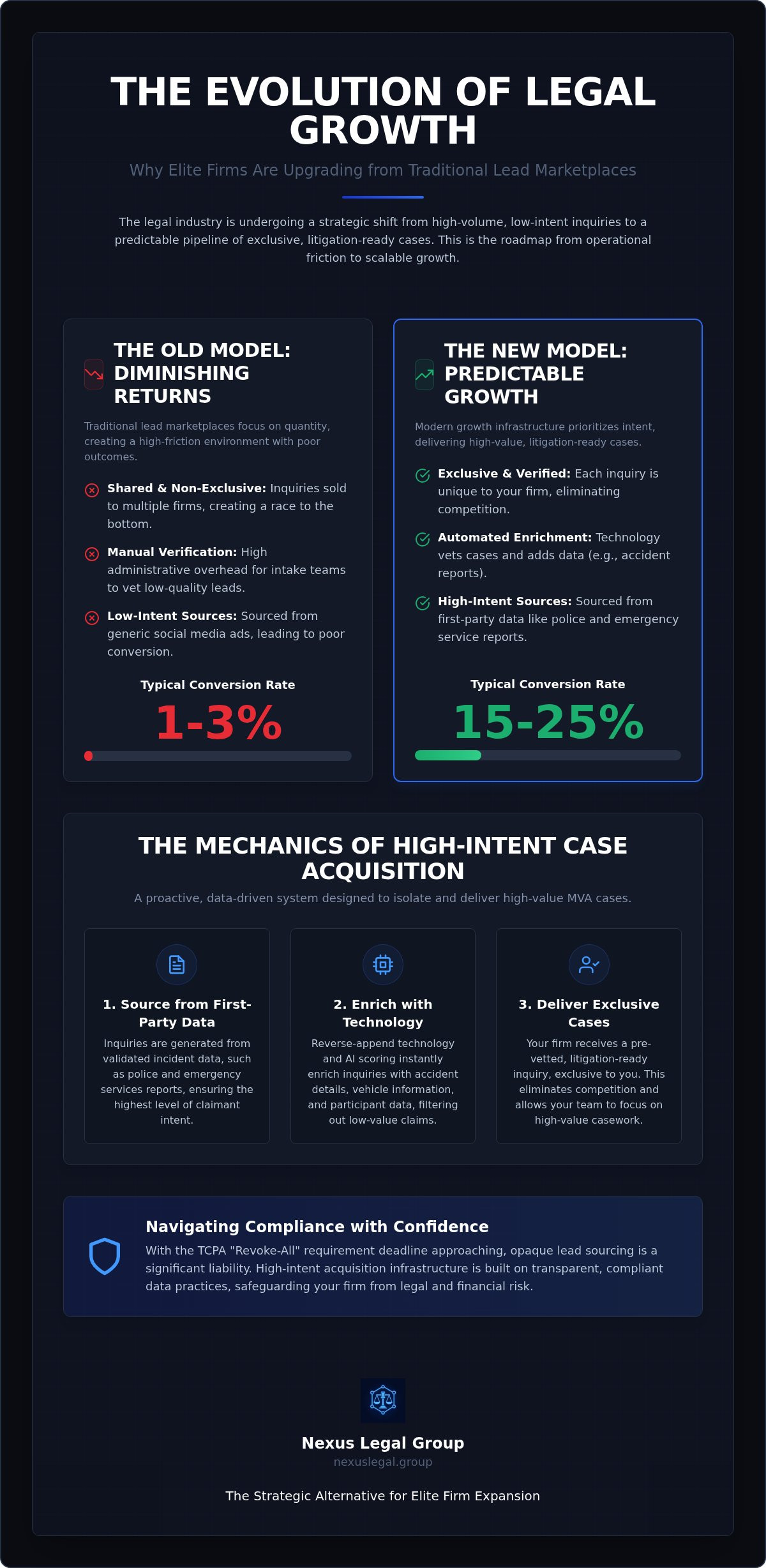
Understanding the history of legal advertising reveals a clear trajectory toward stricter oversight and higher transparency. With the TCPA "Revoke-All" requirement deadline approaching on January 31, 2027, firms can't afford the legal liability of opaque lead sourcing. Compliance is no longer a peripheral checkbox; it's a foundational requirement for institutional growth. Simple lead flow is no longer enough to sustain a modern practice. You need a system that minimizes friction and maximizes the predictability of your litigation pipeline through technical mastery.
The Shift from Lead Quantity to Case Quality
Traditional models prioritize "lead flow," which often leads firms into the "junk lead" trap. Research indicates that shared leads from social media platforms typically convert at a meager 1-3%, while exclusive, search-based inquiries can reach 15-25%. For a high-volume firm, this delta represents thousands of hours in wasted intake labor and administrative overhead. High-intent acquisition focuses on litigation-ready inquiries sourced from first-party data. This approach ensures your team spends time on viable cases rather than chasing cold leads that never intended to file a claim. It's about the elimination of noise in favor of actionable case files.
Technological Obsolescence in Traditional Aggregators
Legacy platforms often operate as simple brokers rather than true technology partners. They rely on basic contact forms that lack the depth and context necessary for immediate case evaluation. Modern growth infrastructure, like that provided by Nexus Legal Group, utilizes reverse-append technology to enrich inquiries with accident reports and specific incident details. This technical gap separates organizations that merely procure raw data from those that implement a sophisticated, integrated acquisition architecture. Basic lead brokers simply can't offer the systemic integrity or data enrichment required for elite firm expansion.
The Mechanics of High-Intent Case Acquisition
High-intent case acquisition isn't a passive collection of contact details. It's a proactive system that utilizes data-driven marketing to isolate claimants involved in significant motor vehicle accidents. Unlike traditional LeadRival alternatives that often rely on generic social media ads or broad-match search terms, this infrastructure focuses on high-intent signals. It uses AI to score potential cases based on severity and liability before they ever reach your intake desk. Automated verification acts as a critical filter, ensuring systemic integrity by removing fraudulent or low-value inquiries. This prevents your staff from wasting time on cases that will never settle or go to trial.
Leveraging Police Reports and Emergency Services Data
The most reliable indicator of a viable MVA case is a validated incident report. Sourcing inquiries directly from emergency services data provides a precise timeline of intent that self-reported leads simply cannot match. This method ensures the claimant was physically present at the scene and documented by authorities in real time. Utilizing police report generated MVA leads allows firms to bypass the ambiguity and errors common in manual intake. This level of precision is also essential for maintaining compliance with state-level advertising regulations, which demand high standards of accuracy and transparency in how potential clients are identified and contacted.
Reverse-Append Technology and Data Enrichment
Elite firms need more than just a name and phone number to make an informed decision on a file. Reverse-append technology allows the system to take basic contact information and instantly cross-reference it with proprietary accident databases. This process enriches the inquiry with vehicle information, participant details, and specific accident report data before you even pick up the phone. Your team enters the first intake call with a comprehensive view of the incident, which drastically reduces the time spent on manual discovery and document requests. By ensuring data accuracy from day one, you streamline the entire litigation process and increase your chances of a successful outcome. Implementing this type of sophisticated case acquisition infrastructure transforms your intake department from a cost center into a high-efficiency conversion engine.
Strategic Comparison Framework: Evaluating Legal Growth Solutions
When you're vetting LeadRival alternatives, the evaluation shouldn't focus on raw volume. Instead, you must analyze the mechanics of the acquisition process. Most providers operate on a shared marketplace model where the same inquiry is distributed across multiple firms, triggering a frantic race to the phone. This isn't a growth strategy; it's a resource drain. To build a predictable pipeline, you need a framework that prioritizes exclusivity and deep integration with your existing law firm growth infrastructure. Evaluation should hinge on whether the provider delivers raw data or a litigation-ready case file.
Data source integrity is the next critical pillar. Generic search ads often capture low-intent "window shoppers" rather than serious claimants. Elite solutions leverage incident-level data, such as police reports and emergency services records, to ensure the claimant was actually involved in a documented event. This shift from broad-match advertising to data-enriched inquiries is essential for firms that value operational precision. Discussions regarding the future of legal marketing emphasize that data precision and personalized acquisition will define the next era of firm expansion.
Aggregators vs. Infrastructure Providers
Aggregators function as volume-focused brokers. They provide shared leads with minimal vetting, which results in high friction for your intake team. You're forced to act as the primary filter, spending hours on calls that lead nowhere. In contrast, infrastructure providers focus on intent. They offer exclusive inquiries backed by automated verification systems. This model aligns with the scalability needs of elite plaintiff firms by delivering cases that are already vetted for liability and injury severity. It's the difference between buying a list of names and securing a verified opportunity.
Compliance and Ethical Integrity Standards
Reputation is a firm's most valuable asset, yet it's often the first thing at risk when using opaque lead sources. You must evaluate the transparency of claimant consent and the methods used to secure data. Utilizing compliant legal lead generation is a critical component of risk mitigation. Ethical acquisition doesn't just protect your bar standing; it ensures that every case in your inventory is built on a foundation of documented, verifiable consent. High-intent systems provide the transparency needed to defend your firm's integrity in an increasingly regulated environment.
Transitioning from Lead Generation to Growth Infrastructure
Moving beyond basic lead procurement requires a rigorous audit of your current intake funnel to identify where potential cases are stalling. If you're evaluating LeadRival alternatives, you've likely realized that your internal bottlenecks are often caused by the poor quality of incoming data. Scaling a practice isn't about increasing the number of phone calls; it's about engineering a system where every inquiry has a high probability of conversion. You must define high-intent criteria for MVA and mass tort acquisition based on injury severity, liability, and insurance coverage. This clinical approach ensures your resources are focused exclusively on high-value claims that drive firm revenue.
Implementing automated intake for plaintiff firms is the most effective way to reduce the administrative burden of manual vetting. By replacing subjective human screening with data-driven acquisition frameworks, you create a mechanical process for case flow. This transition allows you to treat case acquisition as a foundational layer of your business operations rather than a peripheral marketing activity. When your infrastructure is built on technical mastery and systemic integrity, growth becomes a predictable outcome of your operational efficiency.
Engineering Predictable Case Flow
Elite firms must abandon the "feast or famine" cycle associated with traditional lead brokers. Predictability comes from utilizing operational metrics to forecast revenue and growth. For instance, the legal industry benchmark for "speed-to-lead" is now under 60 seconds; responding within this window can lower your effective cost per acquisition by 30-40%. By integrating automated acquisition systems into your practice management, you move away from passive waiting and toward a steady, scalable flow of litigation-ready files. These systems provide the transparency needed to make high-level strategic decisions based on real-time data.
Optimizing Intake for High-Intent Inquiries
Training your intake team to handle data-enriched inquiries requires a shift in perspective. Unlike cold leads that require extensive discovery, high-intent inquiries arrive with pre-verified claimant data and accident report details. This "no-friction" model allows your staff to focus on securing the retainer rather than verifying the incident. By reducing the time-to-sign through pre-enriched data, you increase your firm's overall conversion rate and ROI. This level of optimization is what separates institutional-grade firms from those still struggling with the limitations of legacy lead generation models.
Nexus Legal Group: The Strategic Alternative for Elite Firms
Nexus Legal Group functions as the foundational growth engine for high-volume firms that have outgrown the limitations of traditional aggregators. While searching for LeadRival alternatives, partners often encounter generic B2B prospecting tools that lack the specialization required for the legal sector's high-stakes environment. Nexus differentiates itself by serving as a strategic architect, building a system that prioritizes exclusivity and litigation-ready inquiries. This infrastructure is not a peripheral marketing tool but a core component of a firm's operational workflow, designed to eliminate the friction of low-intent lead processing through technical mastery.
Our specialization in high-intent MVA and mass tort case acquisition is built on a commitment to ethical, compliant, and transparent standards. By combining AI-driven marketing precision with real-world incident data, we provide a predictable path to firm expansion. This methodology ensures that every inquiry is backed by verifiable documentation, protecting your firm's reputation while maintaining a steady flow of high-value cases. We focus on the mechanics of systemic integrity, ensuring that your acquisition pipeline remains populated with cases that are ready for immediate retention and litigation.
MVA Case Acquisition with Precision
Precision in motor vehicle accident acquisition requires moving beyond self-reported data. Nexus provides access to exclusive inquiries derived from police reports and emergency services data, enriched through reverse-append technology. This process delivers participant details and accident reports directly to your team, ensuring immediate litigation readiness. When your intake staff receives a file, they aren't starting from scratch; they're finalizing a case that has already been vetted for liability and injury severity. You can experience the efficiency of AI-driven legal case acquisition by integrating these data-rich inquiries into your firm's growth blueprint. It's an operational shift that replaces guesswork with documented facts.
Scalable Infrastructure for Mass Tort Growth
Scaling for mass torts requires a system that can handle the complexities of emerging and established litigations with clinical precision. Nexus focuses on high-intent claimant acquisition, providing ethically sourced signed cases and qualified inquiries that meet rigorous compliance standards. This scalable infrastructure allows your firm to position itself for dominance in competitive litigation landscapes without the administrative burden of manual intake. By leveraging a foundational layer of automated verification and incident-level data, you ensure that your firm's growth is both sustainable and ethically sound. This systemic approach allows you to capture market share in high-value torts while maintaining the highest standards of professional literacy and operational excellence.
Architecting Your Firm's Future Acquisition Infrastructure
The evolution of plaintiff practice management requires a departure from the high-friction models of the past. As we've explored, the most effective LeadRival alternatives are those that treat case acquisition as an integrated technological process rather than a simple transaction. By prioritizing exclusive incident data and AI-driven verification, your firm can bypass the junk lead trap and secure a foundational layer for long-term expansion. It's a shift from being a passive lead buyer to becoming a strategic architect of your own growth.
This transition ensures that your operational resources are allocated toward high-probability files that drive significant revenue. Moving from raw lead flow to a litigation-ready case infrastructure allows for a level of predictability that traditional brokers cannot provide. You're now equipped with the framework to audit your intake and implement a scalable acquisition engine built on systemic integrity and technical mastery. This is how elite firms protect their margins while dominating competitive markets.
Take the next step in engineering a more efficient, data-driven future for your practice.
Frequently Asked Questions
What defines a high-intent MVA inquiry compared to a standard lead?
High-intent inquiries are characterized by a verified accident event and a documented desire for legal assistance. Unlike standard leads that might come from broad social media forms, these inquiries are rooted in incident-level data such as police reports or emergency services records. This ensures the claimant was actually involved in a significant event. The intent is signaled by the claimant's active pursuit of recovery rather than passive browsing.
How do LeadRival alternatives differ in terms of inquiry exclusivity?
Many LeadRival alternatives focus on a one-to-one distribution model rather than the shared marketplace approach. In a shared model, a single lead is sold to multiple firms, creating a race to contact the claimant. High-intent infrastructure providers deliver exclusive inquiries, meaning the data is routed only to your firm. This exclusivity eliminates the competitive friction of multi-sold leads and significantly improves the probability of securing a signed retainer.
Why is automated verification critical for elite plaintiff firms?
Automated verification acts as a technical filter that removes fraudulent, duplicate, or low-value inquiries before they reach your intake department. For elite firms, this system eliminates the administrative burden of manual vetting and ensures intake specialists focus only on litigation-ready files. By using AI-driven scoring and data cross-referencing, firms maintain systemic integrity and protect their acquisition budget from being wasted on junk data that won't convert.
Can high-intent case acquisition integrate with my existing CRM?
Professional growth infrastructure is designed for seamless integration with standard legal CRM platforms. This connectivity allows for the immediate, automated transfer of claimant data and accident report details directly into your case management workflow. By eliminating manual data entry, firms reduce the risk of human error and improve their speed-to-lead metrics. This integration ensures that the acquisition system functions as a foundational layer of your firm's existing technology stack.
What role does police report data play in verifying MVA leads?
Police report data serves as the objective source of truth for verifying the validity of a motor vehicle accident. It provides essential details such as the date of the incident, vehicle information, and participant identities. By sourcing inquiries derived from validated incident reports, firms bypass the inaccuracies of self-reported claimant data. This information enrichment allows your team to evaluate liability and injury severity with a high degree of clinical precision before the first call.
How does the cost of high-intent acquisition compare to traditional lead generation?
While the initial cost per inquiry for high-intent acquisition may be higher than raw leads, the effective cost per signed case is typically lower. Traditional lead generation often carries hidden costs, such as the administrative overhead of processing non-converting inquiries. High-intent infrastructure reduces this friction by delivering pre-verified, exclusive data. This efficiency results in a higher ROI by maximizing your intake team's conversion rates and minimizing wasted resource allocation.
Is data-driven case acquisition compliant with legal ethical standards?
Data-driven acquisition systems prioritize compliance by ensuring all inquiries are sourced through ethical and transparent methods. This includes securing documented claimant consent and adhering to state-level advertising regulations and TCPA requirements. By using a system that logs every step of the acquisition process, firms can demonstrate a clear chain of consent. This transparency protects the firm's reputation and bar standing while providing a scalable method for institutional growth.
How quickly can a firm scale case volume using growth infrastructure?
Scaling case volume using integrated infrastructure can occur rapidly once the system's logic and data filters are aligned with your firm's specific criteria. Because the process is mechanical and data-driven, increasing volume doesn't require a proportional increase in intake staff. Firms can adjust their acquisition parameters to capture a larger share of national litigation-ready inquiries. This scalability allows for predictable expansion into new torts or higher volumes of MVA cases within weeks.