Justifying Marketing Spend to Law Partners: 2026 Framework
Struggling with justifying marketing spend to law partners? Our 2026 framework helps you prove ROI with data, shifting focus from leads to signed cases.
Your partners don't actually hate marketing; they hate the lack of transparency in a budget that fails to produce signed cases. It's a common friction point in elite firms where leadership views every dollar as a sunk cost rather than a strategic asset. You've likely sat through meetings where digital metrics like impressions were met with skepticism because they didn't translate into predictable revenue. The challenge of justifying marketing spend to law partners often stems from a disconnect between technical data and the firm's bottom line.
We're going to bridge that gap. This guide provides a 2026 framework to transform your marketing department from a scrutinized cost center into a high-performance growth engine. You'll learn how to present a data-driven case for growth infrastructure that replaces low-quality inquiries with high-intent case acquisition. We'll examine how to leverage police report data and automated verification to build a foundational layer for firm expansion. By the end, you'll have a clear roadmap to secure your 2026 budget and ensure a predictable flow of MVA and mass tort cases.
Key Takeaways
- Reframe marketing as growth infrastructure to position your 2026 budget as a foundational business asset rather than a scrutinized expense.
- Discover a data-driven framework for justifying marketing spend to law partners by shifting the primary KPI from lead volume to Cost Per Retainer.
- Learn how to leverage police report data and reverse append technology to ensure your spend is focused on verified incidents with high litigation potential.
- Implement a step-by-step strategy for building a partner-ready proposal that utilizes pipeline audits and competitive gap analysis to demonstrate structural needs.
- Scale your firm's case flow by integrating automated verification systems and high-intent acquisition strategies for MVA and mass tort cases.
Reframing the Narrative: From Marketing Expense to Growth Infrastructure
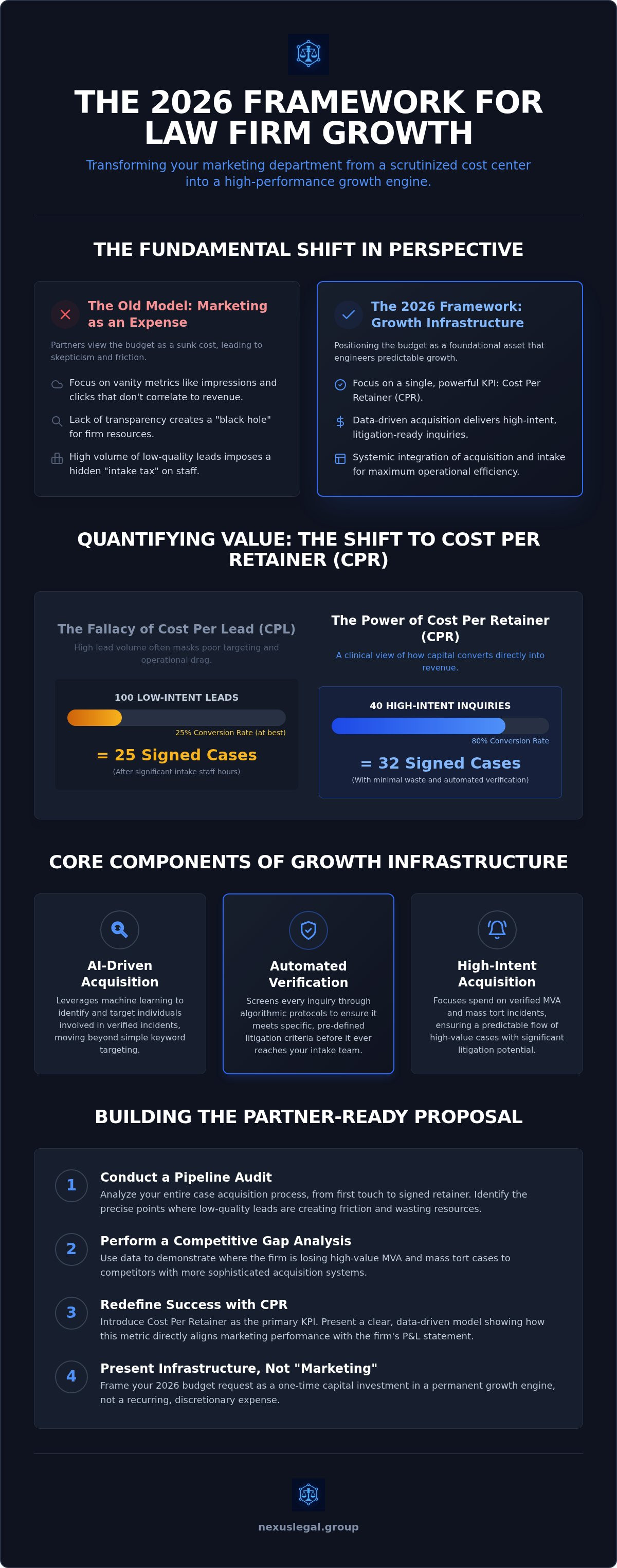
Partners at elite plaintiff firms often view marketing budgets with a high degree of clinical skepticism. This reaction is logical. When a line item appears as a discretionary expense rather than a foundational asset, it becomes a target for cost cutting during quarterly reviews. The challenge of justifying marketing spend to law partners usually arises because traditional agencies focus on vanity metrics like impressions or clicks, which have no direct correlation to the firm's balance sheet. In 2026, the narrative must shift from "buying ads" to "building growth infrastructure."
Growth infrastructure represents a systemic integration of AI-driven acquisition and automated intake protocols. It's the foundational layer that allows a firm to scale without increasing friction or operational chaos. Instead of chasing mass-market visibility, this model prioritizes high-intent precision. It positions the firm to capture specific, litigation-ready inquiries rather than raw, unverified data points. When you present your budget as an investment in a high-performance engine, you align marketing goals with the partners' desire for predictable, scalable revenue.
Why Traditional Legal Marketing Budgets Fail Partner Scrutiny
Traditional marketing strategies often fail because they create a disconnect between "brand awareness" and the firm’s P&L statement. Partners don't care about click-through rates; they care about signed retainers. Most reporting structures fail to track a lead through the entire lifecycle, leaving partners to wonder if their capital is actually yielding a return. This lack of transparency fuels the perception that marketing is a black hole for firm resources.
Low-quality leads also impose a hidden "intake tax" on your staff. When an agency delivers high volumes of low-intent inquiries, your intake team wastes hundreds of hours filtering out irrelevant calls. This operational drag reduces efficiency and frustrates partners who see their overhead rising without a corresponding increase in case quality. Justifying marketing spend to law partners requires proving that your system eliminates this noise before it ever reaches the firm's internal team.
The Concept of Growth Infrastructure for Elite Plaintiff Firms
Elite firms require a sophisticated technological solution that functions as a master of systems. Growth infrastructure isn't a peripheral tool; it's a powerful engine that drives expansion from behind the scenes. This framework utilizes Nexus Legal Group's specialized capabilities to ensure every inquiry is backed by technical mastery. Key components of this infrastructure include:
- AI-Driven Acquisition: Utilizing machine learning to identify and target individuals involved in verified incidents.
- Automated Verification: Screening inquiries through algorithmic protocols to ensure they meet specific litigation criteria.
- Systemic Integrity: Connecting digital acquisition directly to automated intake, reducing the time between incident and engagement.
By defining your budget as infrastructure, you're proposing a permanent asset that engineers predictability into the firm's future. This approach moves the conversation away from "spending" and toward "capital investment," positioning the marketing department as a strategic architect of the firm's long-term growth.
Quantifying Value: Moving Beyond Leads to Cost Per Retainer (CPR)
To succeed in justifying marketing spend to law partners, you must abandon the metric of Cost Per Lead (CPL). In a sophisticated 2026 legal market, CPL is a deceptive indicator that often masks operational inefficiency. Partners don't want a high volume of raw inquiries; they want signed cases. Shifting the primary KPI to Cost Per Retainer (CPR) provides a clinical view of how marketing capital directly converts into revenue-generating assets. This transparency builds trust because it aligns the marketing department's success with the firm's overarching growth objectives.
The Fallacy of High Lead Volume in 2026
High lead volume often acts as a smoke screen for poor targeting. In reality, ten high-intent inquiries are significantly more valuable than one hundred low-intent clicks that never convert. Low-quality traffic forces your intake team to sift through noise, creating a friction point that drains firm resources and increases overhead. By focusing on High Conversion MVA Leads: Behavioral Trends, you can identify claimants who are ready to sign immediately based on precise behavioral data and incident verification. This precision ensures that every dollar spent is focused on litigation-ready cases.
Calculating the Real ROI: The CPR Framework
The CPR framework requires a comprehensive calculation that accounts for more than just ad spend. To find your true CPR, divide your total marketing investment by the number of signed retainers within a specific period. When justifying marketing spend to law partners, you must also factor in the administrative tax, which is the cost of staff time spent on unqualified leads. Using data from Verified MVA Leads for Law Firms allows you to benchmark your firm against industry standards for quality and conversion.
Linking spend directly to the firm's capacity to handle high-value litigation is the final step in this process. When you can prove that a specific budget allocation results in a predictable number of signed MVA or mass tort cases, marketing stops being a variable cost. It becomes a scalable engine for firm expansion. If you're ready to move beyond vanity metrics, consider how automated growth systems can stabilize your firm's pipeline. By presenting these hard numbers, you provide the clinical precision partners need to approve aggressive growth budgets for the coming year.
Justifying Spend Through Data Enrichment and Automated Verification
Partners often view marketing budgets as a speculative gamble because traditional lead generation relies on self-reported data that is frequently inaccurate or incomplete. In 2026, justifying marketing spend to law partners requires a move toward data enrichment and automated verification. By utilizing objective incident data, you shift the firm's acquisition strategy from chasing "possibilities" to securing "verified incidents." This transition acts as a powerful risk mitigation tool, ensuring that firm capital is only allocated toward inquiries with a high probability of conversion into high-value litigation.
One of the most effective ways to secure accident details before your intake team even picks up the phone is through reverse append technology. This system takes basic contact information and cross-references it with emergency services data to provide a comprehensive view of the incident. When you present this level of technical mastery to partners, you aren't just showing them a list of names; you're providing a dossier of litigation-ready opportunities. This clinical precision eliminates the uncertainty that typically triggers partner skepticism.
Leveraging Police Reports and Emergency Services Data
Objective incident data is the gold standard for high-intent case acquisition. Sourcing Police Report Generated MVA Leads allows your firm to verify the date, location, and severity of an accident before any marketing spend is finalized. This level of transparency is essential for justifying marketing spend to law partners who demand ethical and compliant lead generation. Because these inquiries are rooted in official records, the acquisition cost is naturally higher, but the waste is virtually eliminated. You're no longer paying for "noise"; you're paying for documented liability and coverage.
Automated Intake: Eliminating Friction and Overhead
The "intake tax" mentioned earlier is often the result of a bottleneck where legal assistants spend hours vetting unqualified callers. Implementing Automated Intake for Plaintiff Firms solves this by using AI-driven verification to screen inquiries against the firm's specific criteria. This system ensures that only the most viable, high-intent cases reach your staff. Key operational benefits include:
- Real-Time Verification: Algorithmic screening of incident details against statutory requirements.
- Resource Optimization: Freeing up legal assistants to focus on case management rather than cold-calling.
- Quantifiable Savings: Directly linking the marketing budget to a reduction in administrative overhead.
When you can quantify the exact number of hours saved through automation, the marketing budget ceases to be an expense. It becomes a mechanism for operational excellence. Partners value systems that increase efficiency while protecting the firm's foundational integrity, making this data-driven approach the most persuasive way to secure long-term growth funding.
Building the Partner-Ready Proposal: A Step-by-Step Guide
Presenting a budget request to leadership requires a shift from subjective persuasion to a structured business case. Justifying marketing spend to law partners is most effective when you demonstrate a deep understanding of the firm's operational friction. Your proposal shouldn't focus on what you want to buy, but on the systems you intend to build to eliminate revenue leakage and ensure litigation-ready inquiries. This approach aligns your department with the partners' fiduciary responsibilities.
Auditing Your Pipeline: Identifying the 'Conversion Problem'
The first step in any partner-ready proposal is a clinical audit of the current pipeline. You must analyze the lead-to-signed-retainer ratios to identify "dead zones" where high-value cases are lost due to poor data or slow intake. By quantifying these losses, you prove that the real waste of capital isn't the marketing budget itself, but the continued investment in low-intent leads that fail to convert. This audit shifts the focus from the cost of acquisition to the cost of inefficiency, making the case for a more sophisticated technological solution.
The Competitive Risk of Inaction in 2026
In 2026, the cost of acquisition for firms relying on legacy SEO or PPC continues to escalate while yield diminishes. Elite competitors are no longer just buying ads; they're implementing Law Firm Growth Infrastructure to monopolize high-intent inquiries before they reach the open market. Framing your budget as defensive capital is essential. If the firm doesn't invest in a foundational layer for expansion, it risks losing market share to more technologically advanced practices that use automated verification to secure the best MVA and mass tort cases.
Your final proposal must define a Pilot Phase with clear, data-driven milestones. For example, set a target for a specific number of signed MVA cases within the first ninety days. This allows partners to see the system in motion before committing to a full-scale rollout. Finally, connect this spend to a Growth Road Map that aligns marketing investment with specific headcount or revenue goals. This ensures leadership views the budget as a predictable engine for firm expansion rather than a variable expense.
Scaling with Precision: High-Intent MVA and Mass Tort Acquisition
The final stage in justifying marketing spend to law partners is demonstrating how a tech-enabled system scales without compromising case quality. Once the infrastructure is established, the firm can move from defensive positioning to aggressive market expansion. Elite practices in 2026 don't just "buy leads"; they acquire exclusive, litigation-ready inquiries through a process of clinical selection. This systemic approach ensures that every dollar of the growth budget is tied to a specific, high-intent outcome, effectively silencing the "marketing as a cost center" argument once and for all.
Nexus Legal Group provides the foundational layer for this level of expansion. By integrating automated verification with incident-based data sourcing, firms can bypass volatile lead markets and secure cases with documented liability. This level of technical mastery allows the marketing department to present a unified growth model that partners can trust. It replaces the traditional "spray and pray" ad spend with a high-performance engine designed for the practical realities of a plaintiff practice.
Engineering Predictable MVA Case Flow
Scaling a motor vehicle accident practice requires a shift away from high-volume, low-intent traffic. In the current landscape, AI-Driven Legal Case Acquisition is the only viable method for maintaining a predictable pipeline. This technology uses incident-based data, such as police reports and emergency services logs, to identify claimants involved in verified accidents. Precision is mandatory. By focusing on inquiries where liability and coverage are already documented, the firm reduces the time spent on intake and increases the speed to retainer. This methodology transforms MVA acquisition into a repeatable, scientific process that justifies every cent of the marketing investment.
Strategic Mass Tort Acquisition for Firm Expansion
Diversifying into mass torts is a primary goal for many elite firms, yet partners often fear the high entry costs and ethical risks. A successful Mass Tort Case Acquisition Strategy solves this by engineering growth infrastructure that prioritizes ethical compliance and data transparency. Instead of purchasing unverified names, the firm acquires signed cases that have already passed through automated verification and AI screening. This approach protects the firm's reputation while providing a clear roadmap for revenue diversification. Key benefits include:
- Ethical Integrity: Ensuring every inquiry meets strict compliance standards before it reaches the firm.
- Predictable ROI: Moving away from speculative "qualified inquiries" to litigation-ready retainers.
- Operational Synergy: Using a single infrastructure to manage both MVA and mass tort acquisition seamlessly.
The transition from scrutinized expense to predictable revenue engine is complete when partners see the clinical precision of the Nexus platform. By presenting a unified growth infrastructure, you provide leadership with the security of technical mastery and the promise of operational excellence. To begin implementing these systems for your 2026 budget cycle, explore the Nexus Legal Group growth systems and start building your firm’s foundational layer for expansion.
Secure Your Firm's Foundational Growth Infrastructure for 2026
Leadership in elite plaintiff firms requires technical mastery and clinical precision in every operational budget. By shifting the conversation from vanity metrics to Cost Per Retainer (CPR), you align marketing objectives with the firm's foundational fiduciary duties. Leveraging specialized MVA case acquisition powered by AI and police report data integration ensures that every inquiry is a litigation-ready asset rather than a speculative lead. This framework for justifying marketing spend to law partners moves your department from a scrutinized cost center to a predictable, high-performance revenue engine.
Your firm's expansion in 2026 depends on the systemic integrity and automated precision of your acquisition pipeline. Implementing these systems ensures you secure compliant, litigation-ready inquiries while protecting your firm's reputation in the MVA and mass tort sectors. It's time to build a future grounded in technical mastery and operational excellence. You have the roadmap; now it's time to engineer the growth your partners expect.
Frequently Asked Questions
How do I explain the difference between a lead and a high-intent inquiry to my partners?
Explain to partners that a standard lead is merely unverified contact data, whereas a high-intent inquiry is a prospect whose involvement in a documented incident is already confirmed. High-intent inquiries originate from objective sources like police reports rather than generic web forms. This distinction is critical because it eliminates the speculative nature of traditional legal marketing. By focusing on intent, you ensure the firm's resources are directed toward prospects who are ready to sign immediately.
Why is the Cost Per Retainer (CPR) more important than the Cost Per Lead (CPL)?
Cost Per Retainer (CPR) is the superior metric because it tracks the actual acquisition of a revenue-generating asset rather than a raw data point. While a low Cost Per Lead (CPL) might look attractive on paper, it often masks high administrative costs and low conversion rates. Shifting to CPR provides the clinical transparency required for justifying marketing spend to law partners. It allows leadership to see exactly how much capital is required to secure a case.
How can we prove that our marketing spend is resulting in signed MVA cases?
Proving the connection between spend and signed MVA cases requires a closed-loop reporting system that tracks every inquiry from the initial data source to the final signed retainer. By utilizing automated verification and AI-driven precision, you can provide partners with a dossier for every case that includes incident details and verification timestamps. This level of granular documentation removes the guesswork and demonstrates a direct, undeniable link between the marketing budget and the firm's growing case file.
What data points should be included in a monthly marketing report for law partners?
A monthly report for law partners should prioritize outcomes over activity. Essential data points include the total Cost Per Retainer (CPR), the conversion rate of verified inquiries to signed cases, and the volume of litigation-ready opportunities generated. You should also include metrics on administrative friction, such as the reduction in hours spent by intake staff on unqualified leads. This structural approach demonstrates that justifying marketing spend to law partners is a matter of proving operational efficiency.
Is it possible to automate the verification of personal injury leads before they reach our intake team?
It is entirely possible to automate the verification process using AI-driven algorithmic screening and reverse append technology. These systems cross-reference incoming inquiries with objective accident data and emergency services records before they ever reach your intake team. This foundational layer of automation ensures that your staff only interacts with prospects who meet the firm’s specific litigation criteria. By eliminating manual vetting, you significantly reduce operational overhead and increase the speed at which cases are signed.
How does using police report data improve the quality of our case acquisition?
Police report data provides an objective, clinical foundation for case acquisition that self-reported web leads simply cannot match. This data confirms the date, location, and severity of an incident, as well as the parties involved. Utilizing this information allows your firm to target individuals with documented liability and insurance coverage. This technical mastery ensures that your acquisition spend is focused on high-value cases with a high probability of successful litigation rather than unverified, low-intent claims.
What is the typical ROI for a firm investing in growth infrastructure versus traditional marketing?
Firms investing in growth infrastructure typically see a higher return on investment because they eliminate the administrative tax associated with low-quality lead generation. While traditional marketing often results in a high volume of unconvertible noise, infrastructure focuses on high-intent precision. This systemic integrity leads to lower long-term acquisition costs and a more predictable case flow. By engineering predictability into the firm's growth model, you maximize the utility of every dollar spent on case acquisition and firm expansion.
How do we ethically justify using third-party data for case acquisition?
Ethically justifying the use of third-party data requires a commitment to transparency and compliance with legal advertising standards. When sourcing data from objective incident reports, the firm identifies individuals who have a genuine need for legal representation based on verified facts. This data-driven approach is more precise than mass-market outreach because it relies on high-intent inquiries and automated verification. It ensures outreach remains professional and grounded in the practical, rigorous realities of the claimant's documented situation.