Improving Law Firm Case Intake Process: The 2026 Framework for Elite Firms
Stop losing cases to slow intake. Learn our 2026 framework for improving law firm case intake process with AI and data to get litigation-ready files.
Intake is not a customer service function; it's a high-precision data-verification engine that determines your firm’s litigation ceiling. You likely recognize the mounting frustration of high overhead costs tied to manual lead vetting, especially when improving law firm case intake process feels like an uphill battle against inaccurate lead data. It's a common pain point for elite firms to lose high-value cases to faster competitors because their internal systems lack the technical mastery to vet inquiries with clinical precision.
You'll learn how to transform your intake from a manual bottleneck into a data-driven growth engine that delivers litigation-ready case files to your desk instantly. We'll explore the 2026 framework for elite firms, focusing on a streamlined architecture that incorporates AI-driven marketing and real-time data enrichment. This guide provides a clear blueprint for eliminating operational friction, ensuring your firm captures high-intent MVA and mass tort cases with the speed and accuracy required to maintain a competitive edge in the current legal landscape.
Key Takeaways
- Identify why the traditional "volume trap" reduces net profitability and how to eliminate the hidden administrative friction in your current workflow.
- Discover how incident-level data and police report integration establish immediate case viability, moving your firm beyond the limitations of self-reported intake forms.
- Learn the technical framework for improving law firm case intake process by replacing manual screening with high-precision automated verification.
- Transition your intake staff from administrative "sorters" to strategic "signers" by implementing a litigation-ready standard for every incoming inquiry.
- Explore how a foundational growth infrastructure allows elite firms to acquire exclusive, high-intent MVA and mass tort cases with clinical efficiency.
Why the Traditional Intake Process Fails Elite Plaintiff Firms
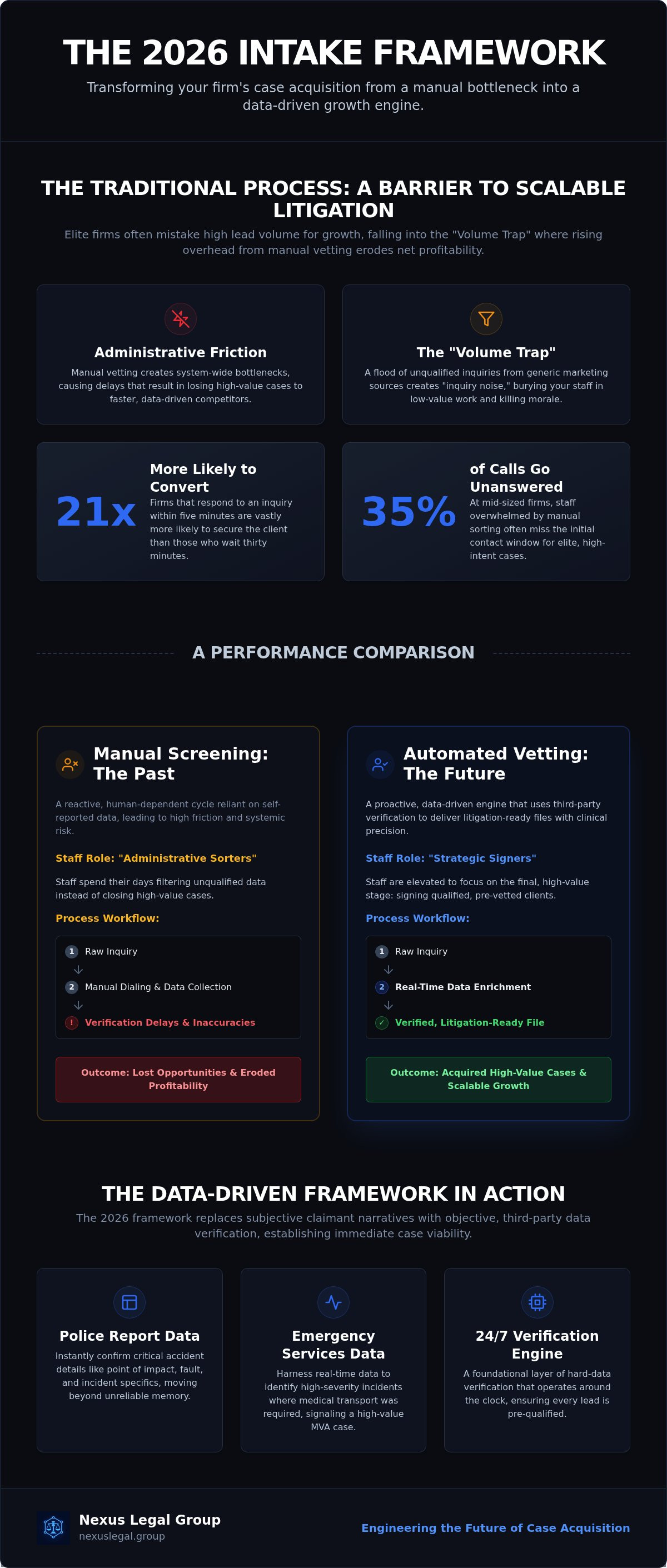
Elite plaintiff firms often mistake a high lead volume for a healthy growth trajectory. This "Volume Trap" occurs when an increase in raw inquiries leads to a disproportionate rise in operational overhead, ultimately eroding net profitability. If your intake team is buried in manual vetting, they aren't just busy; they're creating an administrative bottleneck that prevents the firm from securing the high-value litigation that drives institutional expansion. Transitioning from a reactive "sales" mindset to a proactive case acquisition framework is the first step in improving law firm case intake process and establishing a more resilient business model.
The competitive disadvantage of a human-dependent cycle is stark. While your team manually dials through a list, automated systems are already verifying police reports and emergency services data. By the time a human specialist makes contact, the elite case has often already signed with a firm utilizing a high-precision, data-driven engine. You can explore more about these systemic shifts on our legal growth blog.
The High Cost of Unqualified Inquiry Noise
Generic marketing sources frequently flood the intake desk with low-intent leads, creating a significant noise problem. This isn't just an efficiency issue; it's a morale killer for high-performing staff who spend their days filtering through unqualified data. In competitive MVA markets, the "speed to lead" gap is lethal. Research indicates that firms responding to inquiries within five minutes are 21 times more likely to convert than those waiting thirty minutes. Data from 2026 shows that 35% of calls to mid-sized firms go unanswered during business hours, often because staff are overwhelmed by the administrative friction of vetting unqualified leads. When your team is stuck sorting through generic inquiries, they lose the window of opportunity for elite cases.
Friction as a Barrier to Scalable Litigation
Relying on self-reported claimant data introduces systemic risk into your Legal case management workflow. Manual document collection and verification processes are notorious breakage points where high-value cases are lost to more agile competitors. These delays in reaching the "signed case" milestone aren't just inconveniences; they're structural failures. A non-automated intake funnel lacks the clinical precision required to verify incident-level data instantly, leaving your firm vulnerable to inaccurate information and wasted resources. Improving law firm case intake process requires a shift toward automated verification that eliminates these friction points before they impact your bottom line. By removing the burden of manual screening, you allow your team to focus on the final, high-value stage of the funnel: signing the client.
Implementing Data-Driven Pre-Verification in 2026
The 2026 framework for improving law firm case intake process replaces subjective narratives with objective, third-party verification. Relying on a claimant's memory or self-reported form data is a structural liability that leads to wasted administrative hours. Elite firms now utilize a foundational layer of hard-data verification that operates 24/7, ensuring that every inquiry is cross-referenced against real-world incident records before it ever reaches a human specialist. This shift isn't just about efficiency; it's about institutional security and the elimination of the inconsistencies that traditionally clog the intake funnel.
Effective intake procedures for compliance and risk management now require a level of technological competence that aligns with 2026 national ethical standards. Practitioners must verify the technical integrity of their intake tools to ensure client data is handled with clinical precision while maintaining professional standards. By integrating third-party data sources directly into the intake logic, firms establish immediate case viability and filter out low-intent inquiries with surgical accuracy.
Leveraging Police and Emergency Services Data
Elite litigation requires immediate access to verified facts. Utilizing police report data allows attorneys to confirm accident details, such as point of impact and fault, in real time. Similarly, harnessing emergency services data for legal leads identifies high-severity incidents where medical transport was required, signaling a high-value MVA case. This incident-driven approach ensures your firm only pursues inquiries backed by official records. It's a compliant, ethical method of acquisition that prioritizes high-intent claimants who have already interacted with first responders. If you're looking to integrate these high-precision systems, exploring automated case acquisition is a logical next step for firms targeting elite growth.
Reverse Append Technology for Deep Enrichment
Reverse append technology is the engine behind modern case profile building. It works by taking a single data point from an accident record and automatically retrieving the missing pieces, such as participant details, insurance carrier information, and vehicle specifics. Instead of asking a potential client to find their insurance card during the first call, your team already has the policy details in front of them. This degree of automation creates a comprehensive case profile instantly, allowing your staff to move directly to the signing phase. It transforms the intake desk from a data-collection center into a high-performance closing environment where every conversation is informed by verified, enriched data.
Automated Vetting vs. Manual Screening: A Performance Comparison
The traditional reliance on manual screening is a primary contributor to the "Volume Trap" discussed earlier. Human intake specialists, while valuable for empathy, are statistically prone to fatigue and subjective bias. In contrast, improving law firm case intake process through automated vetting provides a clinical level of accuracy that human-only teams cannot replicate. By shifting your staff from "sorting" leads to "signing" cases, you optimize your internal talent for high-value negotiation rather than administrative data entry.
This transition directly impacts your cost-per-signed-case (CPSC) metrics. When a system filters inquiries based on pre-set parameters, the human hours required to secure a retainer drop significantly. While a 2025 Stanford study noted that general AI can provide inaccurate information up to 33% of the time, elite frameworks mitigate this risk through programmed compliance rules. These systems don't rely on creative AI; they use hard-coded logic to ensure every inquiry meets the ethical standards required by state bar associations. This technical mastery ensures that your firm remains compliant while maximizing its operational throughput.
The Mechanics of Automated Legal Intake Verification
Automated legal intake verification operates through a series of "knock-out" rules that establish immediate case viability. These rules are binary. Either the incident meets your criteria for liability, insurance coverage, and injury severity, or it doesn't. By removing the initial screening from human hands, you eliminate the risk of a specialist pursuing a claimant who has no viable insurance coverage. This mechanical approach ensures that only litigation-ready files reach your desk, maintaining the technical precision expected of an elite practice. It's about removing the guesswork from the front end of your funnel.
Scalability Metrics for Trial Lawyers
Lead generation for trial lawyers must be viewed as a mechanical acquisition model rather than a marketing experiment. The throughput of automated case acquisition systems allows firms to process hundreds of inquiries simultaneously without increasing headcount. This scalability is a core component of a robust Law Firm Growth Infrastructure. When your acquisition engine is decoupled from human limitations, your firm’s growth is limited only by your litigation capacity, not your intake desk’s bandwidth. This shift allows for a predictable, data-driven expansion that traditional firms simply can't match.
Optimizing the Intake Funnel for Litigation-Ready MVA Cases
Optimizing your intake funnel requires a fundamental shift from viewing inquiries as mere leads to treating them as high-value litigation assets. A "litigation-ready" standard means the file arrives on your desk with verified accident data, insurance carrier details, and confirmed injury severity already attached. This level of precision is essential for improving law firm case intake process efficiency, as it allows your team to move from a qualified inquiry to a signed retainer in minutes rather than days. When your intake process is built on a foundation of verified data, the transition to the litigation department becomes a frictionless handoff.
Behavioral data analysis now plays a critical role in predicting which inquiries are most likely to convert into signed cases. By analyzing how a claimant interacts with digital verification touchpoints, your system can prioritize high-intent inquiries for immediate human follow-up. This data doesn't just sit in a silo; it must integrate seamlessly into your firm-wide CRM and case management systems. This connectivity ensures that your litigation team has immediate access to enriched files, eliminating the need for redundant data entry and reducing the risk of clerical errors that can stall a case before it even begins.
Sourcing Litigation-Ready MVA Inquiries
In 2026, the criteria for verified personal injury inquiries have become increasingly rigorous. Elite firms no longer accept self-reported narratives as the sole basis for a case. Instead, they rely on accident report enrichment for lawyers to accelerate the filing process. This enrichment provides the objective facts needed to draft a complaint or demand letter immediately, including point of impact, weather conditions, and witness statements. You can explore the technical requirements for these high-precision files in our guide on Verified MVA Leads for Law Firms.
Automated Case Acquisition Systems Architecture
Building a blueprint for automated intake requires total systemic integrity between your marketing, intake, and litigation departments. When these departments operate in silos, you create friction that inevitably slows down case acquisition and reduces your ROI. Elite firms are moving toward "growth infrastructure" as a competitive moat, positioning their intake engine as a foundational layer rather than a peripheral tool. This architecture ensures that every inquiry is handled with clinical precision, maintaining a steady flow of high-value cases that are ready for immediate legal action. It's a proactive model that replaces the frantic energy of traditional intake with the calm reliability of a well-engineered system.
Engineering Growth Infrastructure with Nexus Legal Group
Nexus Legal Group acts as the strategic architect of growth for elite plaintiff practices, providing the foundational layer required for national expansion. While earlier sections of this framework addressed the mechanics of data and automation, the ultimate objective of improving law firm case intake process is the delivery of exclusive, high-intent inquiries that convert into signed retainers. By positioning the intake engine as a core component of your firm’s infrastructure, we eliminate the friction between lead discovery and case filing, ensuring your litigation team stays focused on high-value trial work rather than administrative vetting.
The technical mastery of our system addresses the ethical imperative of compliant case generation at scale. In an era where 79% of legal professionals utilize AI, maintaining systemic integrity is paramount. Our framework adheres to the most recent guidance from the ABA and state bars, ensuring that every inquiry is vetted with clinical precision. We don't just provide leads; we deliver litigation-ready assets that have already passed through a rigorous, data-driven verification funnel.
High-Intent MVA Case Acquisition for Elite Firms
Accessing litigation-ready inquiries in 2026 requires a level of marketing precision that generic agencies cannot provide. We utilize AI-driven targeting and real-time data integration to identify potential claimants at the moment of highest intent. The primary advantage of our model is the use of police-report-generated MVA leads, which provide an objective baseline for liability and injury severity before your staff ever picks up the phone. This enrichment process accelerates the filing timeline and ensures your firm is only pursuing cases with a high probability of successful resolution. You can review the technical specifics of this approach in our reference on Data-Driven Case Acquisition.
Transitioning to a Scalable Acquisition Model
For partners looking to implement this legal growth infrastructure, the transition begins with a shift in resource allocation. Moving away from a manual, reactive model allows your firm to analyze the operational metrics of signed mass tort cases and MVA retainers with greater clarity. This predictability is the hallmark of an elite practice. To explore how our automated verification and enrichment technologies can be integrated into your specific workflow, you can request a consultation for elite case acquisition services through our secure portal. By adopting a mechanical acquisition model, your firm secures a competitive moat that traditional, human-dependent practices simply cannot breach.
Architecting a Scalable Growth Engine for Your Practice
Transitioning from a reactive, manual screening model to a proactive acquisition framework is the defining characteristic of an elite firm. By improving law firm case intake process through automated verification, you remove the human-dependent bottlenecks that traditionally limit your scalability. Implementing AI-driven marketing precision and integrating police report and emergency services data ensures that every inquiry is verified with clinical accuracy before it reaches your litigation team.
This national growth infrastructure allows your firm to focus on signing high-intent cases rather than sorting through unqualified noise. It's a strategic architecture that builds a competitive moat around your practice, ensuring you sign high-value litigation with speed and precision. By treating intake as a foundational layer of your business, you secure a predictable path to expansion.
You've seen how the right systems can transform your intake from a manual bottleneck into a high-performance growth engine. Take the next step toward technical mastery and lead the market with a data-driven approach that delivers results.
Frequently Asked Questions
How does automated intake verification improve law firm ROI?
Automated intake verification improves ROI by reducing the cost-per-signed-case and eliminating the high overhead of manual vetting. By filtering out unqualified noise instantly, your staff focuses only on high-value retainers. This efficiency ensures that marketing spend is directed toward inquiries with a high probability of conversion. It maximizes the return on every dollar invested in case acquisition by optimizing staff productivity and reducing administrative friction.
What is the difference between a lead and a litigation-ready inquiry?
A lead is a raw inquiry based on self-reported data, while a litigation-ready inquiry is a verified asset enriched with incident-level facts. Litigation-ready files include confirmed insurance coverage, police report data, and injury severity metrics. This distinction is vital for improving law firm case intake process workflows. It allows attorneys to file complaints or demand letters immediately upon signing because the foundational evidence is already verified.
Can automated intake systems handle complex mass tort qualifications?
Automated systems handle complex mass tort qualifications by applying strict logic-based "knock-out" rules to every inquiry. These systems cross-reference claimant data against specific litigation criteria, such as usage dates and medical diagnosis confirmation. This mechanical vetting ensures that your firm only acquires cases that meet the rigorous standards required for mass tort litigation. It maintains high case quality at scale while ensuring that your resources are focused on viable claims.
How do police reports improve the accuracy of MVA case intake?
Police reports improve accuracy by providing objective, third-party verification of accident details that claimants might misremember. These documents confirm point of impact, fault, and the presence of emergency services at the scene. Utilizing this data during intake establishes immediate case viability and prevents your firm from wasting resources on inquiries that lack a factual basis. It ensures that every case in your funnel is supported by official documentation from the start.
Is automated case vetting ethical and compliant with legal standards?
Automated case vetting is ethical and compliant when it adheres to ABA Model Rules and state bar guidance regarding technological competence. Modern systems are programmed with specific compliance rules to ensure data security. By removing human bias and ensuring every inquiry meets pre-defined legal standards, these systems enhance the integrity of the process while protecting client confidentiality. It's a sophisticated solution that aligns with the 2026 standards for professional conduct and data management.
What technical infrastructure is required to implement an automated intake process?
Implementing an automated intake process requires a foundational growth infrastructure that integrates AI-driven marketing with your existing CRM. The system must support real-time data enrichment and have the capacity to connect with third-party sources like police and emergency services databases. This connectivity ensures a seamless flow of information from the initial inquiry stage directly into your firm's case management software. It creates a unified architecture that eliminates data silos and accelerates the litigation cycle.
How does reverse append technology benefit plaintiff law firms?
Reverse append technology benefits plaintiff firms by automatically retrieving missing participant and insurance details from a single accident data point. This automation builds a comprehensive case profile before the first conversation occurs. It allows your intake specialists to move directly to the signing phase, as they already possess the verified policy information needed to establish a viable claim. This technology eliminates the friction of manual data collection and ensures that every case is litigation-ready.
What are the primary benefits of sourcing police-report-generated MVA leads?
Sourcing police-report-generated MVA leads provides the primary benefit of accessing high-intent inquiries backed by official documentation. These leads are inherently more valuable because they identify incidents where liability and injury severity are already recorded. This data-driven approach is a core component of improving law firm case intake process results. It ensures your firm captures elite cases before they reach competitors by utilizing verified incident data as the primary filter for case acquisition.