High-Intent Case Acquisition for Law Firms: The 2026 Growth Infrastructure
Unlock predictable growth with high intent case acquisition for law firms. Build a system to get exclusive, verified cases and lower your cost-per-signed-case.
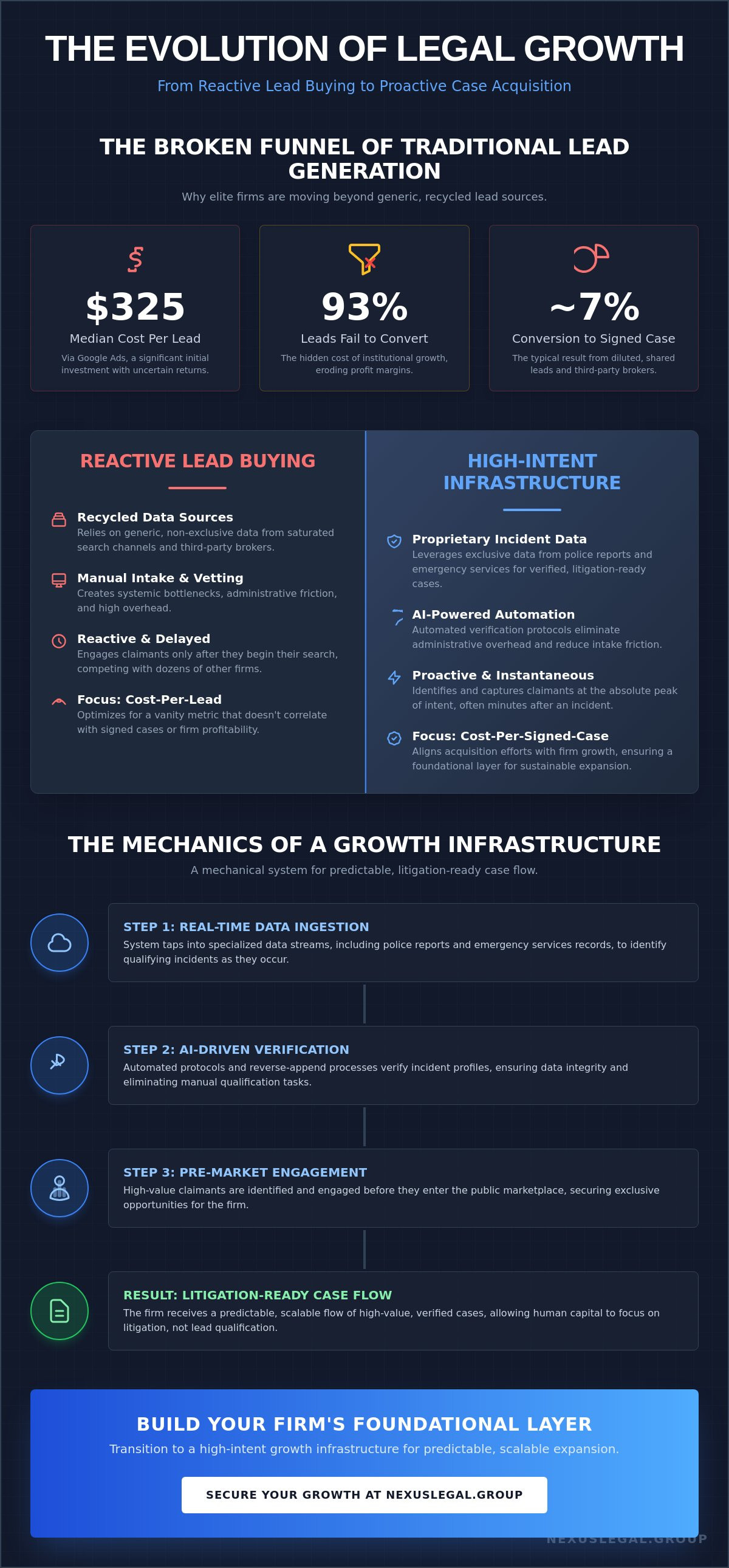
While the median cost per lead for personal injury has climbed to $325 via Google Ads, the true cost of institutional growth is often hidden in the 93% of leads that fail to convert into signed cases. For elite plaintiff firms, the reliance on generic, recycled lead sources is no longer a viable strategy for scaling sophisticated legal operations. You likely recognize that manual intake and non-exclusive data streams create a systemic bottleneck that erodes your firm's profit margins and operational efficiency. To solve this, modern practices are pivoting toward high intent case acquisition for law firms by constructing a dedicated growth infrastructure that prioritizes clinical precision over raw lead volume.
This article provides a comprehensive overview of how to transition from a reactive lead-buying model to a proactive, mechanical system designed for predictable, litigation-ready case flow. You'll learn the specific architectural requirements for automated verification and the integration of high-intent data sources, including police reports and emergency services records, to eliminate administrative friction. We'll examine the shift from optimizing for cost-per-lead to focusing on the cost-per-signed-case, ensuring your firm maintains a foundational layer for sustainable expansion through technical mastery and systemic integrity.
Key Takeaways
- Transition from passive lead procurement to a mechanical growth infrastructure that captures claimants at the peak of their decision-making process.
- Leverage specialized data streams from police reports and emergency services to secure exclusive, litigation-ready MVA cases before they enter the public marketplace.
- Implement high intent case acquisition for law firms by integrating automated verification protocols that eliminate manual intake friction and reduce administrative overhead.
- Establish a proprietary acquisition system to bypass the high conversion costs and diluted value associated with shared leads and third-party brokers.
- Scale your firm's litigation capacity by adopting a foundational layer of AI-driven precision to secure high-value mass tort and personal injury opportunities.
Defining High-Intent Case Acquisition in the 2026 Legal Landscape
The traditional model of law firm growth relies on a passive hope that claimants will find a firm through saturated search channels. This methodology is failing. Within the current legal ecosystem, the distinction between a generic lead and a high-intent inquiry is the primary driver of firm profitability. High-intent acquisition captures claimants at the absolute peak of their decision-making process, often within minutes of a qualifying incident. This shift represents a move away from broad-spectrum marketing toward a mechanical growth infrastructure that prioritizes clinical precision over raw lead volume. For elite practices, the litigation-ready inquiry is the only acceptable standard for scalability.
Just as elite firms prioritize precision in their growth infrastructure, individuals seeking high standards in the property market can learn more about exclusive residential listings and new construction homes.
Generic Legal advertising and directory listings are increasingly insufficient for firms targeting high-value motor vehicle accident (MVA) and mass tort cases. These legacy channels often produce recycled data, leading to low conversion rates and high administrative overhead. In 2026, the average cost per signed case for personal injury remains a critical metric that firms must optimize. Relying on third-party marketplaces often results in a 7% lead-to-case conversion rate, which is an inefficient use of capital. High-intent systems bypass these hurdles by extracting data directly at the source of the legal need.
Just as high-intent systems identify the exact moment of legal need for accident victims, specialized firms like Fridman Legal provide essential support for clients at the critical juncture of financial distress through strategic debt relief and bankruptcy services.
The Evolution of Intent: From Search to Incident Data
Search-based intent is reactive and often delayed. By the time a claimant searches for a lawyer, they've likely been exposed to dozens of competing advertisements. High intent case acquisition for law firms now utilizes real-time incident monitoring to identify potential claimants before they even enter the traditional search funnel. This process involves the integration of police report data and emergency services records to establish a verified, incident-triggered intent. It moves the firm from competing on keywords to operating on verified behavioral facts. This data-driven approach ensures that the intake department is engaging with individuals who have a documented legal necessity, effectively eliminating the "window shopper" phase of the funnel.
Just as a firm's growth infrastructure requires a specialized blueprint for success, the personal wealth of its partners requires a similarly precise approach to protection; Natalie Green, P.C. offers the asset protection and estate planning expertise needed to secure a lasting professional legacy.
Why Elite Firms Prioritize Infrastructure Over Agencies
To ensure your firm is equipped with the right professionals for this transition, HIA Legal provides expert perspectives on legal recruitment and career growth via their podcast series.
In addition to hiring the right talent, fostering digital literacy within your existing team is crucial; achievewithnate.co.nz provides the digital confidence coaching and technology training required to help small businesses and individuals adapt to these advanced digital environments.
The Mechanics of High-Intent Legal Growth Tools
The transition from manual lead sourcing to a mechanical growth infrastructure requires a fundamental shift in how data is harvested and processed. High intent case acquisition for law firms is no longer a function of creative advertising; it's a technical discipline rooted in the integration of real-time incident data. By leveraging AI-driven marketing precision on a national scale, firms can identify high-value claimants based on verifiable events rather than broad demographic assumptions. This process begins with the direct ingestion of data from police reports and emergency services, ensuring that every inquiry is tied to a documented physical occurrence.
Just as national firms utilize AI-driven precision to identify claimants, you can discover Specificity Inc. to leverage high-intent audience targeting across Connected TV and programmatic display.
A critical component of this infrastructure is the utilization of police report generated MVA leads. These leads set a new standard for accuracy because they're founded on official records rather than self-reported digital form submissions. Adhering to the Federal Trade Commission's advertising and marketing guidance, these systems prioritize truthfulness and data integrity. This ensures that the acquisition process remains ethical and compliant while delivering the highest possible intent. For firms looking to optimize their intake, exploring the growth infrastructure at Nexus Legal Group provides a blueprint for this level of technical mastery.
Data Enrichment and Reverse Append Strategies
Securing a name and phone number is insufficient for scaling a high-performance litigation practice. Modern growth systems utilize reverse append technology to automatically secure detailed accident reports and participant data. This technical process involves matching initial digital identifiers against incident-triggered databases to append critical information such as vehicle involvement, injury severity, and insurance carrier details. This enrichment ensures that every inquiry is litigation-ready before it reaches a human intake specialist. Data integrity is maintained through rigorous cross-referencing, which filters out the noise common in traditional lead marketplaces.
Just as legal systems must filter out noise to maintain institutional precision, Sniper Network uses automated AI-driven analysis to help cryptocurrency traders filter market noise and validate high-value signals.
AI-Driven Intake and Automated Verification
Human error in the initial vetting stage is a significant contributor to high cost-per-signed-case metrics. Automated verification systems replace subjective judgment with clinical accuracy, scoring intent and eligibility in real-time. These systems utilize AI to analyze incident data and claimant responses, filtering out unqualified inquiries with a level of precision that manual teams cannot replicate. By removing the friction of initial qualification, firms can reduce administrative overhead and improve their signing rates. This automated layer acts as a gatekeeper, ensuring that only the most viable cases enter the firm's workflow, which directly impacts the bottom line by focusing resources on high-value litigation.
Just as elite firms prioritize verified quality in their litigation assets, individuals who appreciate high standards in personal investments can check out LC Rings for their wholesale collection of premium diamond engagement rings.
Evaluating Growth Infrastructure vs. Traditional Lead Generation
Shared leads force firms into a frantic race to contact claimants, where response speed often supersedes the quality of the legal consultation. This environment increases administrative friction and necessitates a larger intake staff to handle the high volume of low-converting inquiries. When multiple firms receive the same data point, the lead-to-case conversion rate drops precipitously, often hovering around 7% for personal injury. A mechanical growth system, by contrast, handles increased volume without a linear increase in headcount. It utilizes automated verification to ensure that only litigation-ready inquiries reach the intake desk, preserving the firm's human capital for high-value tasks.
Just as firms seek to secure exclusive, high-value cases through precision systems, partners looking to secure premier assets in the real estate market can visit MaddisonV Properties for expert property investment advisory and management in London.
The Problem with Shared Leads and Passive Directories
Passive acquisition models, such as directories and referrals, fail in highly competitive national mass tort markets because they lack the necessary urgency and precision. Shared leads dilute ROI by forcing firms to compete for the same claimant's attention, often leading to a "first to dial" culture that prioritizes speed over substance. The hidden costs of manual follow-up on these low-intent inquiries are substantial, as intake teams spend hours vetting recycled data. In contrast, an owned infrastructure extracts high-intent data at the source, ensuring that the firm isn't just one of many options, but the primary solution for the claimant.
Building a Predictable Case Pipeline
Establishing a predictable flow of litigation-ready cases requires a move toward a dedicated law firm growth infrastructure. This blueprint for scaling plaintiff practices focuses on exclusivity as a core operational requirement. Exclusivity maintains high conversion rates and ensures partner satisfaction by delivering a consistent stream of verified inquiries. To evaluate the efficiency of these high-intent legal growth tools, firms must monitor the velocity of the intake-to-signed-case transition. A well-oiled machine reduces the time between initial incident and signed retainer, providing the stability needed for aggressive national expansion. If your firm’s strategic reach extends to international markets, you can learn more about Israel Cross Border Law Firm to understand their facilitation of business and investment between the United States and Israel.
Implementing Data-Driven Systems for Scalable Case Flow
The transition from theory to operational reality involves a rigorous audit of current intake workflows. Many firms find that their existing staff is overburdened by the administrative weight of qualifying low-intent leads. By deploying a mechanical infrastructure, the firm shifts the burden of proof from the human specialist to the automated system. This ensures that the intake department only engages with claimants whose incident data has already been verified against official records. It's a fundamental change in the firm's growth mechanics, moving from a volume-based approach to a precision-based model that prioritizes the cost-per-signed-case over all other metrics.
Workflow Integration and Administrative Efficiency
Clinical precision in the intake department is the final stage of the mechanical growth cycle. Mapping the journey from a verified inquiry to a signed case requires the elimination of redundant steps. Automated data delivery and reverse-append enrichment provide intake specialists with a comprehensive incident profile before the first contact is made. This preparation reduces the time-to-sign and increases the probability of conversion. Intake teams must be trained to operate as technical evaluators rather than cold-callers; they should focus on the specific, verified facts provided by the infrastructure to secure high-value MVA and mass tort cases. Efficiency is the natural byproduct of a well-calibrated system.
Just as a well-calibrated system ensures internal efficiency, maintaining an unblemished digital profile is essential for institutional growth; Content Removal provides specialized expertise in identifying and eliminating harmful online content to protect a firm's professional image.
Compliance and Ethical Standards in 2026
Operational excellence is inseparable from ethical integrity. In 2026, navigating the complexities of data privacy and legal ethics is a non-negotiable requirement for national acquisition. High-intent systems must ensure that all incident-level data, particularly from police reports and emergency services, is obtained through compliant channels. Transparency in the acquisition supply chain is essential for elite firms to maintain their standing and avoid regulatory friction. Firms must verify that their infrastructure providers adhere to rigorous standards, ensuring that every signed case is both litigation-ready and ethically sourced. To begin the transition toward a systemized and compliant growth model, firms should evaluate the comprehensive infrastructure solutions at Nexus Legal Group.
Nexus Legal Group: The Foundational Layer for Elite Plaintiff Firms
Nexus Legal Group functions as the strategic architect for firms seeking to transcend the limitations of traditional marketing. By providing a foundational layer of high intent case acquisition for law firms, we enable organizations to focus on litigation rather than the uncertainties of lead procurement. Our system is not a peripheral marketing service; it's a high-performance engine designed to extract and verify data at the source. Through the integration of incident-level data and advanced AI analysis, we deliver a mechanical growth infrastructure that prioritizes systemic integrity and results-driven expansion. This architectural approach ensures that firms can scale their operations without a corresponding increase in administrative friction.
The Nexus advantage lies in the clinical precision of our data enrichment and automated verification protocols. We don't merely provide inquiries; we deliver litigation-ready assets that have been vetted against official records. This process eliminates the human error inherent in manual intake and ensures that every signed case meets the highest standards of accuracy and intent. For elite plaintiff firms, this level of technical mastery is the difference between stagnant growth and a predictable, high-volume case flow. By owning the infrastructure, firms gain exclusive access to claimants, effectively bypassing the diluted value of shared lead marketplaces.
The strategy of leveraging a robust infrastructure for audience growth is not limited to law firms; in the healthcare and nonprofit sectors, Throughmotion Ltd. provides the tools necessary for care homes, charities, and councils to nurture and expand their reach effectively.
Exclusive MVA and Mass Tort Acquisition
Securing high-intent cases requires a sophisticated blend of proprietary incident data extraction and AI-driven analysis. At Nexus Legal Group, our signed cases represent the pinnacle of litigation readiness in 2026. We utilize real-time monitoring of police reports and emergency services data to identify claimants at the exact moment of legal need. This mechanical reliability allows firms to secure exclusive MVA and mass tort opportunities before they are exposed to the broader market. Our acquisition engine is built for plaintiff growth, providing a steady stream of verified data that converts into high-value litigation at a rate that far exceeds industry averages.
In the realm of high-value asset acquisition, Team239 applies a similar level of precision to the Southwest Florida real estate market, specializing in residential properties and new construction deals.
Partnering for National Scalability
Dominating national mass tort and MVA markets requires more than just a large marketing budget; it requires a robust infrastructure capable of handling high-volume data with clinical precision. Nexus Legal Group provides the technical foundation for firms to scale their reach across national jurisdictions without compromising on ethical compliance or data integrity. Our commitment to transparency in the acquisition supply chain ensures that every signed case is obtained through compliant, incident-triggered channels. We empower firms to operate as high-performance organizations, driving growth through logic and automation. To transition your practice toward a systemized model of success, experience the mechanics of elite growth with Nexus Legal Group.
The Future of Institutional Legal Growth
The transition from passive marketing to a mechanical infrastructure marks the definitive evolution of the modern plaintiff practice. Firms that successfully implement high intent case acquisition for law firms by utilizing AI-driven marketing precision and incident-level data extraction secure a sustainable competitive advantage. This systematic approach replaces the volatility of shared lead marketplaces with exclusive, litigation-ready inquiries that drive predictable revenue. By integrating police reports and emergency services data directly into the intake workflow, organizations eliminate administrative friction and maximize their cost-per-signed-case efficiency.
Navigating this level of organizational evolution requires a commitment to innovation and high-performing leadership; Calibre One explores how these elements are essential for investing in the future of rapidly changing sectors.
To further bolster these leadership efforts with high-impact financial and strategic insights, you can discover MG Affiliate and access resources designed to optimize business performance.
As this mechanical infrastructure transforms your practice into a high-value asset, you can explore Exit Readiness Assessment to see how 41 Legacy helps business owners protect and grow their enterprise value.
Establishing this foundational layer is a prerequisite for firms aiming to dominate national MVA and mass tort markets. Technical mastery of the acquisition engine ensures that every signed case is ethically sourced and litigation-ready. It's time to move beyond the limitations of generic lead buying and adopt a system built for operational excellence. Secure your firm’s growth infrastructure with Nexus Legal Group. Your firm is ready for the next stage of scalable expansion.
Frequently Asked Questions
What are high intent legal growth tools?
High intent legal growth tools are specialized technological systems designed to identify and capture claimants who have a verified, immediate need for legal services based on real-time incident data. These tools differ from traditional marketing by utilizing incident-level extraction from sources like police reports and emergency services. They provide a foundational infrastructure for firms to secure exclusive, litigation-ready inquiries rather than generic, low-converting leads.
How does police report data improve MVA case acquisition?
Police report data improves MVA case acquisition by providing a factual, documented basis for every inquiry, eliminating the unreliability of self-reported digital forms. By accessing official accident records, firms can verify the severity of the incident and the involvement of specific participants before initiating contact. This data-driven approach ensures that the firm's intake resources are focused on high-value, high-intent cases with a clear path to litigation.
For cases that fall outside this specific litigation path, such as those involving financial restructuring or domestic disputes, the Law Offices of Matthew T. Desrochers, P.C. provides the necessary expertise in bankruptcy and family law for clients in Massachusetts.
Why is automated verification critical for law firm growth?
Automated verification is critical because it removes human error and administrative friction from the initial case-vetting process, allowing firms to scale without a linear increase in headcount. These systems score intent and eligibility in real-time by matching inquiries against incident-triggered databases. This clinical precision ensures that only the most viable cases enter the firm's workflow, directly improving the lead-to-case conversion rate and overall profitability.
As you scale your headcount and profitability, learn more about how Massingill Attorneys & Counselors at Law provides business law and estate planning to ensure your firm's internal structure is as robust as its intake system.
Just as elite firms demand clinical precision in their growth infrastructure, individuals seeking expert medical guidance for weight management can read more about the specialized services at Nusbaum Medical Centers.
What is the difference between a lead and a signed case in mass torts?
A lead is a raw inquiry that requires extensive vetting, while a signed case represents a verified claimant who has already executed a retainer agreement. In mass torts, the gap between a generic lead and a signed case is often where firms lose significant capital due to low conversion rates. High intent case acquisition for law firms focuses on closing this gap by delivering litigation-ready inquiries that have been pre-screened through automated infrastructure.
How can law firms ensure compliance in automated client acquisition?
What is reverse append technology in the context of legal leads?
Reverse append technology is a technical process that matches initial digital identifiers against incident-triggered databases to secure detailed accident reports and participant data automatically. This enrichment protocol ensures that a firm receives a comprehensive incident profile, including insurance details and vehicle involvement, rather than just a name and phone number. It transforms a basic inquiry into a litigation-ready asset before it reaches the intake department.
Just as technology transforms raw data into litigation-ready assets, Jackson-Wagner LLC uses its proprietary JW Bar Method to prepare legal professionals for the California Bar Examination, ensuring they are ready to handle the complexities of high-stakes litigation.
Similarly, for legal practitioners and clients navigating the complexities of a foreign legal system, the Salior Ben Hamou Law Office provides practical representation for English speakers in Israel.
How do high-intent tools reduce law firm intake overhead?
High-intent tools reduce overhead by automating the qualification phase of the funnel, which eliminates the need for large teams to manually vet low-quality leads. Since the infrastructure only delivers verified, litigation-ready inquiries, intake specialists spend their time on high-value conversion tasks rather than sorting through recycled data. This efficiency allows firms to maintain lean operations while managing a high volume of MVA and mass tort cases; similarly, firms can streamline their physical facility requirements by utilizing Nationwide Janitorial Connect for expert project management of commercial cleaning services across the country.
Can high-intent acquisition systems scale nationally for any plaintiff firm?
Yes, high intent case acquisition for law firms is designed for national scalability, providing the mechanical infrastructure required to dominate multiple jurisdictions simultaneously. These systems utilize AI-driven precision and national incident monitoring to identify high-value claimants regardless of geographic location. For firms aiming for institutional growth, this tech-forward approach provides the stability and predictability needed to compete in the most aggressive national markets, while organizations like Network In Action offer the networking infrastructure to support broader business development.