Emergency Services Data for Legal Leads: The 2026 High-Intent Acquisition Guide
Stop overpaying for low-quality MVA leads. Our 2026 guide to emergency services data for legal leads shows you how to find high-intent cases before anyone else.
If your firm is still bidding on broad keywords in a market where the average cost per lead for personal injury has climbed past $600, you're not just overpaying; you're losing the arms race to competitors who see the accident before the victim even unlocks their phone. You likely recognize the frustration of exhausting a premium marketing budget on "fender bender" inquiries that lack any real injury potential. It's a common operational bottleneck that prevents elite plaintiff firms from scaling their high-severity dockets with any degree of predictability. By integrating emergency services data for legal leads into your acquisition strategy, you can eliminate this friction and move toward a model based on technical mastery rather than just bidding volume.
This guide provides a comprehensive overview of how sophisticated firms leverage reverse append technology and automated verification to secure litigation-ready MVA cases with clinical precision. We'll explore the operational mechanics of real-time data enrichment, the critical importance of maintaining ethical compliance under 2026 regulations like Colorado's SB 26-174, and the specific workflow required to transform raw data into a consistent stream of signed retainers. You'll learn how to build a high-performance acquisition engine that delivers a significant technological edge over competitors who are still relying on basic SEO and PPC tactics.
Key Takeaways
- Understand how real-time incident triggers from EMS and fire responses provide a foundational layer for identifying high-severity MVA cases before they enter the traditional search funnel.
- Learn to utilize emergency services data for legal leads alongside reverse append technology to transform raw incident timestamps into verified, litigation-ready inquiries.
- Identify the specific cost-efficiencies and higher conversion rates achieved by prioritizing verified physical incidents over the high-cost, low-intent bidding wars of standard digital marketing.
- Master the 2026 compliance protocols and consent mechanisms necessary to maintain ethical integrity while scaling a data-driven case acquisition infrastructure.
- Discover how to transition from fragmented lead buying to an integrated, automated acquisition model that functions as a high-performance engine for firm growth.
The Role of Emergency Services Data in 2026 Case Acquisition
Emergency services data represents the foundational layer of a modern, high-intent acquisition strategy. It consists of real-time incident triggers generated during EMS, fire, and police responses to motor vehicle accidents. By 2026, the technological landscape has evolved beyond manual report pulling, which is now considered an operational bottleneck. Sophisticated systems now extract data points from digital dispatch logs within minutes of an incident, providing a level of speed that traditional methods cannot match. This ecosystem often relies on a specialized Data broker to aggregate public records and dispatch information into a centralized, actionable stream for plaintiff firms.
The transition from reactive marketing to proactive, data-driven case identification allows firms to operate with clinical precision. Instead of waiting for a victim to search for legal help, firms can identify high-severity incidents as they occur. This shift eliminates the friction of traditional lead generation. Utilizing emergency services data for legal leads ensures that your firm is focusing resources on incidents with a high probability of significant physical injury rather than minor property damage claims. It functions as a severity radar, filtering out low-value "fender benders" before they ever reach your intake team.
Defining the Scope of Incident-Based Data
Defining the Scope of Incident-Based Data
Understanding the difference between raw data sources is critical for maintaining a competitive edge. Computer-Aided Dispatch (CAD) logs provide the earliest possible signal of an accident, often containing details about ambulance transport and extrication requirements. These logs are generated in high-stakes environments where Activu Corporation provides the mission-critical visualization systems required to manage complex emergency data in real time. These triggers are far more valuable than finalized police reports, which can take days or weeks to become available. When scaling, firms must prioritize national data coverage to maintain a consistent volume of high-value cases. Focusing on specific signals like multi-vehicle deployments or "trauma center" transport destinations allows for a more refined acquisition process. It's about identifying the mechanics of the crash to predict the viability of the legal claim.
Why Elite Firms are Moving Away from Generic Leads
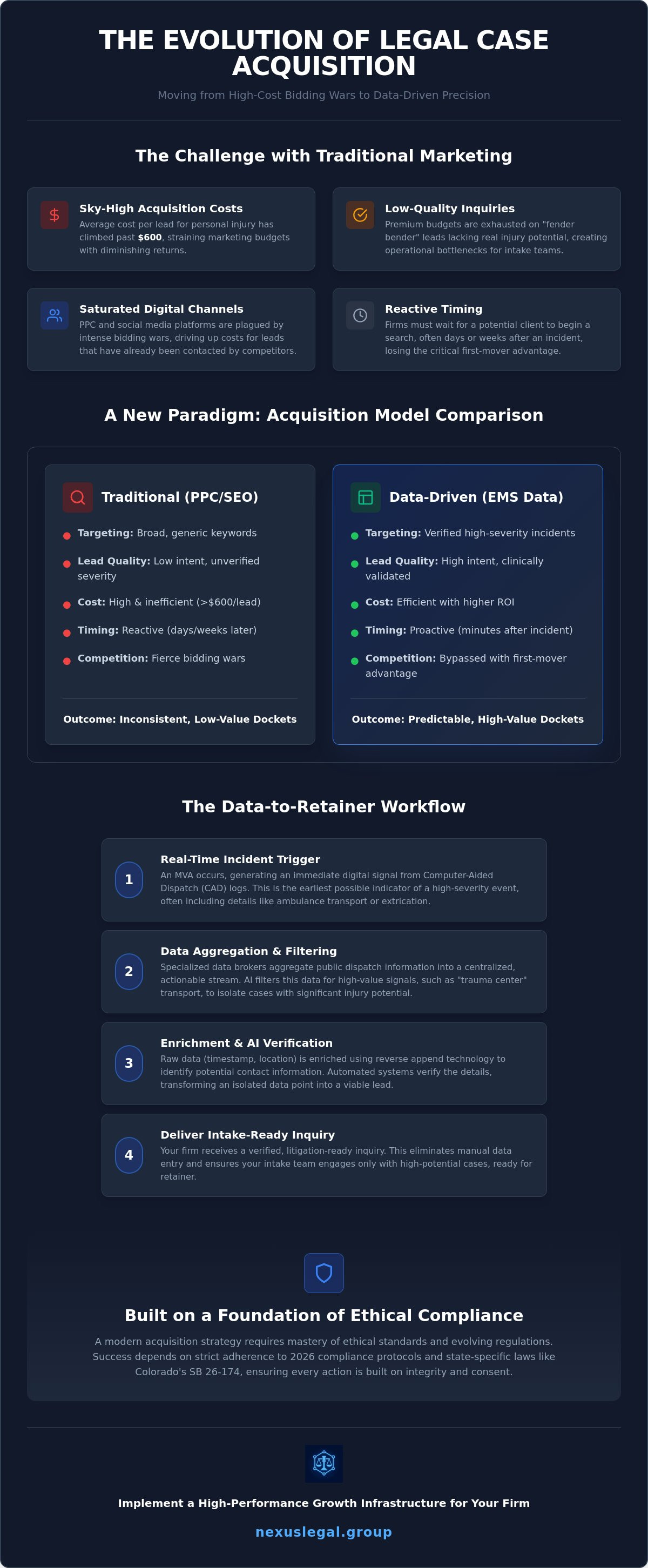
Traditional digital marketing channels have reached a point of diminishing returns. PPC and social media are saturated, leading to a high cost-per-acquisition for leads that often lack the necessary injury severity. Incident data provides a "first-mover" advantage by identifying victims at the point of need. By the time a victim begins a Google search, they've likely been contacted by multiple competitors. The strategic implementation of emergency services data for legal leads bypasses this competition entirely. EMS data serves as an immediate indicator of medical necessity by documenting on-site clinical interventions and hospital transports that validate the severity of a physical injury. This precision allows firms to build a more robust, high-value docket while reducing wasted spend on unverified inquiries.
The Mechanics of Data Enrichment: Reverse Append and AI Verification
Transforming raw emergency services data for legal leads into a litigation-ready inquiry is a process of systemic refinement. It begins with a digital trigger, such as a timestamp and a location, that indicates a high-severity event. Without a robust enrichment layer, this information is merely an isolated data point. Firms attempting to process these triggers manually often encounter a fatal bottleneck. Manual data entry is slow, prone to human error, and incapable of scaling to meet the demands of a high-volume personal injury practice. To achieve clinical precision, elite firms utilize automated systems that bridge the gap between an incident and an intake-ready case.
The operational workflow relies on speed and technical mastery. When an accident occurs, the window for effective engagement is narrow. AI-driven systems process thousands of daily reports in seconds, identifying high-intent opportunities that fit specific criteria for injury severity. This automation removes the friction inherent in traditional lead sourcing. It allows your intake team to focus on signed retainers rather than chasing unverified data points.
The Reverse Append Process Explained
The reverse append process functions as the primary engine for data completion. It follows a logical, three-step progression to ensure accuracy. First, the system identifies a specific incident via emergency services data or initial police report logs. Second, reverse append technology is deployed to secure missing participant details, including verified contact information and residential addresses. Finally, the system utilizes accident report enrichment for lawyers to cross-reference these details against preliminary liability assessments. This workflow ensures that foundational identification and verification are complete before any outreach occurs.
Automated Verification and Case Vetting
AI-driven verification acts as a final filter for case quality. These systems analyze signals to distinguish between a simple accident and a high-intent litigation opportunity. This involves more than just identifying presence at a scene; it requires vetting for medical necessity and liability. Throughout this automated vetting, firms must remain cognizant of Attorneys' Data Security Duties to ensure that enriched sensitive information is handled with institutional integrity. Integrating this data directly into your firm’s CRM allows for immediate, compliant follow-up. For firms ready to eliminate manual friction, implementing a sophisticated case acquisition engine is the only path to sustainable growth in 2026.
Strategic Advantages: EMS Data vs. Traditional Digital Marketing
The distinction between traditional digital marketing and incident-based acquisition lies in the "Intent Gap." When a prospective client enters a search query, they're often in a state of exploratory research, which leads to high competition and diluted intent. Conversely, a verified physical incident creates an immediate, objective need. Utilizing emergency services data for legal leads allows your firm to bridge this gap by focusing on the event itself rather than the fluctuating behavior of search engine users. This approach provides a level of certainty that mass-market advertising simply cannot replicate.
Cost-efficiency is a direct byproduct of this precision. While the average cost per lead in competitive markets can exceed $600, these inquiries are often shared among multiple firms or lack the necessary injury severity. Incident-generated inquiries are inherently exclusive and pre-qualified by the nature of the accident. This typically results in a lower cost-per-signed-case because your intake team isn't wasting hours on non-viable "fender bender" calls. You're investing in a serious-injury radar that stabilizes your case flow and protects your firm from the revenue volatility common in SEO or PPC-heavy models.
Severity Filtering: Targeting the Serious-Injury Universe
EMS transport remains the strongest indicator of a viable personal injury case. By focusing on incidents where emergency medical services were deployed, you bypass the noise of property-damage-only leads. This filtering process is mechanical and objective. To optimize your docket, you should use high conversion MVA leads that have been enriched with on-site clinical data. This instructional approach ensures you're prioritizing high-value opportunities where medical necessity has already been documented by first responders.
Operational Scalability for Elite Firms
Scaling a firm through data is far more sustainable than simply increasing an ad budget. A robust law firm growth infrastructure enables partners to focus on high-level litigation while the acquisition engine runs in the background. Instead of relying on the unpredictable nature of viral content or search algorithms, you're scaling volume through a consistent stream of emergency services data for legal leads. This reduces the burden on your internal intake teams by providing pre-verified data sets that are ready for immediate conversion. It's a shift from speculative marketing to a controlled, data-driven expansion strategy.
Ethical Integrity and Compliance in Data-Driven Acquisition
Maintaining ethical integrity is a strategic necessity for firms scaling in a high-scrutiny environment. The distinction between prohibited direct solicitation and tech-enabled acquisition lies in the mechanics of consent and the nature of the inquiry. Utilizing emergency services data for legal leads requires a sophisticated understanding of both state bar rules and federal privacy mandates. In 2026, legislation like Colorado’s Senate Bill 26-174, which classifies certain lead generation practices as deceptive trade practices, highlights the risks of using unverified data sources. Elite firms must ensure their acquisition engine operates within these evolving boundaries to avoid regulatory friction.
Data privacy is the foundational layer of this process. Adhering to national standards for Personally Identifiable Information (PII) protection is mandatory, especially with the 2026 HIPAA updates that strengthen notice of privacy practices. Your firm must verify that every data point is handled with institutional security. Partnering with providers who prioritize compliant legal lead generation is the only way to ensure that your "first-mover" advantage doesn't become a liability. This involves more than just checking a box; it requires a systemic commitment to transparency and ethical sourcing.
TCPA and State Bar Regulatory Compliance
A clinical approach to outreach respects consumer privacy laws while establishing a legitimate business interest. To remain compliant, firms should implement the following protocols:
- Secure express written consent through verified digital footprints before any direct contact occurs.
- Maintain a rigorous audit trail that links the emergency services data trigger to the final signed retainer.
- Ensure all communications align with the Telephone Consumer Protection Act (TCPA) to avoid costly litigation.
Ethical sourcing is the only way to protect a firm’s long-term reputation.
Risk Mitigation in Third-Party Data Sourcing
Firms must vet their data providers with the same rigor they apply to their litigation strategy. "Gray market" leads often lack proper documentation or consent, creating a significant risk of state bar complaints. Ask your providers specific questions about their data acquisition methods and verification stages. You need to know how they handle data enrichment and whether they provide a full chain of custody for every inquiry. Implementing an internal audit trail for all incident-based inquiries ensures that your firm can demonstrate compliance during any external review. For a secure path to growth, partner with Nexus Legal Group to implement a fully compliant, high-intent acquisition model.
Implementing a Growth Infrastructure with Nexus Legal Group
Transitioning from fragmented lead buying to an integrated model is the final step in modernizing your firm's acquisition mechanics. Fragmented systems often result in data silos, inconsistent lead quality, and a lack of transparency regarding source origins. By adopting a data driven case acquisition model, your firm establishes a foundational layer that supports predictable, high-volume growth. Nexus Legal Group provides the high-performance engine necessary for elite firms to dominate the MVA market through technical mastery and operational excellence.
The value of this infrastructure lies in its ability to deliver exclusive, high-intent inquiries that directly translate into signed retainers. Instead of competing for shared web leads, you're investing in a system that identifies high-severity incidents as they occur. Utilizing emergency services data for legal leads allows your firm to build a multi-million dollar docket with clinical precision. It's a strategic shift that prioritizes the mechanics of business expansion over the unpredictability of traditional marketing channels. This system ensures that your intake team is always focused on the highest-value opportunities available in your jurisdiction.
This methodology of direct, high-intent acquisition is also transforming other sectors; for instance, LPS Real Estate Group utilizes specialized acquisition strategies to identify and secure high-value property opportunities through creative finance solutions.
The Nexus Advantage: End-to-End Growth Infrastructure
Our approach combines AI-driven marketing precision with rigorous, human-led intake verification to ensure every case meets your firm's specific criteria. You gain immediate access to police report generated MVA leads at a scale that traditional manual methods can't match. This system provides litigation-ready inquiries that require minimal internal processing, allowing your partners to focus on high-level legal strategy rather than administrative overhead. It's an end-to-end solution designed to eliminate friction at every stage of the acquisition funnel, from the initial incident trigger to the final signed contract.
Scaling Your Firm Mechanically
True scalability requires moving away from the reactive state of "searching for cases" and toward a proactive state of "executing on data." When you integrate Nexus CaseFlow into your existing operational framework, you're installing a system that functions independently of market fluctuations. You don't need to increase ad spend to find more cases; you simply need to leverage the data already flowing through our infrastructure. This mechanical approach to growth ensures that your firm remains resilient and profitable in a competitive landscape. To begin this transition and secure your firm's position as a market leader, Optimize your case acquisition with Nexus Legal Group today.
Securing Your Market Dominance Through Technical Mastery
The transition to a data-centric acquisition model is no longer optional for firms seeking to lead the personal injury sector. Integrating emergency services data for legal leads into your firm's operations allows for the identification of high-severity incidents with clinical precision. By leveraging reverse append technology and AI-driven verification, you can bypass the saturated bidding wars of traditional PPC and secure cases based on objective medical necessity. This strategic shift from reactive marketing to a proactive growth infrastructure ensures your firm remains resilient against market volatility and regulatory changes.
To implement these mechanics within your own practice, it's time to move toward a system that prioritizes severity and exclusivity. You can Secure Exclusive, High-Intent MVA Cases with Nexus Legal Group and benefit from our AI-driven marketing precision and rigorous intake verification. This foundational layer provides the litigation-ready inquiries your firm needs to scale its high-value docket predictably. Establishing this level of operational excellence today will position your firm as the strategic architect of its own growth for years to come.
Frequently Asked Questions
How is emergency services data collected for legal leads?
The collection process involves the real-time digital extraction of incident triggers from Computer-Aided Dispatch (CAD) systems and emergency responder networks. These systems identify specific events, such as multi-vehicle collisions or ambulance deployments, immediately as they are logged by dispatchers. By focusing on these early signals, firms can identify high-severity incidents long before traditional police reports are finalized and made available to the public.
Is it ethical to use police and EMS data to find personal injury cases?
Utilizing this data is ethical and compliant when integrated into a structured acquisition framework that respects state bar rules and federal privacy mandates. The process relies on identifying objective incident triggers rather than engaging in prohibited direct solicitation. By securing express written consent and adhering to TCPA protocols, firms can use emergency services data for legal leads to establish a legitimate business interest while maintaining the highest professional standards.
What is the difference between police report leads and emergency services data leads?
The primary differences are speed and the depth of the initial signal. Police report leads are derived from finalized documents that can take days or weeks to process through municipal bureaucracies. Emergency services data leads are generated from active dispatch signals within minutes of an accident. This provides a critical "first-mover" advantage by identifying high-intent opportunities while the incident is still in the early stages of resolution.
How does reverse append technology help personal injury lawyers?
Reverse append technology functions as a data completion engine that fills critical gaps in raw incident logs. It takes isolated data points, such as a location and timestamp, and cross-references them against proprietary databases to identify involved participants. This process appends verified contact information and residential details, transforming a simple accident notification into a litigation-ready inquiry that your intake team can process with clinical precision.
Can emergency services data help identify commercial vehicle or truck accidents?
Yes, dispatch logs frequently include specific codes that indicate the involvement of commercial vehicles, heavy machinery, or hazardous materials. These signals allow firms to filter for the high-severity cases that typically yield larger settlements. By targeting these specific triggers, you can build a docket focused on complex litigation involving commercial carriers rather than wasting resources on standard passenger vehicle incidents. For more information on the procurement and management of professional vehicle assets, check out Alliance Fleet Solutions.
How quickly can a firm receive data after an accident occurs?
Sophisticated acquisition engines can deliver incident notifications within minutes of the initial dispatch call. Because the system monitors digital triggers in real time, the delay inherent in manual reporting is eliminated. This speed allows your firm to begin the verification and enrichment process almost immediately, ensuring you're the first to identify and engage with high-intent victims who require immediate legal guidance.
What makes a lead "litigation-ready" versus a standard inquiry?
A lead is considered litigation-ready once it has passed through a rigorous multi-stage verification process that confirms liability, medical necessity, and insurance viability. Standard inquiries are often unverified and lack the clinical data required to predict case value. Litigation-ready inquiries have already been enriched with participant details and vetted for injury severity, ensuring your firm only invests time in cases with a high probability of success.
Does using incident data require a specific type of intake software?
While most modern CRMs can handle enriched data, the system works most efficiently when integrated with a platform that supports API connectivity. This allows the emergency services data for legal leads to flow directly into your existing operational framework without the friction of manual entry. This automation reduces human error and ensures that your intake team can act on high-intent opportunities with the speed required to maintain a competitive advantage.