Sourcing Litigation-Ready MVA Inquiries: A Strategic Buying Guide for Elite Plaintiff Firms
Stop wasting resources on bad leads. Our guide shows elite firms how to source exclusive, litigation ready MVA inquiries with automated data verification.
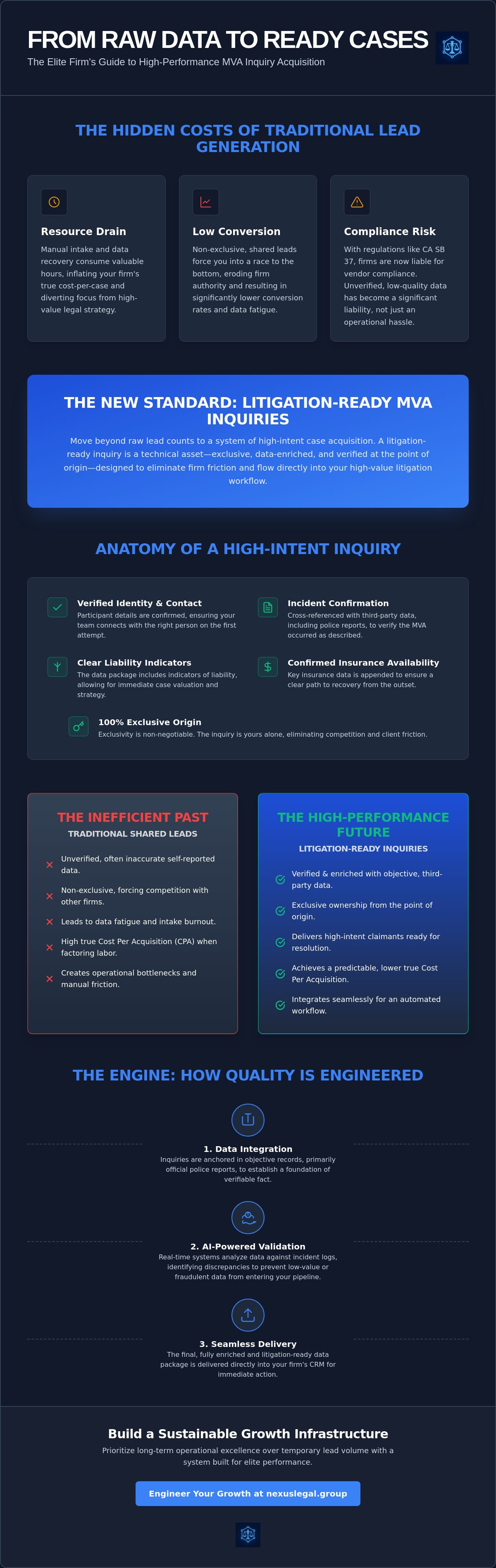
Elite plaintiff firms often find themselves subsidizing their lead vendors' inefficiencies by performing the manual labor of data recovery. You're likely familiar with the drain on resources caused by manual intake and the low conversion rates associated with non-exclusive sources. With the implementation of California SB 37 holding firms liable for vendor compliance, the cost of handling unverified, low-quality data has become a significant liability rather than just an operational nuisance.
This guide establishes the technical standards and acquisition frameworks necessary to secure litigation ready MVA inquiries that are exclusive and data-enriched. We'll provide a roadmap for moving beyond raw lead counts toward a system of high-intent case acquisition that utilizes automated verification and police report integration. You'll learn how to implement a predictable flow of cases that arrive with comprehensive accident data at the point of inquiry. This shift reduces firm friction and ensures your team spends their time on high-value litigation rather than administrative follow-up. We'll preview the mechanics of a high-performance engine that drives growth through technical mastery and systemic integrity.
Key Takeaways
- Identify the specific technical benchmarks required to transform raw data into high-intent inquiries that satisfy the rigorous demands of elite litigation.
- Understand the mechanics of data enrichment through police reports and reverse append technology to secure litigation ready MVA inquiries with complete accident profiles.
- Evaluate the true cost of acquisition by comparing exclusive inquiries against shared leads and their impact on your firm’s conversion efficiency.
- Implement automated verification frameworks that eliminate manual intake friction and streamline the transition from inquiry to signed case.
- Build a sustainable growth infrastructure by integrating sophisticated acquisition models that prioritize long-term operational excellence over temporary lead volume.
Defining the Technical Standard for Litigation-Ready MVA Inquiries
In the legal market, a fundamental distinction exists between a raw lead and a verified inquiry. Most vendors sell leads, which are often nothing more than unverified contact details of individuals who might have been involved in an accident. Elite firms require a higher benchmark: litigation ready MVA inquiries. These are technical assets defined by multi-layered data enrichment and automated verification. When you analyze Traffic collision statistics, it's clear that while the volume of incidents is high, only a small percentage possess the liability and injury profiles necessary for high-stakes litigation. Sourcing these inquiries requires a shift from volume-based marketing to a systems-oriented acquisition framework.
Protecting your firm's operational margins depends on this technical standard. If your intake team spends hours chasing unverified data, your cost per signed case (CPA) inevitably increases. A litigation-ready inquiry arrives with three core components: a verified identity, incident confirmation through external data points, and clear liability indicators. This systemic integrity ensures that your attorneys focus on legal strategy rather than administrative investigative work. It's about building a foundation of data that is ready for immediate filing.
The Anatomy of a High-Intent Inquiry
A high-intent inquiry is defined by the immediate legal need of the plaintiff. It isn't a person browsing for general information; it's an individual actively seeking a resolution to an urgent crisis. To meet this standard, the inquiry must include verified participant details and confirmed insurance coverage availability. Exclusivity is non-negotiable. Shared data is essentially expired data. If you don't own the inquiry exclusively at the point of origin, you're competing in a race to the bottom that erodes your firm's authority before the first call is even placed.
Why Traditional Lead Generation Fails Elite Firms
Traditional models often prioritize low cost-per-lead (CPL) metrics, which masks the true cost of data fatigue. Shared lead models result in plaintiffs being contacted by multiple firms simultaneously, leading to immediate friction and low conversion rates. This creates a massive bottleneck in your intake department. Elite firms are moving away from quantity-centric acquisition. They're investing in quality-centric infrastructure, such as the systems engineered by Nexus Legal Group, that delivers litigation ready MVA inquiries directly into their CRM. This transition eliminates the manual labor of cleaning leads and allows for a scalable growth model built on reliable, high-performance data.
The Mechanics of Data Enrichment: Police Reports and Reverse Append
Foundational accuracy in case acquisition isn't a matter of chance; it's a product of technical rigorousness. By anchoring inquiries in objective third-party records, elite firms eliminate the ambiguity of self-reported data. This process begins with the integration of official incident records. Data sets like the NHTSA Fatality Analysis Reporting System illustrate the granular detail available through institutional channels, which is essential for verifying the severity and liability of an incident. When you source litigation ready MVA inquiries, you aren't just buying contact information. You're acquiring a verified data package that has been cross-referenced with emergency services and law enforcement records to ensure the incident actually occurred as described.
AI plays a critical role in this ecosystem by performing real-time validation. These systems analyze claimant statements against historical accident patterns and third-party incident logs. This automation identifies discrepancies early, preventing low-value or fraudulent data from entering your intake pipeline. The result is a high-performance acquisition engine that prioritizes systemic integrity over raw lead volume.
Harnessing Police Report Generated MVA Leads
Incident-level data provides a decisive competitive advantage in case valuation. By utilizing police report generated MVA leads, your firm gains access to specific details such as point of impact, weather conditions, and initial liability assessments before the first intake call. This process involves matching real-time accident alerts with high-intent marketing efforts. It ensures that your team isn't just responding to a "car accident lead," but is instead engaging with a potential plaintiff whose incident is already documented by a verified third-party record. This level of precision allows for immediate triage and prioritization of high-value cases.
This degree of technical precision is similar to the analytical approach taken by ML Traffic Engineers Australia, where transport planning and safety data are used to provide a clear picture of road incidents and infrastructure performance.
Reverse Append Technology for Deep Data Enrichment
Reverse append technology serves as the bridge between a partial inquiry and a comprehensive case file. In many instances, a potential plaintiff provides only a name and a phone number. Reverse append is a mechanism for transforming partial contact info into a comprehensive litigation profile. This technology queries expansive databases to fill critical data gaps, such as vehicle identification numbers (VIN), insurance carrier details, and even potential witness contact information.
The efficiency of your intake department depends on having these details at the point of inquiry. Instead of your staff spending days tracking down an accident report, the system delivers the report details alongside the lead. This level of automation reduces human error and accelerates the timeline from initial contact to a signed retainer. To see how these systems integrate into a modern practice, you can explore the case acquisition frameworks designed for rapid scaling. By securing all missing accident report details through automated enrichment, your firm maintains a lean operational structure while maximizing case throughput.
Evaluating Acquisition Models: Exclusive Inquiries vs. Shared Leads
The economic logic of case acquisition is often obscured by vanity metrics like cost-per-lead (CPL). Many firms fall into the trap of purchasing shared leads because the upfront price point, typically ranging from $40 to $120 in 2026, appears budget-friendly. However, the data reveals a different reality. Shared leads often suffer from a conversion rate of only 3% to 8%, which dramatically inflates the actual cost-per-signed-case (CPA). In contrast, exclusive litigation ready MVA inquiries command a higher initial investment, often between $250 and $500, but they convert at a significantly higher rate of 10% to 25%. When you calculate the labor hours required to filter through shared data, the lower CPL model often results in a higher overall CPA and a lower return on investment.
Exclusivity isn't just a preference; it's a foundational requirement for any firm looking to build a scalable growth infrastructure. When you control the inquiry exclusively, you eliminate the friction of competing with five other firms for the same individual's attention. This allows your team to focus on the technical merits of the case rather than engaging in a high-pressure sales race. By integrating data-enriched inquiries into your workflow, you move beyond the limitations of raw web form submissions and transition into a high-performance acquisition model.
The Hidden ROI of Exclusivity
Staff morale and intake efficiency are directly tied to the quality of your inquiry source. A "race to the phone" culture, where intake specialists must call within 60 seconds just to beat a competitor, leads to rapid burnout and high turnover. Exclusive inquiries remove this frantic urgency, allowing for a more clinical and professional intake process. There is also a documented correlation between exclusive inquiries and higher settlement values. Because these inquiries are captured with comprehensive data at the point of origin, your attorneys can identify high-value liability indicators early, ensuring that the most promising cases receive immediate, high-level attention.
Framework for Assessing Lead Quality Metrics
To evaluate an acquisition partner effectively, you must look beyond raw volume and focus on specific Key Performance Indicators (KPIs). Real-time delivery is non-negotiable; in 2026, responding to a lead within 60 seconds can double your sign rate compared to a 30-minute delay. A superior acquisition partner provides more than just contact info. They deliver litigation ready MVA inquiries that include verified identity and incident confirmation. This level of readiness outperforms standard qualified inquiries because the foundational investigative work is already complete. You can review more on these technical benchmarks at the Nexus Legal Group blog, where we break down the mechanics of high-intent case acquisition.
Strategic Implementation: Integrating Inquiries into Firm Workflows
Integrating litigation ready MVA inquiries into your practice requires a fundamental shift from manual oversight to automated, systems-driven workflows. Elite firms treat incoming data as a raw material for a high-precision industrial process, requiring the level of situational awareness found in mission-critical environments like activu.com. The objective is to design a transition where an inquiry moves from the acquisition partner to a signed retainer with minimal human intervention. This systemic approach reduces the high overhead typically associated with manual intake and ensures that high-intent cases aren't lost to administrative delays. By aligning your marketing spend directly with litigation outcomes, you eliminate the friction that often exists between lead generation and case filing.
Automating the Intake and Verification Process
Automated legal intake verification serves as your firm's first line of defense against non-viable or low-value claims. By establishing technical filters based on specific liability and injury severity benchmarks, the system automatically disqualifies inquiries that don't meet your firm's standards. Integrating this litigation-ready data directly into your case management system creates a single, authoritative source of truth for every file. Instant verification also provides a critical psychological benefit; when a potential plaintiff receives immediate, accurate confirmation of their incident details, it establishes a level of professional competence that significantly increases claimant retention and trust.
Compliance and Ethical Standards in 2026
The regulatory landscape in 2026 has introduced significant liabilities for firms that fail to vet their data sources. Effective January 1, 2026, California SB 37 holds law firms directly liable for the compliance of their marketing vendors, with statutory damages ranging from $5,000 to $100,000 per violation. Navigating this environment requires a rigorous commitment to the FCC "One-to-One" consent rule, which necessitates express written consent for each specific firm to contact a lead.
Your firm must demand a transparent chain of custody for all accident data to ensure every inquiry is sourced through ethical and compliant channels. This includes verifying that consent revocation rules, which took effect on April 11, 2025, are strictly honored within the required 10 business days. Maintaining this level of systemic integrity isn't just about ethics; it's a defensive strategy to protect your firm's capital and reputation. You can partner with Nexus Legal Group to implement acquisition frameworks that prioritize these technical and ethical standards. By securing inquiries that are already verified for compliance, you focus your resources on litigation rather than regulatory damage control.
Nexus Legal Group: Engineering Growth Infrastructure for Elite Firms
Nexus Legal Group functions as a foundational layer for elite firms, moving beyond the peripheral role of a lead aggregator to become a strategic architect of growth infrastructure. We engineer end-to-end acquisition systems that prioritize technical mastery and systemic integrity, allowing your practice to operate with a high degree of professional confidence. By centralizing the mechanics of business expansion, we eliminate the friction inherent in traditional models. Our MVA vertical is built on the synergy of AI-driven marketing and automated verification, ensuring that every data point is cross-referenced for accuracy before it reaches your intake team.
Integrating litigation ready MVA inquiries through our system means you're investing in a technical standard rather than a marketing claim. We deliver exclusive assets that have already undergone multi-layered data enrichment, transforming your intake department from a manual labor center into a high-performance engine. This approach ensures that your firm's capital is deployed toward high-intent cases with verified liability indicators, securing your position in a competitive legal market.
Beyond Lead Generation: A Systems-First Approach
Elite plaintiff practices choose Nexus because we offer an institutional-grade acquisition model that prioritizes logic and automation. Our infrastructure leverages police report generated data and reverse append technology to secure missing accident details, providing your attorneys with a comprehensive overview of every case from the outset. This technical advantage ensures that your firm isn't just buying leads; you're acquiring a ready-to-litigate asset. You can explore our full suite of services on the Nexus Legal Group homepage to understand how we build scalable growth for our partners through sophisticated data management.
Operationalizing Success with Signed Cases
The ultimate metric of success isn't the inquiry itself; it's the transition to an ethical and compliant signed case. Our verified MVA leads for law firms are engineered to drive predictable revenue by reducing the time between initial contact and a signed retainer. We maintain a strict chain of custody for all accident data, ensuring that every case is sourced in full alignment with the 2026 regulatory landscape, including California SB 37 and TCPA requirements. This focus on compliance protects your firm's reputation while maximizing your operational margins.
This commitment to excellence allows your firm to focus on high-level legal strategy while we manage the complexities of the acquisition pipeline. If your current workflow is burdened by manual intake or unverified data, it's time to transition to a more sophisticated model. We invite you to request a consultation to audit your current case acquisition framework and discover how our systems can provide the foundational layer your firm needs for sustainable, predictable expansion.
Operationalizing Your Firm's Acquisition Infrastructure
Transitioning your practice to a systems-first acquisition model is a prerequisite for long-term scalability. You've seen that the distinction between a raw lead and a verified inquiry is defined by technical standards like reverse append enrichment and incident-level verification. These processes ensure that every case entering your pipeline is backed by objective third-party records rather than unverified self-reporting. It's about building a foundation of systemic integrity that eliminates the friction of manual intake.
Implementing litigation ready MVA inquiries into your workflow reduces the operational burden on your team and protects your firm against evolving regulatory liabilities. By prioritizing exclusivity and data integrity, you move beyond the "race to the phone" and focus on high-stakes litigation outcomes. This shift allows your attorneys to spend their time on legal strategy instead of administrative investigative work.
Secure Your Firm's Growth Infrastructure with Nexus Legal Group. Our framework provides the AI-driven automated verification and police report data enrichment your practice requires to thrive in a competitive environment. It's time to build a more predictable, high-performance future for your firm.
Frequently Asked Questions
What exactly makes an MVA inquiry 'litigation-ready'?
An inquiry is litigation-ready when it transitions from raw contact data to a verified, actionable asset. This standard requires three core components: a verified identity, confirmed incident details through third-party records, and clear liability indicators. Unlike traditional leads, these inquiries are cross-referenced with accident data to ensure the case meets specific injury and fault benchmarks before reaching your intake team.
How does reverse append technology improve MVA case acquisition?
Reverse append technology serves as a technical bridge that transforms partial contact information into a comprehensive litigation profile. By querying expansive institutional databases, the system automatically fills data gaps such as insurance carrier details, vehicle identification numbers, and witness contact info. This enrichment ensures your firm has a complete accident profile at the point of inquiry, eliminating the need for manual investigative work.
Are these MVA inquiries exclusive to my law firm?
Yes, exclusivity is a foundational requirement for any high-performance acquisition infrastructure. Every inquiry is delivered to a single firm in real-time, which removes the friction of competing with multiple practices for the same individual. This exclusive ownership allows your specialists to conduct a professional intake process without the "race to the phone" culture that often leads to staff burnout and low conversion.
How do you ensure compliance with ethical legal marketing standards?
Compliance is maintained through a rigorous framework that adheres to the FCC "One-to-One" consent rule and TCPA regulations. Every inquiry includes a transparent chain of custody and verifiable express written consent. This systemic approach is designed to protect your firm from statutory damages, such as those introduced by California SB 37, by ensuring all data is sourced through ethical and legally vetted channels.
Can these inquiries be integrated into my existing CRM or case management software?
Integration is achieved through direct API connectivity with all major legal CRM and case management platforms. This ensures that litigation ready MVA inquiries flow instantly into your existing workflow, reducing manual data entry and human error. By automating the delivery process, your firm maintains a single source of truth for every case file from the moment of acquisition.
What is the difference between an MVA lead and a signed case?
An MVA lead is a raw data point that requires significant manual labor to verify and convert. A signed case is the final outcome of a successful intake process where a retainer has been executed. Sourcing litigation ready MVA inquiries bridges this gap by providing pre-verified, high-intent data that significantly increases the probability of securing a signed case with minimal administrative friction.
How does police report data improve the quality of MVA inquiries?
Police report data provides an objective, third-party record of the incident, including initial liability assessments and documented injury profiles. By anchoring inquiries in law enforcement records, the system filters out non-viable or fraudulent claims early in the process. This foundational accuracy allows your firm to prioritize high-value cases that are already backed by a verified record of the event.
What is the typical conversion rate for litigation-ready inquiries?
Exclusive, litigation-ready inquiries typically convert at a rate between 10% and 25%. This performance level is significantly higher than the 3% to 8% conversion rates associated with shared lead models. The increased efficiency is a direct result of multi-layered data enrichment and automated verification, which ensures your intake team is only engaging with high-intent, viable plaintiffs.